
The Holzer Centrifuge is a uranium enrichment centrifuge I’ve used as a Macguffin in various settings of mine. It is one of the smallest viable centrifuges and a simpler yet less effective design compared to its contemporaries. It has a maximum capacity of around 0.9 separative work units per centrifuge[1]. In practice with inevitable inefficiences and losses this leads to a mere 0.5-.6 in practice, one of the weakest individual centrifuges to ever spin in its hideous mission.
In All Union, the Polish Holzer centrifuge (named after the ethnic German scientist who led the program), served as one of the primary enrichment sources for the nation’s uranium path. The goal was ease of assembly with just domestic resources, hence why Holzer centrifuges were around 40-50 years behind their contemporaries and low-powered even by the standards of other first-gen designs. Nonetheless, they accomplished their goal.
[1]A napkin calc is as follows, with L being length in meters and V velocity in meters per second. Don’t really ask me to explain what an SWU exactly is.
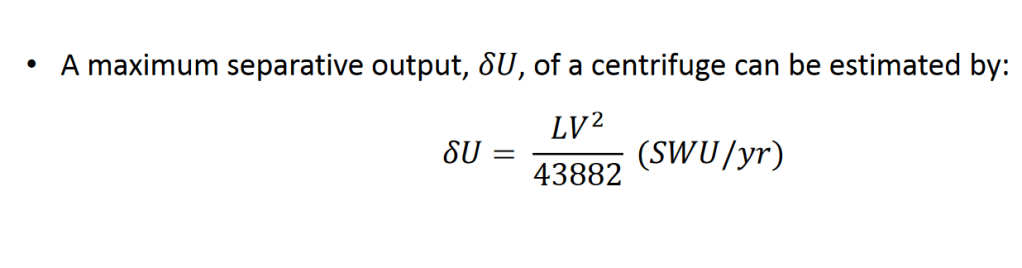
Poland produced at least 50,000 Holzer centrifuges and operated 25,000 of them. Using an enrichment calculator and going by 0.6, the fully functional cascades would produce 77 kilograms of weapons grade uranium a year if working with natural ore to start, or 270 kilograms if working with reactor-grade LEU.
 Fuldapocalypse Fiction