John Blanche, the illustrator who defined the art style of Warhammer 40k, has just passed away. RIP to a legend of science fiction art.
His most famous work, The Emperor On The Golden Throne:
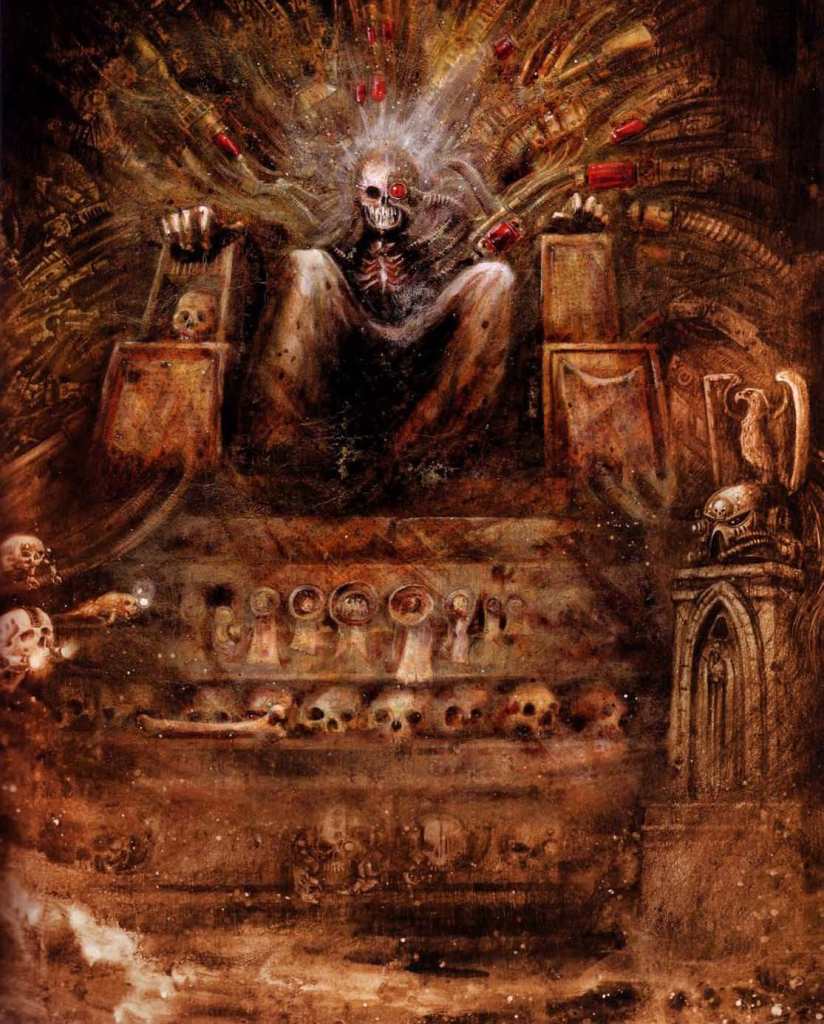

John Blanche, the illustrator who defined the art style of Warhammer 40k, has just passed away. RIP to a legend of science fiction art.
His most famous work, The Emperor On The Golden Throne:
The second major DLC for the Rogue Trader RPG, Lex Imperialis brings in the galactic police, the Arbites, as well as pets (ok, “familiars”). The pets are the most fun part of the DLC. But for some reason, I considered this worse than the previous one, Void Shadows. Not unplayable or not worth it, but not as good. Maybe it’s just I wasn’t the fondest of the ingame stuff, but I think the biggest reason is the plot.
Void Shadows centered around a horrific cosmic nightmare (genestealers). This centers around…. tax evasion. Everything involves an investigation for unpaid or stolen Imperial Tithes. I don’t mind lower-stakes stories, but this is just too mundane. It’s almost Postal 2-esque.
That said, many set pieces are good and the music is probably the best I’ve heard in the game.
A short story centered around one of the most realistic and sensible Warhammer Astartes chapters, The Shot That Kills You is about the Raptors. As it’s short and explody, one shouldn’t expect it to be anything except short and explody. Which it succeeds massively at.
It’s good enough to wash away the internet cruft surrounding the Raptors, who are the poster child for what I like to call the “Gothic-style Halo” ‘fans’ of Warhammer 40k, where the setting is tried to be made respectable and its exaggerated elements downplayed in a manner that annoys me. Thankfully it’s not the case here-an Astartes seemingly flees and lures the overconfident xenos into a trap, not uplinking to his servo-skull drone and calling down a Whirlwind missile strike that obliterates the melee duelists.
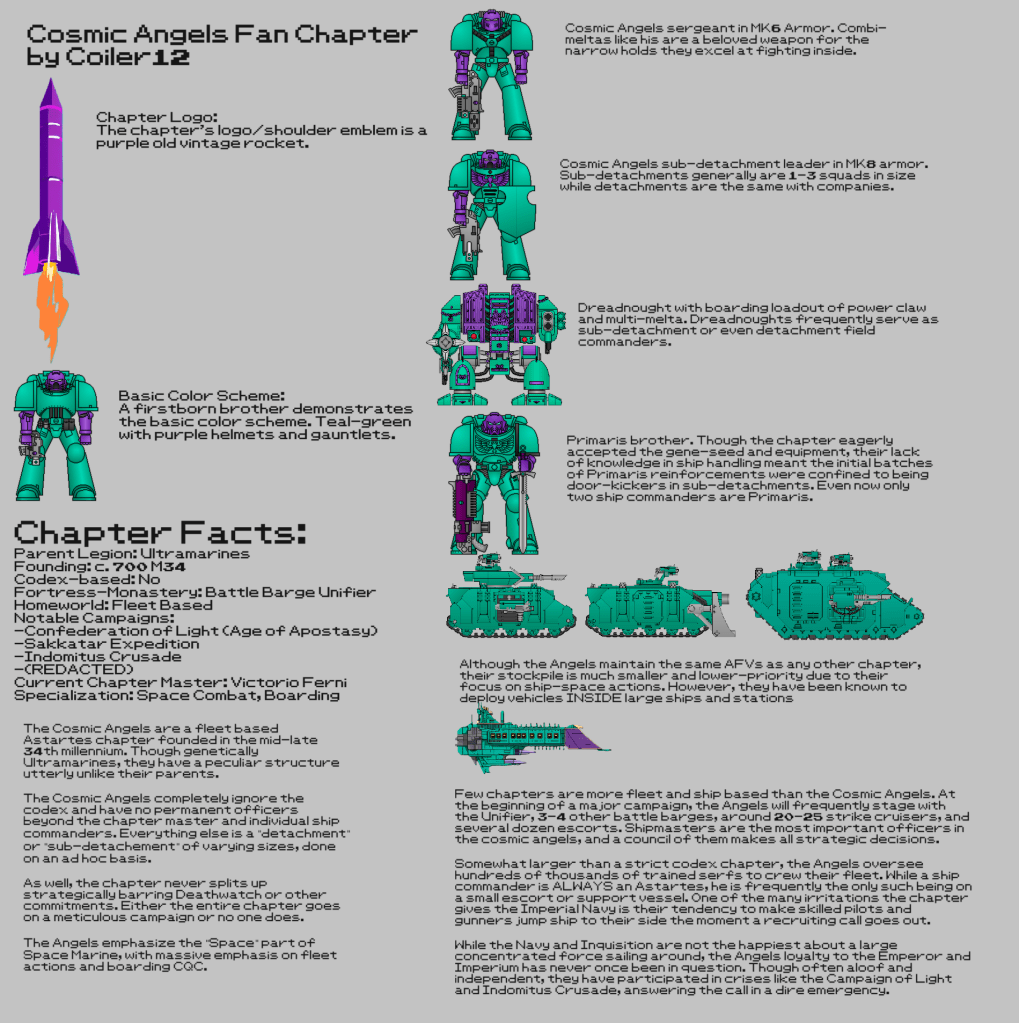
When it comes to Warhammer 40k, I do not have the highest opinion of or interest in the setting’s mascots. I’ve been an Imperial Guard fanatic (no not that kind) since day one of my interest in the setting, and this also applies to their spacefaring counterparts in their humongous flying cathedrals. However, I have made several fan Space Marine chapters (as every 40k fan is obligated to do), and the one with the most detail is the Cosmic Angels. With the aid of Stable Diffusion and some online “marine coloring tools” I made this infographic on them.
(And yes, it is definitely, totally a coincidence that my interest in Starmada and constant setting crossover battles coincides with me elevating an extreme fleet based chapter. Totally. A. Coincidence.)
I’m delighted to announce the initial release of a Starmada project of mine: The Star Wars vs. 40k fleet lists. Based on the fanfic, it aims to bring the battles from said fic to the generalist wargame. So far initial Imperial Navy and Republic fleets have been made. More, including Astartes, Separatists, and whatever else my brain thinks up, is planned.
Notes:
So inspired by the Star Wars vs. Warhammer 40k web serial, I made crossover fleet lists for Starmada. Then using Tabletop Simulator for a convenient hex map and making some quick counters in its editor, I ran a small fleet engagement of four Imperial frigates vs. five Republic ones.
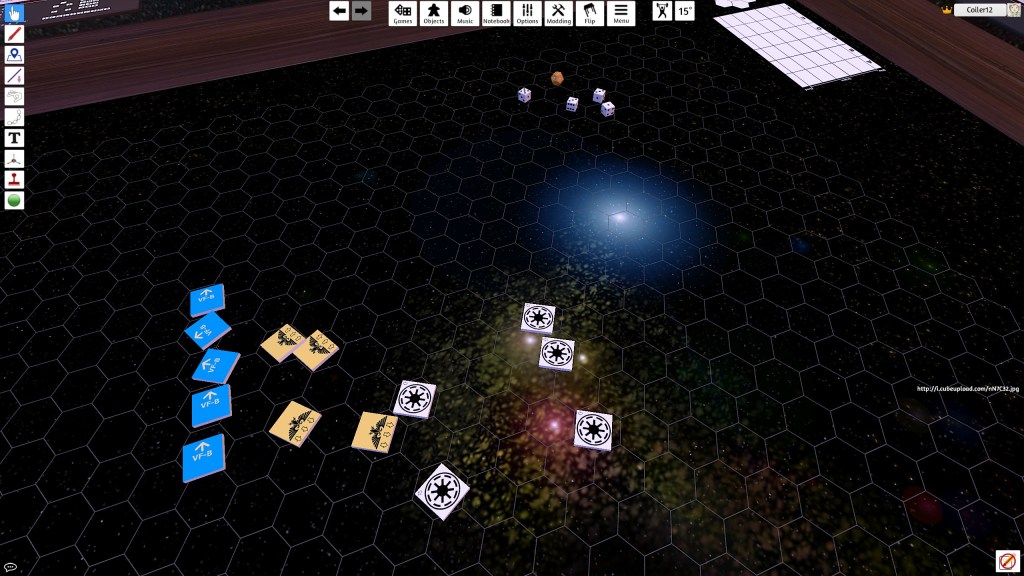
The fleet lists are still subject to major revision but suffice to say the Star Wars side is about accuracy and fighters and the 40k one about brute power and durability. In this case brute force won out as the Imperium destroyed four Republic vessels for the loss of only one of their own.
So the question has to be asked: What about this?
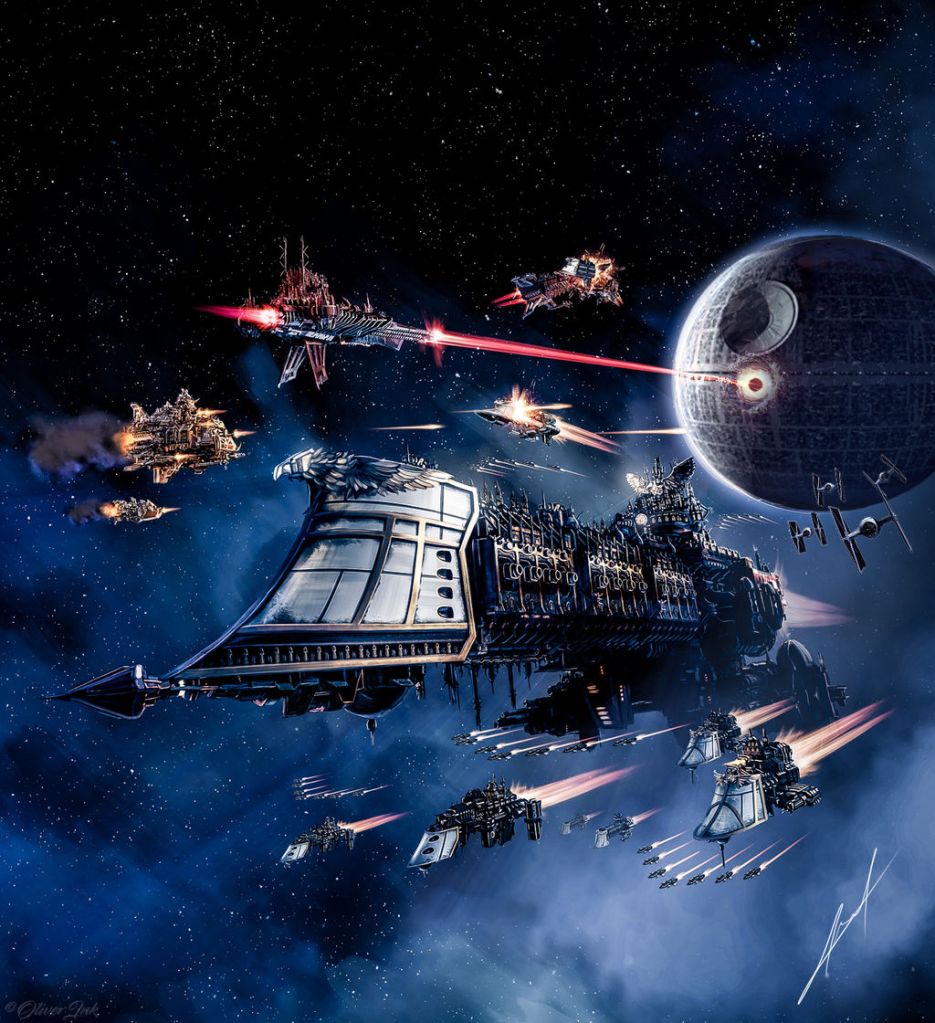
A Star Wars/Warhammer 40k crossover has to include the battles of evil vs. slightly more justified evil and feature a large Imperial Navy cathedral armada going up against the Death Star (presumably with its own array of Star Destroyers). Now I have put some actual thought into this.
So time for one of the biggest internet controversies surrounding the Warhammer 40k fandom. Note that I said “internet controversies”, not “controversies”. This post therefore might be controversial itself. Oh well.
This has to do with Female Space Marines. In-game, for basically all of 40ks solidified existence, the gene-seed that produces the super-space-knights who serve as the mascots of the setting only works with men. Games Workshop has been extremely strict and clear with this. Some online advocates have opposed this and wanted a change.
I’m pretty firmly in the the “no female space marines” category, and not just because my Imperial Guard doesn’t have this problem in the slightest.
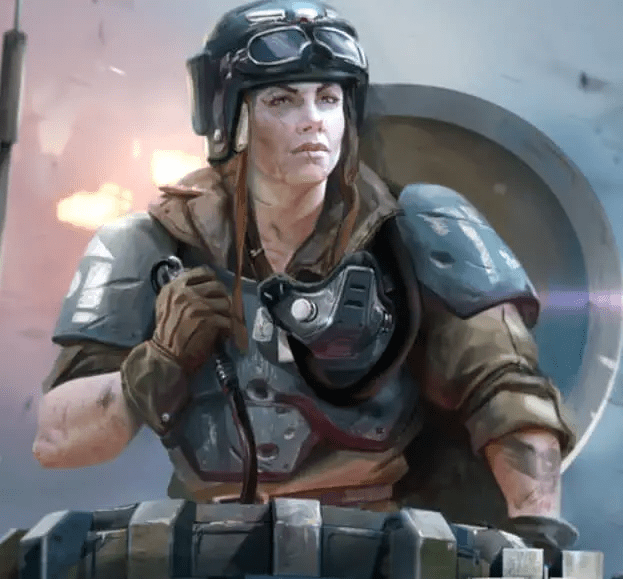
I think one of my reasons is because a Space Marine has become a very specific thing. I would even argue that if you asked a layperson unfamiliar with the setting to describe one, you’d end up with either a Sister of Battle or a female Tempestus Scion (neither of which has any issue). Those can and do exist without any issue. Female techpriestesses can and do exist without issue, if you like someone so covered in augumentations that their initial number of chromosomes becomes irrelevant. Female Eldar and Tau can and do exist…
In fact, this is the diversity argument I have. If female space marines were adopted, they’d actually make the setting significantly less diverse. It means (even) more of the already pushed setting mascots and (even) less of the factions where this isn’t an issue.
(As for diversity in the setting overall, I have three big takes:
I love Warhammer 40k and have some connection to mysteries, so getting Chris Wraight’s Warhammer Crime novel Bloodlines was obvious. Then I started reading it and felt disappointed. Now as a mystery novel, it’s 51% all right. If this was a contemporary or original sci-fi mystery, I wouldn’t think much more of it.
The problem is that it doesn’t take advantage of its setting. Now I’m not expecting or demanding an Ultramarine and an Ork on every corner, but this just never felt like a Warhammer 40k novel. It felt like a basic post-Blade Runner dark sci-fi city mystery only with more skulls and 40k terminology. Which didn’t make the book bad but did feel it wasted its potential.
Deciding to look back at the Warhammer 40k tabletop RPGs whose mechanics ended up adapted to Rogue Trader, the choice of Imperial Guard RPG Only War was not exactly a hard decision. Since that army has been my absolute favorite faction by a parsec from the moment I found out about the franchise, I was eager to see how playing them in a character game as opposed to a wargame worked out.
You can practically see the writers trying desperately to make the experience both true to the Guard’s limitations and playable/fun. I trust I don’t need to go into that much detail that an individual guardsman, even an elite one, is at or near the absolute bottom of the galactic food chain. There’s also the reason why Twilight 2000 was set in a scramble rather than in a war-their life is a very regimented existence with little chance for straying beyond orders.
Thankfully, the solutions are fun and interesting. Characters are part of a beginning chosen/created regiment that has set base gear and characteristics. NPC “comrades” are present to act as additional laser sponges-I mean, partners in war. More can be achieved, but only at the cost of chancing the logistics system (as unreliable and risky as it sounds). The regimental system itself allows for everyone from Tempestus Scion commandos to primitive worlders with swords and animal hides.
So yes, I recommend Only War to anyone who wants to be real serious and face the grim darkness of the far future without the need for power armor or super-enhancements.

