
From the Heavy OPFOR Tactical:
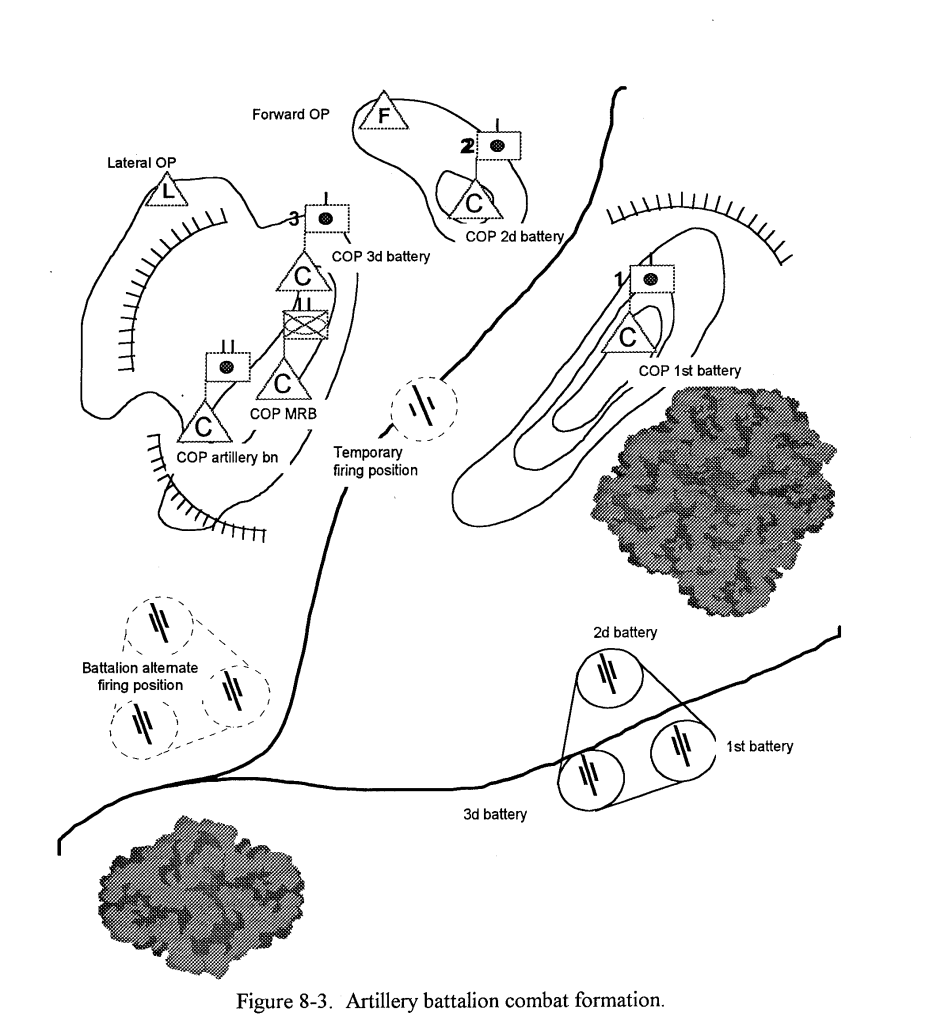
Now a 199X Soviet-patterned formation isn’t going to be representative of everything (in particular, the commander is not always going to double as a forward observer), but it’s worth noting that the movement involves narrow movement around different parts of the same observed, prepared area, not wide ranging, sweeping kiting.
Now redeployment is another story, and it’s where the artillery is going to be more inherently vulnerable and varies a lot on the circumstances. IE not so much in a stabilized front like WWI, post-1951 Korea, or contemporary Ukraine, but a lot in a classic Fuldapocalypse, 2003 Iraq, or the Southern African brush. It also depends on how much the artillery has to actually fire (because if it’s forced into moving/hiding, then it’s effectively suppressed).
So for the fictional case study of the Soviet-Romanian War:
- The northern front is going to be advancing extremely rapidly, close to the best-case paper projections. Deployed artillery will cover the armies when they have to stop, but even the Sovereign Union will struggle to keep their mega-barrages during the rapid advance. Thankfully (for the invaders) enemy counter-artillery capabilities are very weak, especially in the context.
- The southern front has a lot fewer SPGs (and even less advanced ones) and has to bludgeon its way across a very wide river and through fortified areas. There’s just less room to move and the opponent’s capabilities (due to their better units and C3I on this front) are more dangerous.
 Fuldapocalypse Fiction