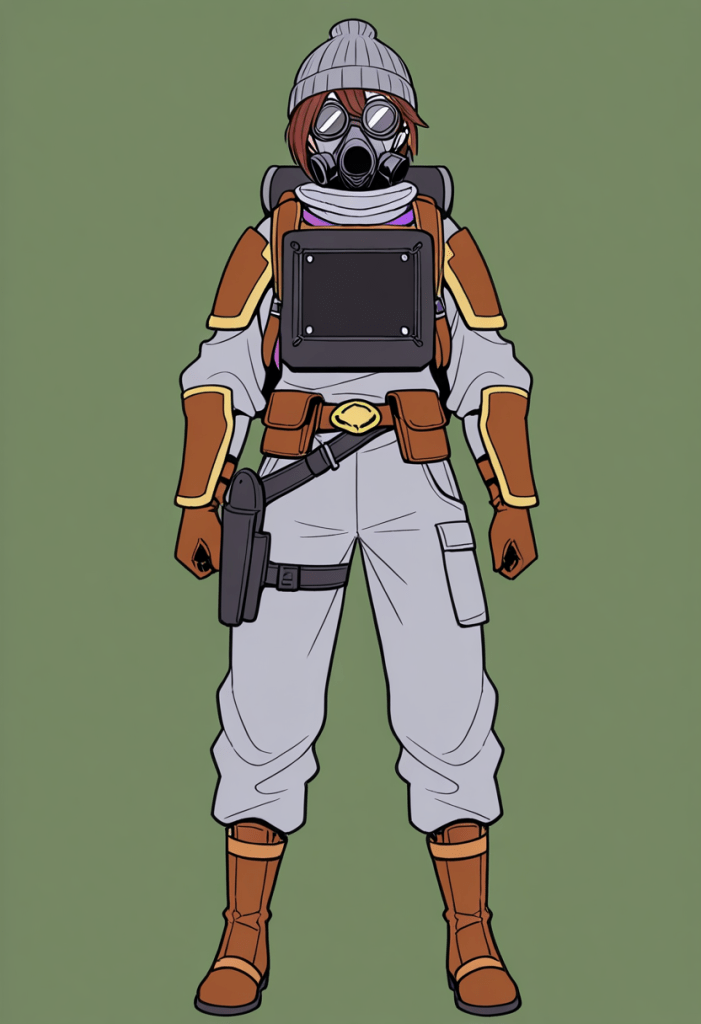
One of the things I love doing in Stable Diffusion is adding in a bunch of stylistic prompts and applying it to someone in a military uniform. This young lady here is one of my favorite recent generations.

One of the things I love doing in Stable Diffusion is adding in a bunch of stylistic prompts and applying it to someone in a military uniform. This young lady here is one of my favorite recent generations.
the XCOM-esque game Chains of Freedom is a new turn-based strategy game that I’ve just completed. It’s well, uh, something. So I wouldn’t have finished the game if it was bad , but man is there so much that drags it and keeps it from being what could have been. A lot of it.
The first issue is the story and setting. Do you want Brown Age throwback graphics of one Cyrillic wasteland after another? Do you want a plot and setting that’s what you’d get if you prompted an AI to go “Make me a science fiction setting based on Command and Conquer, S.T.A.L.K.E.R, Metro, and throw in a couple of general cliches for good measure”? Do you want characters who are either dull or who you’ll hate from the start?
Then there’s the gameplay. Probably the most distinct thing about it compared to other XCOM-likes is that you have to scrounge and craft for items between battles. This is one of those things that’s a lot better in theory than in practice. Other than that, it’s a pretty standard “cover turn based strategy.” Which is a problem when you get into the final act and the game throws monotonous giant swarm after monotonous giant swarm at you. As if to compensate, the last few encounters and the final boss are anticlimactically easy.
This is a 49% game. And as the last couple of Super Bowls have shown for the team that bears that name, close doesn’t let you win. (Hey, gotta drop a football reference on NFL Draft day!)
Delighted to give a happy Easter gift: The release date and preorders for the ebook version of Terrible People and Terrible Things.
Preorder it here. I had a lot of fun making the cover.
A short story centered around one of the most realistic and sensible Warhammer Astartes chapters, The Shot That Kills You is about the Raptors. As it’s short and explody, one shouldn’t expect it to be anything except short and explody. Which it succeeds massively at.
It’s good enough to wash away the internet cruft surrounding the Raptors, who are the poster child for what I like to call the “Gothic-style Halo” ‘fans’ of Warhammer 40k, where the setting is tried to be made respectable and its exaggerated elements downplayed in a manner that annoys me. Thankfully it’s not the case here-an Astartes seemingly flees and lures the overconfident xenos into a trap, not uplinking to his servo-skull drone and calling down a Whirlwind missile strike that obliterates the melee duelists.
See, Buckshot Roulette is one of the most crossover-friendly setttings imaginable. All you need to do is put the crossover character into the game. Since it’s implied to be some kind of supernatural dream anyway (at least in one mode, it’s a long story), you can go into their psychology as they face off against a floating head and heads and repeatedly shoot themselves in the head for a mid-six figure paycheck.
Well, I finally did it and read a classic Vietnam War aviation novel, Stephen Coonts’ Flight of the Intruder. The joke before its infamous film adaptation was released was “Fighter pilots make movies, bomber pilots make history.” Afterwards, it was “Fighter pilots make movies, bomber pilots make bad movies.” Having not seen the film yet (and not likely to sneer, as I enjoyed Iron Eagle of all things), do they make bad books?
The answer in my opinion is kind of but not really but also kinda? Coont’s first novel, this is basically Herman Melville but with A-6s. Read the long, long sequences of a plane doing plane things. The sequences of an attack run. The sequences of a carrier landing. The sequences of doing naughty things in the Philippines. You get the idea. Thing is, even though I didn’t really care for these, I could see the appeal, especially to a non-expert reader back in the past.
So this is another one of those “have I been skewed against this?” books. And there could be worse.
Allan Folsom’s The Machiavelli Covenant is the story of people walking around Europe in search of a nebulous conspiracy. Kind of like his first novel, The Day After Tomorrow, where people walked around Europe in search of a nebulous conspiracy that involved Adolf Hitler’s preserved head. Here it involves the kind of thing that Jon Land would make and make amazing through ridiculous set pieces. Except here, there aren’t any and the whole thing has a poker face that would have given it millions of earnings in the WSOP.
Well, the set pieces technically are ridiculous, but not in a “wow a monster truck chase” kind of way. More like “ok, it’s the twentieth chapter of people getting in and out of cars.” It’s ridiculous in a not-so-fun way, not a fun way.
I truly believe this book could be a quarter of the length it actually was and still work. I hope it was due to some length obligation by the publisher, but given Folsom’s other work, I really doubt it.
A minimalist and creepy horror/puzzle/party (seriously) game, Buckshot Roulette is “what if instead of a revolver, you used a randomly loaded pump-action shotgun in a game of wits with a creepy big-teethed guy?”
While it might sound like a trolling anti-game, it actually works as a combination of luck and skill. Power ups can see which shell is chambered, can eject a shell, and so on. Whoever can get lucky the most wins. While this isn’t the deepest game, it works for what it is.

Created using Stable Diffusion and manual outlining, an under construction casino complex.
Behind every good 1970s movie is a bad 1970s book. Perhaps the ur-example of this saying of mine comes in Peter Benchley’s Jaws. I had heard very little good about the novel but decided I had to see for myself. Well, the shark bit.
I recognized the prose style immediately. And by immediately I mean “A few paragraphs and I recognized the wannabe 1970s pop epic style right away”. Much of the book really feels like someone who wanted to write “‘Arthur Hailey’s’ Tourist Town “, with huge long descriptions of how Long Island resort Amity works, runs, or doesn’t. These are interspersed with long, almost Proust-esque descriptions of things that straddle the line between padding and pretentiousness.
Oh yeah, there’s a shark. Spoiler alert. However, there’s surprisingly little shark. There is a lot of romantic drama and legal drama that Spielberg rightfully threw into the chum bucket. Which is what renders the book nothing but a curiosity. The movie superannuated it. Completely.

