Review: Scythian Dawn

Scythian Dawn

scythiandawn

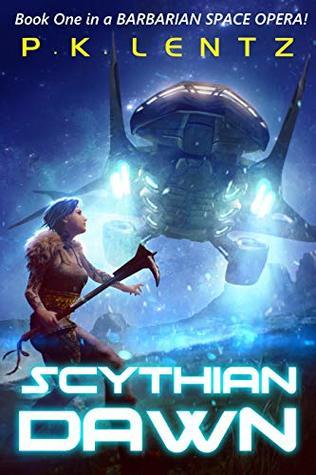
I’ve always had a soft spot for the underused Central Asia in fiction. So when I saw P. K. Lentz’s Scythian Dawn, I knew I had to pick it up. It’s a self-proclaimed “barbarian space opera”, and I was intrigued from the start. That sums it up-it’s nomadic warriors against spaceships. And no, it’s not a stomp or a lopsided game of Civilization.

The execution of the book is merely decent, but I’m willing to accept a decent execution for a very imaginative premise. After all, a Central Asian princess-turned nomad-turned enhanced fighter is more interesting than a spacesuit commando by far.


Review: Contract For Slaughter

Contract For Slaughter

contractforslaughtercover

The first book in the “Eagle Force” series, Contract For Slaughter was released in 1989 by Dan Schmidt, a veteran of the action-adventure genre who wrote literal dozens of Mack Bolan tales. Coming close to the tail end of the 80s action-novel boom, it provides a very, very good example of it.

It’s a team-centric book where a group of colorful mercenaries in the low single digits (in this case four people) form and fight. This is both a first installment (so it has a not insignificant space devoted to the “forming” part) and it’s short (so there’s less room for the final fight). Though to be fair, a lot of the “forming” segments involve fighting too. Lots and lots and lots of fighting. The action is solid for a book of this genre, even if not the absolute best, and Schmidt wasn’t afraid to throw a curveball in terms of the plot and enemies.

What stood out to me, at least a little, was how the weapons were basically 80s Action Novel Bingo. What felt like every single flashy and exotic writers toy showed up in the pages of this book. Ooh, big MM-1 grenade launchers! Ooh, super-advanced G11 rifles! And of course, the classic giant pistols (can’t forget them). Even Jerry Ahern’s beloved Detonics show up as well.

This was one of the cheapest of the cheap thrillers, but I had lots of fun with it nonetheless.


Review: Any Means Necessary

Any Means Necessary

anymeansnecessarycover

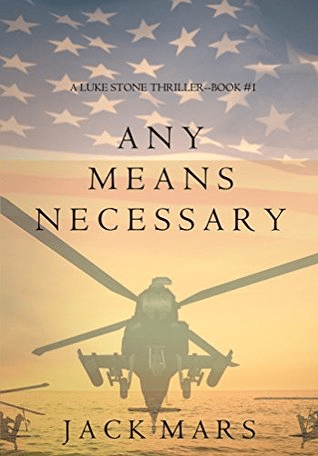
Jack Mars’ debut thriller in the Luke Stone series, Any Means Necessary, was interesting to comprehend. The way I appreciated it was something. The book itself stars super-agent Luke Stone as he battles a Cheap Thriller Evil Plot, and it’s the kind of cheap thriller that has one foot in action movies (read, the protagonist can stay awake for days and jump from a helicopter to a car, crash said car, and still be fine) and the other in 24.

Without spoiling anything, the antagonists shift midway from one cliche cheap thriller foe to another cliche cheap thriller foe. It’s very, very much a “21st Century Thriller” where the technothriller and action adventure genres (always closer than it sometimes seemed) kind of mushed together. And it’s definitely a “51% book”, the kind that’s perfectly fun and adequate, if not excellent even within its genre.

But as an independent novel it’s a different kind of “51% book”. If a mainline commercial 51% book is like a packaged pastry on a store shelf, independent 51% books like this are like the kind of homemade scratch-baked dessert that may not be the most sophisticated or even best-tasting, but still is good and has a kind of “heart appeal”. And this describes Any Means Necessary very well. It’s a homemade apple strudel of a book. And you could do worse than homemade apple strudels.

Review: Retribution

Retribution: A Team Reaper Thriller

teamreaper

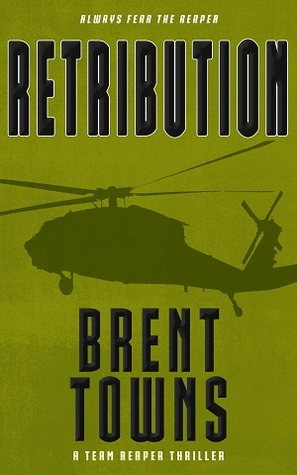
Brent Towns’ Retribution is the inaugural book in the Team Reaper series, intended as a modern continuation of classic action-adventure novels. Here, the titular team forms and battles a Mexican drug cartel, along with its crooked political allies.

This is not high literature by any means and takes its time getting going. I felt the early pacing was slightly sluggish, though not nearly enough to really hurt the book overall…

…especially since the main pacing, once the action really starts, is excellent. As is the action itself. This is an unashamed homage to classic action adventure fiction and works very well at recreating the feel of the genre. The action is good, and that’s what matters in a book like this.

Retribution is a book that I recommend for anyone who likes classic action novels.

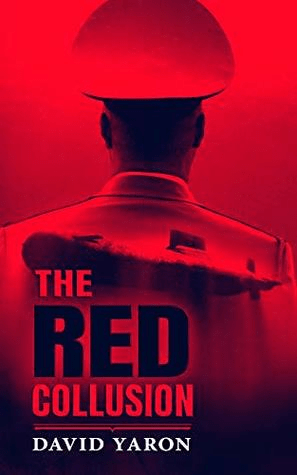
Review: The Red Collusion

The Red Collusion

redcollusioncover

David Yaron’s The Red Collusion is a tale of rogue Soviets in 1981 attempting to start World War III, leading to a climax where they attempt to attack an American ballistic missile submarine.

This book is mostly pedestrian but has managed to surprise me in one regard-the sheer number of conference room scenes. The ratio of “people talking” scenes to “people actually doing something” scenes is very, very, high.

It’s realistic to have people talking and arguing about a big plan before they (attempt to) carry it out, but it’s also realistic to have cars stopped at red lights. Imagine a travel book where the author described every single red light, stop sign, and gas station the car stopped at, as well as every single argument the occupants of the car had about where to stop for gas or food. And then in the final action, there’s a time limit-so they urgently, reluctantly, and desperately stop at those traffic lights.

This is the technothriller version of that. Much of the book, apart from a few decently-written if generic spy fiction scenes, consists of the conspirators talking. It amounts to chapter after chapter of…

“Let’s do this.”

(cue long explanation of and preparations for what they want to do.)

“Actually, it would be better if we did this.”

(cue long explanation/plot thread)

“No, we should really do this.

(you get the idea).

Once they finally get going, the rushed “action” isn’t the worst, but isn’t exactly good either. This leaves the book as a strangely amusing novelty. The Red Collusion is saved from  simple mediocrity by taking a genre trope to ridiculous excess. I’ll leave it up to the readers to decide if it’s a good or bad thing.


Review: Raptor Force

Raptor Force

raptorforcecover

Bill Yenne’s Raptor Force is a case of a book that dips into multiple action subgenres and seems determined to take the worst parts of each while being unable to grab the best. It’s the kind of commandos-vs-terrorists novel that might seem simply pedestrian if it didn’t have the premise it did.

See, the reason the task of hunting down bloodthirsty and effective terrorists is entrusted to this mega-top-secret band of off the grid commandos (based on the Flying Tigers in-universe) is because the US (along with most other countries) gave the UN veto power over its military power projection (!). This is the kind of thing that zombie sorceresses were made to do.

The heroes are all flat space-fillers, the villains are the most cliche terrorists straight out of Command and Conquer Generals, and the stock supporting characters are exactly who you’d expect them to be. This wouldn’t be a big problem if the fundamentals were good, but they’re not.

Raptor Force has the constant perspective and place-hopping of a technothriller but none of its technology or great power conflict. It has the focus of a small-unit book but none of the spectacle or “punch” that a good one has. The actual action scenes are decidedly underwhelming, the worst thing a cheap thriller can be.

This was not a good novel. Even the potentially over the top premise wasn’t run with, opting for the overly serious technothriller style instead of a shameless spectacle.


Review: Marine Force One

Marine Force One

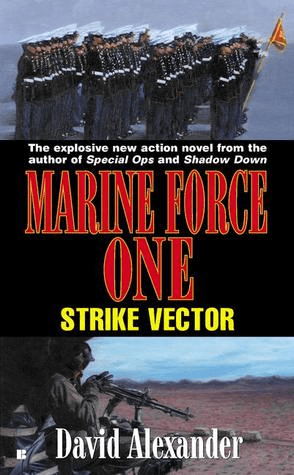
The book Marine Force One is an example of a “51% book” that is elevated by the context in which it stands.

The book tells the story of an elite commando force tasked with hunting SAMs in the Balkans, in a conflict that feels like a jumbled mix of historical recollections of Operation Allied Force (evasive SAMs! Stealth fighters lost!) and think-tank reports (Resurgent Red Russians!) all tossed together. The Cobra Force of our heroes has to hunt the SAMs while butting heads with a Spetsnaz force assisting their Slavic ally.

If there’s one thing distinctive besides being dated, it’s that the main character, Maj. David Saxon, is an ass. He’s a one-dimensional figure who gave up his material possessions and marriage to focus on being in the military (and doesn’t miss his ex or even his son at all), he punches someone for being annoying to him during a debriefing, and when (however briefly) off-duty, he just uses prostitutes as the sole “relationship”. Yet rather than have his seriously flawed character be taken advantage of, Saxon is otherwise treated as a Mary Sue who can do what the rest of the military can’t. Very few other characters, even the villains, enjoy such detail.

Other than that, everything is just good enough. The action is just good enough but not the best. The pacing is at least fast, if not the best. The exposition can be annoying but isn’t too annoying, and so on. So why did I feel better about this book than I ‘ought to’ have? Well , the first part is that sometimes a 51% book is what one needs.

The second part is that given the publication date of 2001, the beginning of a very, very dark decade for technothrillers, the “competition” is less serious. In a context full of overpriced, under-proofread self-published books, legacy series continuing on pure inertia, and the few remaining editor-proof super-authors, a nice light 51% book isn’t bad at all.

Review: Burmese Crossfire

Burmese Crossfire

burmesecrossfire cover

One of the reasons why I sound more critical towards Peter Nealen than I actually am is because this particular book set the bar very high. From the moment I read it, I fell in love. The Brannigan’s Blackhearts series was meant to be a love letter to the classic action-adventure novels of the 1980s, and Burmese Crossfire delivers.

Colonel Brannigan, leader of a small mercenary band, gets a mission to go to the titular Southeast Asian country. Cue a “rumble in the jungle” (with apologies to Ali and Foreman) against many Burmese and North Koreans. This isn’t that much more than a classic simple action-adventure novel. But it takes that formula and with beautifully written, well-done action, hits a home run.

It’s in a well-researched, obscure part of the world that’s an ideal place for a book of its genre. One of my favorite small-unit action-adventure books of all time, this is well worth a read.


Review: The Blue Effect

The Blue Effect

The final entry in Harvey Black’s Effect series is The Blue Effect. This book manages to be slightly better than its predecessors in some ways and a lot worse in another. There’s a sorta-kinda-semi-plot where the British face the Soviets in what could be the make-or-break battle near Hanover. But once again, it never really clicks into a whole that it could have been. If The Red Effect was just listing the ingredients before hurriedly pouring them into a bowl and The Black Effect was having them sit in the mixing bowl doing nothing, this at least turns them into batter-but not a finished dish.

The highlight of this book, besides more tanks exploding, is a very long scene in which a Vulcan bomber soars into action. A part of me was going “oh come on, this relic would probably be shot down, malfunction or just miss”, but another part of me, the part that likes unconventional units, was going “WOW NICE”. I mean, I’d love to read (or even write) a book of unconventional relic units flying into battle. This is not that book.

What really sours the The Blue Effect is not any of the action in the main book, but rather its anticlimax of an ending. Here was where going the Chieftains/Dr. Strangelove route and just nuking everything might very well have been better. Instead, it’s a have your cake and eat it too deal where after a few plotnukes and a few losses, the Warsaw Pact just gives up very abruptly. It’s a circumstance where either another full length tide-turning installment (with proper plotting) or trimming the entire three-book series into one could have been better. And there’s a lot of fat to trim.

Furthermore, all of the hindsight-driven greater “micro”- accuracy of the series (See the now-known durability of tanks with Kontakt-series reactive armor! See the proper tank mix in GSFG instead of just having everything be a T-72!) is squandered by this “macro”-level flop in the conclusion. Whatever issues there are with a clean NATO win in 1984, there are a lot more with it happening in this fashion. If the goal is realism, it’s implausible. If the goal is storytelling, it’s a contrivance and makes the victory seem unearned.

The result is something that could have risen higher than it did, both in this specific book and the overall series.

The Fuldapocalypse 100 Post Special

So Fuldapocalypse has reached a hundred posts. What a ride.

As I’ve said many times before, I went in to Fuldapocalypse expecting a very narrow spectrum where Red Army was on one end and Hackett’s The Third World War was on the other. The formal scale was in part to get me to be more rigorous in my reviewing and in part because I thought the works would be so inherently similar that I needed to highlight their differences.

Almost immediately, though, I became burned out. As I branched out, my scale gradually faded away. “Zombie Sorceresses” aren’t really relevant in outright supernatural stories, and don’t work when the story is implausible and ridiculous from the get-go. Eventually, I just resorted to an inherently “unstructured” review system-and it’s worked out very well. If I want to mention a story is “rivet-countery” or has a huge “zombie sorceress” contrivance, I can just say so in the review without having a formal section.

So, what I have learned from Fuldapocalypse? A lot, but the biggest is…

There’s a lot fewer “World War III” stories than I thought.

Blame my weird tendency to read the imitators first. Take my wargaming background and looking on only a few places at first, and a narrow tendency emerges. After all, if all I see is infodumpy Hackett xeroxed fifty-times stories, it’s like someone only reading fanfics and concluding that Pokemon is about betrayal. Understandable given the narrow perspective, but not really accurate.

Even at the height of the 1980s boom, there were still were a lot more books about stopping World War III than fighting it. And frankly, to me it’s a lot more fun to see the different, the strange, and the classic-but-unread. If I have to choose between either:

  1. zigzagging between feminist superpower stories, basketball mysteries, conventional thrillers, and classic vigilante adventure stories (all of which I’ve reviewed here), with World War III novels when I feel like it…
  2. Reading the entire collected works of William Stroock for the sake of reading something concerning World War III.

I’m definitely going with Option 1.

Even “cheap thrillers” can vary to the point where depending on the era, the prevalent cliches are going to be almost the exact opposite of an earlier/later time. Or there’s an individual work that stands out from that time period.

Reviewing good books is more fun than reviewing bad books.

I’ll review bad books on Fuldapocalypse. But I’ll be honest, I feel a lot better about going “this is an obscure book almost no one has read, and it’s really good” vs. “this is an obscure book almost no one has read, and it’s really bad.”

Part of it is that if I had more fun reading a book, I’ll have more fun reviewing it. Part of it is a feeling that I’m (consciously or not) just selecting easy targets to smash, especially more obscure authors, and an increasing feeling that it sometimes isn’t really fair to do something like that. Well-established authors are another story-I had zero hangups about ripping Executive Orders to pieces.

But part of it is that I think I’ve outgrown my old “deliberately look at something I know is bad to see just how bad” (to a degree), and have come to love sharing hidden gems. I think it may be me being more of a writer (or Command LIVE scenario creator) myself and thus being on the other side of the critic/author divide, so I’m no longer the fire-breather I’ve been in the past.

That being said, as a writer/content creator, you will get criticism. You will get unfair criticism. You will get unreasonable criticism. That’s just how it goes.

The worst titles to review are the uninteresting ones

Uninteresting does not necessarily mean “bad”. In fact, many books I personally enjoyed I struggled to review. Thus the paradox emerges. A solid title in a series I’ve reviewed a past installment in leaves me having to work hard to write something other than “Like Book X in Series Y, Book Z in Series Y is good to read”.

Meanwhile, a book I didn’t like and could think of a very solid, distinct reason why I didn’t like it can easily get a review.

The most and least-reviewed decades are…

At least according to the tags, and as of this post, the number of books reviewed by decade are…

  • 1970s and earlier: 5
  • 1980s: 19
  • 1990s: 20
  • 2000s: 16
  • 2010s: 31

So the “technothriller heyday” of the 1980s is actually the middle of the road.

Reading obscure books is more fun.

I’ve noticed obscure [e]books come a lot more easily to me than big-name thrillers. It obviously depends on the individual book, but I’d think the biggest reason is they’re too long for their own good. I’d rather, all other things being equal, read two 300-page books than one 600-page one. Or three 200-page books. If only because it gives me a chance to review and ever so slightly widen the exposure of an author if that 200-300 page book happened to be good. This isn’t to say there aren’t good long books or bad short books, but it’s a matter of overall taste.

The second biggest reason is there are only so many real big time authors, and I don’t want to read too many books by the same wri-wait a second….

Somehow I read Jerry Ahern’s entire Survivalist series. I might be crazy.

Yeah, I don’t really know how this happened. Maybe blame the season and the fact that the books acted as a valuable time-filler. Maybe blame Ahern writing it as a serial and me going “ok, what’s happening next?” Maybe blame Ahern being surprisingly good with the literary fundamentals, so that even the worse books didn’t feel bad to read and I could always get through them quickly.

I also think reading the entire ‘epic’ has made me less judgemental. Let me put it this way- reading and enjoying dozens of ridiculous pulp tales is a pretty glass-filled house to be throwing stones from.

I’m torn on when to try and read more Jerry Ahern books. On one hand, he could write and some of the premises look good. On the other, well, aren’t two dozen books by one author more than enough. I mean, the Casca series has around the same number, and I’ve liked many-but not enough to want to go “Yep, I want to read every last one of them”.

And finally…

Fuldapocalypse has been a fun experience.

I’ve really loved how Fuldapocalypse has turned out. It’s legitimately broadened my scope of literature I’ve read, given me the chance to write lots of reviews, and given me a lot of fun.

If I had to list the best author I’ve discovered after I started Fuldapocalypse, it’d be Mack Maloney. Maloney has managed two things. The first is providing a scope that’s (for the most part) between the small-unit thrillers and the giant worldwide technothrillers/army books. The second is having a sense of fun and imagination.

But I’ve found many more good writers after starting this blog. And I’ve had many fun experiences with writing about what I’ve reviewed here, good and bad books alike.