Review: Trial By Fire

Harold Coyle’s Trial by Fire is about a…. second Mexican-American war? Uhh? Oh, it was published in 1992. That explains everything. Besides the (long) setup and (shorter) conflict, we get one of the most controversial cheap thriller characters beginning here: Female infantry commander Nancy Kozak, who has a less than ideal reputation among Coyle’s readers.

Sadly, the book once against reinforces my view of Coyle as a one-hit wonder whose Team Yankee, magisterial as it was, could not be exceeded or equaled by any other book by the same author. It’s a weird anti-Goldilocks mixture of either too fast or too slow, and the understandable but contrived background does it no favors. Hate to say it, but… just read Team Yankee again, IMO.
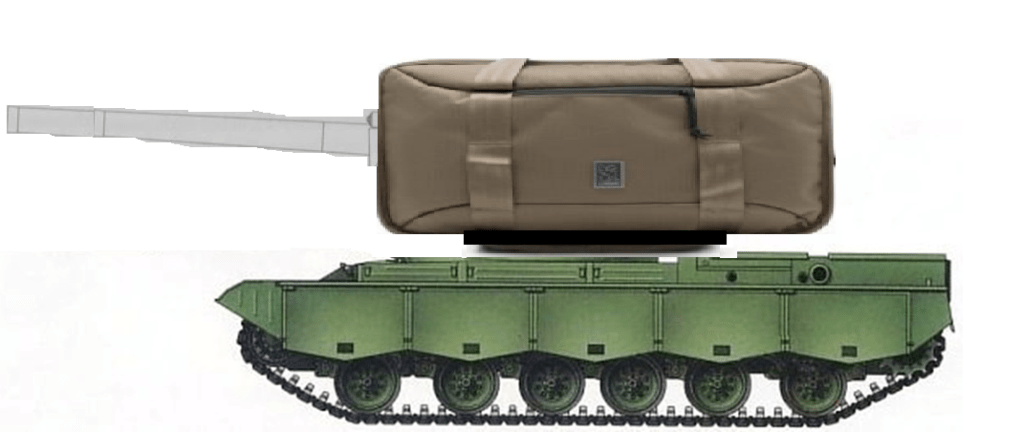

Making vehicles in Stable Diffusion

Simple guide to how I bash together vehicles in Stable Diffusion.
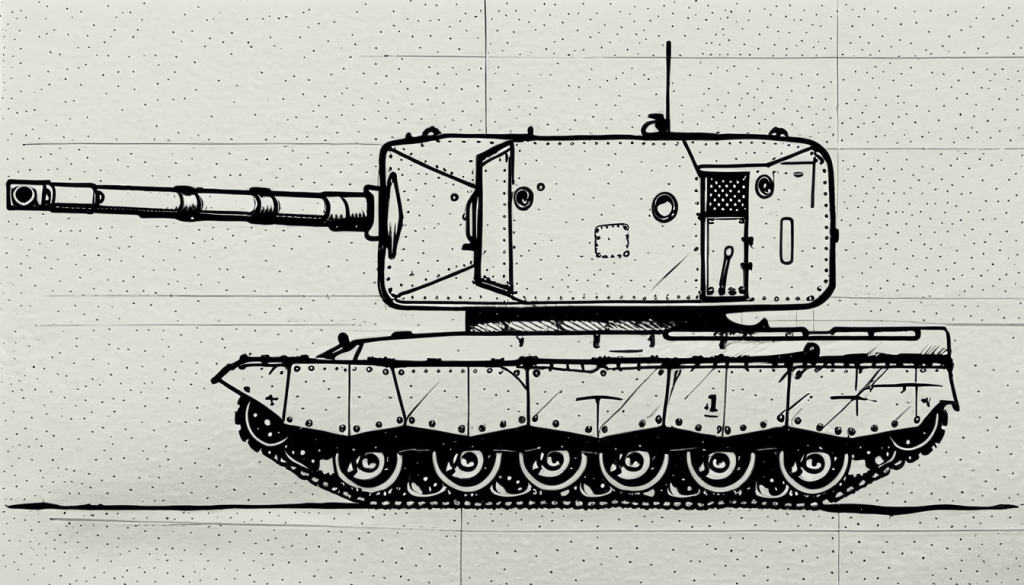
First assemble the shape. In this case it’s the bottom of a tank, a suitcase (!), and a line drawing of a large-caliber field piece.

Then load up Stable Diffusion with a controlnet, in this case, depth.

Use the model and prompt (In this case I use Helloworld 6.0), make sure the controlnet is enabled but not too high, and you get…

One self-propelled AH vehicle!

Wither Fuldapocalypse?

As you may have guessed from my seemingly declining post time, I’m just losing steam on this blog. I’ve thought it’s things like games/writing/etc… and there’s some truth to that. But I feel there’s more to it than that. Like it’s harder to get the urge to blog even if I have the time.

If this blog fades away, so be it. Six years, one thousand posts, and totally changing my perspective on fiction for the better is completely worth it.

And if this can reinvent itself as something other than a review blog, than so be it as well. Either way, starting Fuldapocalypse has been one of the best decisions of my life. I just don’t want to force anything.

BTR-92 Squad

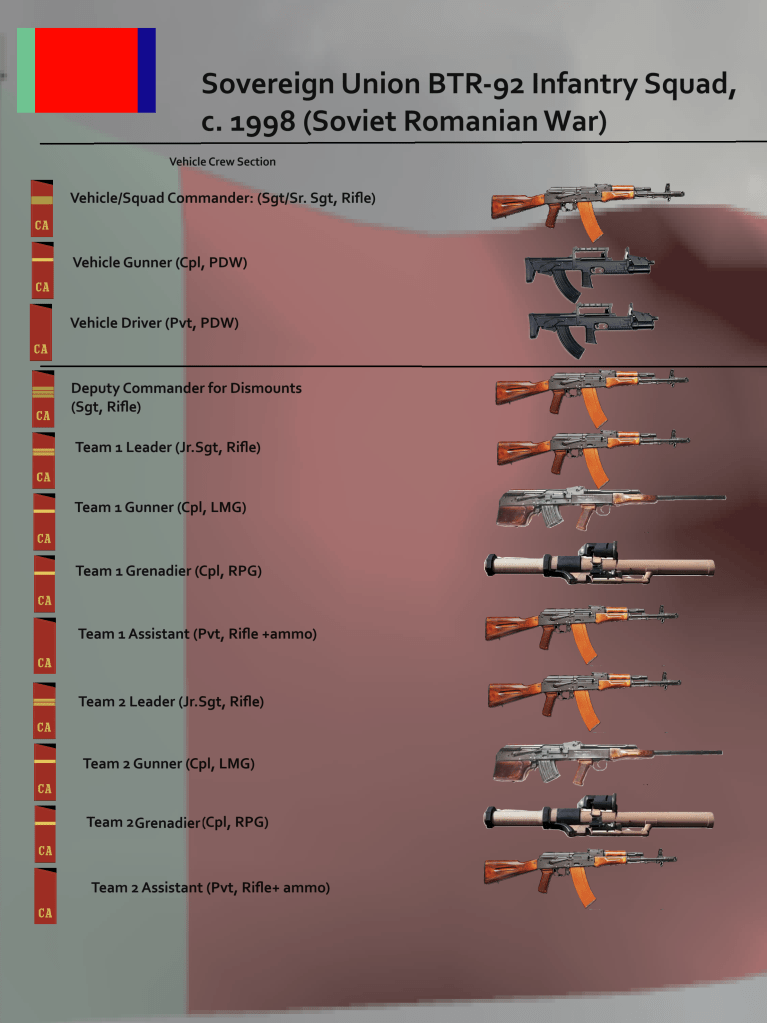
First I did my past piece on Mobile Corps squads, then came the BTR-92. Now the most ahistorically Soviet part of All Union’s military can be made with the two mixed together. In-universe, the creation of this squad was an extremely involved and controversial process.

  • Unlike previous examples, including the mobile corps own BMP/IFV squads, this operates two organizational fireteams. With lots of teeth-gritting, the doctrine emphasizes that “if necessary”, it can operate as a unitary squad or simple overall fire/overall maneuver element. In the Soviet-Romanian War, many did.
  • This has a full-time deputy squad leader for dismounts, whose job is pretty obvious. An emphasis was put on out-of-vehicle operations as these units were designed to spend more time outside.
  • The PDW is the A-91M. The LMG is the “Vepr”, one of many bullpup RPK proposals. The light RPG is in real life the South African (!) Denel FT5 (since a post-apartheid government would be very close to a surviving USSR, and since a post-apartheid arms industry would be very desperate, a license deal for this Goldilocks Rocket Launcher is not impossible).
  • This can be detailed in the Kestrel Publishing entry: Clash: Soviet BTR vs. Romanian TAB . Despite the name, about 80% of that book is just devoted to the Mobile Corps BTR reformation. The pieces on the Romanians basically amounted, cruelly but not inaccurately to “They just followed 196X BTR doctrine, had the equipment to match, and lost”.

Review: Blood of the Ancients

Blood of the Ancients

Like Jerry Ahern, John Schettler decided to take the Kirov series into outright science fiction. Gone are the purely terrestrial squabbles, replaced with sci-fi spaceship battles against aliens and, in this case, an attempt at a John Carter of Mars Homage in Blood of the Ancients. Although much of the book takes place on Earth as the ancient “Sons of Ares” change the past in secret alternate history, this is obviously John Carter through and through.

The issue is that Schettler is not the most inherently suited to write this kind of flowery planetary romance. It would be like a fluffy romance author writing a technothriller. Despite this, it’s a sincere and well-appreciated effort. Who knows, maybe Kirov will turn to nonviolent romantic drama next…

The BTR-92

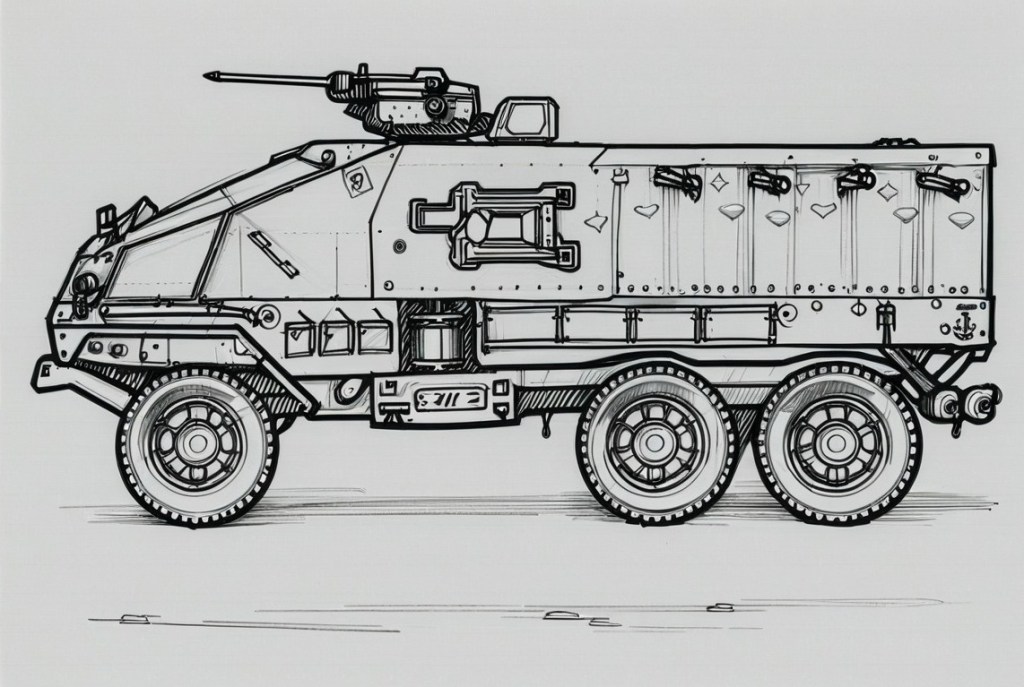
Stable Diffusion has given me the chance to bring a vehicle from All Union to life. Now I had a vision of what the “BTR-92”, the wheeled mainstay of the Mobile Corps, looked like, but on the pages it was described only as “blocky” (and wheeled).

So how I made it: I first smushed some elements together externally. The top and turret came from other APCs, while the bottom (possibly meant to symbolize it being built on that truck’s chassis) came from a Ural-4320. Then I used it as the outline for a controlnet to avoid the “AI doesn’t know what shape to make it” issue.

It’s of course not perfect and with some nitpicking/hindsight, I’d probaby make something that looks less like a low-end APC/MRAP and more like a futuristic advanced one. But it’s still the general shape I wanted, and it was still very fun to make.

How the Fuldapocalypse Skewed Artillery

Fair warning: This is done by an armchair enthusiast with absolutely no practical experience and whose sole experience comes from reading things. I could be totally and completely wrong about many things. Now that that’s out of the way, a look at how a Fuldapocalypse-centric doctrine has skewed perceptions of artillery to the point where Ukraine came as a surprise to many.

To put a long story overly short, the current paradigm in Ukraine is:

  • Largely static front
  • Lots of drones flying around on both sides (which translates to deadlier air power, which in turn makes it a bigger threat)
  • Limited resources

So you can see why smaller, easier to conceal towed guns are liked more.

Now compare this to the Fuldapocalypse:

  • Mobile front
  • Less threat from air but extremely good counterbattery fire
  • Lavish (prewar) spending to afford SPGs.

See the difference?

Now the interesting thing is Caesar-style “truck SPGs”, ie artillery pieces on open wheeled chassis. They have shown the weaknesses of both-ie they’re soft like a towed gun and big like an SPG (and even less maneuverable). However, they’re not really designed for either kind of large-scale war.

Review: Midnight Ops

Midnight Ops

Midnight Ops is the latest Duncan Hunter book by Mark Hewitt . It is also not just the worst in the series but the worst “thriller” novel that I’ve read. Ever. At least as of this post. And I do not mean this lightly. Having read literally hundreds of these books, I’ve reached the point.

So the Amazon blurb mentions a defecting F-22 that flew to North Korea as the MacGuffin. Well you will be “glad” to hear that it takes two thirds of the book to even reach that point at all. And then it goes back to what it was previously doing. What was it doing?

Political rants. I’d say it’s like reading the Facebook page of your boomer uncle from rural Oklahoma, but that would be an insult to boomer uncles from rural Oklahoma. If you trained an AI model on nothing but conspiracy talk radio transcripts and then let it rip for five hundred pages, you’d have this book. But I’m still pretty sure the AI could do better.

The worst part is that I used to like this series! It had the same ridiculously right-wing politics and unstoppable Mary Sue, but could be fun in a Mack Maloney manner. This isn’t. The actual ‘action’ is the same repetitive easy victories that feels like an afterthought. It’s easy to tell the real emotion is in the rants.

So yes, I’ve found the new worst (thriller) novel ever. Welp.

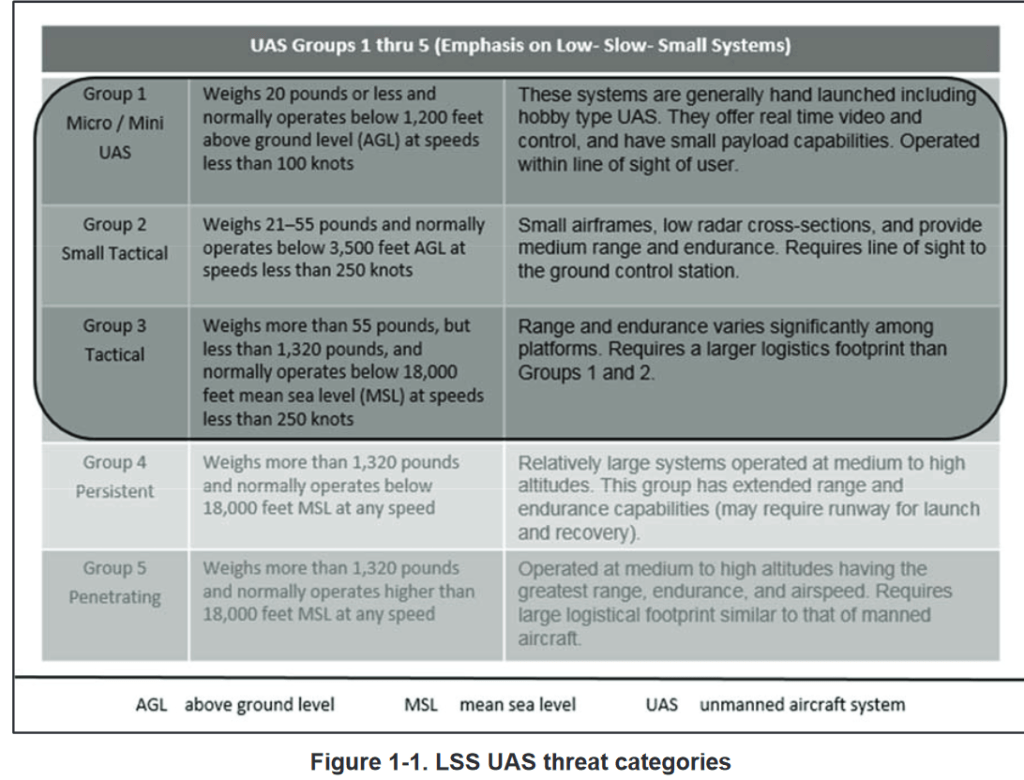
UAV Classes

The US Military has five official group of UAVs/drones.

(from ATP 3-01-81)

The standard hobby drone is a Group 1. Smaller military drones are groups 2 and 3. The ScanEagle is the best American example of a Group 2. The classic Iowa spotter Pioneer is a Group 3, so is the RQ-7 Shadow. Heavy attack drones like the Predator and Bayraktar TB2 are 4, while monsters like the Reaper and Global Hawk are 5.