Review: Vacuum Diagrams

Vacuum Diagrams

Stephen Baxter’s Vacuum Diagrams is a series of linked stories intended to tell the Xeelee from cradle to grave. I mentioned before that like Harry Turtledove, his writing style is a lot more suited for that. And like Turtledove, this is still uneven. There’s attempts at coherent arcs, including a later one where primitive humans have to escape their stone age prison the Xeelee built for them (it makes sense in context), but those really don’t work so well.

Others are basically just “here is a thing. Here is a description of a thing. Here is a character who exists as a camera to show you the thing.” Baxter has managed a sense of wonder and splendor a lot better. Here the scope is so big that it feels tiny. Going billions of light years to a megastructure/portal is done so often that it feels like running an errand (and I’m talking about the human characters, not the aliens).

Some of this has been retconned by later books, although “retcon” isn’t really the best word when time travel exists in universe. Either way, this is not one of Baxter’s biggest hits.
Weird Wargaming AAR: Starmada Star Wars/40k

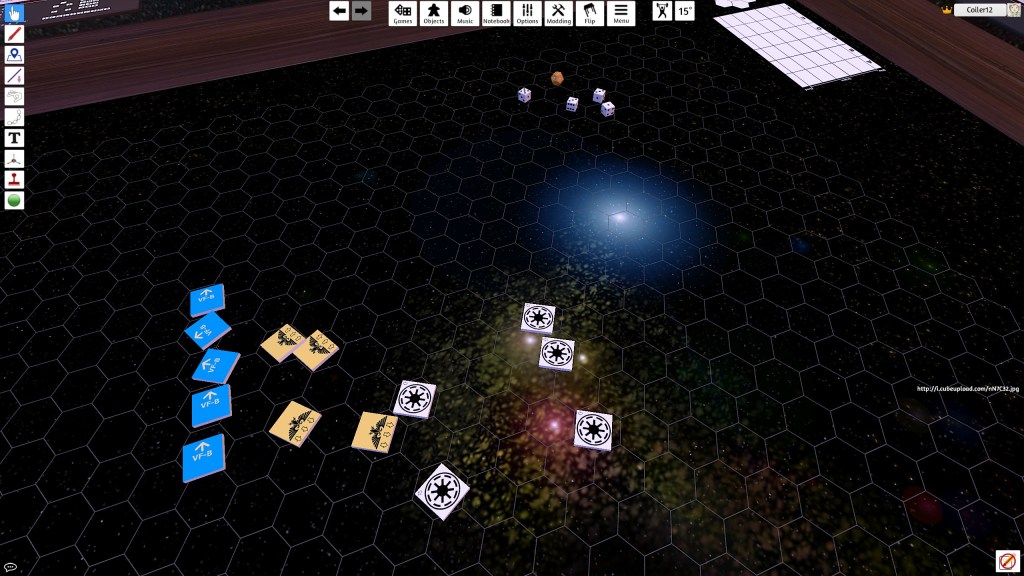
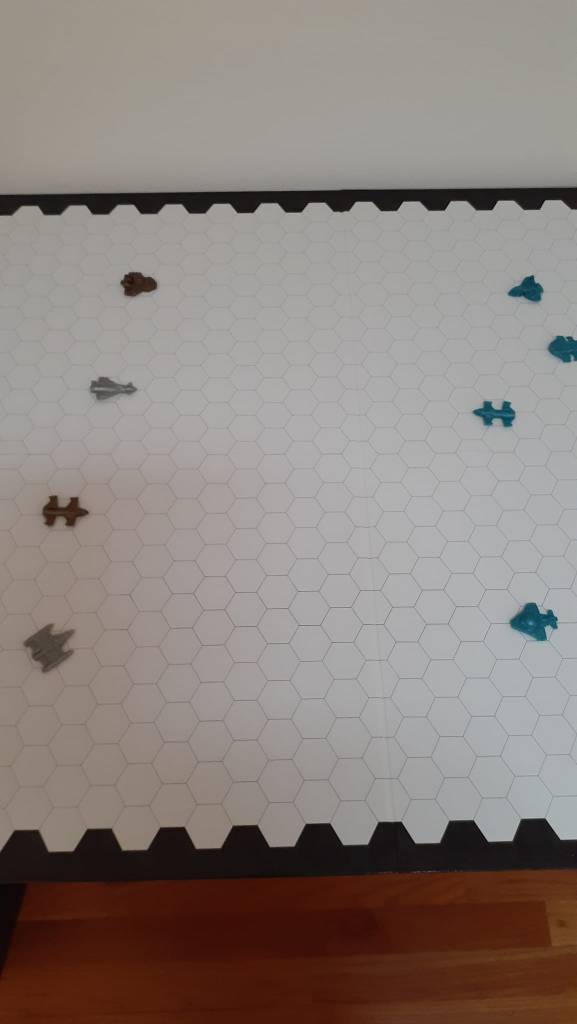
So inspired by the Star Wars vs. Warhammer 40k web serial, I made crossover fleet lists for Starmada. Then using Tabletop Simulator for a convenient hex map and making some quick counters in its editor, I ran a small fleet engagement of four Imperial frigates vs. five Republic ones.

The fleet lists are still subject to major revision but suffice to say the Star Wars side is about accuracy and fighters and the 40k one about brute power and durability. In this case brute force won out as the Imperium destroyed four Republic vessels for the loss of only one of their own.

Review: Xeelee Vengeance

Xeelee: Vengeance

I wanted to like Stephen Baxter’s Xeelee: Vengeance, a tale of time travel, Clarketech, and the most alien aliens that ever aliened.

Unfortunately, this book has one problem. One central problem that is common to all extreme setting-first stories. One central problem that it does absolutely nothing to try and fix: Namely it’s mostly exposition about worldbuilding and speculative physics and whatever. So we get a ton of detail on this futuristic Earth (and Baxter’s other stories), the aliens (and Baxters other stories), every little quirk and thingy (and Baxter’s other stories) and even… Baxter’s other stories. The problem is that if you’ve read a decent amount of the other stories, none of the twists or mysteries work.

When we finally get to the showdown between protagonist Michael Poole and the time-warped Xeelee nightfighter, the book has already dragged on forever and even that drags on forever as well. It’s conceptually interesting but the execution is just terrible. Like “have a detour of padding to reference the John Carter of Mars books” terrible.

Thing is, as an eager worldbuilder myself, I can understand why Baxter did what he did. But as a reader it becomes hard to like it. You have to balance, and this was intentionally unbalanced.

Review: Starmada

Starmada 30th Anniversary Edition

I was looking for something to scratch my spaceship wargaming itch. A set of generalist rules that you could apply to basically any setting and have a semi-reasonable approximation of things. Enter Starmada. Now its newest 30th anniversary edition, it lets you build and battle on the tabletop whatever ships you can imagine.

Naturally as a generalist set it lacks specific gimmicks, with anything offensive having to be translated into weapon qualities (ie a big area blast would be “proximity”, and a powerful kinetic cannon shell would be “crushing”) and anything defensive being translated to either “screens” (roll above X or the attack fails) or “shields” (takes a hit before anything else). You get the idea.

It requires some imagination. But if you have imagination and a willingness to abstract, well let me just say that even my initial crude playtesting sessions had me beaming bright. Want to play as a cumbersome pure brute force fleet going against an agile but brittle rapier? This lets you do all that and then some.

Review: The War of Return

The War of Return

A very timely book, Einat Wilf and Adi Schwartz’s The War of Return is a look at the Israel-Palestinian conflict. That the two support a two-state solution and a return of Israel to pre-1967 borders makes it all the more credible. Trying to go and see why the Palestinians have been more intractable than even the other Arab states, they come to a “temporary UN program”.

I knew about the legitimate beefs the Palestinians have with Israel (yes they exist), and how the other Arab nations have used them entirely as political props and tools for decades without wanting to care for them. Yet the key in the lock they’ve explained is the UNRWA, which ended up becoming both a local government (seriously) with an international fig leaf and something that fanned the fires by using the term “refugee” in a way completely different than what everyone else, including the rest of the UN, uses.

(Short oversimplified version: The UNHCR which handles refugees literally everywhere, has a narrow definition and formal apoliticality. Once someone is settled, they aren’t a “refugee” anymore. So WRT Syria, if they’re settled they’re no longer a refugee. Be it in Turkey, Germany, the UAE, Ireland, America, or Bangladesh, that’s that. Also, whether they were pro-or-anti-Assad is irrelevant in that case. In contrast, the UNRWA has effectively made every single Palestinian family into a dynasty of “refugees”.)

It’s hard not to read this book and think that just a bit of negotiation here and a settlement there can still work (or could even before the current war). This makes it a sad but excellent and true story.

The War Thermos

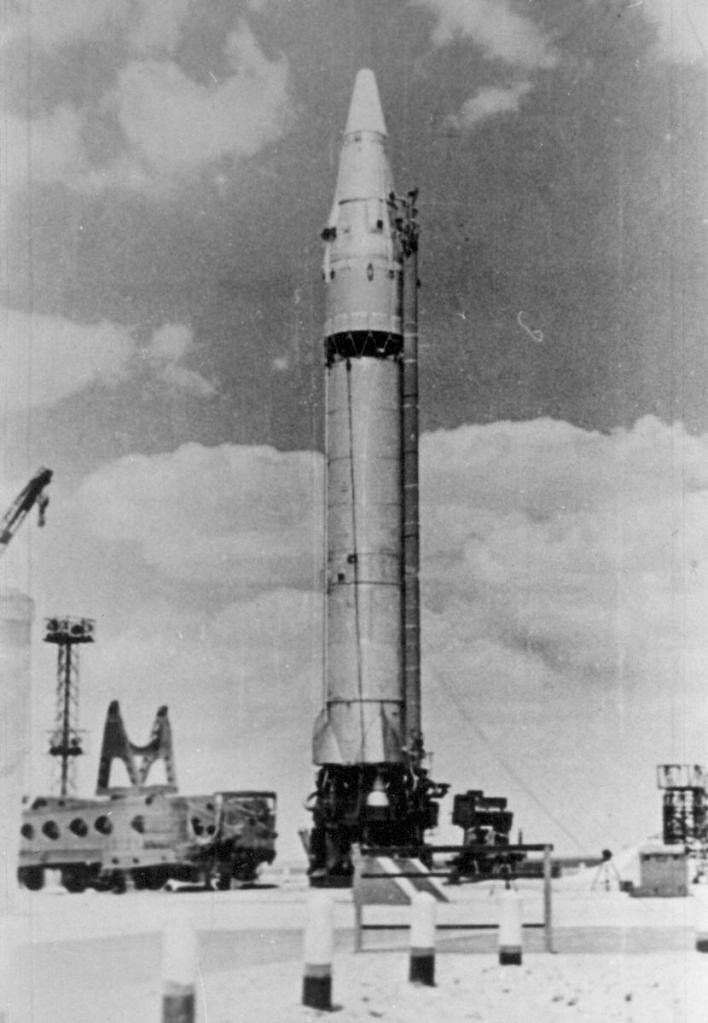
Readiness issues with liquid oxygen rockets historically retired them from the ICBM role once alternatives became practical (be it storable liquid or solid fuels). Yet one technological curiosity was an attempt to work around the issue.

A variant of the R-9/SS-8 ICBM with the typically obtuse Soviet industrial designation of 8K77 had the vacuum flask principle applied to its oxygen tanks. At least in theory, it would keep the liquid oxygen cold long enough for a fueled missile to wait on alert in a crisis. Vacuum flasks are of course better known in the capitalist west by their brand name turned generic name, the thermos.

It would be very cold and then very, very hot.

A Thousand Words: Jodorowsky’s Dune

Jodorowsky’s Dune

In the early-mid 1970s, arthouse filmmaker Alejandro Jodorowsky ended up helming an “adaptation” of Dune. The quotes are deliberate as the movie and its tone would have been Starship Troopers/The Natural levels of intentionally different from the book. In 2013, the story of the most extravagant and absurd movie that never was was finally told in the titular documentary.

This is a great production. Everyone is clearly enjoying themselves as they talk about how the production got more and more crazy. Jodorowsky had his own son play a major role, and of course the son talks about it decades later. The art and effects brought together such figures as Jean “Moebius” Giraud, Dan O’Bannon, and H. R. Giger, the latter two of whom would make a monster movie that was a little successful. Yet the all-star cast was the craziest, featuring Orson Welles (paid in free food) as Baron Harkonnen, Salvador Dali, and Mick Jagger.

What makes the documentary shine is its soundtrack, with Kurt Stenzel’s minimalist electronic score being both a perfect accent and a great piece of music in its own right. (Although I’m biased because I like minimal electronic music, fair warning). The cinematography is also effective.

If I had to have one quibble, it’s that the documentary didn’t have the necessary devil’s advocate/reactor scram button to bring things down to earth. The movie is mentioned as being impossible, but in the sense it was too ambitious for Hollywood. In actuality, it would have been unreleasably bizzare, bound to burn money in its production, and simply strange. (There are scenes in at least some versions of Jodorowsky’s Dune that the documentary doesn’t mention, likely because they’re too weird and/or gross). If it actually got out the door, Jodorowsky’s Dune would probably just have been a bloated mess like Marlon Brando’s The Island of Dr. Moreau.

Still, this is a great documentary about a great story, even if it wouldn’t have been a great movie.