So in Stable Diffusion XL, I typed in the simple prompt “World War III”, used 1985 as the seed number, and got this:

Not bad.

So in Stable Diffusion XL, I typed in the simple prompt “World War III”, used 1985 as the seed number, and got this:
Not bad.
I talked about my fictional 7th Marine Division before. Now I have a more detailed personal organization (though still undoubtedly rough and with inaccuracies). Here it goes. ORBAT chart courtesy of the Spatial Illusion Unit Symbol Generator.
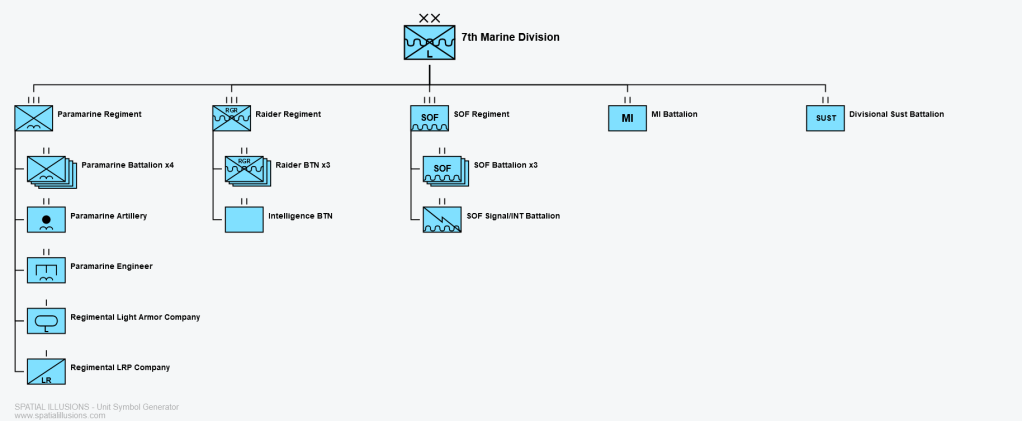
The Paramarine Regiment is like many other light airborne units, with the exception that it has four battalions instead of the usual three and its artillery battalion has thus been increased to four cannon batteries likewise, along with the other regimental support units similarly beefed up. This is to allow each battalion to serve as an independent combined arms unit to hold ground if necessary (ie around a battery in a fire support base with a battalion of infantry and an LRP platoon and light AFV platoon).
The actual battalions are largely standard triangular airborne infantry battalions.
A lighter force with less organic capability, the raider regiment is simple, with three battalions, each of three raider companies and a heavy weapons company. A regimental intelligence battalion is included because of the importance of intelligence and planning to their missions. It’s meant as a direct action-slanted commando force ie the classic Rangers.
The SOF regiment has three SOF battalions, below which any formal organization would be varied and inexact by nature (each has a number of teams, varied as you’d think, but around 10-15 each). Its communications/intelligence battalion is there similar to the ranger regiment.
Divisional assets are just more support and administrative elements, there because the 7th is not intended to be a “field” organization.



Some Stable Diffusion concepts for the logo of either the division itself or one of its subunits. You’ll notice a theme of black birds. Yes, I know crows are already the mascot animal for electronic warfare units, but oh well.
It goes without saying that in All Union, the 7th Marine Division was formed and saw action, including the 2002-2009 conflict in Western Sahara that marked the largest and bloodiest war the US military fought in that TL. If I ever need a fictional American commando force in my writing, I can always use it.
TJ Newman’s Falling is a thriller about an airliner pilot faced with an ultimatum on a previously routine flight: Crash on purpose or your family gets killed. Reading it gave me a weird feeling. Not a bad feeling, but a weird one.
I’ve seen reviews that have said “this book was clearly trying to be a movie”. And this is a very, very blatant example of this. It’s not a bad example, and neither is it a bad book. I was reminded a lot of the movie Speed, which is not exactly a horrible thing for a thriller to remind you of. But at the same time, people remember Speed a lot more than they remember the novelization of Speed, because it’s the kind of thing that’s far better told in visual format.
Not surprisingly, this book is being made into a movie. I’ll have to see how that turns out, but I’ll just say that if being too much like an action movie is the worst thing in a thriller, it’s a good thriller. Especially if it’s written by a veteran flight attendant who thus knows a thing or two about airplanes.
Michael Knights’ 25 Days to Aden is one of the best nonfiction military histories I’ve read recently. As of this post it’s also very timely. Diving deep into the crucial but obscure in the outside world battle for the city of Aden in the early stages of the latest Yemeni civil war, it tells of how a coalition of the UAE, putting its petrodollars to effective use, and local Yemenis ousted the Houthis from the vital port city.
The biggest problem with this book is very obvious from the first page. Knights clearly relied completely on UAE sources, and thus the book is about as biased towards them as Arrian was towards Alexander. It’s not so much the exact facts (Kenneth Pollack, no fan of the Arab militaries, has praised the smaller, well-resourced Emirati army as a big exception), so much the tone that, along with the usual issues in war reporting, leaves one feeling inherently suspicious.
However, this insiders look also has great advantages. It shows a skillful campaign conducted with limited resources and the quirks and compromises that had to be made when dealing with a low-education local army. The two things that accurately jumped out at me were A: It was calculated that 20% of all ammunition would be wasted with random ‘celebratory’ gunfire, and B: Chewing khat was so vital and important that one simply did not fight battles in Yemen during chew time. It also shows that tanks still are very important even in an age of drones and smart weapons, but that kind of goes without saying.
Finally and most importantly, Knights is unbiased in a crucial way in that he has no illusions about treating the temporary victory as more than what it was. The political context of Yemen in its entire history can be summed up by me saying “latest civil war”, and Knights mentions the effectively unsolvable political context.
So keeping its biases and flaws in mind, this is a highly recommended read.
A pop culture history, Selling the 90s is a book about one man’s life in a comic store in the bubble era. This goes through 90s crazes such as the Death of Superman and Magic The Gathering. For someone like me who was a child in the 1990s, it was a fun nostalgia hit.
Unfortunately, it could have been more. The book is very much a set of lists and events. It’s just “here’s this. Now here’s this. Now here’s this. Oh, and this happened too. So did this!” It still has enough to be interesting, but its setup does it no favors.
Still, there are worse books to look back at retro fun.
Of all the things to lead to a genre-defining series, the original Friday The 13th movie (yes, I did choose a Friday the 13th to review that movie) is one of the most bizarre and mystifying. Instead of the iconic hockey-masked monster, there’s a middle-aged woman and a vague attempt at a mystery. Not one element of it stands out from the pack of later slashers. If it had been made as little as a year later, no one would have paid it any mind.
The plot is simple: A bunch of would-be camp counselors are killed by a vengeful mother until one of them, Final Girl Alice, turns the tables and kills her. Yet it was in the right place and the right time, and the rest is history.
(Weirdly, the later and more goofy Friday films are actually the best-made, but that’s a story for another post).
In the chaotic time of late 2020, Carver College stepped up to the basketball court to… lose. A lot. A tiny religious college, it was perhaps the most blatant of the tomato cans that appear in all kinds of sports. With no illusions, it stepped up to play multiple Division 1 schools as a kind of fill-in, getting badly needed money and experience.
Plenty of other colleges have done the “face a much stronger opponent for prestige and cash” before, but it’s interesting to see it going to this level. It’s one of those 2020 sports footnotes alongside things like Eastern European table tennis, the Belarusian Premier League being the most engaged one in the world, and the Denver Broncos running out of quarterbacks.
Edited by Elspeth Ritchie, Women at War is a collection of academic essays about the massive expansion of women in the US military through the years of war in the 21st century.
Now there’s a few things I’d like to say about the controversial topic of women in the military. The first is that in the “yes or no” arguments, my armchair opinion is “we don’t really have a choice”. As the current crunch shows, topping up a big volunteer military is tough already. There simply are not 200,000 ready gigachads who would join the military instead. The second is that I hate the term “combat roles” to refer to the controversy of infantry/armor/etc…, because it implies a false dichotomy between never intended to be in harms way and full inclusion in fields where you could raise legit objections. The third is that the worst thing that could happen to women in the military (or minorities in any field, basically) is the kind of identity-politics obsessed person who thinks that any disproportionately small amount of _____ in _____ must be due entirely to the Bias of the System.
Anyway, this actual book is a mixed bag. There are a lot of understandably dry but very thorough and cited articles on various effects that are done with proper hard-science rigor. Then there’s the fluffy pretentious ones that feel very out of place. Like I understand getting figures on how many women have been “naughty” on overseas deployments is going to be hard, but you could at least try instead of engaging in theorizing that ranges from the obvious to the silly. And that at least you can justify the theoretical with the difficulty in getting solid figures. There are other topics where instead of examining say, how the cultural differences in another country make the incorporation of women into the military better or worse, the writer just gives out marshmallow talc.
Stuff like this is why I just can’t recommend the book fully, even though it has many excellent articles and resources. Then again, that and its high price is just the nature of academic publishing. Of course, the other side of the coin is that you can get lots of relevant facts, figures, and stories about the topic, which is also the nature of academic publishing. So its your call.
Generally speaking, to make a good Mystery Science Theater 3000 episode, the movie itself has to have some redeeming qualities. Obviously not good qualities, but signs of basic competence and the ability to do something memorable. The Starfighters is the exception to this rule. For it is simultaneously one of the best MST3K episodes and one of the worst movies shown on the program.
The movie can be summed up as “lots of stock footage of F-104s, intercut with terrible stiff acting to fill out the movie.” Famously there are two long scenes of the planes refueling in midair. Which is about as exciting as it sounds. And stock footage of them flying. And stock footage of them bombing, as well as stock footage of them firing AGM-12 Bullpup missiles.
There is one genuinely interesting thing in the movie, and that is a line that accurately shows the 1960s approach to aviation safety. Given the F-104’s infamously high accident rate, it rings even more ironically. Basically, back then the dominant theory was that every crash was the pilot’s fault and the solution basically amounted to “git gud”. Said mindset is blatantly stated in one scene where people discuss the safety of the plane.
But other than that, this is a great mock of a bad, bad, bad movie.
I want to say that Roger Mattson’s Stealing the Atom Bomb does the story of a critical and underreported part of nuclear history justice. In the mid-1960s, Israeli agents swiped enough highly enriched uranium to make multiple first-generation warheads from an enrichment plant in Pennsylvania. As the subject matter is incredibly secret, Mattson had to wade through a massive jungle to find out more. To his credit, the book is well-researched and detailed.
The problem is that so much of the book is about how the investigations went. That could be interesting in and of itself, but it’s told in such a stilted, dry way. So I regretfully have to say that what could have been a great resource has become a niche topic for nuclear weapons historians.
 Fuldapocalypse Fiction