
Some cityscapes I’ve made in Stable Diffusion:

And a mech for good measure:


Some cityscapes I’ve made in Stable Diffusion:
And a mech for good measure:
Harry Turtledove’s 2008 After The Downfall is not an alternate history per se. Rather it is an example of the dreaded “isekai” that started with Mark Twain’s A Connecticut Yankee In King Arthur’s Court. A German soldier gets warped from the Battle of Berlin to a fantasy world and then stuff happens. A lot of stuff. A lot of predictable stuff.
This is not one of Turtledove’s better books. Take a ridiculously obvious and unsubtle plot/message, writing that can’t make up for it, and one of the fastest intro-to-sex-scene ratios I’ve ever read. And the “payoff” of that isn’t worth it, trust me.
The best I can say about this is that it’s a sincere attempt at something different and not a series installment stretched out over a long time to get more money. But that doesn’t make the actual book any better.
With both the college and pro football seasons having started, it’s time to look at Fred Segal’s Freezing Cold Takes, a compilation of football media predictions that ended up being extremely wrong as well as the context surrounding them. It’s not the deepest book, but it’s certainly deeper than the fired-off hot takes concerning sports that long predate the internet.
As a fun bit of NFL history, this book is worth a read. You’ll laugh and you just might learn something. While it shouldn’t be the last word, its good as a first one.
Because I’m inspired by WWIII87 doing something similar and since I don’t think I’ll ever touch on the topic in any proper All Union successor, here it goes. It was in my mind, now it’s not. Enjoy.
Like with most wars since 1900, if not since the invention of gunpowder, the Soviet-Romanian War in All Union was won by artillery. While the Soviets had far more and far more advanced tube pieces, fire control was a lot more varied on both sides.
The top tier of fire control lay in the front level assets and units in the mobile corps, from battalion to corps itself. These contained most of the what the “recon strike complex” needed to succeed and did. Drone (and advanced non-drone) spotters, high performance datalinks, widespread designators for smart munitions, and advanced digital computers, all of it was present and used to great success. Perhaps the biggest air/artillery feat was the near-destruction of the Romanian 6th Tank Division before a single bullet was used in direct fire. The Romanians and allied Bulgarians had nothing like it. This was what caused a gigantic amount of alarm in the US and western militaries…
…although calmer heads pointed out that while still dangerous in the extreme, the Romanians had very little ability to disrupt the system.
The medium tier was done by most regular Soviet units in the traditional division/army formation and the best Bulgarian/Romanian units. This involved fire control computers and other technological advantages, but still showed signs of stiffness and weakness in comparison to their upper tier (not the same as ineffectiveness, of course).
The low tier was largely manual and familiar to anyone in World War II, and was conducted by the bulk of Bulgarian and Romanian units, as well as a few low-category Soviet units mobilized for the war. There were many reasons why the southern front was less open and why the Romanian defense there was more effective: Units of mobilized Bulgarians instead of high-tech mobile brigades, the use of the Danube and more defensive lines, the proximity of Bucharest meaning that there was a “back to the wall” attitude, and many of the regime’s most loyal and stubborn units being deployed there prewar, possibly for political reasons.
Yet one has to be better C3I on the Romanian side (a large fortified area meant they could use field telephones and other such rugged measures far better) and worse such measures on the Soviet/Bulgarian side (especially as they had to go on the offensive). Which in turn made fire control better/worse.
Steven Seagal has had a career trajectory that very few artists have duplicated. Imagine a one or two-hit wonder who, next thing you know, is making cheap grindhouse flicks on behalf of a dictator. Well, with Seagal you don’t have to imagine.
Anyway, the lone movie of his that many people like unironically is the cheap thriller Under Siege, AKA Die Hard On A Battleship. The plot is a very simple one and involves villains taking over the USS Missouri and Seagal being the one to stop them. Look, it’s not exactly a deep and intelligent movie, all right?
Thankfully, it is a fun movie. A very fun movie. It has Tommy Lee Jones and Gary Busey as delightfully crazy and corny supervillains, a chance to see a battleship in action, and takes full advantage of its setting. I think it goes without saying that a warship is one of the better places to set a Die Hard knockoff.
Political reporter (but the book is thankfully almost without mention to contemporary politics) David Weigel wrote The Show That Never Ends, a story of the heyday of progressive rock in the 1970s. It’s an interesting book. But it’s not a perfect one.
Weigel succeeds at putting prog rock, a genre many are embarassed to like (I’m not) into perspective. Its underappreciated just how big it was in its time due to the “punk not disco effect”, where films and shows set in the past will emphasize what was “cool” instead of what people actually listened to. Jethro Tull could make two silly concept albums and both were hugely successful.
The problem is that the book comes across as aimless and meandering. It has width at the expense of cohesion-much like prog rock itself. While not for everyone, music fans will enjoy this for what it is.
So the conventional forces of the United States in All Union, unlike its superpower counterparts, have not been the most central to any of my drafts (yet…). Therefore I figure I should infodump some of my musings on it right now.
The reformation of the USSR brought about a period of aimlessness among the US Army. With the fall of the Berlin Wall and the former Warsaw Pact states forming an independent de facto buffer, priorities became much lower. Going from all of Germany to the northern tip of Norway and Thrace is somewhat of a downgrade.
That being said, there has been a shift of forces to the south. The US 9th Infantry Division is in Turkish Thrace to, in the event of a Thraciapocalypse, serve as a mobile counterattack force. The lighter 51st Infantry is in Northeastern Greece near the triple border to make sure the rival NATO countries play nice serve as a tripwire for any Soviet-Bulgarian push south.
The need for “Americi-BTRs” that historically was filled by the Strykers came in the form of LAVs, both the LAV-25/Piranha of real life USMC fame for that branch and the unrelated but similarly named LAV-300/600 series for the Army.
The medium-ization of the Army came as followed: Two brigades in existing heavy divisions with their Bradley mech inf brigades replaced with LAV mech inf brigades ie BMP-BTR mixes, two “medium-heavy” divisions based around LAV-300s with a divisional tank battalion that would stay behind on lower-intensity deployments, and one “medium-light” division with the LAV-300 series, more uparmored HMMVs as the infantry carrier, and no organic tanks. For the USMC, the Seventh Marine Division came into being, along with Combined Arms Regiments (mixes of tanks and LAV-Bisons proposed in real life) for the three active USMC divisions.
More to come…
Robert Cole’s Cataclysm is a story of post-apocalyptic survival as a man and his family struggle in the aftermath of a nuclear exchange-I mean, terrorist attack. I have to mention this “night of the war” (to use the Survivalist’s term). Because not since the beginning Fuldapocalyptic days of The Red Line have I seen a setup so contrived when it didn’t have to be. In fact, The Red Line can at least be excused as commercial editors wanting it to be contemporary for sales reasons.
This independent novel has no such justification. Anyway, might as well tell this. So nuclear weapons destroy many American major cities in a strike that’s more than Arc Light but less than a classic Strangelove/North Star wipeout. That’s not so bad and I’d even call it somewhat refreshing to have some semblance of a government left. Except it’s not the obvious normal nuclear war. No, its setup goes like this: Islamic terrorists snuck nuclear bombs into said cities and detonated them. In response, the American government launched an immediate retaliatory strike against the fifty largest Muslim-majority cities across the world before concentrating on licking its worlds.
It feels gratuitous, and even for me a little insulting a setup. Like you could have just had say, Iran go nuclear, get several ICBMs, and have a “normal” exchange with them and no one would bat an eye.
Anyway, the book itself has a lot of exposition about every single slightly relevant thing. It also has constant references to the author’s protagonist’s “past wargames”, which makes this turn into the Survivalist-Kirov (this is not a bad thing).
The next arc is terrorist weaponized mega-smallpox, because one cheap thriller cliche wasn’t enough and Cole had to include another one. All he needed was VX gas for the Cheap Thriller WMD Triple Crown. But he goes for the second-best thing, and a tried and true literary device: When in doubt, have your characters fight a bunch of crazy bikers. In fact, such a super-biker gang becomes the main antagonists, a delightful change from the terrorists I was expecting.
The literary and action fundamentals are adequate. This sounds like passive-aggressiveness, but it’s not. Thankfully, the whole leaning so much into “Postapocalyptic Kirov” and huge expositions come across as endearing and not annoying. I had a lot of fun reading this book, and that’s what matters.
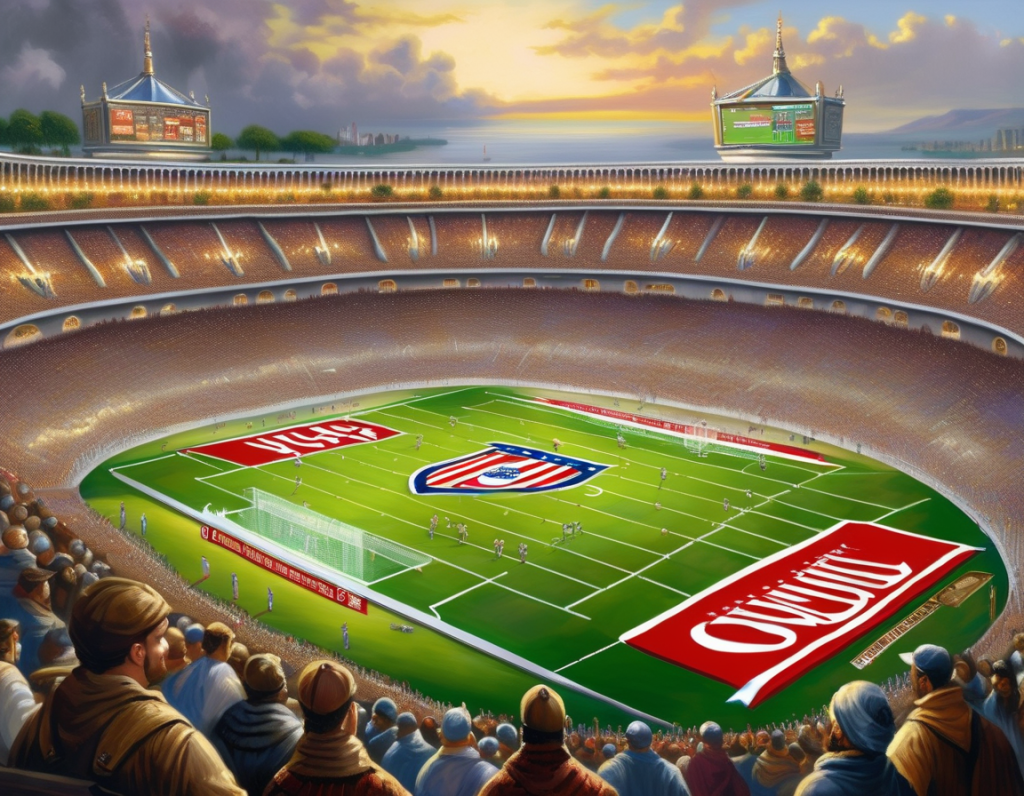
I just had to share this bizarre AI generation. Prompt was something like “Medieval Venetian style football stadium, in the style of Thomas Kinkade.”
Had a delightful meeting with fellow Fuldapocalypse afficianados on the subject of “Cold War Gone Hot”, and on different points of divergence in particular. It was a great time. The video can be seen below. Topics range from alternate history in general to our books to pondering why all these conventional World War IIIs seem to happen in the 1980s and not earlier.
 Fuldapocalypse Fiction