Wither The Running Back

With NFL season approaching, a hot topic for (some) football fans is-the salary of running backs?

The short answer is that running backs have recently gotten a significantly smaller portion of the pie compared to other players (especially wide receivers). This is due to a decades-long trend towards more passing and also due to a more recent trend where a rookie wage scale was implemented-and almost all running backs burning out in that period before they could theoretically enjoy free agency riches. Because of this and because running backs thrive in the different college game, a team can draft a running back, use him, then draft another one.

It’s hard not to sympathize with someone whose career is short even by athlete standards and who has to be slammed by giants over twenty times a day. But it’s also important to note that the other 45 or so players on an NFL team are also facing physical pressure. There’s no realistic way that the owners and other players are going to give their share to appease players who can be reasonably considered more replaceable. And a certain subset of fan and reporter will always talk about the poor struggling running back and not the players who are earning much more (and not just in absolute terms) than they did in the past.

I do feel like the old “walking tank” running back may be more in vogue. People who otherwise would have trained as Barry Sanders-type “agility running backs” are likely to want to aim for a wealthier, safer receiver position instead. But since you can’t teach size….
Review: Inheriting the Bomb

Inheriting The Bomb: The Collapse of the USSR and the Nuclear Disarmament of Ukraine

I’ve looked forward to few nonfiction books as much as I anticipated reading Marina Budjeryn’s Inheriting The Bomb, about how nuclear weapons were removed from Ukraine after the USSR’s breakup (the word choice is deliberate). I was not disappointed. This is an amazing book that can for all intents and purposes clear up the “could Ukraine have kept its nukes” confusion.

I’ve already posted about WMDs and the non-Russian SSRs. Short answer is “They never had control or the necessary pieces to maintain the arsenal of nuclear weapons on their territory, but they nonetheless had the raw technical ability to make an arsenal”. Raw technical ability but little else. Budjeryn doesn’t go into that much detail on counterfactuals (though she does wisely defer to credible experts in that regard and cites them).

She does go into lots and lots of detail on the political twists and turns and not just for Ukraine itself. Yet it was far more reticent than Belarus or Kazakhstan were and viewed itself as a legitimate holder of the weapons. Factors from the fact that Russia was threatening Ukraine almost literally from day one (and by Yeltsin officials and not Zhirinovsky-ist fireeaters) to the desire to preserve jobs in the giant Dnepropetrovsk missile plant are mentioned. This is a great, indispensable book about a very important topic, and I cannot recommend it enough.

The Weapon

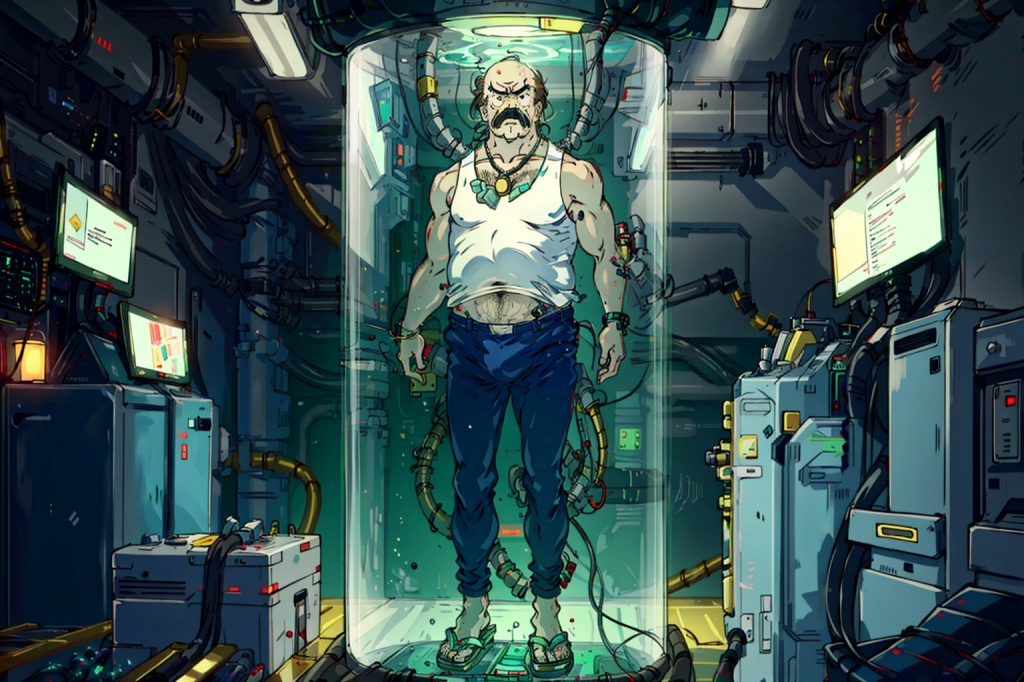
See, in a bunker that only a few people know the location of, someone rests in a stasis tank. Even fewer people know that this man is there, and fewer still know his significance. If the multiverse needs his services, he will be unleashed, and the cosmos will never be the same. Only a tiny amount of people know his name. They call him…

Carl.

A Thousand Words: Fat Man And Little Boy

Fat Man And Little Boy

Before there was Oppenheimer, there was 1989’s Fat Man and Little Boy, a far less well received movie about the development of the nuclear bomb starring Paul Newman as Leslie Groves and Dwight Schultz as Robert Oppenheimer. Knowing its reputation and knowing my interest in the subject matter, I felt I had to check it out.

Most of the critiques are accurate. The movie does treat the making of the nuclear bomb as a hokey war movie with Newman and Schultz as the cliche general and scientist right out of central casting. The movie is VERY clear on what side its makers are taking in the debate about nuclear weapons (it’s uh, not that of Curtis Lemay) and is not subtle in its points. And yes, it’s historically inaccurate in many ways.

Yet it’s still better than I thought it would be. For all those legitimate issues, it’s a technically well made movie. It may be a hokey war movie, but its direction and (especially) sets are solid. Even the final scene when the bomb finally detonates (spoiler) is interesting in that the filmakers obviously knew they couldn’t do the explosion justice with the effects of the time so they chose an indirect vision that’s surprisingly effective.

It’s not the best film ever, but it doesn’t quite deserve the scorn its gotten. Plus Ennio Morricone’s score is typically amazing.

Review: Crimson Snow

(Warning: This review contains many uses of the words ‘tanks exploding’. It’s a sort of contest to see how often I can fit that phrase in. So let the tanks explode!)

Ryan Aslesen’s Crimson Snow is a science fiction novel about tank battles. It is nothing but tanks exploding. And the occasional cliched angst, but mostly tanks exploding. When tanks are not exploding, the book is not very good. When tanks are exploding, it is mostly adequate. There are actually so many scenes of tanks exploding that they kind of blend in, and the scenes in between the tanks exploding (including one bizarre played-straight scene where the main heroine uses a ‘pleasure bot’), do nothing to add to the coherence.

Because of this, this book depends on whether or not you like tanks exploding enough to look past its flaws. If you really, really like tanks exploding, go ahead and read it. If you don’t, there are better books out there featuring tanks exploding.

(Final “Tanks Exploding” count: 8, not including this sentence)

Nuclear Terrorism Cont.

Back to my “hypothetical nuclear terrorism” reading, and some of the analyses have given me this impression.

So there are some ifs beyond the norm that actually make it more likely. Besides the usual “if you have the resources and personnel for the job”, there’s two things that make the job of the would-be nuclear terrorist easier and their opponents harder.

  • Being willing to take the hit of large and likely fatal amounts of radiation during transportation and construction. This is pretty self-explanatory, especially when using comparably “fresh” (and thus high radiation) spent power reactor fuel as an input.
  • Being willing to detonate the bomb in a target area closer to the assembly site, even if it’s less damaging and/or prestigious.

However, this narrows the personnel pool even more. It may be a slight narrowing, but it’s still a narrowing. It’s also worth noting that the first point makes a “factory accident” a lot more likely, perhaps countering the advantage of fanaticism.

Five Fuldapocalyptic Years

This blog has been active for five years and now has close to a thousand posts. It’s been a joy to make. And it’s unironically and seriously helped change my view of literature as a whole. When I started the blog, my view of fiction and cheap thriller fiction in general was narrow and (unknowingly) distorted. Now I can see a much clearer picture.

So to all who’ve read and commented on this blog, thank you.

Review: Grant’s War

Grant’s War

Eric Meyer is one of those authors who just writes a ton and ton of ultra-cheap thrillers. I’ll even admit that I had to check to see if he was a real person and not just an obvious pen name shared by multiple actual writers (the answer is “yes, he is a real person as far as I can tell”, by the way). This is the kind of book I’m dealing with when I read Grant’s War.

The premise is simple. It’s a war novel where protagonist Jack Grant, after being (mostly) falsely convicted, faces the stereotypical “army or jail” choice. He chooses the army just in time for 9/11 and the war in Afghanistan. And he gets there just in time for a scene where he grabs a red-hot AK by the barrel and throws it aside before dispatching its wielder in a fistfight. So, in other words a lot more Jon Land than Jon Le Carre.

While this book is not exactly one that contains deep characterization or excellent literary fundamentals, it’s nonetheless good by the standards of the assembly-line slop that makes up its genre. And that alone is enough for me to recommend it.