Fictional Prime Ministers

Two fictional Prime Ministers of the UK, created in Stable Diffusion. They are Jane Fallow and Alister Stern. Stable Diffusion with the right models is very good at making these “pseudo-photos”, especially if it’s in an undemanding format like an upper body portrait. And yes, I’ve taken advantage of this to see what characters in my writing have looked like. Also yes, you may see these names in a story…

Review: Duped

Duped: Slave Of The New Confederacy

I’ve read a lot of alternate history in my life. But not until Lena White’s Duped: Slave of the New Confederacy did I read a certain alternate history subgenre. In this case, alternate history fetish fiction. Now, there’s nothing wrong with fetish fiction. But this is a particularly shallow example of it.

Here’s the actual alternate history summarized: The South won the Civil War and became an independent country with slavery and still has it in the present in this book. (I will give Duped legitimate credit for not buying or promoting the Lost Cause mythology of the CSA’s secession and values not being slavery related.) During the Great Depression, slavery in its traditional form collapsed for economic reasons. But then in the 60s, it returned and reversed. Slaves became objects of ‘love’, mostly white females, and the slavers became mostly black males.

You can probably see where this is going. Anyway, the protagonists go south for what they think is just some harmless play acting as slaves. Spoiler alert: It’s not, and the book ends with basically just a sequel hook. It’s basically just a very strange footnote in how alternate history can fit into more or less any type of story.

The Cluster Debate

So the Americans have provided cluster weapons to Ukraine. Unsurprisingly, the internet debates around them have not been the most fruitful or productive. The consistent opponents are one thing in that I find their arguments as flawed as they are understandable. Yes, it’s perfectly fine to be concerned about unexploded ordnance and collateral damage-as if there wasn’t plenty of that already, most of it caused by…. someone other than Ukraine.

But the more interesting thing to me has been the talk, largely from OSINT accounts, of treating clusters as an unstoppable superweapon. Between this and the Bayraktar TB2 slobbering of days past, it’s as big a sign as Michael Jordan’s baseball career that excellent talent in one area doesn’t equal having it in another. Anyway,

  • Concern about unexploded bomblets, and not just for collateral reasons, is valid.
  • Clusters are situational and even in the past before “normal” shells got better designed, had many situations where they were worse. They also had some where they were better.
  • Cluster shells will still be extremely useful, if only because they’re a fresh source of things that things that go boom.

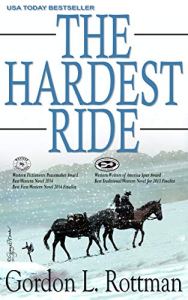
Review: The Hardest Ride

The Hardest Ride

Having loved Gordon Rottman’s nonfiction books, I figured I’d give his fiction novels a try, starting with The Hardest Ride. Even though westerns aren’t really my genre, I felt “why not? I know this guy can write.” So I opened this story of a cowboy and a mute Mexican woman.

It’s written in first person, which is a little awkward, and is full of “darn tootin” slang, which is even more awkward. Yes, you can make a realism argument for it, but it’s like phonetically spelling out every character with a non-English accent. The whole thing just makes it less readable more than it makes it more immersive. The first half of the book is a mere slog as the characters stumble around from town to town.

Thankfully, the pace picks up after said mute woman is kidnapped and the remaining half is devoted to her rescue. It’s well written but falls into the small pit of “too realistic for its own good” (where the author knows firsthand human limitations but still wants to have the main character accomplish something spectacular). Still, at least it’s a plot, and it’s not poorly written.

This is an iffy book, but it’s a good kind of iffy and I’m looking forward to see if Rottman can improve in later installments.

Rediscovering Attrition

Every so often an observer will encounter a war (the Ukraine conflict being the most recent) and then find that numbers, firepower, and the dreaded capital-A Attrition still matter, as they always have. Some of this is just seeing technological hype being inevitably worn down by realistic imperfection. But more of it is just because of the annoying way the Liddell-Hart/Boyd/Lind “MANEUVER WAR” crowd has wormed its way into military discourse.

Ok, so a lot of it is just WWII mythology of the Germans running circles around the French. But guess who’s amplified all that? Yep, the maneuverists. And in Liddell Hart’s case going all the way back to the first ever recorded battles where the “Indirect Approach” always won. So much as how people become legitimately shocked when, after a long dose of Pierre Spreyism, it turns out a new piece of military equipment actually works, they also become shocked when it turns out that fortifications are indeed viable if not essential, that the Big Breakthrough is hard, that maneuver has limits, and that there are few substitutes for force and attrition.

Studying actual doctrine even in maneuverist periods doesn’t make one surprised. After all, a Sov Kras Don Circ Heavy Opfor operational maneuver group gets going with a massive breakthrough concentration of firepower and stays going through mobile organic firepower. But going by popular media does.

Review: For Whom The Bell Tolls

For Whom The Bell Tolls

It’s not often that Fuldapocalypse reviews a genuine classic, but today it does with Hemingway’s For Whom The Bell Tolls. There’s pretty good reasons for this. Classics are either deserved legends or overhyped clunkers in my eyes. Guess which one this is.

This story of Robert Jordan, an American volunteer in the Spanish Civil War, is a slow, dull, and most of all pretentious slog. And get used to seeing “Robert Jordan”, because Hemingway spells his full name out in basically every single mention. He also has Spaniards talk like the King James Bible or Silver Age Thor. I was basically going “Ok, that bridge that ROBERT JORDAN is sent to destroy had better have the whole fate of the war hinging on it” not long into the book.

Maybe this would work for someone else. But it didn’t for me.

Review: North Korea’s Hidden Assets

North Korea’s Hidden Assets

H. John Poole returns to Fuldapocalypse with North Korea’s Hidden Assets, a warning about how North Korea may be stronger than anticipated. Or rather, that’s a central message in a meandering book. The content here ranges from loooong descriptions of Iwo Jima fortifications (because as a country occupied by Japan, they were undeniably influenced by its doctrine. Legit link, but not worth the obsession he shows) to constant tirades against the clunky, idiotic American doctrine and how the North Koreans have so much better military culture and small unit tactics.

Some of the book’s arguments are good. Poole spends a lot of time legitimately arguing against mirror-imaging a Second Korean War as being a repeat of the mechanized charge to take the entire peninsula that was the first. He argues and reasonably so that the north would be more likely to bite, hold, and wear the Americans and southerners down to win at the peace table. And the fortifications and tactics from the first Korean War are at least more relevant. So are the surprisingly few times he looks at contemporary North Korea (the nominal point of the whole thing)

But this book is mostly axe-grinding. It’s also hypocritical in that Poole portrays it as some kind of secret hidden source when almost all of its analysis comes from official US government documents-showing at least someone else already there knows of a worst-case perspective on North Korea. There are much better serious studies of that opponent out there.

A Thousand Words: Soylent Green

Soylent Green

Soylent Green is perhaps the most early 70s movie of all time. Set in the dark far off future of 2022, the film is a documentary about life in a Warhammer 40k hive city, cautionary tale of overpopulation and societal breakdown as well as a grand mystery. The problem looking back on it in hindsight is that everyone now knows the big twist about what the titular food is made out of (human corpses). But there’s more to it than just that.

See, the movie is very early 1970s in that the characters dress and talk so similarly that sometimes I had trouble telling them apart. But it also takes the most ridiculous set pieces and expects the viewer to treat them with utmost somber seriousness-and I don’t just mean “ridiculous” as in later shown to be inaccurate ie the prison Manhattan in “1999” in Escape from New York. It shows a wildlife sanctuary consisting of one tree in a greenhouse bubble and a long scene where rioters are literally scooped up in bulldozers and expects both to be serious.

The movie isn’t badly made and you could do a lot worse than watching it. But it is ridiculously dated and belongs to the pretentious pre-Star Wars school of 1970s sci-fi.

On The Term “Thunder Run”

One of the most curious military terms is “Thunder Run”. It originally referred to an armored push into Baghdad in 2003. It has since come to generally mean “any fast, tank-heavy offensive, especially into closed terrain where tanks are otherwise not the most suited.” Especially one that’s inherently high-risk, as this was. It takes nothing away from the skill and courage of the 2003 Thunder Runners to point out that the conventional Iraqi army in that period was massively flawed and worn-out and that it could have easily failed against a more capable opponent, as happened in a similar attempt in the Yom Kippur War.

However, I find it even more interesting in terms of etymology. See, the name “Thunder Run” is pretty self-descriptive. It’s an attack that’s swift like a thunderbolt and involves dozens of thundering-ly loud armored vehicles running towards the opponent. In other words, its something that even someone with little such experience can grasp the meaning of.