Review: Seizing Power

Seizing Power

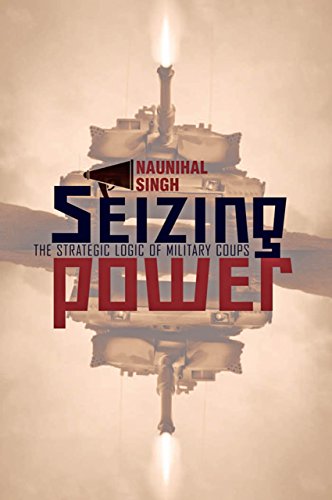
Naunihal Singh’s Seizing Power is a book about military coups and how they work. The timing of this review is a complete coincidence and has no bearing on recent events whatsoever. Anyway, Singh studies the basic three types of coups and makes an academic argument that they are in essence, “coordination games”-that is to say they have to give the appearance of inevitability instead of actual hard power (in most cases.)

Singh divides coups into three categories. The first is coups from the top, like say, the central party committee imprisoning the president and attempting to seize control. The second is coups from the middle, like say, a division-sized force dashing from its base on the border to the capital and hoping the rest of the army can join it. The third is coups from the bottom, like say, rioters in support of a parliament with no army on its own trying to sway the military and take vital television stations. (Yes, all three examples happened in Russia/The USSR. They were the 1991 August Coup, the recent Wagner uprising, and the 1993 constitutional crisis).

Singh spends most of his time covering all three types of coups that happened in Ghana in its history, and then ends with the August Coup of 1991, a coup from the top that should have effortlessly succeeded but in fact failed miserably. Like most academic histories, it gets a little too pendantic at times. But it’s still a great read.

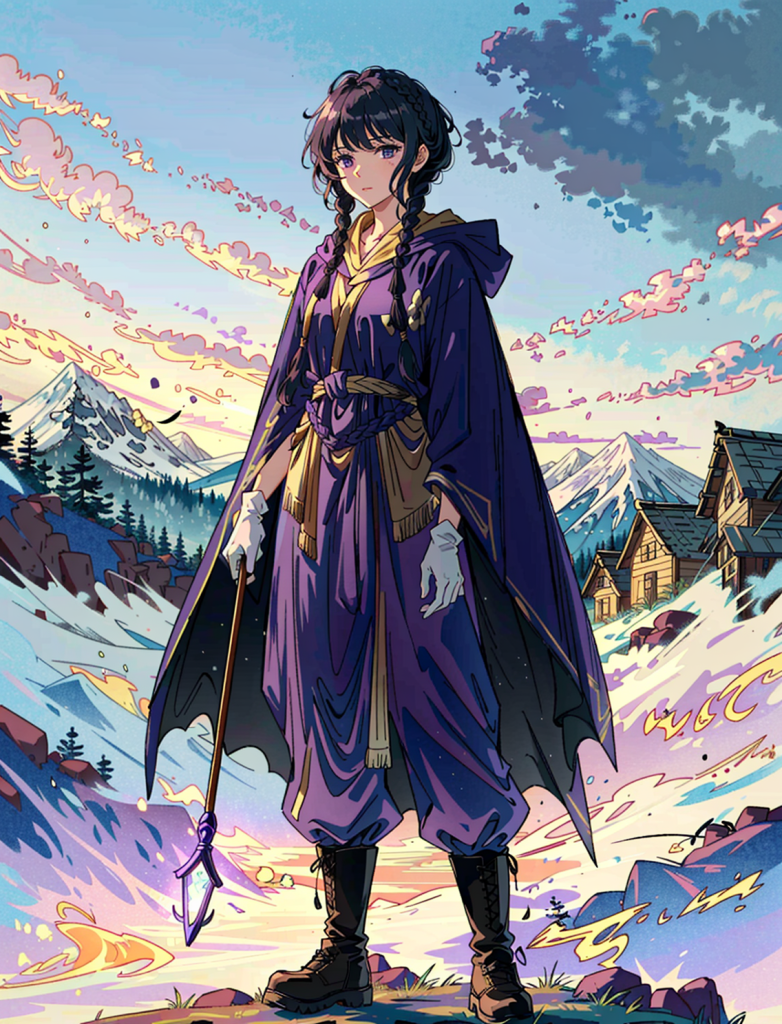
Stable Diffusion Noita Fanart

The protagonist of the Noita game, known as “Mina” (which essentially just means ‘you’ in Finnish), or “The Noita” (witch) is a deliberately ambiguous figure wearing covering purple robes. So I felt I needed to do a theoretical unmasked version in Stable Diffusion. This “Mina” is female, with hair in traditional Scandinavian braids.

A Thousand Words: Dave’s Redistricting

Dave’s Redistricting

One of my internet hobbies has been using the Dave’s Redistricting site. It allows you to draw up hypothetical legislative districts and see their demographics. I’m currently using it to make hypothetical seats for a vastly expanded US House of Representatives. It’s both fun and illuminating to see how you have to balance various challenges.

It’s very illustrative of showing how it’s actually harder to make “fair” districts than you might think. You can get a nice sensitive block of counties-that are safe seats. Or you can take half of those counties, balance it with half of a large city, and then you can make an evenly bipartisan district-but how “representative” really is an obvious artificial creation like that?

If you like politics in any form, you have to check this out. It’s simple, easy, and is great for both counterfactuals and actual debate.

Review: The Bucharest Dossier

The Bucharest Dossier

I knew I had to read a spy thriller when I saw the setting was Romania. So I eagerly snapped up William Maz’s The Bucharest Dossier. That the author actually grew up in said country during the bad old days made me want it even more. Sadly, what goes up must come down. Taking place in the obvious year of 1989, it uses this excellent setting and…. squanders it.

A clumsy moral equivalence between Ceausescu’s Romania and Reagan’s America and making many of the events of the 1989 revolution the actions of foreign intelligence makes this sour. The author to be fair labels it a work of fiction in the afterword, but I can still see how it leaves a bad taste. There’s also the characterization and love story not really doing it for me.

That leaves the main plot. Now I’ll admit I’m not the biggest fan of Le Carre-style grounded spy novels. So I may be biased in this regard. But it still amounted to little more than a 51% story that was dragged down by its other weaknesses. The book does portray its setting mostly well, which makes me think that Maz would have been better off writing a plain historical novel.

Oh well. This could have been a lot better than it was.

World War III Sports

With the actual war done, the WW31987 blog turns its attention to the really important things: Sports! My personal hunches, since this is in July/August.

  • MLB stops the season and probably either voids it (sure beats the real life World Series cancelations of the 94 strike and the 1904 boycott), or goes straight to the playoffs after the war ends.
  • The NFL hasn’t started yet and won’t start the first game until the second week of September, and the war ends in late August. (Ironically, there was a disruptive strike that year, dunno how the war would affect that). Given its lucrative nature, I can see a wait and see approach followed by starting the season after the war.
  • The NBA and NHL start in the late fall and are thus largely unaffected.
  • For European soccer leagues, I’d say it depends on the country. The historical Bundesliga started several days before the war would have begun, though a crisis could have averted it. My hunch is that the countries not directly hit (ie, France, etc…, would just launch a delayed and possibly shortened season after the war’s end), while Germany, the nuke victims, and the Scandanavian countries that were invaded would wait and possibly cancel the seasons.

One footnote: 2020 was the historical season that Mike Trout qualified for the Hall of Fame (played in at least 10 seasons). With obvious fears of the season not being able to be completed due to COVID, there was talk as if it would count as official. The Hall responded by saying that 1994 counted for the sake of eligibility, and thus even a World Series less 2020 would as well. Or a World Series-less 1987.

Stable Diffusion Team Logos Part 1

The Logo Project

So Action PC sports games let you insert custom logos. When making a draft league in the newest edition of Action PC Football, I felt “why not fire up the Evil Abominable Intelligence Art Machine”? And I loved the results. Logos were made for all teams in this American Football league. Some were tongue in cheek references to existing teams, some were original, some were multiple iterations that I’ll gladly show here, and so on.

Division A-East

New York

Yep, the pseudo-“Jets” have a knight standing in front of a fighter jet. This is the first “Roundel Logo”, which I ended up with a lot of. Maybe it was the prompts, maybe it was the model, but oh well.

Boston

This was the logo I had the most fun making. I wanted something with the “Don’t Tread on Me” Gadsden snake style, a tricorn hat, and something weird. The prompt was done in the style of eccentric artist Jean-Michel Basquiat, and I’m glad with how it turned out.

Miami

Not very surprising. Don’t really have much to say about this.

Canton

A maroon bulldog. This looks the most like an actual team logo. Probably the most fun “realistic” logo I had.

Jacksonville

Based on the USFL team and an ancient execution technique, the “Brazen Bulls” have, well, a brass bull and a shield on their logo.

Big Vs. Little Targeteering

With regards to unguided bombs, one of those things that’s still a little iffy to me is what’s more suited for a few big bombs and what’s for a bunch of little ones. I can guess, with something like a strongpoint or large building being viewed as worthy of a giant demolisher while a group of enemy infantry/soft-skins is better suited for a large stick of small fragmentation ones.

I also have this suspicion that general purpose bombs are acceptable for most aerial targets. This is backed up by the data from the Gulf Wars showing the bulk of dropped bombs being Mk82s and derivatives. And of course, anything that can explode is not useless. Both of these below have uses and both can be deadly.

Defenders of the Danube

The narrative of the Soviet-Romanian War in All Union focused largely on the northern front, where advanced mechanized units burned through the Romanian countryside in a rapid (but not bloodless) stomp. However, by far the hardest going was the southern front, a push across the Danube with Soviet and (majority) mobilized Bulgarian troops.

Shown here are several of the Romanian defenders in fortifications prior to the battle. Most of the troops in the fortified positions were mobilized Patriotic Guards , almost all from areas ineligible for the (itself stretched and mobilized) regular army: Women and men both too young and too old for “regular” service.

There was very little standardization for these desperation formations in terms of either equipment or uniforms. The blue uniforms designed for the Patriotic Guards can be seen in these [pseudo] photos and drawings of them in the fortifications prior to the war, but so can plain and camouflage uniforms.

All pictures made in Stable Diffusion.

Note: Stable Diffusion, at least the models I use most, is currently not very good at doing exact military equipment pieces well. Hands are pure genius in comparison. Hence why I don’t have them actually holding weapons. You can justify it by saying that the Securitate was afraid of mutinies or wasting ammo. -C

Review: Cody’s Return

Cody’s Return

Stephen Mertz was the main man behind the “Jim Case” pen name adorning the front of the Cody’s Army books in the 1980s. Since he didn’t have the exact rights to the men’s adventure stories featuring John Cody, he made a new character named (brace yourself) – Jack Cody! Who also had thrilling action adventures! What a coincidence! The late Chet Cunningham did something similar with “SEAL Team Twenty”, and it predates self-publishing by quite a bit when authors worked for multiple firms. (In fact, there were times when the throwaway series couldn’t even keep the main character’s name consistent!)

Cody’s Return, in spite of what the name implies, is not the first book in the series. It is, however, the first book in a self-declared trilogy that centers around a crazed arms dealer and his even more crazed girlfriend/cult leader.

The thing about the original Cody’s Army was that, with some exceptions, it was very much a middle of the road series that had all the weaknesses of its format. Which is to say that something like a classic men’s adventure novel is extremely shallow even by cheap thriller standards. And this is the case here as well. This isn’t always a bad thing, but it does make it hard to pick one over another.

What makes this worse is that the book is aiming for a huge plot that it’s trying to stuff into too few pages. I get it’s the intended beginning of a trilogy where the author has complete control, but even in that circumstance it still feels too poorly done. Which is a shame. The plot of nukes, crazies, and colorful characters is something that almost needed a meatier book to do right.

Mertz is a champion of the genre, but he’s done better.