Fuldapocalypse Year In Review

I had a good 2022. I’ve read and reviewed a lot of books and other stuff, and managed to publish my second full-length novel, The Lair of Filth. My third, All Union, is coming along nicely (even if I’m in a bit of a holiday break at the moment). So yeah, it was a pretty good year. Even if a lot of it was wasted doing horrible things in People Playground.

Glad to keep doing this blog that has been such a great experience for me!

The Zombie Gym Leader Who Never Was

It’s no secret that all kinds of fictional works change from their beginning to their final product. And a minor character in a classic video game embodies this very well. In the Kanto Pokemon games, Erika is the grass-type specialist leader of the Celadon City gym. Wearing traditional Japanese clothing, her characterization is that of a graceful flower lady (who has a tendency to fall asleep).

But apparently she wasn’t always that way. And some of the changes made to her were after her Gen I artwork had already been drawn.

Development and concepts assets that have emerged have shown a picture of the original Erika. She would have been placed in what would have been Lavender Town (which in the final version didn’t have a gym at all). And, unsurprisingly, she would have specialized in ghost types. The sole ghost specialist who actually emerged in Gen I was Agatha, portrayed as a normal person who just happened to use ghost types.

At least judging from her art design, Erika would, uh, not have been. Her eyes were closed and the Poke Ball in her sprite was in midair, which could be justified as her juggling it but which was likely meant to have her hovering it with supernatural powers. Finally, her clothes were folded in a way that was only used for the dead in her initial sprite. (A pretty big implication of this is that her design was changed in Yellow and all later appearances to be folded the correct way).

In other words, she was heavily implied just from the visual assets alone to be some kind of undead. Since no final text dialogue was made, there’s no 100% confirmation, but it’s pretty clear. Would this design carrying over really change much?

Probably not. Unlike a few other Gen I leaders, Erika did not become a superstar in her own right. At the time, not much would really change. Except for her prominence. See, spooky Lavender Town became a centerpiece of internet creepypasta campfire stories immediately. And having someone who was an outright zombie? Oh yeah, she’s definitely getting featured in them. So even if official media stays out, Erika the Zombie would become a star of the internet.

Since a multiverse canonically exists in Pokemon, Zombie Erika probably lives in some variant universe. Much as how creepy supernatural anime Sabrina exists alongside normal actress game Sabrina. Who knows, maybe this Erika starts conventional Fuldapocalypses as a hobby. Has the zombie sorceress been found?!?

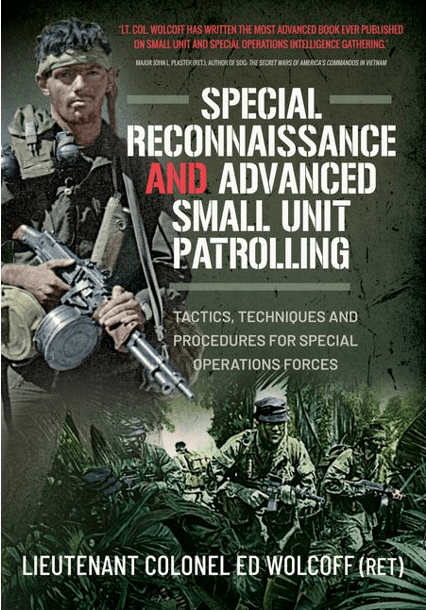
Review: Special Reconnaissance and Advanced Small Unit Patrolling

Special Forces (specifically MACV-SOG) veteran Edward Wolcoff has created a masterpiece in Special Reconnaissance and Advanced Small Unit Patrolling. Despite the long and clunky title, the book itself is very accessible. The goal was to create a list of tactics, techniques, and procedures determined by both theory and practice. It was also to present them in a way that was easily accessible and not written in field manualese (indeed, taking issue with official doctrine is stated in the introduction as a big motivation for the entire book). Wolcoff succeeds admirably in both parts.

This is not just for people who actually do light infantry patrols. Even armchair writers like me will find it very useful for both research and curiosity. Few stones are left unturned. This aims to be comprehensive and it succeeds. It does arguably focus a little too much on the past, but given the author’s Vietnam service, this is quite understandable. While “tone” isn’t the most relevant for a book like this, I enjoy how this comes across as being critical of official doctrine and often greatly so, but not in a bitter or axe-grinding way (Wolcoff has said that he submitted this book to a security review and cooperated with the Pentagon in its publication, FWIW).

What I particularly like is how Wolcoff makes it very clear that failure is as big a teacher (if not more) as success. Survivorship bias can skew things massively, so it’s important to look at what didn’t work as well as what did. This is a great resource for well, anyone, and well worth a purchase.

Review: Spetsnaz The Inside Story

Spetsnaz: The Inside Story

There are few Cold War authors who I have less respect for than defector Viktor Suvorov (pen name), nor are there more who’ve influenced the thought and discourse around Fuldapocalypses in a such a negative way. Since Suvorov was one of the biggest popularizers of the mega-super Spetsnaz , I felt that his Spetsnaz: The Inside Story would be an excellent first book to review.

Now defectors, confidential informants, and the like are generally not the best or most reliable people. Some may be and have been deliberate double agent sneaks to muddle the waters. But more have had mundane issues. Issues like exaggerating their own importance and telling their new handlers what they want to hear. There’s a reason why American military officers in the cold war considered intelligence defectors not noble dissidents but unreliable weasels while having far more respect for enemy field commanders who stayed loyal until December 1991. Suvorov fits this negative stereotype to a T (and I’m not the only one to say this).

The story begins with a description of shovels. Yes, military entrenching tools are important for digging in, other utilities, and make for a good enough melee weapon. Then Suvorov dives deep and talks about how spetsnaz train with their shovels as weapons and that it involves putting one alone with only a shovel against a crazed dog. Woof.

So yeah. If Suvorov says that a bicycle has two wheels, walk around and count them. There’s accurate points here and there, but remember what they say about a broken clock (or that he just grabbed it from an accessible source that others would soon do with less embellishment, or took information that wasn’t that controversial). Suvorov also introduces the “Icebreaker Theory” where he states that Stalin was going to invade west and Germany simply preempted him. (You know who else said that?). The Icebreaker Theory, which he would later expand into a full book, goes from “questionable” to outright uncomfortable in my eyes given how it echoes the Germans own justifications for Barbarossa.

Then there are the psychologically iffy parts. Perhaps the least credible sentence in the book is “In the spetsnaz soldier’s opinion the most dangerous thing he can do is put faith in his comrade, who may at the most critical moment turn out to be a beast.” It’s not like successful war has always relied about trusting one’s colleagues in crisis, and that demanding special operations would demand more of that. I can believe them to be ultra-cynical, cold, and hard-edged (to say nothing of having grown up in an autocratic society), but Suvorov generalizes every single one of them to be those mixed with (in another dubious quote) “A spetsnaz soldier knows that he is invincible.” This strikes me as playing to the crowd, because it’s what an armchair observer with little knowledge of actual battle dynamics would think the ultimate warrior mindset would be like. Even some of the accurate statements come across as being aimed too low: For instance, his (correct) emphasis that a safehouse keeper/secret agent should be someone who blends in and doesn’t have any profile to attract attention is accompanied by a swipe at the likes of James Bond, with Suvorov apparently figuring that most of his audience gets their knowledge of spycraft from that.

Even leaving plausibility issues aside, Suvorov’s writing is rambling, pretentious, and sensationalist to the extreme. This is not aimed at people who would actually have to make a serious plan about dealing with the serious, legitimate threat of opposing special forces. This is giving a general audience the treasured “inside peek” that Bill James recognized and criticized. It’s the Cold War equivalent of someone from the Pakistani intelligence services talking about Osama bin Laden’s giant mountain fortress and his army of countless infiltrators throughout the world in the early 2000s.

The biggest problem is that there’s now basically no point to read this for solid information. In an age where you have western analysis done with much greater access and info (ie, Heavy OPFOR/GENFORCE-Mobile) and translated real primary sources (ie, Voroshilov Lectures), including those on the spetsnaz themselves, having a dated “I WAS THERE” “expose” like this is basically worthless as a practical source. One of my biggest pet peeves is that Suvorov has been cited far too often by Cold War wargamers despite better sources having long been available now.

What it does show is the tone of the times, and of the kind of sensationalist book that appears to stoke every zeitgeist. In this sense, it (and Suvorov’s other books) are surprisingly close to the stereotypical true crime paranoia book. Except with spetsnaz instead of serial killers or whoever.

Review: Blown Cover

Blown Cover

The fourth book in Mark Hewitt’s Hunter series, Blown Cover is a book where I did not want the crazy to stop. The crazy was the entire point of the series, and for it to become just another middling thriller would be taking the “Captain Beefheart Playing Normal Music” issue to extremes. Thankfully, the crazy becomes, if anything, even crazier.

There’s Amelia Earhart conspiracies, Hindenburg conspiracies, the same conspiracies in the last three books, and more. And this book even has a -shock- actually well written action set piece. There’s a genuinely effective action scene where the protagonist has to struggle his way to the cockpit in a depressurizing plane that’s truly well written. Yes, there’s hundreds of pages of clunky crazy surrounding it, but still.

So yes, I had genuine fun with this book. It might even be my favorite so far in the series, just because of how excessive it is. I like excessive cheap thrillers.

Review: The Eleven Days of Christmas

The Eleven Days of Christmas

For Christmas, I feel like I should review a Christmas book. A Christmas book that’s also a Fuldapocalyptic history book is Marshall Michel’s The Eleven Days of Christmas, about the final significant bombing campaign in the Vietnam War. Michel, himself an aviator veteran of the war, left no stone unturned to try and get the full story. To try and find the truth about Linebacker II, he went not only to American sources, but as many North Vietnamese ones as he could access, and even esoteric ones like the memoirs of Joan Baez (who was in Hanoi at the time).

The result is a masterpiece that illustrates Strategic Air Command as this clunky newbie that had sat out the war and then blundered into it. And also spun its clumsy, ineffective performance into a great victory. This is perhaps the biggest unintentional weakness of the book: The claim that Linebacker II was mixed at best and ineffective at worst is a lot less controversial now than it was at the time he wrote it.

Still, anyone interested in the Vietnam air war has to get this book. Merry Christmas and happy holidays to all!

Mobile Corps Artillery

Indirect fire assets available to a GENFORCE mobile corps. As expected, they have a lot of them. The basic forces are largely equipped and organized with 1990-era Soviet equipment.

Battalion

Combined arms battalions have a…. something of 24 2S31 120mm gun-mortars at paper strengths. Why the “something”? It’s because it’s called a battalion in the document, but feels a little awkward to have a battalion under the command of a battalion. It’s just as confusing in Russian, where it’s a variant of the word “division” equivalent to a western battalion of artillery or missiles-yet a different variant of “division” is a classical multi-regiment/brigade division. Anyway, the battalion’s battalion/division-whatever takes the place of the classic regimental 2S1 formation.

The other indirect-capable (if clumsy) asset is the four 2A45 Sprut 125mm AT guns in the battalion’s anti-tank battery. While the USSR used towed anti-tank guns in the classic TD role throughout its existence, it also used everything for indirect fire. Although firing tank ammunition and only having a max elevation of 25 degrees, a big cannon is a big cannon is a big cannon.

Light motor rifle battalions used for infantry-dominant areas and heliborne operations have 8 towed 82mm 2B14 mortars and just as many 2B16 Nona-K 120mm towed gun/mortars.

Brigade

Intended to be treated similarly the Basic Forces division, combined arms brigades have an organic artillery regiment. This consists of 54 six-inch SPHs (the 2S19 Msta is the default) and 18 light multiple rocket launchers (the default is the “Prima”, a version of the BM-21 with 50 tubes per truck instead of 40). The artillery regiment has its own set of organic spotter drones.

Light motor rifle brigades, which are used for a similar role as the battalions mentioned above, only larger, have 18 MRLs, 36 towed 2A65 Msta-Bs, and 18 2A61 light 152mms (Think a smaller, lighter 152mm gun with muzzle brake on a three-pronged D-30 carriage).

Corps

The combined arms corps has two missile brigades with eighteen surface-to-surface missile TELs each (Tochka/SS-21 in the document, but anything in that category could be used). It also has a multiple rocket launcher brigade with 72 medium MRLs (default is BM-27, but again, anything in that ballpark). Rounding it out is an artillery brigade of Giatsints- 48 towed and 48 self-propelled.

The corps air assault battalion has eight 2S9 Nonas.

Front/Strategic Grouping

Fronts will have brigades/regiments, usually lumped into one administrative artillery division of the weapons mentioned above and 2S7 eight-inch SPHs. They will also usually have a rocket brigade of the 9A52/BM-30 Smerch or something similar (bigger than a BM-27, that’s for sure), as well as longer-ranged ballistic and cruise missiles.

The guns and multiple rocket launchers are almost always pushed down to army and corps-level artillery groups in battle.

Review: No Need to Know

No Need to Know

The third in Hewitt’s Hunter series, No Need to Know is every bit as out-there as the first two (if not more). Once again, I’m in the somewhat unusual position of not recommending them for other people while having a blast reading them myself. The conspiracies don’t stop in this book, and neither do the set-pieces.

In fact, this is actually better paced if anything than the second and especially the first book. While it’s still overly long, it feels like it flows better and doesn’t have that many outright dull moments. Ok, except those involving the details of operation the YO-3 airplane, which is obsessed over throughout the series.)

That sounds like faint praise. And the inherent flaws of the first two are still there. But still it’s nice to see an author’s craft get genuinely better.

A Thousand Words: Electric Football

Electric Football

As Christmas approaches, it’s important to acknowledge a rite of passage every American child has faced. Getting an electric football set and only using it once. I remember getting an electric football set, thinking the players were actually programmable (ha!), watching them shake downfield once after turning the game on, and never touching it again.

The creation of Norman Sas and Tudor Games shortly after WWII, electric football involves a vibrating board to move its players. When the NFL expanded massively in popularity, electric football gained the official license, becoming the Madden of its day. If Madden was programmed in two days by people who couldn’t make the cut at Game Freak or Bethesda.

Now electric football is both technically improved and far less popular because, you know, video games exist. But it was and still is a thing.

Mobile Corps Order Of Battle

So my book project now has a name: All Union. To celebrate this milestone and excellent progress on it, I figured I should share the rivet-counting infodump of very little actual relevance to the plot (or is it…) but which is fun to do: An Order of Battle chart of the Mobile Corps (of GENFORCE-Mobile inspiration) of the Union of Soviet Sovereign Republics, most famous for their actions in the invasion of Romania.

The methodology is simple: For the number of corps and locations, I went with this analysis, which predicted eight total by the turn of the millennium and theorized their number by district. In actual history, only one was created, the 5th Guards Army Corps stationed in Belarus. For their numbering, I went with the invaluable ww2.dk and looked for defunct/easily disbandable corps HQs in the general area (HQ cities here NOT always correspond to historical bases). So on with the fun exercise/sneak preview-oops, did I say too much??

General Notes

Mobile Corps have adopted a degree of heraldry beyond previous divisions. All save one have a geographic semi-nickname, and all have a “mascot” creature displayed prominently on all unit patches and symbols. The “Sovereign Guards” honorific was made to reward units for the Romanian war without worrying about legacy “guards” titles from long ago.

Western TVD

5th Guards Mobile Combined Arms Corps “Neman” (bison): First (and in actual history only) mobile corps created. Peacetime garrison Minsk, Belarusian SSR, served in Romanian invasion under Dniester Front.

7th Sovereign Guards Mobile Combined Arms “Vena” (elk): Peacetime garrison Vitebsk, Belarusian SSR. Served in Romanian invasion under Dniester Front, given sovereign guards status postwar.

28th Mobile Combined Arms Corps “Buh” (medieval lion): Peacetime garrison Lviv, Ukrainian SSR. Served in Romanian invasion under Dniester Front. Considered one of the primary frontline units against independent, hostile Poland.

Northwestern TVD

26th Mobile Combined Arms Corps “Lagoda” (Karelian Bear Dog): Peacetime garrison Petrozavodsk, Russian SSR. Did not participate in Romanian invasion but was on high alert and was earmarked for a proposed second large offensive operation that never had to be conducted.

Southern TVD

17th Sovereign Guards Mobile Combined Arms Corps “Fergana” (Huma bird): Peacetime garrison Tashkent, Uzbek SSR. Participated in Romanian invasion under Dniester Front. Given sovereign guards status postwar. Its base in the otherwise remote area makes it the closest thing to a strategic reserve mobile corps, and it is poised to always go either west, east, or south. One of the main characters in All Union, Cholpon Murad-Kyzy, served in the 17th Corps during the war in a forward medical station.

Southwestern TVD

64th Sovereign Guards Mobile Combined Arms Corps “Donets” (nightingale): Peacetime garrison Luhansk, Ukrainian SSR. Participated in Romanian invasion under Dniester Front. Given sovereign guards status postwar. Its base in the birthplace of All-Union president and legendary leader Anton Yatchenko is widely believed to not exactly be the most coincidential, as is it receiving sovereign guards status and massive accolades.

32nd Mobile Combined Arms Corps “Roman-Kosh” (mythical hippocampus mermaid-horse): Peacetime garrison Sevastopol, Russian SSR [not a typo]. Participated in Romanian invasion under Danube Front, the only mobile corps to do so. Is believed to be the mobile corps with the most focus on amphibious invasions and operations in extreme terrain. There are even rumors that detachments from it are earmarked for the seizure of Iceland should it come to that.

Far Eastern TVD

57th Mobile Combined Arms Corps “Kisilyakh” (lynx): Peacetime garrison Ulan-Ude, Russian SSR. Did not participate in the Romanian invasion but was earmarked and prepared as part of the ultimately unnecessary second offensive operation.

43rd Mobile Combined Arms Corps “Amur” (mosquito): Peacetime garrison Khabarovsk, Russian SSR. High-priority unit for potential war with China. Because of this and its distance did not participate in the Romanian invasion and was never considered for doing so, even as part of the hypothetical second wave.

VNG/Efir Group

“VNG Elite Corps”/”Efir Group Corps”/”Phantom Corps” (ghost): Peacetime garrison Gorky, Russian SSR. Formed after the Romanian invasion, exact strength still unclear. Under the control of KGB successor VNG (based on an acronym that can translate to “All Union Monitoring Group”). Part of the mysterious and nominally private “Efir [Aether] Group, which officially is nothing but a small real estate firm registered in Pune, India. It is said that the corps is haunted and anyone who gazes at its facilities without approval is immediately flung out of a tall window by poltergeists.