How Big Would The Mobile Forces Have Been?

The GENFORCE concept featured an eastern OPFOR divided into legacy “Basic” and more advanced, mixed, “Mobile” forces. Yet how many formations of the latter would plausibly exist in a nation the size of the USSR?

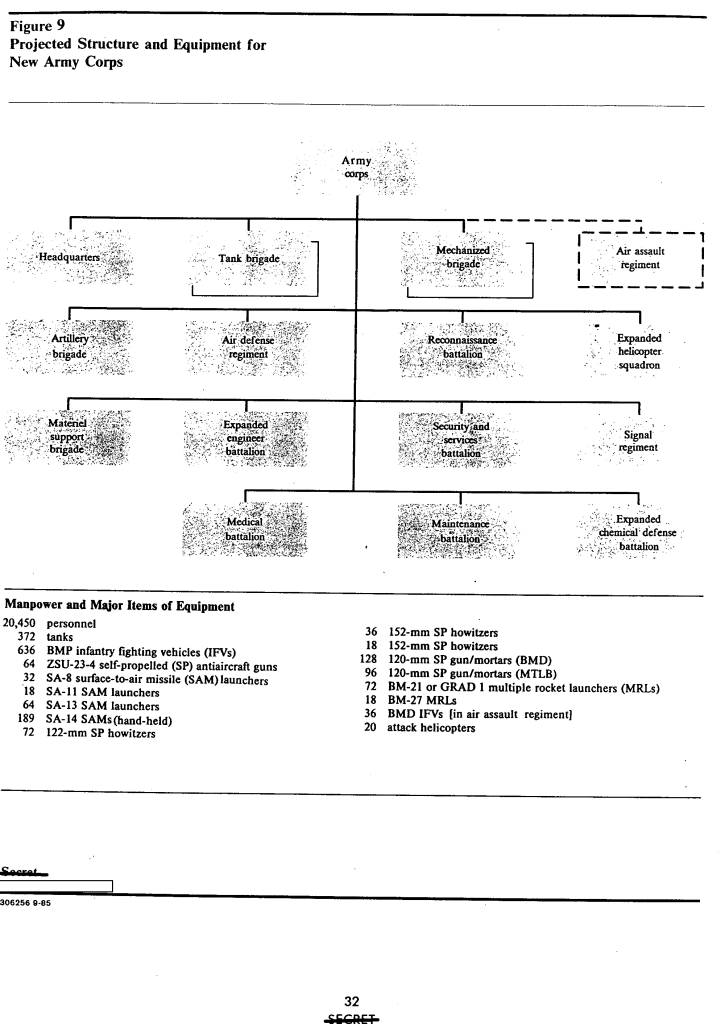
I found a possible answer in a 1985 CIA analysis called “Trends And Developments in Warsaw Pact Theater Forces, 1985-2000” (a great source for a continued Cold War in its own right). The mobile combined arms corps, effectively a big division, is mentioned.

Obviously assuming a surviving USSR and Warsaw Pact, the document estimated that nine such corps would be ready by 2000. Three of these would be in the western theater, two in the southwestern, and one on in the northwest. Two would be in the Far East and one in the south/middle east.

180,000 personnel would be needed from a napkin calc of corps numbers x paper strength of each corps. It’s actually closer to the actual number than most because existing tail assets could be used to support them. However, there will be undoubtedly more people than that necessary, especially to have them achieve their full potential.

The problem isn’t getting that many soldiers. It’s getting that many good soldiers, especially because these mobile corps are specifically designed to be better and more complex tactically than previous line formations. And because they have to compete with the airborne and naval infantry for the best inductees.

Interestingly, the document itself also mentions the possibility of the tank divergences continuing, with the basic forces (word choice deliberate) getting a less exotic model and the mobile corps getting a more out-there one. This would also coincidentally make two bureaus/plants very happy instead of one, so I can see it happening.

It’s an interesting document in any case.

Review: Primary Target (Jack Mars)

Primary Target: The Forging Of Luke Stone

A prequel to the Luke Stone adventure novel series, Primary Target is one of those books that somehow manages to hit every single genre cliche and then some. Reading this gets the most cookie-cutter action hero imaginable, almost literally every single type of cheap thriller villain showing up at some point, and 51% action.

In other words, I loved it. This is the best kind of 51% book, and it’s the perfect type of novel to relax one’s mind in between deeper and more fulfilling books. I recommend this as silly fun.

Review: Albatross

Albatross

The progressive rock band Albatross appeared, released one self-titled album in 1976, and then disappeared. Listening to this album, it’s very easy to see why. The album is dominated by a fourteen-minute track called “Four Horsemen of The Apocalypse”, which contains lots of crude synthesizers, lyrics about the Book of Revelation, and a segment of seemingly random notes that’s reminiscent of the Crazybus Theme.

Progressive rock is frequently referred to as “70s rock by bands who acted innovative and pretentious but in truth just copied Yes.” And this describes Albatross perfectly. Every single prog rock cliche is present in this album. Every gimmick and mess.

Dare I say that Albatross is the New Deal Coalition Retained of progressive rock? Yes, I do. But unlike that, it’s not creepy or mean-spirited (well, except maybe for “Humpback Whales”, the track that glorifies whaling to the tune of what one listener called ‘Dancing Gnome Music’). In fact, from time to time, this album is actually fun in a so bad it’s good way.

Escape From The Facility

My current People Playground mod-enabled obsession is the “Facility Escape”. The background for this RP is simple: A character from another setting is trapped in the mysterious mad science super-facility and has to try and escape, fighting their way past an army of workers, security contractors, androids, and who knows what else.

Characters from settings as distinct as Undertale and Hotline Miami have been placed in the playground. The (intentional) clumsiness of the human figures just, if anything adds to the fun. There’s nothing like jury-rigging an “epic” sword vs. chainsaw battle.

Characters who have “earned the privilege” of escaping have the final exit simulated by a black hole being created with them sucked in. This symbolizes a portal to their home setting (or somewhere else?) being activated.

Review: Friday The 13th

Friday The 13th

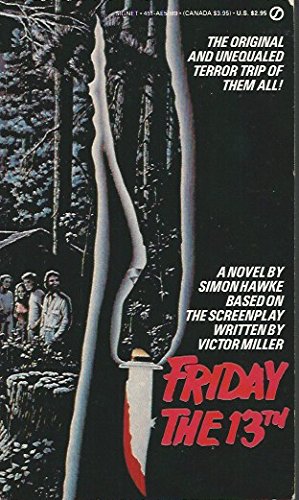
Film tie-in novelizations do not have a good reputation. The tie-in for the first Friday The 13th movie is no exception. Granted, it has a shallow film as a base (the movie is a stilted, aged terribly movie that doesn’t even have most of the sleaze/exploitation elements of its sequels). But author Simon Hawke didn’t even try very hard.

There is one exception. That would be the doomed lovebirds Jack and Marcie, whose shallow sleazy character in the actual movie gets stretched out to a long piece of angsty exposition. But that amusing bit of padding can’t make up for the rest of the book. Especially because, having been released several years (!) after the movie, you can’t even use the justification of being rushed!

It’s one of those things that’s basically just sort of… there.

Review: Gaming The Game

Gaming The Game

Sean Patrick Griffin’s Gaming the Game is about the gambling scandal centered around NBA referee Tim Donaghy. Its main “character” is now former pro gambler Jimmy Battista, who handled the actual betting side of things (oversimplified of course). I generally don’t like true crime books, but heard good things about this and the subject matter of sports betting was a naturally interesting one to me.

This is one of the best true crime books I’ve read.

The narrative (most of which centers around Battista, not Donaghy), is well-written and soundly researched at the same time. It really helped fill a gap in a part of the sports betting world I hadn’t really had to look up before-genuine sharps. (Touts are mentioned once dismissively, as they should be). You get to read about a lot of people, some of whom I could guess who their true identities were (Griffin rightfully uses pseudonyms).

The icing on the cake is an appendix where Griffin delves into line movements to see what effect the Donaghy actions -regardless of the man’s claims- had on the games he reffed and bet on. By giving it its own section, he can be extremely detailed and technical while not interfering with the flow of the rest of the book. The analysis could easily be a book unto itself.

If you have the slightest interest in sports betting or sleaze, get this book.

What Does Mobilization Mean?

Doing a rare commentary on a contemporary military situation, since it happens to overlap with what I’ve read about. Fair warning-I’m not an expert, I’m a civilian enthusiast who has read too much and seen too many order of battle charts. Take this what you will.

So, moving with the speed and grace of the Austin Powers steamroller victim, Russia has finally declared a “partial” mobilization after seven months of brutal attrition, including training units. At first limited to reservists and people with military experience in out of the way provinces (let’s be realistic), it’s nonetheless very broad. The initial goal is 300,000 troops, which sounds like a lot and is still politically dicey. Why they did this is obvious-the Ukrainian counteroffensives and the failure of their improvised semi-mobilization left them with little choice.

People have talked ad nausem about the equally obvious issues with training and equipping that many (or more) troops, as well as morale. So I’ll mention two topics. The first is what they can legitimately accomplish. This is to serve as a stationary dug-in meatshield as the first line of defense. Every army needs an infantry meatshield from somewhere. In the early summer Ukraine was doing this, desperately throwing poorly equipped and trained militia to the east. Of course, you can have that or you can have the 1991 Iraqi infantry formations, but there is a legitimate use for low-quality troops, at least on paper.

What they cannot do effectively is launch offensives. You can probably understand why this is a big deal. And that’s especially if they have worse and their opponents better equipment.

Now for the rivet-counting nerd part and what you need to equip 300,000 people (this is NOT saying the real ones would be equipped or organized this way, just showing how demanding it is equipment-wise). Using a mostly foot OPFOR infantry division as the baseline (ie, largely only suitable for defensive operations), and assuming a handwaved 20,000 strong divisional slice of support troops beyond the 10,000 strong division itself, you get get 15 division-equivalents, which is…

  • 465 tanks
  • 540 artillery pieces
  • 270 multiple rocket launchers
  • 540 anti-aircraft guns.

Even in Russia this does not grow on trees, especially after the stockpile has already been plundered massively.

Review: Will To Fight

Will To Fight

In the Will To Fight study/book, RAND analysts tried to take a look at one of the most important yet hard to study parts of war-the will of the soldiers to fight. It’s a mixed bag. On one hand, it’s sincere in trying to tackle something essential, and its detail is excellent.

On the other, it’s centered around a chart that resembles what you see in the dreaded DoD Powerpoints of Doom. This is not the most surprising thing, but it is still a little too awkward. And beyond the well done simulations and descriptions of games with morale factors and how they affect outcomes, it still has the feeling to trying to directly quantify what’s admitted in the study itself as not directly quantifiable.

Nonetheless, the topic is well-cited and well handled, and is important enough that “mixed” quality still makes it well worth a read.

My OPFOR Countries

Screenwriter Stephen E. de Souza has a catch-all Latin American country called “Val Verde” he uses whenever a politically neutral country in that part of the world is required for one of his movies. (In Arnold’s Commando, John Matrix wiped out the entire military of Val Verde by himself.) I have made several Val Verdes in my brain that I’m in the process of putting down in writing, and which may become more than just an order of battle chart.

They are:

Cardona

Cardona is the conventionally weakest OPFOR country and the closest to de Souza’s Val Verde in terms of theme. It draws from both South American and Southeast Asian influences (if I wanted to be really shameless, I could have it have large conveniently Spanish-speaking regions and equally large parts with native Asian languages.)

Cardona’s military is large in numerical terms but lightly equipped and is focused on internal control rather than external invasion. It also has no shortage of irregular groups of all shapes and sizes.

Seleucia

Named for the Seleucid Empire, Seleucia is a catch-all Middle Eastern OPFOR country. Like its namesake, it features terrain from the Mediterranean to the Altais. A diverse and fractious nation, it is at times (ie, when the scenario calls for it) a strong state and at times a weak one. But even at its conventionally weakest, it’s still more powerful in material terms than Cardona is.

Seleucia can be the opponent in everything from irregular warfare to Gulf War level major battles. It also can have nuclear weapons in some cases.

Teutonia

Named after a form of Germany, Teutonia is the developed western European country. The most technologically advanced of these states for the time period, it was once a world power and remains a continental one.

In addition, Teutonian exports are found all over the world, including in the other two mentioned countries. Teutonia is a nuclear power if the tech level of the scenario allows it.

All three will be elaborated on, possibly in prose form… (winks)

Review: The Last Great Death Stunt

The Last Great Death Stunt

Clark Howard’s The Last Great Death Stunt is perhaps the strangest and most bizarre book about a man deciding to jump off the Golden Gate Bridge imaginable. Written in the 1970s, it’s basically to Evel Knievel-style feats what the movie Rollerball was to football and other physical sports. It’s a future where the world is so peaceful that conventional sports with winners and losers are so boring and out of focus, they’ve gone under.

Instead, the public’s eye is on ever-crazier “Death Stunts”. However, there is a backlash against even this, and the book begins with the government planning to outlaw them. Before they do, legendary Death Stuntman Nick Bell aims to do one mega-stunt on the final day of legality-leap off the Golden Gate Bridge and survive! The book centers around him, rival Jerry Fallon, and the authorities trying to stop the stunt from taking place.

The execution is only adequate, with prose and plotting worthy of a 51% cheap thriller. There are sleazy secenes you’d expect from a 1970s mass market novel. There are a few too many padding infodumps in a short book.

But the concept, taken completely seriously, is so great that adequate execution still makes for an excellent, if weird book. But I like weird. So I loved The Last Great Death Stunt.