Weird Wargaming: Conventional Bush War

The Rhodesian Bush War passed without a decisive 1975-style conventional campaign. Of the two main guerilla organizations, it was the Ndebele, Soviet-favored ZIPRA that placed more of an emphasis on conventional operations, compared to the majority Shona, China-favored ZANLA’s “people’s war”. A combination of largely successful preemptive strikes by the Rhodesian military and a (smart) focus on inherent strengths than weaknesses by the opposition meant that the large battle never came.

The common wisdom about such an operation “Zero Hour” (as one code name for it was) is that it would be stopped with ease (although it does not help that most surviving prominent sources are either from the ZANLA-veteran regime or former Rhodesians, neither of which has an incentive to talk up their opponent). But even if the first such offensive was stopped with ease, the rebels definitely had the people and enough hand-me-down aid to try multiple times.

Such an offensive would feature the fairly light Rhodesian military against an opposition that would have at least T-34/85s, BTR-152s, appropriate artillery, and even rumors of fighter aircraft. (If said fighter aircraft could disrupt the deployment of the infamous Fire Forces, it would not be good for the Rhodesians). It can obviously be played with any kind of wargaming ruleset that can handle early/mid Cold War equipment and formations.
Review: Punk’s Fight

Punk’s Fight

Former F-14 RIO Ward Caroll’s Punk’s Fight is actually the third book in his series starring an F-14 pilot (write what you know, I guess). I nonetheless chose it as my starting point because it takes place during the beginnings of Enduring Freedom and I was fresh off reading about the Afghan air wars. Maybe the first two books were better. Because this one was not very good.

Do you want Herman Melville’s Overdescriptive F-14 Ride followed by a contrived way to get his main character to the ground war and lots of self-aggrandizing? If so, then this is the book for you. To be fair, its technical realism is an arguable selling point, but it squanders it on unlikeable and axe-grinding characters, mixed with the protagonist’s not-exactly-ideal adventure on the ground when his Tomcat goes down.

I can see why some people would like this book and series, but I didn’t.

Review: Wings Over The Hindu Kush

Wings Over The Hindu Kush

Lukas Muller’s Wings Over The Hindu Kush shines a light on an obscure footnote in aviation history: The Afghan air forces (yes, plural) between the Soviet withdraw and Enduring Freedom. Leaving behind a large quantity of helicopters and aircraft, there were enough parts and willing pilots for the Taliban and its rivals to create air forces up until 2001. As someone aware of their existence and interested in how functional air units could be maintained from such “scraps”, this book was an easy purchase.

In a complex, fluid situation without the best documentation, getting the detail that Muller did was no small feat. The book isn’t the biggest or most absolutely detailed, but it does tell the story of these helicopters, Fitters, and Fishbeds. And it’s a very interesting story.

The strike aircraft were far from the most capable or effective (the transports in a place with poor infrastructure were far more vital), but their mere presence in such conditions was surprising. And this book clears up the surprise in a great way.

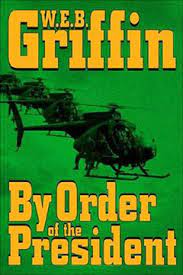
Review: By Order of the President

By Order Of The President

Despite being one of the most prolific and successful military fiction writers, it’s taken me a very long time to read W. E. B. Griffin. I started with By Order of the President. And well, I sure hope the rest of his books aren’t like it. The story of the search for a stolen Boeing 727 and the sinister plot behind it, it doesn’t exactly fly through the skies gracefully.

Although to be fair it does seem like the wrong genre for its author’s writing style. Viewed one way, it’s just a stylistic misfit. All the detail, the flashbacks to the past, and the grounded way of writing all feel much more fit for historical fiction (which most of Griffin’s famous work is) than a contemporary thriller (which this is). As for the parade of meetings and travel that makes up nearly all of the book, it arguably fits into the “too realistic for its own good” category. At the very least, it’s an orange read by someone who prefers apples. But I could all this the benefit of the doubt…

…If the main character was someone other than a half rich German, half rich Texan (Griffin famously said outright that “rich people are more interesting than poor people”) super-agent who hit my suspension of disbelief hard. Or if the story, regardless of realism or style, was better paced. As it stands, it just clunks along and then rushes when it’s near its conclusion.

Finally, I got the impression that this was aimed for the people for whom reading about something is interesting in and of itself. The technical descriptions and organizational procedures made it seem that way. It’s either a flaw or another orange compared to my favored apples.

I can still see Griffin’s appeal, and he was successful and famous for a reason. This isn’t something inexplicably popular and published like William W. Johnstone. But I still see him striking out at the first at-bat I noticed.

The Eternal Death (And Life) Of The Tank

The year is 1916. Someone peers through his binoculars and sees an artillery shell smashing into one of these new tracked machines called “tanks”, destroying it. Shaking his head, he goes “These can’t amount to anything, they can be destroyed so easily.” (Even with modern tanks, if a big artillery shell hits it, it’s gonna hurt.)

The year is 2022. Someone looks on the internet and sees a drone launching a smart munition and destroying a tank. Shaking his head, he goes “these must be obsolete, they can be destroyed so easily.” Some things never change.

I could point to 1918 and heavy machine guns (really, the M2 Browning was considered a prime antitank gun at its introduction), 1944 and bazookas, 1973 and ATGMs, 1991 and laser-guided bombs, 2003 and smart cluster shells-you get the idea. Many others have said with far more knowledge and eloquence than me about the importance of armor, mobility, and firepower, regardless of its destructibility. So I’ll take another route.

Imagine something that is objectively less well armed and less armored than a tank. Now imagine that it, vulnerable to everything a tank is and so much more, is nonetheless not obsolete but remains totally indispensable. I’m talking of course about the classic basic box-APC, proof against small arms and some shrapnel. There’s a reason why Ukraine in the current war has been so eager to receive any kind of vehicle with an engine and armor plating, and why released footage of its current offensive in Kherson has shown them being put to good use.

There’s a reason why, especially on any kind of open terrain, armored forces are so much more accomplished than unarmored ones. And no amount of anti-tank gadgets can change that.

Review: Soviet Era Airliners

Soviet-Era Airliners: The Final Three Decades

In many ways, Aeroflot mirrored the USSR itself. Its breakup in 1991 scattered the massive airline’s assets across all the independent republics. Christopher Buckley’s Soviet-Era Airliners: The Final Three Decades tells the story of what happened to all the “Classics”, “Crusties”, “Carelesses”, “Clobbers”, and more. While the collapse of the USSR and the failure of its aviation industry to make a competitive product caused its new-build civil aircraft industry to fall apart instantly, there were lots of surplus planes around.

This book does a great job showing most of their fates. There’s lots of details and even more excellent photographs. If you like civil aviation at all, this is a great book. I was curious to see what happened to these flying trilobites, and now I know.

Weird Wargaming: Missile Iowas

The Command database now has many more hypothetical proposed missile upgrades of the Iowa-class battleships, including adding a ramp for fixed-wing aircraft in one entry (!). These ships bring a very strange feeling to me. Because they inspire equal parts awe, horror, and disgust.

See, the problem is that missile launchers intended for long-distance operations render the 16 inch guns nothing but a heavy explosive risk. This has been known in real life too. There was a serious consideration during the reactivation of the Iowas (primarily to have tons of box launchers for Tomahawks) of just leaving the guns closed up and inoperable. They’d be unlikely to fire in a fleet action, and if they did fire, it couldn’t be good for any sensitive machinery in the rest of the ship.

So my head regards the Missile Iowas with derision. But my heart adores them. Simply because of how crazy and audacious they are. Do I really need to explain this?

Anyway, for the boring details, they’d likely be used in a way similar to how the real 1980s reactivated Iowas were. As the centerpiece of surface action groups. If you wanted to be cold-hearted, you could treat them as expendable sunk costs. But you can also revel in the absurdity.

Arthur Hailey: Technothriller Writer?

Generally speaking, alternate history questions about how some creative artist’s career could have gone differently are not my favorite thing. There are just too many inputs and inspirations, and one would be hard pressed to find something more volatile than popular culture tastes. That being said, I’ve found one author who I can definitely see sliding into a different genre if he’d come to fame 10-15 years later.

That author is Arthur Hailey, most famous for his novel Airport, which inspired the movie that spawned the entire disaster genre (and its parody in Airplane!). Hailey loved to write books that examined a complex thing (be it banks, airports, car factories, or what not) in amazing detail, before climaxing in some kind of crisis. He also loved technology to the point of taking too many futurists at face value (Passenger pods loaded into planes on conveyor belts!)

Hmmm, massively researched technical detail? A love of technology? That sounds like he’d be right at home with technothrillers.

In fact, I can so easily imagine Arthur Hailey’s Aircraft Carrier. The carrier and everything from the catapults to the air tasking order is described in minute detail. As is the drama surrounding members of the crew, which will consist of at least two middle-class Americans committing adultery. Then, in the final chapters of the book, the carrier will sail into action! But it won’t be a full on Fuldapocalyptic world war with the carrier fending off a hundred Tu-22s in the GIUK Gap while a nuclear sword of Damocles hangs over everyone’s head. Hailey just wasn’t that high stakes a writer, and his target audience probably wouldn’t go for something as tense as that. It would probably be something like El Dorado Canyon, probably against a fictional OPFOR country. The carrier accomplishes its mission, but not before a million more “I know the exact designation of a Scud TEL” infodumps are launched and at least one of the adulterers is blown up.

Look, I didn’t say it was going to be a good technothriller.

Indeed, as much as Clancy and Bond’s books may have been dated and rendered less potent by their technology becoming considerably less novel, Hailey’s have aged far worse. And I’m not (just) talking about their culture and characterization. Their entire gimmick is “this is a thing.” And if you already have the slightest familiarity with that thing in ways that audiences in the 1960s and 1970s did not, the books become empty clunkfests.

Still, it’s very easy to see the success of someone who wrote in a very similar style (Airport is basically a peacetime technothriller, after all) translating to something else down the road. That’s the fun of alternate history.

Review: Crimson Star

Crimson Star

The third Maelstrom Rising book, Peter Nealen’s Crimson Star takes the action to the American west. With the collapse into anarchy and invasion underway, the Triarii have their hands full. Having read this, I feel like it is both a lot better and a lot worse than the first two books.

First, the good. It’s written in third person, which is so much more suitable for a work of this nature. So much. Granted, the viewpoints are a little too restricted (try telling pre-Fuldapocalypse me that I’d think that), but it’s still a huge step that makes it so much better to read. And of course the action takes advantage of the larger scope, with lots of vehicle units and large forces. It is as good as anything else Nealen has done.

Now, the bad. The annoying slobbering over the Mary Sue protagonists reaches new heights. Any alternative to them is viewed as a completely incompetent obstacle. The narration does everything but say that their training was a combination of “SEAL, Ranger, Special Forces, and gutter fighting.” It got irritating, and it would be even more so if I hadn’t adjusted my expectations. After all, it sold itself as Larry Bond. By now, it’s actually Jerry Ahern’s The Defender updated to the present with more realistic battle scenes.

Do they balance each other out? My answer is: I still want to read the next book in the series. Make of that what you will.

A Thousand Words: Airport

Airport: The Movie

I was not exactly the fondest of the original novel Airport. So what did I think about the Burt Lancaster movie, which basically created the disaster genre? It was mixed, but I’m willing to give it a break based on its limitations. Having read the book first was not the best way to appreciate the movie, especially as it tracks the plot well. Too well.

First off, the cinematography is dated and clunky. This isn’t the movie’s fault, but it was one of the last “old fluffy Hollywood” movies, and it was made just before movies got more dynamic and more of an edge (the low body count in this compared to later disaster films is something.) But that’s not really its fault.

What I do think is its fault is trying to cram too many subplots from the book into an inherently shorter movie. A looser adaptation would have been preferable, especially because the book is not very movie friendly. It has too much overhang of “look inside an airport” and less focus on the main “a plane is in danger” plot.

Thankfully, the cast and crew are undeniably talented, and they do the best within these limitations. It’s easy to see why it made so many imitators, and at the time, it would have been seen rightfully as a giant spectacle.