Basically every piece of nuclear technology is advertised as being “proliferation resistant”, for obvious reasons. And in many cases that’s legitimately true (albeit that as an armchair non-physicist, I wouldn’t be the best at explaining exactly why ). But I’ve had a few hunches and read my share of case studies. And there are undoubtedly a few wooden horses with hoplites lurking inside (at least according to the Roman version of the story).
One is chemical enrichment, which has never been commercialized but has been demonstrated and proposed for decades. There’s actually a real case study of its role in a nuclear weapons program. For Iraq’s pre-1991 nuclear infrastructure, it sought a chemical enrichment plant. To directly make weapons-grade uranium via the chemical method would be hideously impractical according to its proponents (argued as taking over a decade ), but to make LEU that would in turn be easier to further enrich (or use in reactors indirectly) is another story.
Another is small modular reactors. The suspicion I have is that unlike the eggs-in-one-basket normal sized ones, it’d be easier to have some units be used for normal power and others “throttled” (for lack of a better word) in ways that are far less efficient for electricity-but more so for weaponizable plutonium.
Of course, I know very little about the technical side of things so I could be totally off-base, especially for the modular reactors. But it’s still something I’ve thought about.
Not to be confused with the Black Eagle Force book of the same name I reviewed previously, Dallas Barnes’ Blood Brothers is the tale of Native Americans, casinos, and underworld intrigue. It’s also the book that, because of its subject matter, has highlighted the inherent differences between me as a writer and me as a critic.
Now the book itself is a 51% potboiler in a genre I’m not the most interested in. Yes, it’s full of cliches and doesn’t make the best use of them, but it’s also competently written. That’s what a 51% book is, basically. What separates it is the element that makes up the bulk of the plot, beyond the opening “publicity stunt gone wrong” incident that drives it.
See, it’s about the struggle to build a casino. Now the reader in me was thinking “is this really the best plot for a thriller? Something as low-stakes [no pun intended] and not really that economically beneficial as a casino?” But the writer in me went “Well, uh, you made an entire book where one of the main plots was about the establishment of an online casino. Clearly you thought it would be a a suitable plot point.”
I’ve said before that I don’t think being a critic has made me a better writer, but do think that being a writer has made me a better critic. This book is an interesting specific example of that. The critic part of me doesn’t think that highly, while the writer part of me can understand.
So, the long-feared Russian all-out invasion of Ukraine has begun. I kind of suspected this would happen when A: 75% of the Russian Army, including units from Eastern Siberia, was moved to the border, and B: The Kremlin began making knowingly impossible demands. Frankly, knowing what I know now, it’s kind of miraculous that it took thirty years to get this far.
(And no, Ukraine couldn’t have kept its for all intents and purposes unusable nukes it technically inherited, and it still did the right thing in not trying.)
Fuldapocalypse will continue as normal, as fiction is not real life. I will refrain on commentary as even the well-informed and honest accounts can be subject to confusion. However, I will say that when it became clear that war was inevitable, I made the very deliberate decision to pivot away from my Soviet-Romanian “big war thriller”, and not just because of the general concept or even the area. Having a massive, high-tech, Russian-led army striking against a former client whose only effective resistance is urban and unconventional warfare is a little too on the nose-in fact, the scenario is so similar that you could basically do a find and replace for “Belarus” and “Bulgaria” and change nothing else.
Thankfully, I do have some very good news. The pivot away from that concept to a follow-up thriller involving gambling, mansions, nuclear weapons, and dirty black ops in Southeast Asia with aged characters from The Sure Bet King has gone beautifully. The plot for that has finally clicked, and I’ve been making excellent progress there.
Written by nuclear expert James Kunetka, Parting Shot promised a more grounded, realistic look at the infamous “The Germans have a nuclear bomb” World War II alternate history. When I saw the Sea Lion Press review, I knew I had to get it. So I did.
It’s indeed the most plausible “WWII German nukes” AH out there. In fact, it’s arguably too much so. This is a rare example of the kind of book that’s possibly too realistic for its own good. The Germans go with a gun-type device, because that’s the easiest to build. Although that arguably just shifts the bottleneck from the physics package itself to uranium enrichment-it’s why I’m certain that’s the reason the Iraqis went with a more complex but less U235-hungry implosion design. But then again, having a cheap thriller drag you into plausibility arguments isn’t the best itself.
And make no mistake-the final fight leaves no doubt that this is intended as a thriller. Only the contrivances of that (and other scenes) mixed with the intent to be more realistic leads to an awkward stumble. The very nature of a program that wasn’t even close becoming unrealistically successful is jarring in and of itself. And even the bomb proper didn’t really work for me, being a cheap thriller cliche just short of “HITLER LIVED!”
Finally, the structure of the book works against it being a good thriller. Having stuff told in the past tense and jumping between past and (then) present takes away a lot of the drama. This is still an ambitious book, but it kind of falls apart from that very quality. If it’s too realistic for its own good, it’s also too scattered.
Norman Friedman turns his knowledgeable eye to one of the most arbitrary ship classes in British Cruisers. Going from the early 20th Century to the Cold War, he covers the enigmatic ship type that can best be summed up as “bigger than a contemporary destroyer, but not too big”. From wartime workhorses to unusual goofy designs, Friedman leaves few Royal Navy stones unturned.
The final desperate attempts at large capital ships after 1945 are the most interesting to me. The large “escort cruisers” started off as ASW helicopter ships, then grew into the famed de facto light carriers they became and were later used as. Everything else was rightly shelved. But this is a typically excellent technical history of cruisers in all eras.
For the 666th post on Fuldapocalypse, I figure I’d do a “suitable” piece. It was either than or something on the SS-18 missile, whose NATO designation cannot be a coincidence (18=6+6+6=designation name “Satan”.) But I digress.
The id Software masterpiece that popularized the First Person Shooter genre, Doom is the deep, complex story of a sole surviving spacesuit burly man against a giant horde of demons. Ok I kid. But it is still one of the most successful and influential games of all time, ported to a degree that it’s become a meme/security/programming challenge to see if a certain device can be made to run Doom.
What makes Doom interesting and effective even decades after its initial release is that it’s a movement game. The “Doomguy” can run around at massively high speeds, and most of the enemy projectiles can be dodged. Thus it’s about player movement skill. Later cover-shooters are more about player timing skill. And the awkward turn-of-the-millenium games that took place after hitscan and slow characters but before cover mechanics were mastered-
-Well, the only “skill” involved is knowing the layout and how many powerups are there. It’s a kind of deterministic rut that stands as one of those things that doesn’t bring nostalgia. But the rapid movement of Doom is one that definitely does. This is a classic for a reason.
I’ve had a soft spot for Leroy Thompson’s The Bodyguard Manual, simply because of its excess. Sadly, The Counter Terrorist Manual is not quite as well, excessive. The impression I got of this was, well, like one of those “here’s what happens!” picture books, giving a very basic history and overview of SOF units. So it’s not even a book for mall ninjas. It’s a book for wannabe mall ninjas.
But, that’s not necessarily a bad thing. This does give the idealized basics of counter-terror special forces. Just take everything in it with a highway truck of salt and you’ll be fine. And don’t read if you desire the slightest depth or critical perspective.
Saddam Hussein’s Iraq had a legitimate nuclear weapons program that was, by most accounts, very close to building a functioning Fat Man-level device before the invasion of Kuwait. A draft nuclear operations manual was even made. For all intents and purposes, it was destroyed in the 1991 Gulf War and there was no serious attempt to restart it prior to 2003.
The WMD swing-and-miss isn’t really the subject of this post. It was a combination of the inherent untrustworthiness of the Iraqi regime (which still would have more than willing to make genuine WMDs), a desperate desire to avoid a false negative after 9/11, and a bizzare bluff aimed at Iran by a Saddam who was increasingly believing his own propaganda. I have increasingly believed that, after 1991 and especially after 2001, that the Iraq War, or at least the country undergoing a catastrophic meltdown (see the Syrian Civil War), would have been inevitable given that element and the inherent instability of it, but that’s for another time.
Anyway, the Iraqi design was a spherical implosion device centered around 15-18 kilograms of highly-enriched uranium. The first incarnation of it was very wide (over a meter), with the big Tu-16 and Tu-22 bombers being the only delivery systems capable of dropping it. Later it shrank to the point where it could fit inside a ballistic missile, and active programs were focused on making longer-ranged missiles that could carry such a device. The yield is unknown and the only available references to them in open sources I’ve found are understandably redacted. One theory based on text size I’ve seen argued that the small design had the strength of only one kiloton and the big one three, which fits with the yield of early North Korean (pure test) designs. More generous estimates put it around 10-20. Regardless, it was unlikely to be more than low double digit kilotons in terms of blast strength. It’s worth noting that even the lowest-end estimate would still mean a radioactive version of the 2020 Beirut explosion.
Barring the invasion of Kuwait or other serious external interference, the program could have been up and churning out warheads by the mid-1990s. Of course, there would be serious external interference. Israel’s hyped attack on the Osirak reactor arguably owed more to the mania of Menachem Begin than any practical effect. Begin was the admitted inspiration for the supervillain Magneto (to give an idea of his temperament), and someone who embodied Alexander Wallace’s “hurt people hurt people” statement. Osirak was physically unsuited to producing weapons-grade material in quantity, and its destruction led to a much more hardened and dispersed program. Nonetheless, the Israelis would try.
Would they succeed? Would having the bomb actually lead to a calming effect, as argued by some? (Given the Kargil and Ussuri wars, I’m skeptical). As with everything involving the “devices”, there’s a thankfully small sample size to consider. There are many, many unknowns. But the atomic wolf was truly there.
AlloAmericana: Myths and Legends From Other Americas
Alexander Wallace’s edited anthology of the folklore from different Americas is a treat. From Native American legends adopted by settlers to the West Coast from 17th century Japan to D. B. Cooper, this takes the reader through many a myth and legend. The collection of authors each brings something distinct and good to the table.
If I have any critiques, it’s that the short story collection format is only useful for a brief snapshot of a world. But that’s not the fault of the editors or authors, and some times this is all you need. I believe this is my favorite Sea Lion Press anthology to date.
Minnesota is home to a very strange demographic: Just as how North Carolina has an unusually large number of basketball colleges, the Land of Ten Thousand Lakes has an unusually large number of “romantic” scandals involving female politicians. And they have ranged from the most powerful (state Senate Majority Leader Amy Koch, forced out after a relationship with a subordinate), to the most embarassing (State Rep Tara Mack, literally caught in the act with another legislator), to the absolute most bizarre.
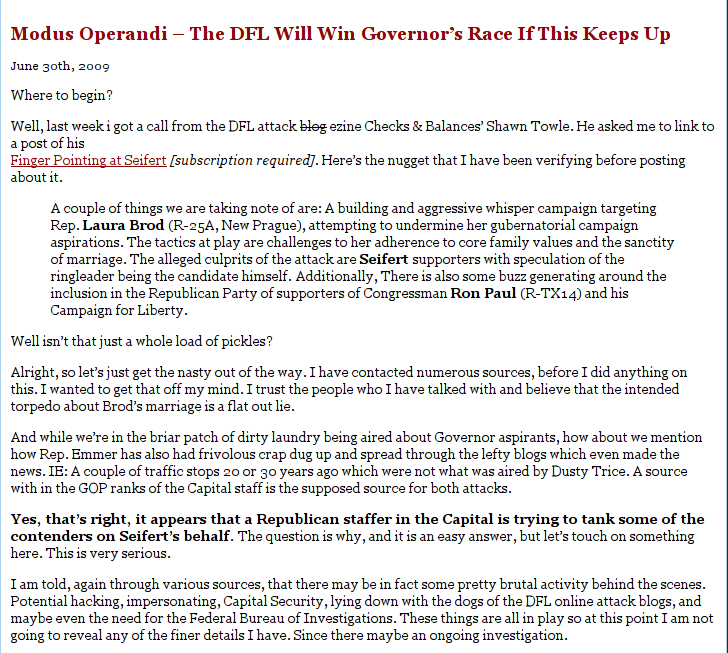
Even after nine tumultuous years, I still haven’t seen a political scandal as utterly bizarre as the Laura Brod one. And it’s not about anything she did or was accused of doing (consensual affair and posing for an ill-considered photo). It’s about how it unfolded.
Much of the stuff is only accessible via archives, but as far as I can tell, this is how I’ve read it went down. In August 2008, State Rep. Laura Brod had an affair and posed for a naughty photo. In 2009, when she was expected to run for governor, a ton of internet gossip and drama went out (but no real concrete evidence). There was legal action involving her and a “John Doe”. Brod bailed out of her expected campaign for governor for “health reasons”, and then did not run for reelection in 2010.
Hacking, impersonating, yikes!
In 2011, she was appointed to the University of Minnesota Board of Regents. Around the same time, the Koch/Michael Brodkorb scandal broke, and Brodkorb sued for gender discrimination, alleging that women who slept with male superiors weren’t punished the way he was. A list of his allegations against specific people mysteriously and briefly ended up online, in what was largely regarded as a deliberate mudsling.
In July 2013, out of nowhere, a single-use Tumblr appeared with the Brod photo and the words “This is a picture of University of Minnesota Regent and former State Rep. Laura Brod. A thousand words describe this picture and the story behind it.” But those ‘thousand words’ did not appear (until now, arguably). The now-defunct City Pages ran a series of articles about the Brod photo, talking about its supposed political importance, and eventually going into the details of when the picture was taken and that Brod had spent campaign money on legal fees afterwards. They did not mention or even really speculate on anything like who the photographer/”other man” was, if the relationship brought about any conflict of interest, or anything that would make it a legitimate scandal and not just a tawdry swipe at someone no longer in office.
The result was that everyone expressed sympathy for Brod, and rightfully so. Everyone from her divorcing husband to people who called themselves staunch political opponents spoke on her behalf. The articles about the photo trailed off, no real news about investigative results emerged, and everyone moved on. Laura Brod later remarried and had a successful life outside of government.
The strange thing is the slow drip nature of it, which, combined with the lack of actually identifying or speculating, has made me wonder if that meant the people releasing it were covering for the photographer/”other man”.
Of course, that was a little long ago, but Minnesota couldn’t resist keeping the “streak” going. State GOP Chair Jennifer Carnahan was forced out amid a trafficking (!) scandal, and drunkenly stated that she didn’t care about her ill congressman husband because he’d “soon be dead”. Then came the retaliatory gossip on the internet alleging that she had multiple abortions.
Meanwhile, New York political scandals tend to be boring. Then again, we never elected a pro wrestler as governor…

 Fuldapocalypse Fiction