Formations in the Fog Of War

Two previously speculated-upon formations that have not had much evidence to substantiate their (exact) existence include Iraqi “Special Forces Divisions” and the “Islamic Regiments” of the 1980s Afghan mujaheddin.

The former were depicted as regular army formations containing soldiers with at least some greater training and morale than the bottom-of-the-barrel rabble. They were fairly conventional triangular motorized infantry divisions in terms of structure, operating in either trucks or wheeled APCs. These divisions contained no organic (part of their structure) tanks, but could easily get them cross-attached if need be.

The latter were supposedly black-clad formations of raiders with more organization and standardization than the usual bands, but nothing (usually) heavier than normal crew-served weapons. They consisted of about 600-900 people broken into multiple small battalions. It’s worth noting that their layout does bear a resemblance to the kind of “guerilla regiments” that Mao described in detail in On Guerilla Warfare.

Of course, there is a hint of truth to these formations. There were/are large commando formations in the Iraqi and especially Syrian armies, the Republican Guard did have an unambiguous “Special Forces Division”, and the mujaheddin did occasionally operate in formations the size of the fabled “Islamic Regiments”, as well as deploy better trained and equipped subunits. This is of course is what leads to the inevitable exaggerations.

And also, the joy of generalist wargaming rules and alternate history is that these units can easily be simulated as if genuine. Neither requires much in the way of exotic equipment or modifiers to use.

Review: A Pius Man

A Pius Man

Declan Finn’s A Pius Man is a very weird thriller. It was intended as a conservative Catholic response to The Da Vinci Code and its array of knockoffs, yet delays in the publication of the book had the unfortunate effect of making it appear after the trend had already gone away. So it’s like a scathing critique of disco music-that came out in 1989.

As for the book itself, it’s an awkward mixture of conventional thriller (see the central casting Thriller Protagonist!), out-there thriller (See the pope in his super-armor confront raised-from-childhood KGB assassins!), and a self-serious defense of Pius XII’s historical record that reads like a mediocre undergraduate essay. All this is clumsily shoved together.

I still wouldn’t call this book really “good”. But it’s at least different and a little distinct. Your liking of it will depend on your liking of difference for its own sake. It’s the “mean 51%” compared to stuff like Marine Force One or other rote “shoot the terrorist”‘s “median 51%”.

Veterans Day

Happy Veterans/Armistice/Remembrance Day, on the anniversary of the end of World War I. Often overlooked and forgotten, it killed more Americans than Vietnam. It killed over four percent of France’s population. Even if the nuclear button had not been pushed, the hard-to-predict casualties of a Fuldapocalyptic Third World War would have been enormous. We should be thankful that such a thing never came to pass.

Review: Project 19

Project 19

James Ronsone and Matt Jackson’s Project 19 is an alternate history story about a far more severe Gulf War. In it, the Soviets, eager to disrupt the world’s oil supply (and thus raise the value of their own products) have more or less openly supported the Iraqis with piles of modern equipment and trained pilots. Thus they charge full-force down the Arabian Peninsula, and the squash of the historical war turns into a frantic struggle instead.

The very designation of this book (and its series) is a matter of question. It’s an alternate history “big war thriller” for certain, but even though not designated as such, I feel it deserves the term “World War III”. Yes, the location is different and so are some of the participants. But I see a giant conventional Soviet-American conflict and know only one thing to call it.

As for literary quality, it’s a little awkward. On one hand, the characters are Steel Panthers cutouts who exist to stand around in conference rooms or operate military equipment with cameras strapped to their heads so that the reader can see them. And the prose, well, sometimes it comes across as even clunkier than what I’ve read in the Kirov series. That is no small feat. Finally, while the technical inaccuracies are never more than mild, something this infodumpy has no right to get details like “Chinese T-62 copies” (which never existed) wrong.

But on the other hand, this is an extremely hard genre to write well. I’d even go so far as to say that “big war thrillers” are arguably the hardest type of fiction to write well. They’re certainly tougher and require far more balancing than normal action hero or small unit stories. What Ronsone and Jackson want to do is make a broad scope telling of a very different war. And here they succeed. It comes at the expense of a lot of other things, but this book succeeds in its main goal.

Apart from that dichotomy, I could have a few more nitpicks about the plausibility. The Soviets couldn’t supply an external country with high-end tanks without either stripping their most essential forward forces or diverting a year or two’s worth of factory production. Even there, advanced tanks didn’t grow on trees. The speed at which the Iraqis advance is more than the ideal distance of a successful operation, much less the imperfect, generally slow military that they were. But all these can be handwaved aside in the name of wanting to provide a challenging opponent, which is where this succeeds. I particularly like the US military being placed in a position where it doesn’t have total air control right away.

So in conclusion, this book has many virtues and flaws. Though not the best example of its subgenre, it’s nonetheless readable for fans of Larry Bond and the like.

The Big Artillery Lethality Chart

The 1957 edition of FM 6-40, Field Artillery Gunnery, has these projected casualty figures for battery and battalion artillery barrages being fired at vile Circle Trigonist opponents. What makes this interesting is that it’s a time period that has all the calibers: The classic old 75mm, the 105 and 6 inch guns well known to later people, the big 8 inchers, and the really big monsters.

Now it’s important to note that these are in absolutely (to the point of being unrealistic) ideal conditions. There’s no cover whatsoever, the fuzes are proximity ones that will explode at the perfect height, and, for what it’s worth, it was made in an era where infantry body armor was far less prominent than it would later become. That being said, it’s still a great resource.

My First Technothriller

If one counts Clive Cussler (or, in this case, “Clive Cussler’s”) novels as technothrillers, then one called Fire Ice was the first techno-thriller I read. Then it gets weird because well, I honestly can’t remember the next ones I read until reading the The Big One alternate history novels, which is kind of like getting into cinema by watching The Room, Who Killed Captain Alex, and Plan 9 from Outer Space.

My next mainstream technothriller was Dale Brown’s Flight of the Old Dog, a perfectly good choice. My first Tom Clancy was Red Storm Rising. The big crossover was the Survivalist novels, where the tiny thread connecting the po-faced technothrillers I’d read before to the ridiculous action excess that series revealed to me was that both were technically World War III novels.

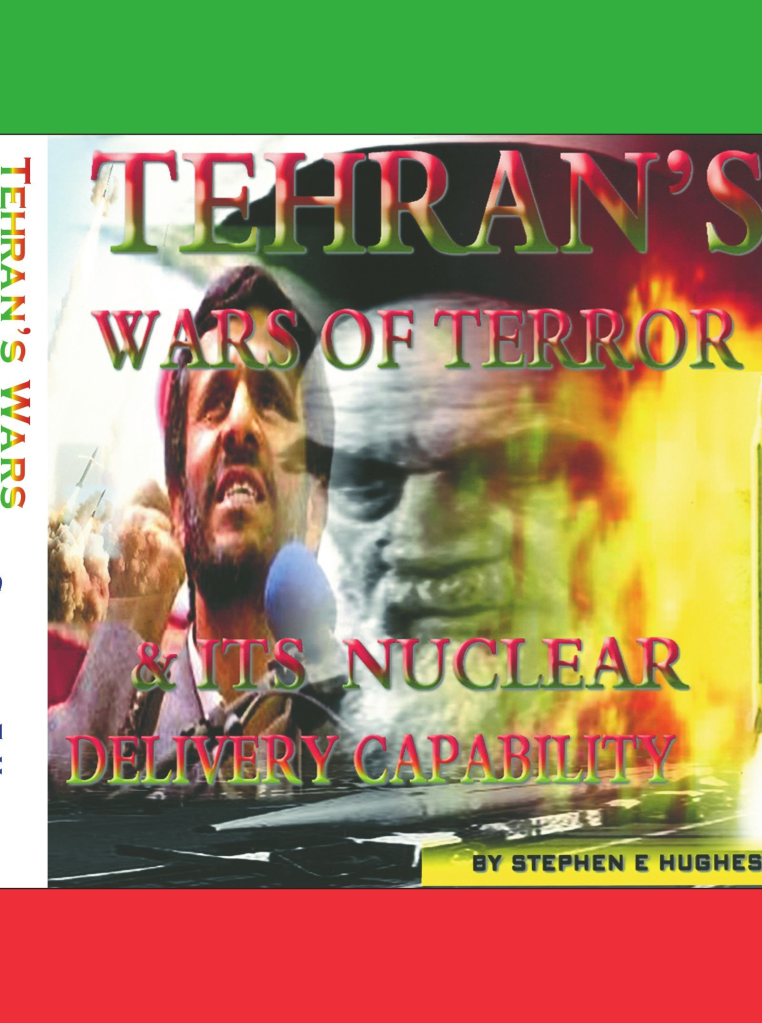
Review: Tehran’s Wars of Terror

Tehran’s Wars of Terror and Its Nuclear Delivery Capability

The worst book cover deserves to be seen in all its “glory”

Stephen Hughes’ The Iraqi Threat was a letdown. This is even more of a letdown. Trying to move through the smoke of the infamously secretive post-revolutionary Iranian military (with their five million new systems that appear in every new parade) would be a worthy and very useful endeavor. This not only fails in that regard, it acts like it doesn’t even try.

First off, I’m a “you can’t [usually] judge a book by its cover” type of person. I can understand having a bad cover or a crude cover. But this is an exception, because the cover of Tehran’s Wars of Terror is, without a doubt, the worst I’ve seen of any military reference book. And one of the worst I’ve seen period.

The cover is perfectly representative of the absolute slapdash mush inside. The Iraqi Threat at least had a central theme that it followed. This is just a rambling collection of various articles that are connected with only a vague link to Middle Eastern warfare. It doesn’t even work as a basic “know your enemy” primer because it’s so gargantuan and aimless. I feel surprisingly confident in saying that it’s quite possibly the worst military reference book I’ve read. And if not, it’s certainly down there.

NaNoWriMo Announcement

So, I’m going to be doing NaNoWriMo. You might see fewer posts on this blog during that time because of obvious changed priorities. I feel confident because when I wrote the Smithtown books and The Sure Bet King, I was able to write at a pace that met the equivalent of the NaNoWriMo goals.

As for the subject matter of the book, while I want to keep a lot of the exact details hidden, I will say this: I’m going to be using NaNoWriMo to be my first step into the pool that is the Larry Bond-style “big war thriller.” I figured the format works well for taking a step towards something new, and I’m really, really excited to take a crack at a genre I frequently love to read and made this blog to review.

Review: Point of Impact

Point of Impact

Stephen Hunter kicks off his Bob Lee Swagger (aka Deadshot-13) series of sniper thrillers with Point of Impact. I was eager to finally get the chance to read this book, as I’ve heard good things about the series. I was not disappointed. This was a great novel.

Now, granted, there are some bumps. The amount of machismo in the writing’s tone is a little much even for me. More importantly, it has an awkward mix of “Herman Melville for snipers” where it talks about grounded, important setting up for a shot, and “Sniper John Rourke” where the main character can fight at the level of a video game hero and make very accurate shots in a very short amount of time.

But these are not deal-breakers by any means. The action is excellent. The book is long yet well-paced and never feels like it drags on. It has the “slow buildup” of Jon Land at his best applied to a much more serious plot and executed quite effectively. Finally, the big twist feels like an unintentional/accidental critique of the worst “shoot the terrorist” thrillers where the main character doesn’t actually have that much agency. This is definitely not one of those.

I loved this book. I recommend this book. It’s not the absolute best thriller I’ve read, but it’s definitely up there.

Review: Russian and Soviet Ground Attack Aircraft

Russian And Soviet Ground Attack Aircraft

Alberto Trevisan and Anatoly Borovik’s Russian and Soviet Ground Attack Aircraft is the latest addition to my collection of technical, diagram-filled books on aviation history. It’s meant to be a comprehensive, picture-heavy catalogue of all the “Samolety Polya Boya”, a term that can be very awkwardly translated to [their definition] “Battlefield Aircraft”. The “Russian” in the title is accurate, as this book also includes World War I and post-1991 designs.

The “Samolety Polya Boyas” in this book range from the famous Il-2 and Su-25 Sturmoviks to low-end propeller planes to high performance edge cases like the MiG-23BN/27s (the proposed but never adopted final upgrade package that included the ability to mount radar pods and refuel in midair warms my Flogger fan heart). It also looks at never-were designs in the same range, most notably the postwar Illyushins, which were victims of technology, doctrinal changes, and being extremely ugly.

Some of the types it does and doesn’t focus on can feel a little arbitrary. While I suppose that’s the perils of dedicating a book to as vague a term as “ground attack aircraft”, I feel obligated to point it. Thankfully their choices never feel too weird or too bad, and I can understand the desire to avoid mission creep.

If I had one quibble (besides a somewhat iffy layout), it’s that there isn’t enough “how” in the book for my tastes. I would have liked to see an Air Battle Central Europe-esque section on the doctrinal “division of labor” between them, helicopters, and higher-performance bombers/strike aircraft, and how it evolved and changed. While I can get information on that from other sources (and/or intuit it based on capability-your slow short-legged ground attackers are not going to be used for deep, well-defended targets if they can help it), it’s still a lacking feature.

But the rest of the book is still great. The artwork is excellent, the list of aircraft covered is very big despite its self-imposed limitations, and the technical detail (especially for paper aircraft with fewer sources available) is surprisingly high. Even without the parts I would have liked, this is still a great resource for a centerpiece of the VVS.