Review: The Secret Weapon

The Secret Weapon

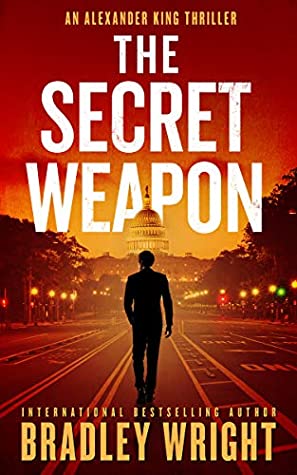
A thriller in the Alexander King series, Bradley Wright’s The Secret Weapon is an example of how tough it is at the margins. My history with the author is a little strange. I’d read some of his books in the past, where they faded from memory as bland and mediocre. Then I saw this book, felt it was bland and mediocre-and then realized I’d read the same author before.

Anyway, the book isn’t really the worst ever. On-paper, it does what a cheap thriller is supposed to do, and only feels like its slightly below average in every category that matters-the action is slightly less exciting, the pacing slightly less efficient, and so on. Yet it’s that little bit that makes the difference.

Because the “action hero” genre is so big, has so many choices, and is reliant on execution rather than concept, for something to fall behind somewhat means there’s a lot out there that’s better. This isn’t like the much tinier “big war thriller” genre where a flawed entry like Chieftains or Arc Light can still be conceptually interesting enough to recommend. Instead, its flaws means it sadly misses the cut.

A Thousand Words: Revolution X

Revolution X

What happens when you take a pair of has-beens fading rapidly from relevance and merge them together? You get Revolution X, an arcade light-gun shooter starring a past-its-prime Aerosmith. The plot is simple-save Aerosmith from a bunch of people in yellow gas masks who’ve outlawed fun. You do so with a gun that fires CDs as well as bullets. Yes, it’s that kind of game.

The gameplay is mostly simple-fire at the hordes of enemy goons on your screen, put more quarters in when they inevitably kill you, repeat as necessary. Two of the later levels make this worse by trying to be more complicated. One, a maze, is simply annoying. The other, a time-sensitive mission where you have to completely destroy a bus before it reaches its destination, is considerably more aggravating.

By the time of its release, Aerosmith had long since fallen from the heights of their popularity, and with more powerful and smaller consoles just coming out, arcades would soon follow. This game is one of those weird novelties that can only happen at a specific time.

The Case For Flawed Ambition

Of all the literary attitudes I’ve had that have changed since I started blogging, I think none is bigger or more important than how I’ve approached ambition. In the past, I’d had this attitude that if the execution was subpar, the ambition wasn’t worth the effort. It was better to aim for something attainable, so the thinking went.

Now, well, I’ve found myself enjoying works of fiction more when they aim/aimed to be highly ambitious, even when their execution is obviously flawed. Part of this is me now knowing how many “51%” books there are, knowing there’s no shortage of competent but middling fiction. From that perspective, something distinct, or even trying to be distinct, can stand out more. If nothing else, it’s a lot more fun and/or interesting to review. Repeatedly saying “this is formulaic but competent”, even if true, isn’t the most fun.

Another part is that it just felt better to write such out-there stuff when I wrote the two Smithtown books. Previously, I’d wondered why authors who had a good amount of creative control sometimes tended to go more out-there into “Arkansas vs. The Blimps” territory as their series’ progressed. Now, I need not wonder.

Review: The Mongol

The Mongol

The final Casca book credited to Barry Sadler (regardless of its actual authorship-according to some stories I’ve heard, it was a manuscript found after his death), The Mongol is a 51% book in a 51% series. The “which period of history should we put Casca in a theme park version of” wheel stopped at “Genghis Khan” this time.

The good news is that compared to previous flops like The Trench Soldier and The Samurai, this book is significantly better. The bad news is that, like every other Casca book, it’s still melodramatic pulp historical fiction that does almost nothing with its supernatural premise. For a quick read, one could do a lot worse. Yet there isn’t really anything to recommend it ahead of the first two Cascas either.

Thus it’s perhaps fitting that a middling series ended (for a time) on such a middling note.

Review: Altered States

Altered States

The ninth Kirov book, Altered States, is where the series really starts to hit its stride. By Schettler’s own admission, the response to the question of “should I write about the missile cruiser’s later adventures or an alternate World War II where the German surface fleet was bigger?” was “Yes.” And he was glad to oblige, combining the cruiser soap opera with a huge naval battle in a location I haven’t seen in a while-the GIUK gap.

(There’s a Kirov, but there’s not any Backfires or Aegis cruisers or F-14s. It’s like my original vision of Fuldapocalypse mixed with what the blog later became)

This sets the stage for the giant wargame sandbox/time travel soap opera that the rest of the series would become. Not quickly or even the most effectively, but it still does. I’ll admit that the “alternate sandbox” approach is my own favorite way of wargaming, which is why I’ve grown fonder of the series. I’ve found later, similar installments in a series hard to review, and this is one of them. But still, this is where it really clicks into place.

Fuldapocalypse Second Anniversary

Today is the second anniversary of Fuldapocalypse’s first post. It’s been a great experience, even as it’s long since outgrown its original goal. An inherently diverse blog is a lot easier to write for than an inherently restrictive one.

Sometimes I wonder just how far I could have gone if I’d stayed with my original goal and just pressed on reading and narrowly analyzing as many conventional World War III tales as I could handle. But that would have been far more forced and far less pleasant than what the blog ended up becoming.

Review: Neptune Island

Neptune Island

The first in the “Lincoln Monk” series (how’s that for a protagonist name) by Tony Reed, Neptune Island is a delight to read. One of the biggest problems with trying to find good cheap thrillers is that the cover and even the blurb alone can’t easily tell whether a book is going to be good or bad.

That being said, this book of a Cheap Thriller Protagonist (capital-that’s how blatant it is), a supervillain billionaire, a superweapon, a beautiful biathelete, and a giant mutant crab is the most fun I’ve had reading a thriller in some time. It’s the kind of book that tosses every sort of “restraint” and “realism” aside in favor of ridiculous spectacle, and it’s great fun, especially after a period of more serious and sedate works.

It’s amazing, and is the kind of book that’s a delight to find. Sure it’s “implausible” and there’s a lot of contrivances, but those are small potatoes. The action is great, the setup is great, it manages to have very good buildup (which I’ve found is surprisingly rare among cheap thrillers), and the whole thing is just incredibly goofy-and really, really fun.

Review: The Natural

The Natural

Sports fiction strangely suffers from the exact same problem that political fiction does. Because there’s so much available in the true world, both past and present, fiction has to be either an obviously forced and exaggerated version or often come across as feeling simply redundant. While success is not impossible, it’s an uphill climb.

One of the classic sports novels is Bernard Malamud’s The Natural, famous for its enduring reputation and movie version that sits alongside Starship Troopers in the field of “movies completely different from the book”. Having read the original book, I have to say: I don’t like it.

There’s one big problem with this book about baseball, which is that Malamud didn’t know that much about the sport. While others have gone into more detail, I’ll say this. There’s some errors like talk of a past World Series between the A’s and White Sox (two AL teams), but the bigger issue is simple. Hobbs comes across as what someone who doesn’t know that much about baseball would think a great player is.

Hobbs is good (unless the plot calls for him not to be) and good in a very boring way, simply hitting and hitting and hitting, not even rising to the level of classic Paul Bunyan baseball stories like how Cool Papa Bell supposedly got hit in the back by his own line drive simply because he ran so fast. Nope, it’s just four home runs in a game and “wondrous averages”. This isn’t a John Rourke or Blaine McCracken of the diamond, it’s a guy skilled in the baseball equivalent of “Special Forces, Ranger, SEAL, and gutter-fighting”.

Without that frame of reference, a lot of it is just references to various baseball legends-Babe Ruth, in the form of the Whammer. Fred Merkle’s baserunning fail, in the form of Fisher’s Flop, the Black Sox (in the form of the ending), and so much more (as the Gerry O’Connor article points out). A modern version would incorporate versions of Bill Buckner, Steve Bartman, and the 2004 lunar eclipse, to give you an idea of how blatant it all is to anyone who knows the slightest bit about early 20th century baseball.

So why am I suddenly so hard on realism and accuracy, when I’m clearly not when it comes to other books? Because the book is self-serious, for one. It’s like trying to write a literary novel about the life of a man who was a soldier, making the battle scenes right out of a stereotypical John Wayne movie, and sometimes descending to Ian Slater levels of technical inaccuracy. Would that interfere with the tone? Definitely.

Especially since, with the benefit of hindsight, this just looks like an exaggerated version (remember the introduction) of the Capital N Narrative approach to sportswriting, the clumsy and inaccurate reduction of a game into a tale of personal morality and internal struggle, applied constantly to real games by sportswriters of dubious quality (sometimes with extra crass humor).

Finally, the prose simply isn’t very good. It’s blocky, incredibly “lush”, and everything is either overdescribed or underdescribed. None of the characters are particularly interesting. And to be honest, in many ways the book feels just as shallow as the movie, only with a different morality. Give me saccharine goo that knows it’s saccharine goo over pretentiousness that doesn’t know its own subject any time.

Review: Air-Mech Strike

Air-Mech Strike

The book Air-Mech Strike holds the origin of the infamous “Gavin” nickname for the M113. It’s also extremely dated and, for the most part, badly written. This is a very 1990s book, despite being published in the early 2000s.

The “Gavin” name is a little more forgivable in this context because it’s meant to refer to a heavily modified and upgraded M113 instead of just the stock vehicle itself. The problem is that the authors want to have their cake and eat it too-they want an existing vehicle to fill the “medium motorized” infantry role out of legitimate concern that a big procurement wouldn’t happen in the post-USSR budget crunch, but also want a lavishly upgraded one. Yes, they give supposed cost figures, but I’m still skeptical (to put it mildly).

There are huge lists of TO&Es, to the point where I could probably just say “read the book itself” if I was doing a Weird Wargaming on the “air mech strike force”. There are piles and piles of 1990s NETWORK SMART WEAPON BUZZWORDS. There’s a utopianism that goes far beyond the reasonable arguments to mechanize existing airborne forces.

This is only backed by lopsided and unconvincing hypothetical case studies with absolutely no effort to “stress-test” the proposal. There’s a cakewalk in Central Asia against ragtag (conventional) opposition, a Kosovo intervention with pushover Serbs that might have been understandable before the actual war, but which feels like it would turn into the next Market Garden with the knowledge of their abilities gained after it, a Second Korean War where a risky deep attack is brushed aside as succeeding in one paragraph, and a Kuwait defense scenario that rightfully argues it’d be better than a footbound “speedbump”, but doesn’t examine how much better.

Ultimately, it just comes across as being enthralled by a certain type of theoretically possible toy. This is the land warfare equivalent of arguing for an air doctrine built around flying aircraft carriers, a naval doctrine built around submarines of various sizes, or any other gimmicky weapon that could be technically buildable.

Review: The Eleventh Commandment

The Eleventh Commandment

It’s time for Fuldapocalypse to turn to another author of high sales but low reputation, British writer, politician, and convicted criminal Jeffrey Archer. Even though a lot of Archer’s books, from their descriptions, come across as the type of work I call the “pop epic” (ie, Sidney Sheldon), CIA thriller The Eleventh Commandment looked like a grocery store cheap thriller. In fact, it looked so much like a grocery store cheap thriller that I felt a bit of trepidation-would this be nothing but a Marine Force One with a more well-known author’s name on the cover, forgettable mush?

The answer is “kind of.” Its realism, or lack thereof, comes from simply adopting a different baseline. It wants to be a serious cloak and dagger story, which makes every inaccuracy and contrivance more glaring. Furthermore, the prose is very blocky, the pacing slow, and despite seemingly high stakes on paper, it doesn’t feel that way in practice. At least it’s not too long, but it’s just dry and clunky.

The result is something that feels like it has all the weaknesses of a cliche cheap thriller, but few to none of the strengths. Whatever Archer could write, this kind of novel is not it.