First, I found out about Never Was magazine, an online magazine devoted to alternate history, after they announced a partnership with Sea Lion Press. Signing up and liking what I saw, I’ve posted a link to it on the sidebar blogroll. Looking a little deeper, I saw a piece on a subject dear to Fuldapocalypse-World War III Without Missiles. I recommend checking it out.
Second, as you may have noticed from the Red Hammer Down review, I’m experimenting with changing the layout just a bit. Nothing too big, just something done for the sake of curiosity.
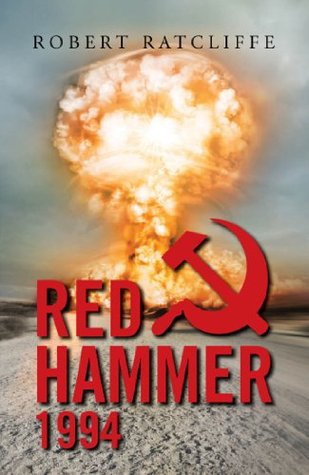
Robert Ratcliffe’s Red Hammer 1994 is a tale of an alternate nuclear World War III in the early 1990s. The feared regression to authoritarianism takes place in post-1991 Russia, and its leader proceeds to launch a nuclear strike on the west. Cue a big picture, wide-scope look at everything from bombers to silos to submarines to, yes, conference rooms.
The characters feel just like they’re just there to operate military equipment instead of being actual characters. The plot is basically “have a nuclear war that stays mainly counterforce and thus only mauls civilization instead of wrecking it totally, and show every part of it in set pieces”. The grounded and frequently realistic (at least technically) nature of the book is somewhat admirable, but works against it when questionable moments like a giant force of super-Spetsnaz in the continental US emerges-or for that matter, the basic plot happening at all. The ending is incredibly abrupt (and not in a plausible Dr. Strangelove way) and the most positive elements are some of the set pieces themselves.
This is what it is. If you like technical detail and want to see Herman Melville’s Story Of A Moderate Nuclear War, you’ll like this book. But if you want a solid narrative, this isn’t it.
Be sure to check out the tenth anniversary post on the Glorious Trash blog describing how it came into being. I regularly read the blog and find it very entertaining (you can see it linked on the sidebar), and the post was a delight to read.
Jim Heskett and Nick Thacker’s Primary Target is not the deepest story, nor does it have the most plausible premise. Basically, circumstances lead to assassin Ember Clarke having to participate in a trial by combat, fighting off other assassins trying to kill her over the course of several weeks.
However, in spite of this setup, it’s well done. Yes, it has the “this isn’t a movie but I do super stuff anyway” gripe I’ve seen far too often, and its premise deserves action far more bizarre and over the top than what actually occurs. But the book remains a solid cloak and dagger thriller.
Granted, I’m not the biggest fan of such novels, but I still like variety. And this is cloak and dagger done very well.
Telling the story of National Guard soldiers and their families during a 198X Fuldapocalypse, Burke uses some plot devices I’ve thought would have worked, like using fictional unit designations. He also aims for characterization and doesn’t hesitate to show the duller parts of military life. The result is something that tries to be something fuller than just tanks exploding…
…With an emphasis on tries. A lot of the high-level military details are anachronistic and in some cases outright “off”. The most jarring example to me was how the Soviets would focus on NORTHAG (which would be true) and thus do nothing but special forces operations in the American sector at the beginning of the war (which would not be). The action suffers from the same rough prose as the rest of the work and sometimes devolves into listing armaments in full.
Because of this, it comes across as being like a somewhat worse Chieftains-a tale of a conventional World War III that’s ambitious, but erratic and unpolished in execution.
One of my theories about Harry Turtledove is that, for all times he’s been labeled “the master of alternate history”, he never had the most enthusiasm for the genre. It goes like this: Turtledove wanted to write Byzantine/Eastern Roman-themed fantasy, but after Guns of The South, alternate history became the money-making niche that he was stuck in. Turtledove would be neither the first nor last writer to have their most successful fiction be considerably different from the type they actually wanted to write.
Or maybe he did have enthusiasm for the genre, but didn’t have the mindset needed to really take advantage of it. Or maybe the nature of alternate history and needing to appeal to a generalist audience who doesn’t have the most knowledge of history forced him into a corner. Whatever the reason, The Man With The Iron Heart symbolizes the weaknesses of his style vividly.
The plot is simple. Reinhard Heydrich survives, gets the Werwolf resistance movement up and running, and launches a horrifically hamfisted/anachronistic Iraq War analogy. In reality, the German populace at large had no stomach for continued resistance, and the Allies, who came close to turning Germany into a giant farm, were prepared to crack the whip. The Werwolf plan was doomed from the get-go by the scarce resources and infighting that was baked into the Nazi regime from day one.
The execution of the book is done just as clumsily and clunkily as the setup. Much of Turtledove’s writing has the problem of what I frequently call the “technothriller without technology or thrills”, and this is no exception. It uses the “alternate history as a genre format” where there’s a big-picture, broad-viewpoint look at the situation and changed world. However, if the changed world is nothing but an unrealistic and worse, uninteresting analogy, that format is the worst possible.
Alternate history is a very divided genre. There are a lot of reasons for this, from the vague nature of what it even is to the different desires of different fandoms to how it’s frequently not considered advantageous to label a work as such. But that the “mainstream” end often consists of books like this doesn’t help.
Maybe there’d be more overlap if someone really did extensive research, made it more character focused, and kept it feeling substantially different while providing still noticeable but far more subtle commentary. Instead, Turtledove wrote this book, which I do not recommend.
Stephen Kinloch Pichat’s A UN ‘Legion’: Between Utopia and Reality is a very inconsistent book. This may be due to its subject matter, which involves the various proposals for a UN standing army, proposals made since before the formal United Nations Organization even existed.
About half the book, at least figuratively, is written in a particularly bad form of “academic-ese”. I had trouble getting through it and I read long dissertations for fun (seriously). Even if unintentional, the problem is that the political obstacles to such a force are so obvious and so easily explained that any long statement will become unfulfilling.
That being said, the other half of the book is a concise, well-written, and well-sourced example of various proposals. They come in two categories. The first is a gigantic “World Army”. The earliest proposals, made during World War II, fit this category, with numbers that seem big to a modern reader but weren’t back then. “World Armies” frequently were capped by a standing high-readiness force (think the 18th Airborne Corps or maybe the USMC/VDV).
The second is a smaller and more theoretically practical “UN Army”, a comparably small force designed for specific contingencies. One of the most detailed examples, which Pinchat describes, is the ‘Vital Force’/’UN Legion’ proposal amounting to several brigades of light to medium troops. Others amount to similar versions of the same thing-something that can conduct most normal peacekeeping missions, but without the ad hoc nature of existing setups.
I’m a little reluctant to recommend a book that sinks to such lows, but it’s still a good resource. It’s just a bit of a shame it’s not better laid out, but this is an academic history and the text is still good when it counts.
I discovered a sport called “short hockey” existed. That is hockey played with four skaters and a goalie per team with 10 minute periods across the width of a half-rink. As it’s much less exerting, teams can play a lot of games in just one day. As the ownership/sponsorship of all the Russian short hockey leagues I’ve seen by sportsbooks shows, it’s aimed more at gamblers than actual fans.
So I figured, what would “short baseball” look like? As is, baseball already has many more games feasibly scheduled than many other sports. Yet I decided to amplify it more with two tiers.
Semi-short baseball, which is like conventional baseball only with six innings, games ending in ties after two extra ones, a designated hitter, and some pace of play rules. Semi-short leagues, despite their betting-friendly nature, are treated as serious competitions with ceremony, champions, and the same rigorous record-keeping.
Mega-short baseball, which is just a means to an end of making as many gambling-friendly matches. Games are five two-out innings which automatically end in ties after the bottom of the fifth, there are rapid pitch clocks, and, most crucially, pitchers have to throw the ball in the least stressful way possible. This both saves on the need for countless pitchers and encourages scoring by having pitches be easier to hit. There are also no formal standings and essentially no official record-keeping.
If I can find an appropriate place for it in my fiction, I’ll gladly put “short baseball” in, with an alternate history background as to how it got started and developed (which almost certainly means earlier and more widespread legal sports betting in baseball-friendly countries).
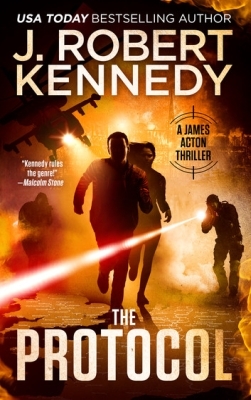
The initial book in J. Robert Kennedy’s James Acton series is The Protocol. This secret history conspiracy archeology thriller comes at sort of the tail end of my reading binge of this “genre”. Having read a lot of them, I’ve returned to more conventional cheap thrillers and have moved on for now.
This book embodies the reason why. A 51% book with an ancient mystical MacGuffin and super-conspiracy is still a 51% book if it has middling, mundane action. Especially if the MacGuffin itself is an unoriginal ripoff (as this is-I’ll just say there was an Indiana Jones movie that had the same kind of artifact and leave it at that). Just because something seems more outlandish than the blandest “shoot the terrorist” novel on paper doesn’t mean it comes across that way when actually reading it.
I’m not against ancient bizarre MacGuffins and super-conspracies in the slightest. But just having them doesn’t make them the equals of the best thrillers any more than using a similarly shaped bat makes one equal to a baseball Hall of Famer. It’s a lesson I’ve learned throughout my binge, and this is a good, even if not the most pointed, example of that.
One of my personal in-jokes is how few Larry Bond books I’ve actually read and reviewed on Fuldapocalypse, which is either two or three as of this post. The books are Cauldron, Red Phoenix, and Red Storm Rising if you count it. This combined with the increasing diversification of the blog makes me sometimes go “Boy I’ve reviewed more [insert genre or author that’s nothing like him] books than I have Larry Bond’s”.
Bond, along with Hackett himself, is the most “Icelandic” of the authors I’ve read on Fuldapocalypse. The most tied to wargaming. The most determined to have a “broad-front”, top-to-bottom perspective with a bunch of viewpoint characters.
And well, I have to say he’s not the most impressive, at least judging from the sample size I’ve seen. Not the worst by any means, but you’ll notice how “meh” I sound in my review of Red Phoenix. I’ll be fair and say that I think a big part of it isn’t his fault. In short, I know too much about the subject matter to be impressed the way a “normal” reader might be.
And yet, from the broader perspective I’ve experienced, my respect for him has actually grown. For Bond’s work remains distinct. There are lots and lots and lots of more “normal” cheap thrillers, and it’s, to be frank, not the hardest genre to succeed in. There are much fewer “big-war thrillers”, and it is a harder genre to do right.
Larry Bond can’t be faulted for trying. And there’s certainly room in the literary sphere for books in his style alongside the spacesuit commandos and terrorist-shooters.



 Fuldapocalypse Fiction