I have a possibly unpopular confession about tactical decision games. I’m not the biggest fan of them. Now, don’t get me wrong, I have no problem with them existing and I can definitely see their use. It’s ironically not in spite of, but because of my armchair enthusiast status that I’m somewhat wary of them. From the perspective of someone who isn’t potentially doing them in real life, it feels like couch coaching. You’re sitting on the couch telling the sportsball player to sports the ball in the right way, when you have past school experience at best.
And that of course assumes there is one right way. One thing I like about John Antal’s Choose Your Own COA-Adventure books is that doing counterintuitive things like charging up the middle can sometimes work.
That being said, it’s less a “down with TDGs” and more “I should like them more than I do”. Plus I’ll admit that I have a soft spot for converting fictional battles/actions into TDGs with just the right amount of modification. While it’d be outside the scope of a “TDG” per se, my dream is to do a simulated reenactment of Iron Eagle (imprisoned pilot, generic Middle Eastern OPFOR) using realistic mechanics and seeing what assets are needed to save Col. Masters.
Basically every piece of nuclear technology is advertised as being “proliferation resistant”, for obvious reasons. And in many cases that’s legitimately true (albeit that as an armchair non-physicist, I wouldn’t be the best at explaining exactly why ). But I’ve had a few hunches and read my share of case studies. And there are undoubtedly a few wooden horses with hoplites lurking inside (at least according to the Roman version of the story).
One is chemical enrichment, which has never been commercialized but has been demonstrated and proposed for decades. There’s actually a real case study of its role in a nuclear weapons program. For Iraq’s pre-1991 nuclear infrastructure, it sought a chemical enrichment plant. To directly make weapons-grade uranium via the chemical method would be hideously impractical according to its proponents (argued as taking over a decade ), but to make LEU that would in turn be easier to further enrich (or use in reactors indirectly) is another story.
Another is small modular reactors. The suspicion I have is that unlike the eggs-in-one-basket normal sized ones, it’d be easier to have some units be used for normal power and others “throttled” (for lack of a better word) in ways that are far less efficient for electricity-but more so for weaponizable plutonium.
Of course, I know very little about the technical side of things so I could be totally off-base, especially for the modular reactors. But it’s still something I’ve thought about.
So, the long-feared Russian all-out invasion of Ukraine has begun. I kind of suspected this would happen when A: 75% of the Russian Army, including units from Eastern Siberia, was moved to the border, and B: The Kremlin began making knowingly impossible demands. Frankly, knowing what I know now, it’s kind of miraculous that it took thirty years to get this far.
(And no, Ukraine couldn’t have kept its for all intents and purposes unusable nukes it technically inherited, and it still did the right thing in not trying.)
Fuldapocalypse will continue as normal, as fiction is not real life. I will refrain on commentary as even the well-informed and honest accounts can be subject to confusion. However, I will say that when it became clear that war was inevitable, I made the very deliberate decision to pivot away from my Soviet-Romanian “big war thriller”, and not just because of the general concept or even the area. Having a massive, high-tech, Russian-led army striking against a former client whose only effective resistance is urban and unconventional warfare is a little too on the nose-in fact, the scenario is so similar that you could basically do a find and replace for “Belarus” and “Bulgaria” and change nothing else.
Thankfully, I do have some very good news. The pivot away from that concept to a follow-up thriller involving gambling, mansions, nuclear weapons, and dirty black ops in Southeast Asia with aged characters from The Sure Bet King has gone beautifully. The plot for that has finally clicked, and I’ve been making excellent progress there.
Saddam Hussein’s Iraq had a legitimate nuclear weapons program that was, by most accounts, very close to building a functioning Fat Man-level device before the invasion of Kuwait. A draft nuclear operations manual was even made. For all intents and purposes, it was destroyed in the 1991 Gulf War and there was no serious attempt to restart it prior to 2003.
The WMD swing-and-miss isn’t really the subject of this post. It was a combination of the inherent untrustworthiness of the Iraqi regime (which still would have more than willing to make genuine WMDs), a desperate desire to avoid a false negative after 9/11, and a bizzare bluff aimed at Iran by a Saddam who was increasingly believing his own propaganda. I have increasingly believed that, after 1991 and especially after 2001, that the Iraq War, or at least the country undergoing a catastrophic meltdown (see the Syrian Civil War), would have been inevitable given that element and the inherent instability of it, but that’s for another time.
Anyway, the Iraqi design was a spherical implosion device centered around 15-18 kilograms of highly-enriched uranium. The first incarnation of it was very wide (over a meter), with the big Tu-16 and Tu-22 bombers being the only delivery systems capable of dropping it. Later it shrank to the point where it could fit inside a ballistic missile, and active programs were focused on making longer-ranged missiles that could carry such a device. The yield is unknown and the only available references to them in open sources I’ve found are understandably redacted. One theory based on text size I’ve seen argued that the small design had the strength of only one kiloton and the big one three, which fits with the yield of early North Korean (pure test) designs. More generous estimates put it around 10-20. Regardless, it was unlikely to be more than low double digit kilotons in terms of blast strength. It’s worth noting that even the lowest-end estimate would still mean a radioactive version of the 2020 Beirut explosion.
Barring the invasion of Kuwait or other serious external interference, the program could have been up and churning out warheads by the mid-1990s. Of course, there would be serious external interference. Israel’s hyped attack on the Osirak reactor arguably owed more to the mania of Menachem Begin than any practical effect. Begin was the admitted inspiration for the supervillain Magneto (to give an idea of his temperament), and someone who embodied Alexander Wallace’s “hurt people hurt people” statement. Osirak was physically unsuited to producing weapons-grade material in quantity, and its destruction led to a much more hardened and dispersed program. Nonetheless, the Israelis would try.
Would they succeed? Would having the bomb actually lead to a calming effect, as argued by some? (Given the Kargil and Ussuri wars, I’m skeptical). As with everything involving the “devices”, there’s a thankfully small sample size to consider. There are many, many unknowns. But the atomic wolf was truly there.
Minnesota is home to a very strange demographic: Just as how North Carolina has an unusually large number of basketball colleges, the Land of Ten Thousand Lakes has an unusually large number of “romantic” scandals involving female politicians. And they have ranged from the most powerful (state Senate Majority Leader Amy Koch, forced out after a relationship with a subordinate), to the most embarassing (State Rep Tara Mack, literally caught in the act with another legislator), to the absolute most bizarre.
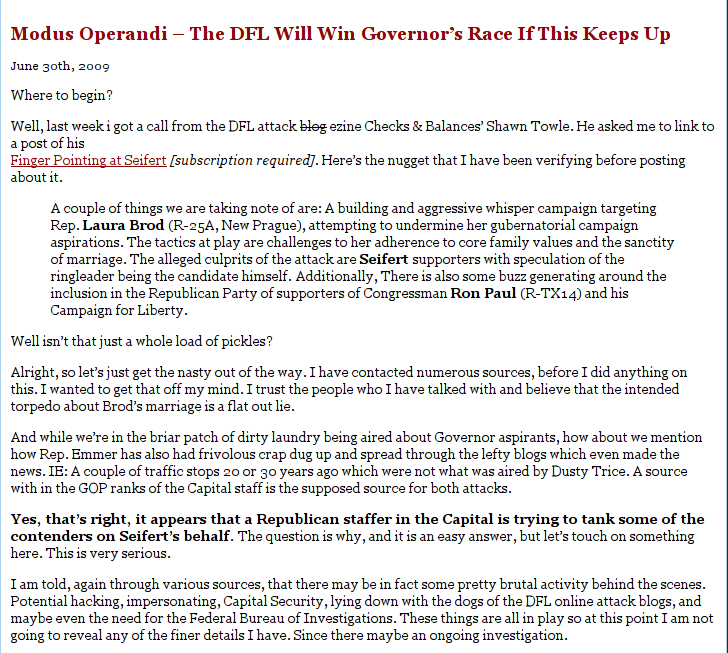
Even after nine tumultuous years, I still haven’t seen a political scandal as utterly bizarre as the Laura Brod one. And it’s not about anything she did or was accused of doing (consensual affair and posing for an ill-considered photo). It’s about how it unfolded.
Much of the stuff is only accessible via archives, but as far as I can tell, this is how I’ve read it went down. In August 2008, State Rep. Laura Brod had an affair and posed for a naughty photo. In 2009, when she was expected to run for governor, a ton of internet gossip and drama went out (but no real concrete evidence). There was legal action involving her and a “John Doe”. Brod bailed out of her expected campaign for governor for “health reasons”, and then did not run for reelection in 2010.
Hacking, impersonating, yikes!
In 2011, she was appointed to the University of Minnesota Board of Regents. Around the same time, the Koch/Michael Brodkorb scandal broke, and Brodkorb sued for gender discrimination, alleging that women who slept with male superiors weren’t punished the way he was. A list of his allegations against specific people mysteriously and briefly ended up online, in what was largely regarded as a deliberate mudsling.
In July 2013, out of nowhere, a single-use Tumblr appeared with the Brod photo and the words “This is a picture of University of Minnesota Regent and former State Rep. Laura Brod. A thousand words describe this picture and the story behind it.” But those ‘thousand words’ did not appear (until now, arguably). The now-defunct City Pages ran a series of articles about the Brod photo, talking about its supposed political importance, and eventually going into the details of when the picture was taken and that Brod had spent campaign money on legal fees afterwards. They did not mention or even really speculate on anything like who the photographer/”other man” was, if the relationship brought about any conflict of interest, or anything that would make it a legitimate scandal and not just a tawdry swipe at someone no longer in office.
The result was that everyone expressed sympathy for Brod, and rightfully so. Everyone from her divorcing husband to people who called themselves staunch political opponents spoke on her behalf. The articles about the photo trailed off, no real news about investigative results emerged, and everyone moved on. Laura Brod later remarried and had a successful life outside of government.
The strange thing is the slow drip nature of it, which, combined with the lack of actually identifying or speculating, has made me wonder if that meant the people releasing it were covering for the photographer/”other man”.
Of course, that was a little long ago, but Minnesota couldn’t resist keeping the “streak” going. State GOP Chair Jennifer Carnahan was forced out amid a trafficking (!) scandal, and drunkenly stated that she didn’t care about her ill congressman husband because he’d “soon be dead”. Then came the retaliatory gossip on the internet alleging that she had multiple abortions.
Meanwhile, New York political scandals tend to be boring. Then again, we never elected a pro wrestler as governor…
You are a rogue state with limited resources, and you want to make more powerful rockets. What is your improvised expedient? The answer, be it in North Korea or (with the most documentation) in Saddam’s Iraq, is frequently to cluster existing engines.
And what kind of engines would they be? There are the ubiqutuous Scud derivatives, but there’s also something even more readily available-surface to air missile engines, especially those (ie, SA-2s) becoming ever-less effective against actual opposing planes. Iraqi rocket/missile designs made extensive use of repurposed Guideline engines.
It’s gotten to the point where I’ve been making (oversimplified, of course) hypotheticals using the launcher and ballistic missile online calculators. Just input the relevant characteristics, thrust and size dimensions for the engines/rockets in question, and see the result! Quite an interesting bit of diversion for me.
As the kind of person who likes reading dry academic papers for fun, I occasionally find something that brings a huge smile to my face. In this case, it was the work of the Alliance To Feed The Earth in Disasters (ALLFED). Especially their proposed megaprojects of building a ridiculous number of greenhouses, seaweed farms, “coal butter” plants, and so on. A way to ensure that eight billion people can still eat well after a major catastrophe (nuclear war, Yellowstone-esque eruption, etc…) that massively disrupts conventional agriculture.
It honestly reads like something you’d expect from a popular science magazine in 1958. And that is not meant to be an insult in the slightest. Having lived through the COVID pandemic, having seen both a genuine societal disruption and a massive ramp-up of special production, I can say that while one is right to be skeptical about the smoothness of such an endeavor… something like it is still possible in broad strokes.
There’s another type of story that seemingly just doesn’t appear in the conventional World War III niche (as far as I can tell): Stories centered around those with neither political or military capability. And by that I don’t mean the opponents in later Tom Clancy novels. The poor innocents caught up in the heat of war are often used in historical wartime fiction, but seem at best only in parts of conventional Fuldapocalypses (ie, Bannon’s wife in Team Yankee).
I think the biggest reason is well, no real incentive to do so. I don’t really have the best knowledge, but I can speculate that historical fiction writers don’t need to use an inherently contrived “Cold War hot but not that hot” setup to tell such a story. There’s plenty of historical conflicts that readers will understand better, and if a fictional one is needed/wanted, making it small, contemporary, or both can offer more of a hook.
So it’s a catch-22. The subgenre would benefit immensely from outsiders bringing their perspective. But most outsiders, even cheap thriller writers, don’t have much motive to write such a thing.
In the 1905 World Series, Giants utilityman Sammy Strang had one plate appearance where he struck out. This entitled him to his complete share of the gate, the equivalent of around $33,000 today. Over a century later, another sportsman would only appear briefly yet cause a great amount of money to shift hands.
On January 9, 2022, in an otherwise undistinguished game between the Golden State Warriors and Cleveland Cavaliers, an injured Draymond Green made a ceremonial appearance at tipoff to be able to “start” with returning Klay Thompson before immediately fouling an opposing player and leaving. The result was that those who bet the under on his player props triumphed. However, this was not an issue of just him getting hurt quickly. His plan was announced shortly before the game, creating a window for people for hammer said unders.
It was an example of what Jason “Spreadapedia” Weingarten rightfully summed up as “One word: Greed”. And it demonstrates what I consider the odiousness at both sides of the sports betting industry. A big reason for the outsized losses is the presence of the “Single-game parlay”, where you can make parlay/accumulator bets (ie, you get a bigger payout, but they all have to win), on different elements of one game. Parlays are notoriously more profitable for the books overall, which is why they push them. However, the nightmare scenario is that all those blockbuster parlays (usually strings of giant favorites) actually hit. So yes, the books were playing with fire, and got burned.
However, I also have surprisingly little sympathy for the people who tried to take advantage of the error and got restricted for it. One of the secrets that a lot of casual observers don’t know are that many, if not most pro bettors (Protip: DO NOT BE A PRO SPORTS BETTOR) are people who pounce on slow/off/etc… lines instead of being super-handicappers. It’s why their complaints about being constantly restricted have fallen on deaf ears to me. And for something so obvious, I’m extra-uncaring about their “plight”.

 Fuldapocalypse Fiction