Wither Boeing

So Boeing planes have been in the news for…. issues. What’s surprising about it to aviation observers is how unsurprising they consider it. And as for why? Well, here’s the oversimplified and likely wrong in a few ways explanation.

So Boeing seemingly was a legend of Engineers until the evil Finance People ruined it. Anyone who has looked at the history of the auto industry will find this familiar. And while there is truth to nickel and diming, the context both on and above the ground is always more complex. If you look at the types of cars produced on both sides of the Pacific before the oil crisis/bubble popped, yes, there was a time when engineering was obvious-and obviously excessive.

In short and simply: Boeing was/is the last of the big post-WWII dinosaurs to encounter serious competition. There was no need for it to shape up because of the lack of a challenge, buoyed by their spectacular good luck concerning federal policy. The 747 came and was snapped up by airlines just in time for the oil crisis. But since the airline industry was a symbotic pampered cartel then, it was just passed on to customers to bail them out. Then came deregulation after that, with Boeing taking advantage of the boom. Then came the opening up of previously closed-off markets after 1991, and then…

…then the low-hanging fruit already got picked and the guys in Toulouse figured out how to make good airplanes. Oops.

Naming a Submarine Class

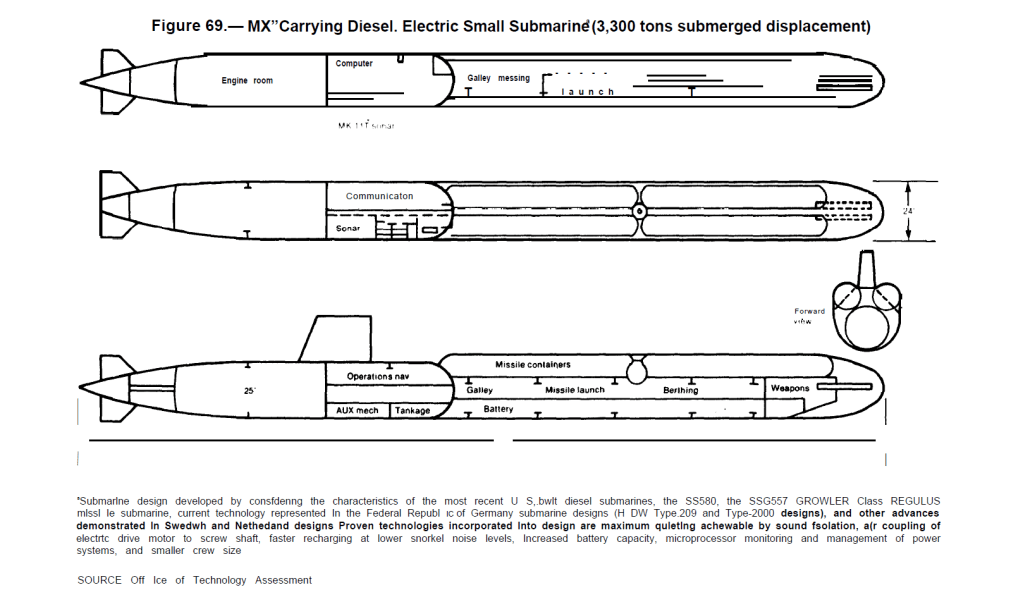
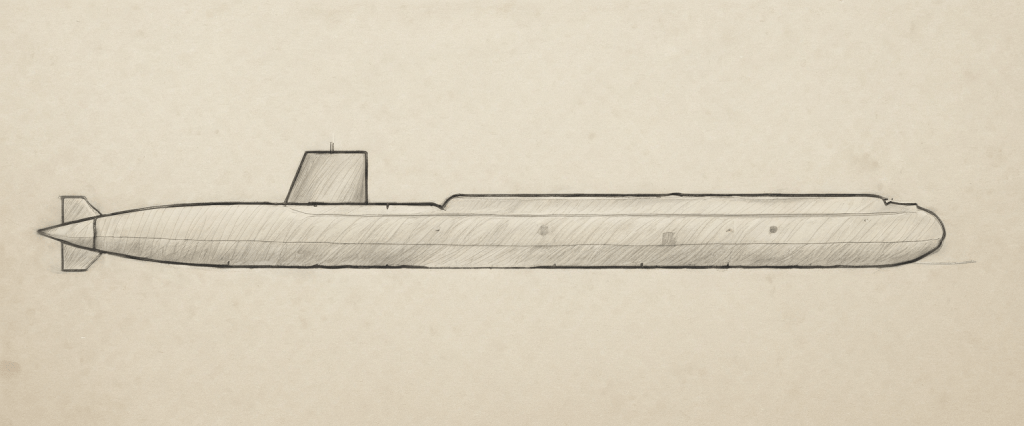
I’m torn with submarine names for the MX-SSB class, a real proposed design that I’m using in All Union

(Bottom picture made in Stable Diffusion from the outline of the sub above)

The problems are:

  • The class is large at circa 50 boats, so the naming scheme needs to support such a large class.
  • There is no historical precedent since the US never used diesel missile subs, much less in large numbers.
  • Both fish and people just don’t seem right to me (subjective I know)

I’m leaning towards lakes (ie, the Lake Tahoe class with some/all of the Great Lakes thrown in), but am wondering if there’s something that just can click. Thoughts?

One Neat Trick to Lessen Supply Requirements

What if I was to say that in certain theaters, your supply requirements can be lessened significantly? One only need compare built-up Iraq and not-so-built-up Afghanistan to see the different challenges. Or Vietnam vs. the Fulda Gap. But this is one that can best be used by an OPFOR against a wealthier foe-although rising global standards of living allow this to be applicable more and more.

Ok, so the US Army ranks different supply types by “Classes”. Now Class I, the one we’re focused on, is in short, food. Now one field manual, based on WWII experience, has it being about 7 pounds per person per day. Add that to a 20,000 strong division slice and you get 71 tons per division per day. But more room can be saved for other supplies if you adjust the Class I supply to a different amount, like say…

nothing.

Beyond what they have on their basic loads, the troops are to loot, plunder, and “requisition” food completely. Entirely. And remember: This is not neglecting enough food. This is a completely deliberate choice. What could go wrong?

(Answer: A lot.)

Cass the Heroes OC

Cassia Orsellio from Rogue Trader is one of my favorite characters in it. Yet she reminds me a lot of a Fire Emblem Heroes character: Not (just) a Fire Emblem character but a Heroes OC. She shares the following traits with the new introductions from that mobile game:

  • Is a mysterious, powerful (literal and figurative) noblewoman.
  • Is humanoid but still not human in some ways.
  • Has a central gimmick (in this case her warp eye).
  • Has a sort of “overdesigned JRPG” style about her (looking a lot more like an eastern RPG character than the western fantasy/sci fi ones of the rest of the cast).

Weird Wargaming: Patton’s Division of the Future (of 1932)

Then-major George Patton in 1932 made a long essay about the ideal army for the “war of the future”. Most importantly, it had order of battle charts. The whole thing is well worth a read, but some thoughts/highlights:

  • Underestimated motorization, saying you can have agility (professional army) or mass (conscript army) but not both. This was true in WWII (even for the Americans to an extent), but postwar motorization rendered that largely (if not entirely) moot. He proposed nationalizing civilian trucks for motorization in wartime.
  • Proposed a standing army of about 315,000 people. Which uh, isn’t actually that much less than the post-Vietnam volunteer army. Especially adjusted for national population size.
  • Patton is extremely Pattonesque. Believing his higher-trained army can always beat a numerically superior qualitative one (uh, not always the case), and being a grandfather of manueverism (not surprising). To his credit he does acknowledge the problem of keeping an elite army elite after attrition (and showing knowledge of how pre-gunpowder, almost all casualties were in the rout, whereas firearms made large losses inevitable against peer opponents)
  • The most unusual part is at the smallest level, which consists of a “section” built around a tripod-mounted belt-fed machine gun and has 19-20 men at paper strength. It’s divided into a rifle squad (fairly plain ten rifles) and an LMG squad (one LMG gunner, several assistants for it with pistols, and four riflemen) . Two such sections form a platoon.
  • Above that it’s a now-familiar triangular division. Three line platoons in a company, three line companies in a battalion, three line battalions in a brigade, three brigades in a division, a divisional tank battalion. Aka, by and large the standard post-WWII division.
  • Brigades would have a company of heavy machine guns (at the time an anti-tank weapon) and a battalion of three 75mm batteries (two field guns and one howitzer). Of note is no apparent organic division artillery, with it either being the brigade artillery or handed down by corps (the WWII Soviet prioritization taken to even greater extremes)
  • The 39-strong divisional tank battalion is mentioned as having tanks of the “Vickers-Armstrong or modified Christie type”. Tank platoons are a fairly unusual “vanilla and Firefly” type of having three “normal” tanks and one tank chassis with a larger-caliber cannon. At the time, this wasn’t unusual. Everything above platoon for tanks is conventional.
  • An infantry division has an organic paper strength of around 8,000 people.

All in all a very fascinating document. Patton may have been prescient in making a modern army, but I still wouldn’t want him commanding it (he would have been a good armored division commander, but deserved nothing higher). And of course, this army is easy to make and wargame in the underappreciated interwar period.

(Special thanks to the Tactical Notebook for its own analysis of Patton’s proposal which brought it to my attention)

The SI AI Scandal

Many people don’t know that sports reporting was one of the first big ways that “modern AI” as we know it came into public view. Basically, if you had a box score for a game where you couldn’t or decided it wasn’t worth it to send an actual reporter, an AI could (and still can) extrapolate a game story based on it. Sure, you don’t get the “yes they sportsed but we sportsed harder” quotes from the participants, but is that really a big deal?

Of course, that assumes one admits to using it. In the case of once-great Sports Illustrated magazine, they tried to sneak AI in. With presumably machine-generated (and if not machine-assisted) articles and “reporters” who were the sportswriter equivalent of Aimi Eguchi , the institution that once gave us Rick Riley’s reports was reduced to the algorithm gaming self-publisher.

Now I have no problems with AI in creative endeavors, but if you want to make something completely with it, it should be labeled as such. (I’ll leave other legal concerns aside for now). I can think of ways to make an openly fake (for lack of a better word) recapper. But any technology can be used for bottom feeding, and this is no exception.

The Holzer Centrifuge

The Holzer Centrifuge is a uranium enrichment centrifuge I’ve used as a Macguffin in various settings of mine. It is one of the smallest viable centrifuges and a simpler yet less effective design compared to its contemporaries. It has a maximum capacity of around 0.9 separative work units per centrifuge[1]. In practice with inevitable inefficiences and losses this leads to a mere 0.5-.6 in practice, one of the weakest individual centrifuges to ever spin in its hideous mission.

In All Union, the Polish Holzer centrifuge (named after the ethnic German scientist who led the program), served as one of the primary enrichment sources for the nation’s uranium path. The goal was ease of assembly with just domestic resources, hence why Holzer centrifuges were around 40-50 years behind their contemporaries and low-powered even by the standards of other first-gen designs. Nonetheless, they accomplished their goal.

[1]A napkin calc is as follows, with L being length in meters and V velocity in meters per second. Don’t really ask me to explain what an SWU exactly is.

Poland produced at least 50,000 Holzer centrifuges and operated 25,000 of them. Using an enrichment calculator and going by 0.6, the fully functional cascades would produce 77 kilograms of weapons grade uranium a year if working with natural ore to start, or 270 kilograms if working with reactor-grade LEU.

A Strangely Good Simulator

Now People Playground has no shortage of contraptions simulating various pieces of military equipment. Fixed wing aircraft are either the best or worst, as you get one pass before having to either try and land the thing (no fun) or let it crash (more fun!).

The strange thing is that if you pit one of these resistible forces against the moveable objects of elaborate destructible buildings also made in-game, you get a bizarrely realistic and illustrative example of the problem with urban warfare targeting. A bomb or explosive, even one that hits a building, won’t necessarily destroy more than a small part of it. A large bomb can do better but has the problem of more collater-I mean, no problems whatsoever since this is People Playground.

Quite fun that a silly ragdoll physics simulator can illustrate the issues of having one shot, having to dive, aim, and lead, and knowing the target is not guaranteed to be neutralized even after a successful hit.