Review: Shanghaied on the Rio Grande

Shanghaied on the Rio Grande: A Novel of World War Three

Just looking at the suffix of this book made me go “I had to review this.” Granted, William Joiner’s Shanghaied on the Rio Grande is more like a short story. But it’s still a World War III invasion story. I thought the length of this would mean there was some kind of publishing mistake or the story was unfinished, but no. It’s wrapped up within its few pages.

This reads like a teenager with little knowledge of the military or geopolitics who read far too many 1980s adventure novels writing a fanfic of those. I do not mean this in a negative term. The Chinese seize control of the American nuclear arsenal and walk in, dominating and trying to force Americans to become Buddhists (seriously). Opposing them are heroic Texans, one of whom is named Billy Bob (also, seriously). The story wraps up incredibly quickly (as in two pages) once the Americans get their nukes back and rout the Chinese.

Is this stupid and offensive to Texans and Chinese alike? Yes. But is it fun? Also yes.

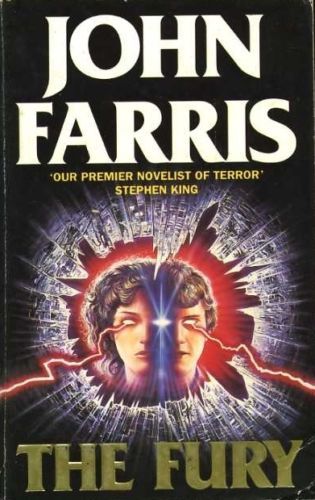
Review: The Fury

The Fury

John Farris’ psychic horror thriller The Fury is an extremely 1970s novel. The horror story of psychic heiress Gillian Bellaver and the Sandza family consisting of father/agent Peter and psychic son Robin, it manages to have both the good and bad of its genre in full, making it a very “mean 51%” book.

The Fury has genuinely atmospheric tension, excellent body horror, and a serviceable plot that anyone who’s seen Carrie and/or Scanners can get into. It also has horrendously purple smut scenes and incredible pretentiousness. For every “good icky” scene like horror powers manifesting, there’s a “bad icky” scene like-well, pretty much all of the “naughty” there is.

Beyond that, it just has too much missed potential. There’s an entire metaphysical world described past the immediate characters that reminds me of the Warp from Warhammer 40,000, but instead of exploring that and the emergence of superhumans, Farris spends way too much time on middling action and not-so-middling character scenes.

Still, this is unique enough and good enough that I’d at least recommend giving it a shot. I can see different readers having different tolerances for its weaknesses.

A Thousand Words: Power Slap

Power Slap

A show devoted to a “sport” that is as bizarre as it is dangerous, Power Slap is the brainchild of Ultimate Fighting Championship head Dana White. While White is no ones idea of an ethical person, but this is a low even for him. You might think that slapfighting is some silly, wimpy gimmick. That would be wrong. Expect maybe the silly part. You might also think that slapfighting is some kind of boxing but with open hands. That would be extra-wrong.

Slapfighting goes like this: The combatants stand on either side of a short table. Starting with the winner of a coin flip, they take turns being the attacker and victim. The attacker does an open-hand powerful slap. The victim…. holds their hands behind their back, and it’s a foul if they so much as flinch slightly.

Yes, this is a sport that literally forbids any kind of defense. There’s a reason why even people active in boxing and mixed martial arts have been scorching this for its danger. More than one commentator has argued, and I agree, that it feels like a way to prove the detractors of early MMA right. It’s nothing but hitting until one person falls down (or the round ends).

I love mixed martial arts. But this is an offshoot I do not. It feels like trying to skip straight to the highlight reel knockouts without grasping that the reason why those knockouts are so impressive is that they’re earned in a way that hitting a literally defenseless opponent is not. Or maybe it’s just Dana White being weird. Wouldn’t be the first time him or another promoter acted that way.

Review: Secret Luftwaffe Projects

Secret Luftwaffe Projects

Through diligent research and the uncovering of the original drawings and plans, Walter Meyer sheds some light in Secret Luftwaffe Projects. As a basic guide to the Luftwaffe wunderwaffe napkinwaffe, this is excellent. It also doesn’t pretend to be anything that it’s not, and doesn’t extrapolate or make wild claims.

But what it is is (deliberately) broad, shallow, and focused entirely on the basics. Each wunderplane gets a very short description of its role and a sheet of its (intended) stats. There’s no context or even reasonable speculation, but this isn’t the kind of book for this. It’s an encyclopedia of planes that never were, and in that role succeeds beautifully, complementing rather than competing with other books on the same subject.

And besides, it’s very fun to see all the crazy contraptions one after another. I recommend this book to any aviation enthusiast or anyone interested in the bizarre, because a lot of the planes here are just weird. But what did you expect?

A Thousand Words: Mega Man

Mega Man

Mega Man and Street Fighter are two of Capcom’s legendary franchises. Perhaps fittingly, they followed the same pattern: Breaking out with a rightfully praised and successful second installment after a less-than-ideal first one. And in both cases, the way they were clunky were the same: The very basics of what would make them so great were there, but they were incredibly rough around the edges.

Mega Man 1 thus has everything the later games have: Platforming, shooting, and defeating bosses to use their weapons. And in 1987, there wasn’t that much of a comparison. The problem is the second game two years later utterly obliterated it in terms of usability, difficulty, ease of play-everything, basically.

So in Mega Man 1, you have only six Robot Masters compared to the eight of pretty much every later game. But the game is overloaded with the kind of “cheap difficulty” even by the standards of the time. Spikes explain this very good. In later Mega Man games, falling into spikes kills you instantly-but if you were knocked onto them by an enemy and still had your brief recovery frames, then you had a small chance to escape if you jumped right away. Not so here-if you come into contact with spikes, goodbye.

There’s also no real good starting boss/level, and in true 1980s game fashion, the game is unwinnable unless you get a “secret” item in one stage. You could do worse for other vintage platformers, but you could also do a lot better. Like, say, one of the nine direct sequels.

Review: In The Presence of Mine Enemies

In The Presence of Mine Enemies

Harry Turtledove’s In The Presence of Mine Enemies is an expansion of a previous short story that tells the tale of a secret Jew in an Axis victory world. There’s turmoil in the Reich, and Turtledove’s classic “obvious historical parallel” is to the late USSR with obvious “Gorbachev” and “Yeltsin” figures. This is a very frustrating novel, and it shows both Turtledove’s strengths and weaknesses at full blast.

The obvious strength comes from its set pieces. The story it was based on was widely acclaimed, and in particular the “August Coup” is very well done. It also has an interesting advantage in that it’s one of the Axis victory novels that is the least unintentionally glorifying of them (as described in this post). The only wunderwaffe are the ICBMs the Germans used off-camera to blast the Americans into submission after World War II, and it’s hard to imagine a less romantic setting than the last days of the USSR. Finally it has a sinister tone and unromantic in general. The reformists are still racist (ie we want elections, but only involving “proper Aryans”), and the “August Coup” is foiled not by any fluffy ideals, but by exposing the Jewish heritage of one of the conspirators.

That works. The rest of the novel does not.

It’s long, slow, and padded out with stuff like games of bridge repeated constantly. Much of the book is given over to a lame love triangle drama. While the parallelism is understandable, it can get a little too blatant at times. The good parts of this book are great, but the bad parts dramatically outnumber them. It’s an interesting discussion piece, but I wouldn’t really recommend it for pleasure reading.

Review: An Untaken Road

An Untaken Road

Steven Pomeroy’s An Untaken Road is officially a book explaining why mobile ICBMs never caught on with the US military the way they did elsewhere. It’s that, but it’s also a history of the many, many, many different proposals for missile basing of all sorts. That alone makes it very good, especially since there’s a huge synergy with Nuclear War Simulator (after all, you can easily build and uh, “test-fire” a lot of the platforms described here).

At times the central argument can get a little pretentious and a little too focused on abstract themes. But as a pure source of information, this is excellent. There were a lot of nuclear missile base proposals right out of cheap thrillers, and this book is a great resource on them. It’s also a serious and informative look at nuclear war strategy. So I highly recommend it.

Review: Star Wars vs. Warhammer 40k Season 2

Star Wars vs. Warhammer 40k, Season 2

My voracious consumption of the Star Wars vs. Warhammer 40k fan audio drama continues apace. Having finished the self-declared second season, I feel like I should give my thoughts on it. The planet Axum is the site of the first gargantuan Imperium-Republic slugfest, and no stone is left unturned.

The pace does slow as seemingly everyone from top to bottom gets a viewpoint treatment. Clones, guardsmen, marines, admirals, Jedi, you name it. I will sadly say that a few times it does feel like the story focuses too much on individual trees and not enough on the forest, and that I’d like to see more post-Axum installments where more time and events pass in one episode.

However, this also has the virtues of such an approach, and it shows as well. A lot of the set pieces are excellent to the point where it feels like Larry Bond decided to take up writing crossover fanfiction. The culture clash as the tamer Star Wars universe is exposed to the gonzo craziness of 40k is still there and still well done. And it has one of my personal favorite plausible moments: When Republic clone troopers see Guard Ogryns, look at the huge humanoids, and think they’re Astartes/Space Marines. It’s very much a “the Panzer IV looks like a Tiger” situation, and I smiled.

For all my minor critiques, I’m majorly enjoying this drama.

Review: Dead In Their Tracks

Dead In Their Tracks

After the arduous effort of writing a book, you sometimes need to relax with a nice simple 51% novel. And JT Sawyer’s Dead In Their Tracks fit the bill nicely. The plot is the usual cheap thriller fare. The action is nothing to write home about, though I will say the book is very lean and moves very quickly and nicely.

Still, it’s like potato chips. But sometimes potato chips are what you need. I had fun and that’s what matters. Not every book can be deep, and not every book should be.

A Thousand Words: Iron Eagle II

Iron Eagle II

The budding Iron Eagle franchise was walloped by two things. The first was actor Jason Gedrick, who played Doug Masters, being occupied with the movie Rooftops, forcing his character to be killed off. Ask Alien fans how they feel about star characters being unceremoniously disposed of. So there was one misstep.

The second was glasnost. “Teaming up with the Soviets against a Middle Eastern petty dictatorship” doesn’t have the same appeal as fighting them. And if Mirages/Kfirs as “MiGs” are questionable, F-4 Phantoms as “MiGs” are downright laughable, being a far better known and far more distinctive shape. The plot is similar to the much later Top Gun: Maverick, in that a vague opponent has a nuclear facility that needs to be blown up, and then things blow up. However, that MacGuffin is common enough that I can believe it as just a legit coincidence.

For all the stumbling, this movie still has explosions, and is cheesy to a degree that makes the first look like a serious art film drama in comparison. Come for the terrible accents, stay for the “BMP” that’s an M113 vismod on the level of the costumes on dogs in The Killer Shrews. It’s not art, but you probably weren’t expecting a movie called Iron Eagle II to be art. It is extremely stupid fun.