Review: The Vengeance Of The Tau

The Vengeance Of The Tau

The first Blaine McCracken book to stumble, The Vengeance Of The Tau is an interesting case study in how a series can lose its mark while still remaining good. This still has all of Land’s strengths and weaknesses.

Where it goes wrong, besides just having big shoes to fill, is in the revelation of its MacGuffin. While Land is normally great at slowly building up and finally showing what ridiculous premise the book has as its foundation, here he implies something incredible and reveals it to be more lame and mundane. This isn’t just the final gimmick turning out to be something less than Land’s most out-there, it’s an example of going backwards that he almost never does in other books.

This, combined with somewhat less crazy set pieces, makes this lesser in comparison to McCracken books that came before and after it. In a vaccuum it’s still Jon Land, and it’s not even the worst book in the series, but there are definitely better ones.

Review: Black Sea Terror

Black Sea Terror

Eric Meyer and Todd McLeod’s SEAL Strike: Black Sea Terror is a short story. The story of SEALs preventing a shipment of S-400 missiles to Syria, it reminded me of Chet Cunningham’s SEAL Team Seven novels. Or rather, it reminded me of a hypothetical Chet Cunningham SEAL Team Seven novel that was shrunk to a fifth of its size to fit in a magazine.

The S-400 system itself is treated as a multirole missile that’s somehow incredibly dangerous on its own (and no, it doesn’t have any kind of different warhead) instead of just being a high-end SAM. The action is just passably good enough, in a “small bag of potato chips” way.

In fact, a “small bag of potato chips” accurately describes the entire book. It’s tiny, insubstantial, and not truly “good” by any measure, but it’s still quite “edible”.

Review: The Gambit

The Gambit

Take a stilted first novel, add a difficult genre, and you have Brad Carlson’s The Gambit. This tale of Iranian plots and the Americans out to stop them reminds me of, if anything else, an even rougher version of Gavin Parmar’s Unseen Warriors. The problem is that technothrillers are harder to do right than small unit thrillers. I don’t want to be hard on the author. This is a first novel, I know firsthand how much effort writing any kind of long fiction is, and everyone has to start somewhere. But I have to be hard on the book.

There’s the clumsy prose, but there’s also the awkward pacing. There’s the action that falls well below even the standards of Marine Force One, but there’s also a ton of conference rooms and really rote instances of military equipment doing its thing (I hesistate to use the term “action” for the scenes describing it). There isn’t even an out-there premise. It’s just “shoot the terrorist” and stopping the most basic and mundane plots, all the while moving through something horrendously unpolished.

There are good independent first novels. This is not one of them.

Review: Black April

Black April

George Veith’s Black April is an excellent chronicle of the final fall of South Vietnam. Taking as many sources as he could, Veith paints the picture of an understudied and underappreciated campaign.

The interior workings of the North Vietnamese are very fascinating and, in my opinion, the best part of the book. This is because the campaign was the biggest example of a Soviet-style army defeating a western-style one decisively. While all the planning texts and documents can show a strict operational plan where everyone adheres to their role, in any reality, friction and human conflict is always there, and this shows an example of it in practice.

Veith is on less firm footing with the southerners. While his goal to emphasize the damage of the aid cutoff and give the southerners a fair emphasis compared to their scapegoating as inept bumblers from start to finish is admirable, his opinions about the primacy of the aid cutoff don’t always match with the examples he shows. This isn’t to say that it wasn’t an incredibly important factor, but the frequent examples are of southern units getting chopped up by better-handled northern ones, not attritional slugfests that only ended when they ran low.

Still, this book is an excellent historical reference.

Review: Bloodstorm

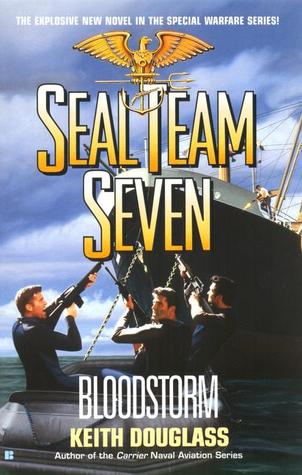
SEAL Team Seven: Bloodstorm

st71 cover

A Chet Cunningham SEAL Team Seven novel, Bloodstorm is a strange book. It features a globetrotting chase to hunt down loose ex-Soviet nukes, going everywhere from Libya using them in a Dale Brown-ist fashion to Afghanistan (in a pre-9/11 book) to Syria.

There’s the usual tons of weapon descriptions, including a “Bull Pup” (two words) that matches the ill-fated OICW in terms of what it does. Like Frontal Assault, this is a hyperactive thriller that zips around the world over the span of a comparably short book-and yet it still feels overly padded. Cunningham was no stranger to writing out large quantities of books very fast, and this feels like one of them, with a huge amount of  sloppiness. While a cheap thriller is better off moving too quickly than moving too slowly, there are better books of this type out there.

Review: The Ragnarok Conspiracy

The Ragnarok Conspiracy

Erec Stebbins’ debut in the INTEL 1 series is The Ragnarok Conspiracy. If you can accept A: Politics that are flipped 180 degrees from the stereotypical “shoot the terrorist” thriller (without spoiling much, it involves western antagonists destroying Muslim holy sites from the get-go), and B: Said politics being too-frequently pushed with all the subtlety of an after-school special, it’s not a bad thriller.

The political preachiness is a knock against it, but it’s not nearly bad enough to get in the way of a thriller with good fundamentals. Yes, it’s a rote thriller. Yes, its message doesn’t exactly go well with a main villain who’s the kind of person Blaine McCracken deals with on a daily basis. But I’ve definitely read worse.


Review: The Suns of Scorpio

The Suns Of Scorpio

sunsofscorpiocover

A while ago on Fuldapocalypse, I reviewed the first of Kenneth Bulmer’s Dray Prescot “sword and planet” novels, Transit to Scorpio. That was at least somewhat fun. The second novel, The Suns of Scorpio, is less fun and more pretentious. And after only one book, the novelty of the setting has definitely worn off.

The setting is about a continent wide and a millimeter deep. This wouldn’t be such a problem if it was supposed to be mundane (ie, a world with a convenient near-endless supply of mobsters for Mack Bolan to kill) but it’s intended to be “exotic” and “awe-inspiring”. What it comes across as is nothing more than a literary version of the kind of trashy sword and sandal movie you’d see on Mystery Science Theater. By trying to be more than it is, the setting turns into less than it is.

Of course, the setting and concept are all secondary to the execution in this kind of work. And here it fails even more crucially. Bulmer’s prose is ridiculous without being ridiculously fun. To call it purple would be an incredibly horrific understatement. Yet it really isn’t that exciting. It should be, but it isn’t, since Bulmer just overdoes everything. Especially the descriptions.

To top it off, The Suns of Scorpio ends on a cliffhanger that brings the artificiality of the setting to full force. I’ll just say that after reading this, I knew why the sword and planet genre declined so much in popularity.

(As an aside, with 52 entries completed before Bulmer’s death, Dray Prescot is one of those individual series that far outstrips the entire “conventional WWIII” niche in terms of quantity).

A Thousand Words: xXx: State Of The Union

xXx: State Of The Union

One of the few comparative advantages that books have over visual media in the spectacle department is that huge feats can be added with no extra cost. The time and money spent on an author writing something is, for most intents and purposes, the same whether the author is writing a nonviolent office romance or a baseball third baseman fighting evil Georgists on the moon.

The flip side is that this makes most thrillers hard to actually adapt. Only the most successful can get movie/TV adaptations, and those have a bunch of risks. Smoothed out, they have many changes. Enter xXx: State Of The Union, the movie that most accurately shows the spirit of the most ridiculous “airport thrillers.”

The original xXx, starring Vin Diesel, was considerably worse. That was a period piece dated immediately in the “90s X-Treme” area (despite being released in 2002). This sequel, starring Ice Cube, manages to transcend all of that. You have stormtroopers in futuristic masks participating in an American coup attempt. You have a tank battle on board an aircraft carrier. You have a finale where a car’s tires are deliberately ripped so it can go on train tracks (where of course it fits perfectly).

Somehow it all added up so that this one and only representation of the craziest cheap thrillers ended up getting on the screen with a budget that did it justice. Something with this exact blend of “amazingly stupid” and “stupidly amazing” very rarely comes around. And that it is why, in spite of all its many, many faults, I just love this movie.

Review: 38 North Yankee

38 North Yankee

Ed Ruggero’s debut novel, 38 North Yankee, tells the story of an American infantry company in a Second Korean War. It has its issues, but works a lot better than his later book, Firefall. That had a ridiculous setup it didn’t need. This is more grounded and plausible.

Ruggero’s legitimate veteran status both gives the book a degree of verisimilitude and makes it diverge too often into Herman Melville territory.  Most of the “box checking” elements are done right. There are viewpoint characters but not too many. There are things that realistically go wrong. Unlike John Antal’s significantly worse Proud Legions, he doesn’t overemphasize the important of the main character’s unit. This is one of the most grounded “big war thrillers” I’ve read.

However, it also has the weaknesses of being grounded. The viewpoint jumps and the over-detail (including maps) clashes with the fog of war inherent in such thing. And by aiming for the plausibility it does, it sometimes stumbles into the trap of “military action can be written in a plausible or engaging/exciting way , but it’s very hard to do both.” It’s a problem that neither writers of truly serious fiction nor Mack Maloney have, but which something of this nature does.

That being said, none of these are deal-breakers and the book is very much worth a read. It might be the best Second Korean War novel I’ve read, even more than Red Phoenix.

Another (but similar) opinion can be found on the Books That Time Forgot blog.

Review: The Book Of Basketball

The Book Of Basketball

I’ll be honest, The Book Of Basketball was one of my favorite sports books, as fit someone who grew up reading Bill Simmons’ web columns. Now it looks worse in hindsight. And I don’t mean the tasteless jokes.

The secret about Simmons is that his difference from the stuffy old sportswriters is and was a matter of style, not substance. There’s the same focus on the capital-N Narrative, the “he’s got that clutch spirit” eye test, and the sort of only-a-sportswriter-can-see-it “intangibles” that aren’t talent anyone can see or statistical/tactical analysis an expert can. It’s just dipped in sleazy jokes and pop culture references.

The not so-secret part about him is his unashamed Celtics fandom. This ranges from harmless (much of the description) to mildly annoying (ranking Celtics high and then clumsily placing Magic Johnson and Kareem Abdul-Jabbar ahead of Larry Bird to go “see, I’m not biased-see”) to the seriously flawed (Having an entire chapter devoted to excoriating Wilt Chamberlain while praising Bill Russell).

The opinionated history of the NBA section is funny, somewhat informative, and really well-written. It should have been stretched to the then-present, instead of, say, the sections complaining about the MVP award and the abominable “Russell, then Wilt” chapter. There’s the inevitable “Of course a surviving Len Bias would have been a legend and not the kind of Christian Laettner/Danny Manning-esque player who’s great in college but merely good by pro standards” section.

Then there’s the Hall of Fame Pyramid, where his concept of the best 96 players of all time, from Tom Chambers to Michael Jordan are listed. It’s a fun but obvious attempt to have the cake (see, it’s a logical ranking-a formal ranking) and eat it too (“This guy knew The Secret [a banal “teamwork” cliche Simmons tries to pass off as profound], I don’t need numbers”). Take a combination of Simmons’ previous antics and an obsession with winning championships (and not the kind of obsession an actual player or even a fan understandably has, but a specific “I’d rather be Robert Horry [7 titles] than Charles Barkley [0 titles]” statement) and the result is not that good.

The anecdotes are often well-done, but lose their power when submerged in a combination of inconsistent use of stats (Simmons goes from fluffy “stats” like total All-Star appearances to an overimpressed Thomas Friedman-esque reaction to advanced stats to the sort of “You can’t measure heart”-style quotes that the likes of Fire Joe Morgan would rightfully tear to pieces), and the cliches. The Team Player against the Selfish Greedy Superstar, the man who can rise to the occasion and grab the ring vs. the man who just doesn’t have it in him. This Manichean writing is dinosaur sports commentary at its worst.

This book feels like a long-range two pointer, inefficient and outdated. There are some good moments, just like how there are still justified long two shots. But, with a decade of hindsight and a more open mind, there’s more bad than good here.