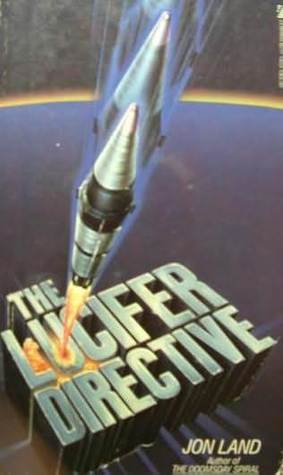
Review: The Lucifer Directive

The Lucifer Directive

jonlandcover

This early Jon Land thriller, his second published novel, has all the hallmarks now familiar to me after reading literally over a dozen of his books. In The Lucifer Directive, a young college student gets a wrong number call that changes the fate of him and the world. What makes this book relevant to the original goal of Fuldapocalypse is that the evil plot involves triggering a (nuclear) World War III.

It’s very hard to review a lot of books by the same author in the same style – even if it’s a style one enjoys. And this book, while a little clunkier than some of Land’s later books, still does his “escalating craziness” gambit very well.

In fact, think one of Land’s biggest strengths as a writer, besides his sheer over-the-topness, is his skill at that kind of plot “buildup”, for lack of a better word. Granted, it’s it’s not done in the most graceful way. Yet it works, and works very well.

Review: Dragon’s Fury

Dragon’s Fury

dragonsfurycover

Jeff Head’s Dragon’s Fury is a very interesting book, and I mean this without any snark. Viewed in one light, it’s just a clunky 800-page self-published book with robotic prose, a “Heroic Eagleland vs. the Alliance Of Evil” (which somehow includes India) plot,  and a lot of axe-grinding, the kind that would seemingly be just forgettable.

But viewed in another light, it’s weirdly impressive how many technothriller cliches it has. They’re all there, even contradictory ones. Take something with…

  • The bloat and diversion into domestic politics for the sake of soapboxing of later Tom Clancy. (Although Dragon’s Fury’s politics make Executive Orders’ seem restrained, tasteful, and left-wing in comparison)
  • The sci-fi excesses of Dale Brown at his most out-there (there’s a battle in Dragon’s Fury featuring space battleships).
  • The “look out, it’s the MacGuffin superweapon” theme of many technothrillers, especially post-1991 ones.
  • Similarly, the “a thousand viewpoint characters and a million technical descriptions” style common to the genre.
  • The robotic “play by play” battle description of books like The War That Never Was.

All these come together into something worse than the sum of their parts. The bloating and tangling keep it from being a  breezy “51% book”, turning it instead into a total clunkfest. The sci-fi and superweapon components aren’t crazy-fun like Blaine McCracken taking one of his periodic trips into outer space, just out-of-place. The battles get uninteresting very fast, especially given the “show everything in every theater” aspect of it. The big, detailed descriptions don’t work in a setting that isn’t grounded.

If it had the same “political manifesto as told by an early, monotone text-to-speech device” prose but was half the length, and had only two or three of those technothriller staples instead of all five, I’d dismiss it as “forgettably bad.” However, by incorporating all of them, by somehow taking every military/technothriller plot device and using them so consistently poorly in a way that not even Patrick Robinson can manage, Dragon’s Fury manages to become something different. It manages to become unforgettably bad. That the book is an audacious, sweeping tale of a multi-year world war (in a time when many technothrillers were lowering their scope and/or stakes) just amplifies everything.

It’s not enjoyably bad. Even I had a hard time getting through this book. But it is indeed unforgettable in its ambition. It’s as if Florence Foster Jenkins tried not only singing but writing an epic Wagnerian opera accompanied by an unironic Portsmouth Symphony Orchestra. I’d put this book, alongside the previously mentioned Patrick Robinson novels, as an example of the depths the technothriller sunk to in the 2000s. Robinson’s works were the “conventional commercial publishing” side, and this is the “self-publishing” side.

Review: The Hunted

The Hunted

huntedcover

Alan Jacobson’s The Hunted is the first entry in his OPSIG Team Black series of thrillers, although the later ones wouldn’t be written for some time after the initial publication date of this in 2001.

Reviewing this book was a little difficult. As I’ve said many times, I’m not the biggest fan of straight-up cloak and dagger books, which this definitely is. That being said, it’s kind of middling and feels (not surprisingly given its nature) like a smoothed-edges “grocery store thriller.” The climax is well-done, but getting there can be a slog.

The only thing that really jumped out for me was the book giving a “secret history” explanation for the death of Vince Foster, making the antagonist responsible. But even that tidbit can’t sustain this sluggish book.

Review: Marching Through Georgia

Marching Through Georgia

marchingthroughgeorgiacover

For a while, SM Stirling’s Draka series was a lightning rod for controversy in the online alternate history community. So I wanted to see how these tales of a continent-spanning slave empire fared as books, minus the controversy over their “plausibility”. Fittingly, I started with Marching Through Georgia.

As the paratroopers jump into the Caucasus, there are anachronistic assault rifles and Vasilek-style automortars against Kar98ks and MG34s. There are the equivalent of postwar MBTs with gun stabilizers. Now it’s not quite the most exaggerated “Vietnam technology against a WWII army” some people have claimed and the Drakan characters are certainly challenged, but it’s unmistakably clear that the Drakans are better than the Germans they’re fighting, that they have better equipment and are better fighters. The deck is clearly stacked and the “These are author’s pets” alarms are clearly ringing. So I could see why the backlash came.

In literary terms, the prose is functional even with a lot of clunky exposition to establish how the timeline diverged (a problem hardly unique to it). There are worse stories out there. The biggest problem is that the Draka themselves aren’t just unsympathetic, they’re uninteresting.

Although to be fair, this never really rises above the level of “slam-bang action war story with even more sleazy titillation thrown in”. In fact, it got to the point where I felt that all the effort expended in (not unreasonably) critiquing its plausibility seemed like punching down.

Take a decent-at-best war romp story with an inherently pulpy nation, add in a bunch of BISEXUAL AMAZONS, and for good measure, toss in some of the  understandable “commercial alternate history” tropes like “there’s still people and events the readers will recognize despite the point of divergence being centuries ago”. Now think-would something like that really stand up to massive, gigantic scrutiny over its plausibility? Would you even expect it to?

Review: Pandora’s Temple

Pandora’s Temple

After being buried for more than a decade, Blaine McCracken returned in Pandora’s Temple.

This book shakes off the cobwebs of Dead Simple and returns to what made the early McCrackens so excellent. Ridiculous MacGuffins, even more ridiculous action set pieces, giant plot twists, and more. A Blaine McCracken book works best when it’s utterly crazy, and this certainly qualifies as such.

It’s a little rougher and more “overstuffed” than some of the early McCracken novels (not that I’m complaining about too few ridiculous set pieces, it just feels a little clunkier), but is still an incredibly fun spectacle that can definitely sit along side them.

Review: The Chosen One

The Chosen One

Walt Gragg’s The Red Line was one of the first books I reviewed on Fuldapocalypse-and how could I not, with it being a Russo-American World War III, the kind that was supposed to be the blog’s bread and butter? Now his second book, The Chosen One, is out. And I felt I had to review it.

So, an Algerian man somehow becomes recognized as the “Madhi”, gets a huge army, is able to unify most of the Middle East, equip said huge army, and launch a conventional World War III. It doesn’t take place in the Fulda Gap, but the book does have all the hallmarks of the “big-war thriller” that I had in mind when starting the blog.

It has tons of viewpoint characters from top to bottom, lots of battles, a focus on air, land, and sea (via a cruise missile strike on the American fleet), and the general tropes of the subgenre. So I can say I feel very comfortable in declaring this a World War III book.

A lot of the big-picture stuff doesn’t make much sense (even in a spherical cow lines on a map way), which I’d be more forgiving of if it wasn’t brought up repeatedly in conference room exposition scenes. It’s not quite at the level of The Red Line’s convoluted way to turn the clock back to the 1980s, but it’s still there in force.

There are a few too many viewpoint characters for the book’s own good, they’re not exactly the least stereotypical, and they make the pacing jumbled (the kind of thing I sadly expected). Part of this is a cutaway to the antagonist’s stereotypical childhood. I’ll just say that A: I was reminded of Life Of Brian, and B: you shouldn’t be reminded of Life of Brian in what’s supposed to be a serious story.

As for the actual action, it’s strange. The prose descriptions are ridiculously melodramatic (not that that’s necessarily a bad thing, but still, given the tone, it clashes), but it also has more than its share of dry weapon over-description as well. There’s also anachronisms with the weapon names (which isn’t so bad if you don’t mind every enemy tank being an “M60” or “T-72”) and tactics (which is understandable but still a little out of date to see carrier aircraft flying at low altitude and having trouble hitting hardened shelters).

It’s not the absolute worst, but it’s still not what it could have been. The conclusion is also a stumbling point, which has a firefight inside an Egyptian pyramid (Ok?) that’s taken seriously and focused on while a big tank battle occurs elsewhere and is only mentioned in passing (not ok), and ends with a really, really blatant sequel hook.

This is a sort of oddball novelty-it has the roughness and er, “quirkiness” of some of the more uneven independent “big-war thrillers”, yet it’s a mainstream publication. And regrettably, its fundamentals just aren’t good enough to be more than an oddball novelty.

Review: Operation Zhukov

Operation Zhukov

It’s been a while. But John Agnew’s Operation Zhukov has brought me back. Back to the time when I started Fuldapocalypse.

So in an alternate 1992 with the USSR still going, the just-reunified Germany clashes with Poland, and it expands into a (conventional) Fuldapocalypse. And yes, there is a reference to the Fulda Gap, although most of the action follows British units farther north.

And this brought a weird feeling to me, a feeling of strange comfort and nostalgia. This is a book of constant clunky jumping around between paper-thin Steel Panthers Characters who exist purely to operate military equipment. This is a book of conference room and makeshift conference room infodumps. This is a book of clashes too grounded and technically “realistic” to be over the top fun but too detailed to be genuinely realistic (what fog of war?).

Because of all that, it’s a callback to the day where I was expecting to review books in a spectrum so narrow that I’d highlight the (in)accuracy of tank unit TO&Es to see how the book differed from the others in the pack. Here, I can say that it has more accurate T-80s in the GSFG arsenal and not the more commonly used but technically inaccurate T-72s. A similar pattern exists throughout the entire book-while there’s undeniably some issues somewhere in the “there’s this many roadwheels on this type of tank” type of description, I didn’t see any big red flags (no pun intended).

I would probably have been frustrated with this book had I read it some time ago. Now, knowing that there are many individual authors who’ve written more books than the entirety of the “Conventional World War III” genre, I feel strangely nostalgic.

This kind of book isn’t crowding out any genre and isn’t setting any bad trends. This specific book isn’t badly made for what it is, not having any truly massive errors or truly gigantic bloat. Yes, I consider it a little flat, but “flat” isn’t the worst thing a book can be. Operation Zhukov can be summed up as the World War III version of Marine Force One, a “51% book” that fits its (in this case, narrow) genre with the most basic competence but doesn’t go above or beyond it.

Review: Enemy Unidentified

Enemy Unidentified

enemyunidentifiedcover

The third book in the Brannigan’s Blackhearts series, Enemy Unidentified takes it in a different direction. See, there’s a (then) unidentified group that has carried out one of the bloodiest terror attacks ever, and the right people to take out the perpetrators on an oil platform in the Gulf of Mexico are- John Brannigan and company. How surprising!

Now the book itself is typical action-adventure. I could sum up the basic plot with one sentence as always, that sentence being “The Blackhearts storm an oil rig.” But it’s very well done, and contains one of the best cliffhangers I’ve read. Yet this falls into the problem of stuff like this being hard to describe, even in good terms. What I find more interesting is the direction the series took, and how I felt about it.

Starting here, the books became somewhat more serialized. When I first read them, my feeling was disappointment, especially after the high of Burmese Crossfire. Now, especially having actually written an action-adventure book, I feel differently. The concept of a big-picture series has grown on me. If it can keep the author motivated, it makes the stories better than just somewhat interchangeable “51%” potboilers.

A Thousand Words: Dr. Strangelove

Dr. Strangelove

Welcome to A Thousand Words, my attempt to expand Fuldapocalypse into visual media. Since this is a blog that’s technically about World War III, I figured I’d open it up by reviewing the movie that probably, more than any other, represents World War III in popular culture. This movie, obviously, is the Stanley Kubrick/Peter Sellers classic Dr. Strangelove.

The movie itself is excellent. I could complain about how some of the humor seems a little forced at times, but the positives vastly outweigh the negatives. It’s a classic for a reason.

What I find more intriguing is how utterly different Dr. Strangelove is from, say, Red Storm Rising. The entire plot centers around nuclear war, as opposed to the sidestepping most of the “WW3s” I knew did. It’s started by an American general, and there are only a few characters. Granted, some of this is the movie format at work, but still.

Review: Seven Days In May

Seven Days In May

Fletcher Knebel and Charles Bailey’s “foil the American coup attempt” novel Seven Days in May is one of those interesting books. I’d liken it to seeing the original Street Fighter, Wolfenstein 3D, Command And Conquer, or any early, genre-defining video game.

On one hand, it’s clear to see how much of a foundation it set for countless “Nation In Crisis” thrillers to follow.  One the other, well, even after accepting that this is the kind of book that isn’t centered around explosions, it’s still too dry for my tastes.

It’s almost exactly like seeing an old fighting game, realizing what it laid out for the genre-and then finding that in actual gameplay, it’s a clunkfest where a special attack is almost impossible, but if you can pull it off, it’s an instant match-winner. The prose is stuffy even by the standards of the time, and even by the standards of nonviolent political novels, I’ve seen better-written suspense elsewhere. But at the same time, I’d think it would come across as far fresher if actually read at the time it was originally published, and can appreciate it for its historical value if nothing else.