In the late 1970s, the BDM Corporation did a study for what a plausible space warship could look like (thanks to the invaluable Atomic Rockets for its analysis).
It has a spin-gravity crew quarters, is powered by nuclear reactors, and its armament consists of a laser in a de facto turret, a forward facing railgun, and a rear-facing particle beam (because the radioactive particles can’t risk hitting the ship).
The Space Shuttle in the picture is for scale-the whole thing is about two hundred meters long!
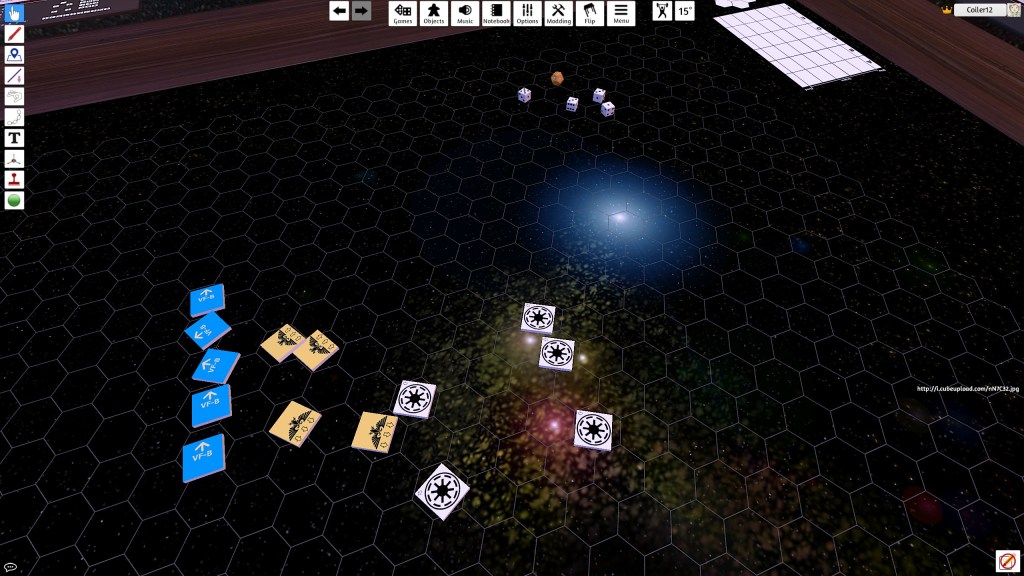
So inspired by the Star Wars vs. Warhammer 40k web serial, I made crossover fleet lists for Starmada. Then using Tabletop Simulator for a convenient hex map and making some quick counters in its editor, I ran a small fleet engagement of four Imperial frigates vs. five Republic ones.
The fleet lists are still subject to major revision but suffice to say the Star Wars side is about accuracy and fighters and the 40k one about brute power and durability. In this case brute force won out as the Imperium destroyed four Republic vessels for the loss of only one of their own.
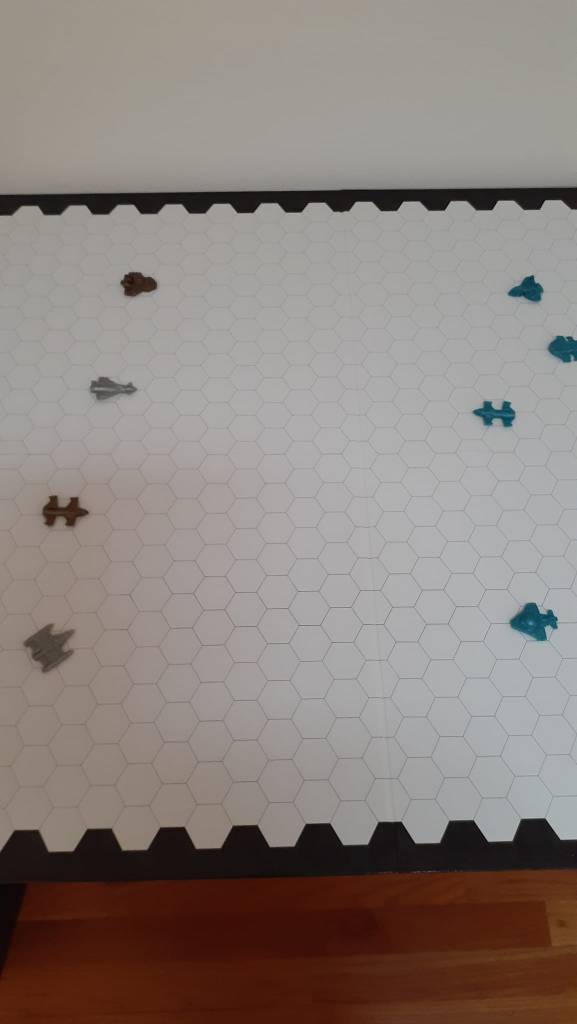
Welp, it’s finally happened. I’ve gotten a hex board.
Game board+ some cheap model spaceships as placeholders if nothing else + stands if I do get miniatures + time and effort = Physical games that I fully intend to show and share on Fuldapocalypse when played. Starting with Starmada.
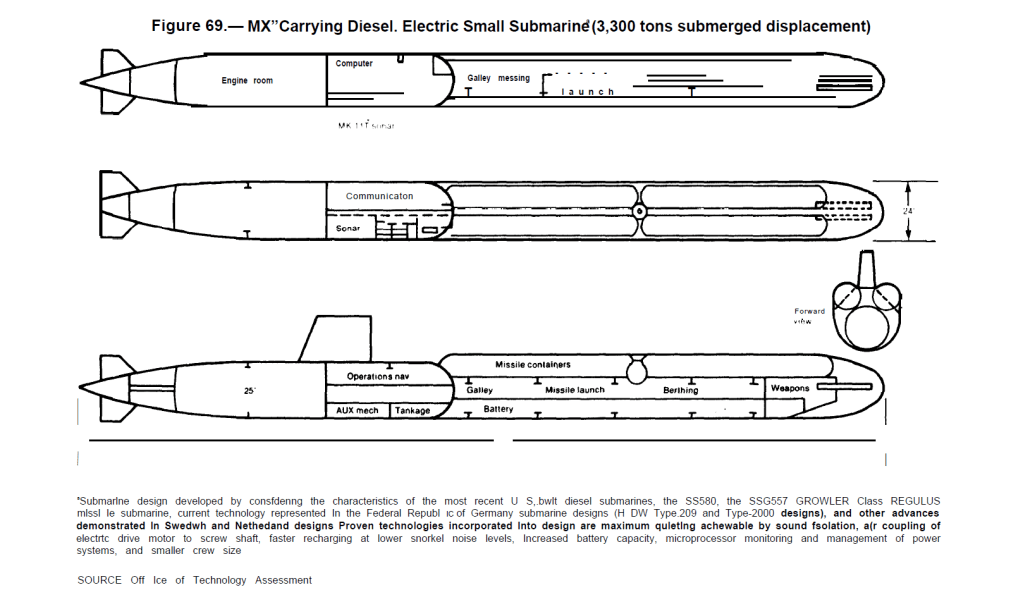
I’m torn with submarine names for the MX-SSB class, a real proposed design that I’m using in All Union
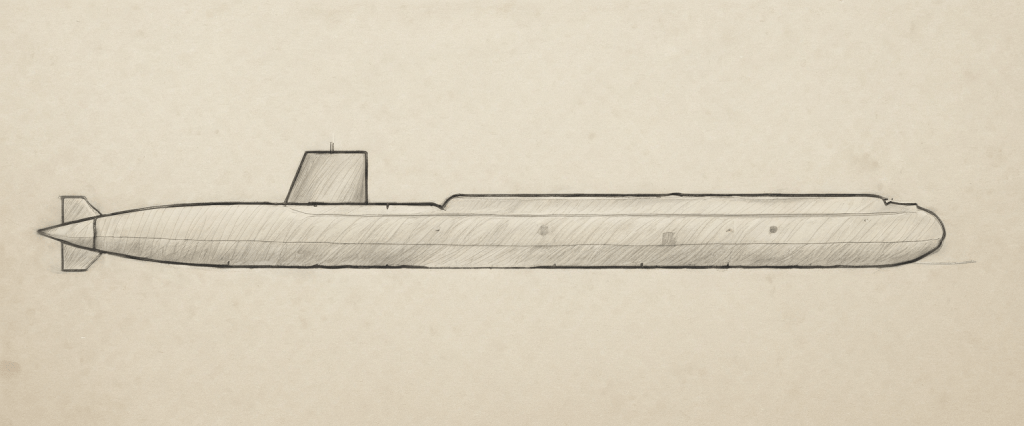
(Bottom picture made in Stable Diffusion from the outline of the sub above)
The problems are:
The class is large at circa 50 boats, so the naming scheme needs to support such a large class.
There is no historical precedent since the US never used diesel missile subs, much less in large numbers.
Both fish and people just don’t seem right to me (subjective I know)
I’m leaning towards lakes (ie, the Lake Tahoe class with some/all of the Great Lakes thrown in), but am wondering if there’s something that just can click. Thoughts?
Then-major George Patton in 1932 made a long essay about the ideal army for the “war of the future”. Most importantly, it had order of battle charts. The whole thing is well worth a read, but some thoughts/highlights:
Underestimated motorization, saying you can have agility (professional army) or mass (conscript army) but not both. This was true in WWII (even for the Americans to an extent), but postwar motorization rendered that largely (if not entirely) moot. He proposed nationalizing civilian trucks for motorization in wartime.
Proposed a standing army of about 315,000 people. Which uh, isn’t actually that much less than the post-Vietnam volunteer army. Especially adjusted for national population size.
Patton is extremely Pattonesque. Believing his higher-trained army can always beat a numerically superior qualitative one (uh, not always the case), and being a grandfather of manueverism (not surprising). To his credit he does acknowledge the problem of keeping an elite army elite after attrition (and showing knowledge of how pre-gunpowder, almost all casualties were in the rout, whereas firearms made large losses inevitable against peer opponents)
The most unusual part is at the smallest level, which consists of a “section” built around a tripod-mounted belt-fed machine gun and has 19-20 men at paper strength. It’s divided into a rifle squad (fairly plain ten rifles) and an LMG squad (one LMG gunner, several assistants for it with pistols, and four riflemen) . Two such sections form a platoon.
Above that it’s a now-familiar triangular division. Three line platoons in a company, three line companies in a battalion, three line battalions in a brigade, three brigades in a division, a divisional tank battalion. Aka, by and large the standard post-WWII division.
Brigades would have a company of heavy machine guns (at the time an anti-tank weapon) and a battalion of three 75mm batteries (two field guns and one howitzer). Of note is no apparent organic division artillery, with it either being the brigade artillery or handed down by corps (the WWII Soviet prioritization taken to even greater extremes)
The 39-strong divisional tank battalion is mentioned as having tanks of the “Vickers-Armstrong or modified Christie type”. Tank platoons are a fairly unusual “vanilla and Firefly” type of having three “normal” tanks and one tank chassis with a larger-caliber cannon. At the time, this wasn’t unusual. Everything above platoon for tanks is conventional.
An infantry division has an organic paper strength of around 8,000 people.
All in all a very fascinating document. Patton may have been prescient in making a modern army, but I still wouldn’t want him commanding it (he would have been a good armored division commander, but deserved nothing higher). And of course, this army is easy to make and wargame in the underappreciated interwar period.
(Special thanks to the Tactical Notebook for its own analysis of Patton’s proposal which brought it to my attention)
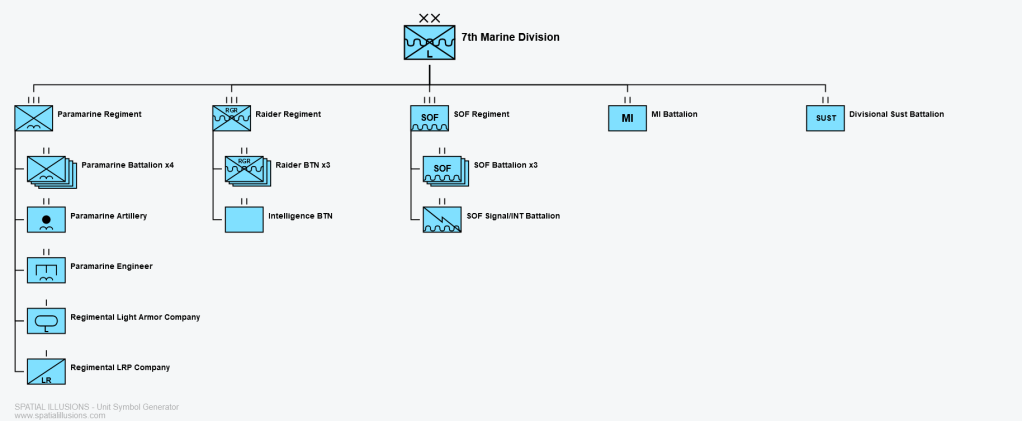
I talked about my fictional 7th Marine Division before. Now I have a more detailed personal organization (though still undoubtedly rough and with inaccuracies). Here it goes. ORBAT chart courtesy of the Spatial Illusion Unit Symbol Generator.
Paramarine Regiment
The Paramarine Regiment is like many other light airborne units, with the exception that it has four battalions instead of the usual three and its artillery battalion has thus been increased to four cannon batteries likewise, along with the other regimental support units similarly beefed up. This is to allow each battalion to serve as an independent combined arms unit to hold ground if necessary (ie around a battery in a fire support base with a battalion of infantry and an LRP platoon and light AFV platoon).
The actual battalions are largely standard triangular airborne infantry battalions.
Raider Regiment
A lighter force with less organic capability, the raider regiment is simple, with three battalions, each of three raider companies and a heavy weapons company. A regimental intelligence battalion is included because of the importance of intelligence and planning to their missions. It’s meant as a direct action-slanted commando force ie the classic Rangers.
SOF Regiment
The SOF regiment has three SOF battalions, below which any formal organization would be varied and inexact by nature (each has a number of teams, varied as you’d think, but around 10-15 each). Its communications/intelligence battalion is there similar to the ranger regiment.
Divisional Assets
Divisional assets are just more support and administrative elements, there because the 7th is not intended to be a “field” organization.
Logos
Some Stable Diffusion concepts for the logo of either the division itself or one of its subunits. You’ll notice a theme of black birds. Yes, I know crows are already the mascot animal for electronic warfare units, but oh well.
Usage
It goes without saying that in All Union, the 7th Marine Division was formed and saw action, including the 2002-2009 conflict in Western Sahara that marked the largest and bloodiest war the US military fought in that TL. If I ever need a fictional American commando force in my writing, I can always use it.
So the conventional forces of the United States in All Union, unlike its superpower counterparts, have not been the most central to any of my drafts (yet…). Therefore I figure I should infodump some of my musings on it right now.
Background
The reformation of the USSR brought about a period of aimlessness among the US Army. With the fall of the Berlin Wall and the former Warsaw Pact states forming an independent de facto buffer, priorities became much lower. Going from all of Germany to the northern tip of Norway and Thrace is somewhat of a downgrade.
That being said, there has been a shift of forces to the south. The US 9th Infantry Division is in Turkish Thrace to, in the event of a Thraciapocalypse, serve as a mobile counterattack force. The lighter 51st Infantry is in Northeastern Greece near the triple border to make sure the rival NATO countries play nice serve as a tripwire for any Soviet-Bulgarian push south.
The need for “Americi-BTRs” that historically was filled by the Strykers came in the form of LAVs, both the LAV-25/Piranha of real life USMC fame for that branch and the unrelated but similarly named LAV-300/600 series for the Army.
The medium-ization of the Army came as followed: Two brigades in existing heavy divisions with their Bradley mech inf brigades replaced with LAV mech inf brigades ie BMP-BTR mixes, two “medium-heavy” divisions based around LAV-300s with a divisional tank battalion that would stay behind on lower-intensity deployments, and one “medium-light” division with the LAV-300 series, more uparmored HMMVs as the infantry carrier, and no organic tanks. For the USMC, the Seventh Marine Division came into being, along with Combined Arms Regiments (mixes of tanks and LAV-Bisons proposed in real life) for the three active USMC divisions.
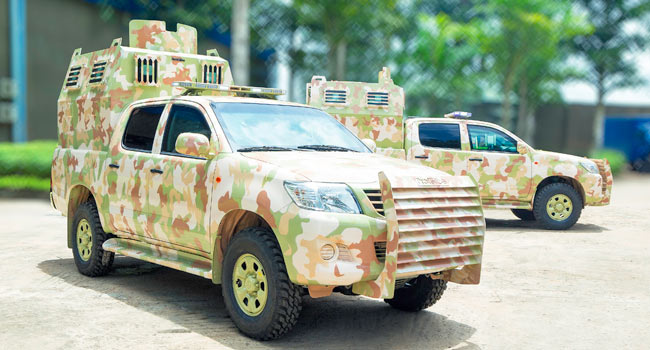
Stable Diffusion gave me a chance to make something I’ve long imagined: A truck-APC belonging to a Seleucian (one of my OPFOR countries) Motorized Special Forces unit. First, the picture itself.
There are many existing heavy-duty pickup conversions like this: An armored pickup with the bed replaced by a capsule that’s even more fortified.
(You get the idea)
Now for their organization: Seleucia’s large “Special Forces” components are motorized to varying degrees. The quotation marks are because few of them are what NATO would consider “special forces”, with many being simply conventional troops with better training and motivation than the other ragged masses of that country’s huge army. Still, Seleucian motorized SF have shown their capability.
A Seleucian motorized SOF battalion is similar to a light infantry one, only with armored personnel carriers. As the mere “transport” capacity is prioritized, motorized SOF often ride in older and/or cheaper vehicles-like armored pickup trucks. APCs frequently hide after dropping off their dismounts. A common defensive tactic for Seleucian commandos is to drive close to an ambush site, conduct the ambush on foot, then scramble back to their carrier and move to another one later on.
However, it is not uncommon for Seleucian motorized SOF to accompany heavy units of tanks and SPGs in conventional operations. Here they fight similarly to Stryker/BTR style infantry in faster wheeled APCs of other countries. In conventional defensive operations, motorized SOF have a somewhat unusual role as mobile antitank detachments. Thanks to their skill, mobility, and flexible organization, SOF battalions with large amounts of of anti-armor weapons can be used similarly to the tank destroyers of other nations.
The Saxon and BTR-152 are examples of the basic style of APCs frequently found in Seleucian motor SOF units. Tracked vehicles, mostly basic ones like M113s and MTLBs, are rarer but not unheard of, especially where the terrain suits them.
Using a ballistics calculator, I came up with a 185mm artillery piece with the following performance. Why that? Because few/no real guns have the caliber, and I wanted something between 152/155mm and 203mm. When not obtained via the calculator, results are extrapolated from the S-23, the closest real life equivalent, with some enhancements like faster loading and lighter weight to simulate better technology:
185mm Artillery:
Maximum range: 27-41 km, depending on ammunition.
Rate of fire: 2 rounds/minute
Average shell weight: 70-75 kilograms
Approximate Mass: 13,700 kg
The artillery piece is usually self-propelled on a tracked mount, but towed variants do exist. It tends to serve as a corps/army level weapon whose primary goal (and largest shell portion) is counter-battery and other missions where range is more important than size, although it can do anything a big gun can. Advanced users have developed nuclear shells for it, and the usual conventional ammunition types (regular HE, cluster, etc…) have been made.
In Nuclear War Simulator, one of my favorite creations to use and drop is something I’ve called the “Huangdi Bomb”. The name, after Chinese for “Emperor”, is a pun on Tsar Bomba. Only this has a bigger boom at 75 megatons. It’s also, in the backstory, a lot more advanced and sophisticated. Unlike the publicity stunt that was the Tsar, the Huangdi is a mass-produced, deployable weapon capable of fitting inside either an H-6 or large ICBM without issue.
It’s also, judging by the maximum payload of the Badger and its yield (the classic yield-weight calculation), the most efficient nuclear weapon ever made. As it has a multi-decade lead on the other megabombs, this isn’t surprising. As for how and why such a beast is used, the theories for the gargantuan warhead are hitting extremely large targets, making accuracy issues irrelevant for simple countervalue operations, improving warhead efficiency in a big design before trying to apply it to smaller ones, and contributing to deterrence by intimidating would-be-opponents with its yield.
In various NWS scenarios, I have about twenty Huangdis made overall, in both air-dropped and missile carried versions.









 Fuldapocalypse Fiction