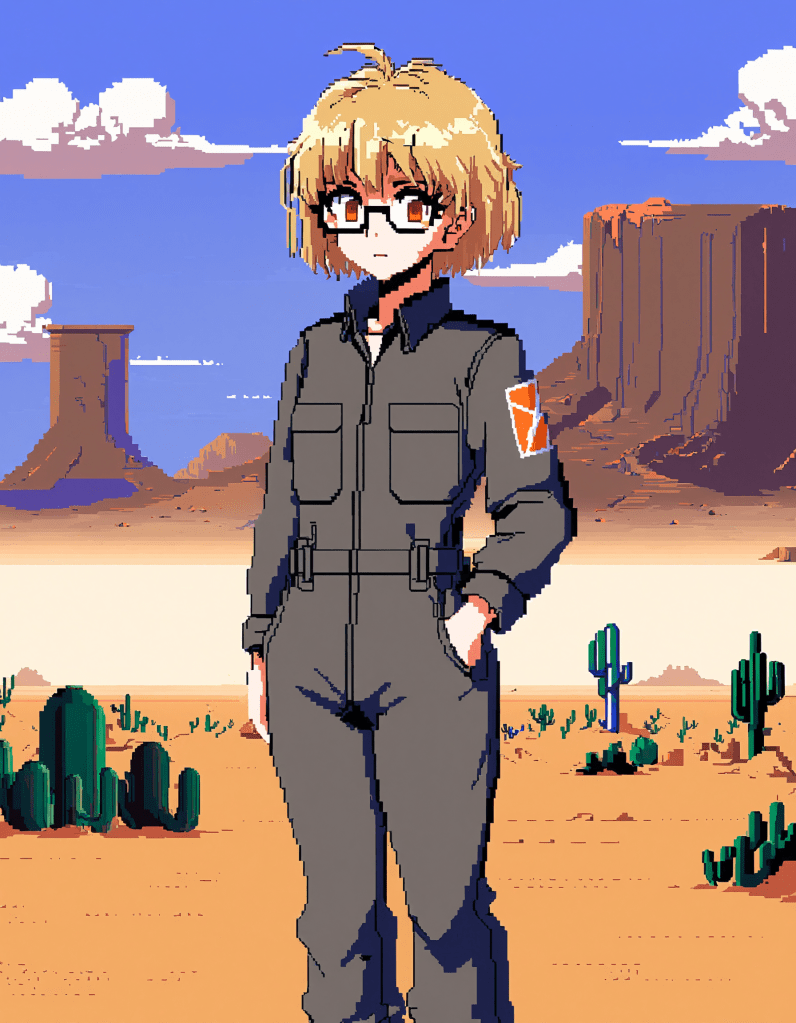
Meet “Claire Velazquez”, one of my latest AI projects. Claire began life as one of the blank-slate characters with no face. Namely, she was one of the runaways you could control in Road 96, with this random icon being the only clue as to her looks.
So with the only cues being “short hair in some kind of bob” and “glasses”, I turned to prompting various Stable Diffusion models. Claire tends to wear grey working clothes and in her anime depictions has orange eyes.
Claire was a runaway (duh) with a long and “eventful” journey. She managed to escape via truck (the method that avatar used) and find employment outside of Petria.
In my 5+ years running Fuldapocalypse, I think I may have found the most dull book I’ve ever reviewed. That would be a reference book with the appropriate name of The British Carrier Strike Fleet After 1945. I feel a little bad calling it that because A: It’s a reference book, and B: It actually has quite a lot of good information about British carriers.
However, even by those standards I found it a slog. To put it very mildly. And I read reference books for fun! So I’d still recommend it if you like aircraft carriers. Just be warned.
The game Road 96 is an adventure game in the style of the old Telltale ones where you walk around, do dialog choices, and play the occasional quick time/minigame as one of a series of teenage runaways trying to escape the country of Petria in the mid-1990s. You go through one somewhat different set of campaigns which you can change through varying degrees, either by dialogue choices/actions or picking how you’re going to travel (via hitchhiking, transport, a car if available, or if you’re really crazy, walking).
On one hand, I saw basically every plot twist coming and the setting is a little iffy. Not the graphics, which are good for what they are and have an excellent visual design. Petria is a semi-eastern European country (its strongman leader looks like Brezhnev) whose residents have the demographics and style of 21st Century Americans. And for a desperate-to-escape country, it really only resembles a moderately lower-class area of the West.
The characters make up for all of it, as they combine quirks with genuinely hidden depth. While the story is a little janky due to the nature of the gameplay and has the adventure game problem of your choices ultimately not mattering that much to the main plot, it works and more importantly can jump between tones in scenes without it being seeming forced or jarring.
So yeah, I had a lot of fun with this game, even if it’s not normally my style.
Naval forces in All Union’s Soviet Romanian War were bound to play a peripheral role. Romania had a small and weak navy, a relatively short coastline, and massive conventional amphibious landings were geographically dubious and militarily even more so. Constanta was overrun and surrendered almost immediately after the war began. Even Soviet historiography talks very little about what they and the Bulgarians did at sea, mostly just mentioning bombardment, surveillance, transport, and other routine supporting tasks. Most naval infantry units fought on land.
Yet it would be a mistake to assume that the navies did nothing or that there was no drama. Although overshadowed by the crossing of the Danube and the massive deep airborne operations, one of the largest postwar aerial/amphibious landings was conducted in Tulcea County.
Units near Bolhrad would cross/lift/fly over or infiltrate via smaller boat.
Heliborne units from the Black Sea would stage and make large landings in the depths. Black Sea Fleet aircraft and ships would naturally support them.
The Tulcea operation was considered lower priority and was assigned fewer resources and, uncharacteristically, had its commanders given instructions to not try and force it if the initial advance stalled. (In contrast, the Danube Front units tasked with taking the Constana area were told to rightfully treat it as a high-priority one).
Notable events:
September 8-9: Landings. Many inoperable Romanian ships destroyed in port.
September 8: Romanian corvette M290 sunk by SS-N-14 missile. Romanian submarine SC-02 sunk.
September 9: Sole successful Romanian air attack against Soviet Warships. Missile craft Kittivyek sunk by Romanian MiG-21s. Two other unsuccessful attacks. Five aircraft and four ASMs shot down.
September 10: Gunboat PSKR-710 destroyed by mine. Four Romanian craft sunk. Romanian submarines Pastrav, SC-01 sunk.
September 11: Final attempted Romanian air/missile attack on naval targets. Completely unsuccessful. Romanian submarine SC-05 sunk by Soviet submarine S-39 in the first post-WW2 mutually submerged sinking. Soviet landing ship SDK-303 sunk by mine.
September 13: Tulcea operation completed with mutual link-up.
September 14: Final surface engagements of the war, a duel between small boats in the north and Bulgarian ships sinking an attempt to flee southeast into the open ocean, presumably to Turkey.
September 16: Final naval engagement. Romanian submarine Ton sunk.
The main takeaway was that ASW was successful (no Soviet ships lost, no disruption) but it was under ideal circumstances (being able to just smother a small area).
Vipin Narang’s Seeking the Bomb is another nuclear proliferation study, this one focusing on how the bomb was sought, not why. This is an incredibly frustrating to read (but very fun to review) book because of how it wobbles across both extremes of political scientist writing.
Right off the bat a gargantuan flaw comes into being: Having a central thesis heavily committed to theories and charts that simply don’t really translate well into an incredibly complex set of situations with a very small sample size. This is disturbingly common in works by political scientists, of which the author is one. It’s also adversarial in its nature and cites multiple kinds of “conventional wisdom” as wrong, including both other scholarly studies and pop-history claims. This feels like a college work in that it’s written to defend a thesis argument rather than simply study the subject.
Fortunately, this book has a lot of strengths as well. It is very well researched and has an effective categorization of nuclear seekers as either hedgers (building up the known capacity but holding back for political reasons), sprinters (just openly moving ahead at all costs), and hiders (trying to keep it concealed until too late). Its story of how India moved from hedging to blatant hedging (doing an unweaponized explosion in 1974 with obvious hints) to just open use is well done as a case study.
Yet I still feel it lacks somewhat in terms of applying technical capacity. This is not to say the book never acknowledges it-it recognizes that South Africa’s ability to make a domestic enrichment plant and other technologies contributed to it being the one successful hider, praises the scholarship of Unclear Physics even as it disagrees with its conclusions, and mentions that Libya’s program was doomed. But I think more detail, more appreciation for both technical challenges and opportunities, and a couple fictional “Nth Country” hypotheticals would have done better. Almost any reasonably advanced country could sprint to a bomb in the kilotons, even if cruder and more dangerous than established ones, if they really wanted to, and I don’t think Seeking the Bomb comes across as appreciating that in its text.
Still, if this is an uneven book it’s an interesting and well-done kind of uneven, and I don’t regret reading it.
So a while ago I did the obsessively number-crazed Soviets studies on their planned rates of advance. Looking at my descriptions and map games writing in All Union, I’ve thought “hmmm, how could this go in practice? Or at least fictional speculative practice?”
The Theory
Against NATO, 40-60 km a day on average was the goal. Against a weaker opponent (like one based on the Chinese conventional forces at the time), it was even more, around 70-100. By the 1990s GENFORCE (what I patterned the mobile corps off of), it was down to ideally 30-40, albeit against a stronger opponent.
Romania in Practice
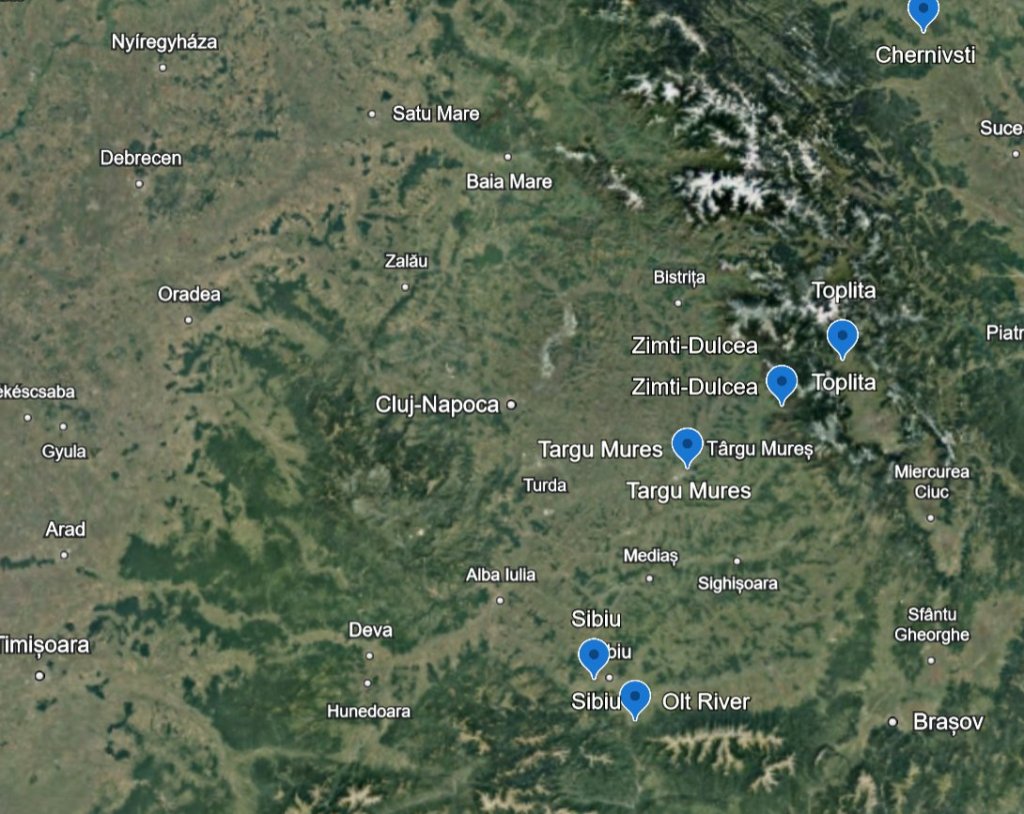
As it stands, I focused mainly on the 17th Mobile Corps, and had a (fairly) detailed route after much Google Mapping. It left a line of departure from near Chernivtsi on September 8, 1998, and came to a final stop around Sibiu on the 16th-17th. On the way it cleared out the important crossroad town of Toplita, crossed the Carpathian mountain roads, and fended off an attack on its bridgehead near Dulcea.
Map is a vague generality. Different subunits progressed around different mountain roads and frontages. Length is hard enough, don’t ask me to do width.. :p
Using a pure napkin calc, this comes to 285 kilometers from the Chernivtsi border region to Sibiu, which leads to 8-9 days of high-intensity fighting, which means a very rough 30-35 kilometers a day. So not bad by GENFORCE standards, especially with a rough terrain making up for a weaker on paper opponent and with the counterattack at Dulcea costing it an entire day.
So not too bad….
The Problem
Of course the definition of “rate of advance” is incredibly arbitrary (does it mean anything in that unit, so can we count a patrol of BRDMs moving far ahead and encountering no resistance before circling and stopping, then the main force reaching that spot without issue later?) and depends a lot, as anyone would admit, on circumstances.
In the same war, many Danube Front formations barely made it past the river, and some that did moved at the equivalent of a brisk walk. But clearly a unit of press-ganged Bulgarians with 1940s equipment having to do an opposed crossing of a very long river and then facing coherent defenders with many fortifications is not the same as a high-tech, high priority force smashing across the plains against a broken foe.
It’s hard to find a book with a more accurate title than The Big Book of Serial Killers.This is an A-Z compendium of both solved and unsolved serial murders. Being exactly what it claims to be is… beneficial. It does not shy away from how simultaneously disgusting and pathetic nearly all of them are. Even the smarter ones come across as less Tzeentchian chessmasters and more people who just got away with pulling the same basic trick against soft targets-until they couldn’t.
The book even pads it out by including a few cases of people who weren’t the classic kills-for-the-sake-of it murderers. It includes a handful of terrorists and excessively violent robbers who simply Trevor Phillipsed their way past every victim. The comparative effort of those makes the mentally ill creeps stand out even more.
While its subject matter is obviously not for everyone, this book is excellent for what it is.
Against my better judgement, I got another H. John Poole book. The title made me naively think “oh, this could be a set of practical drills approached from a different perspective.” So like any H. John Poole book, this is about 5% reasonable well-thought out arguments (in this case: Formations should be simpler and grenade skill should be focused and emphasized) mixed with 95% incoherent rambling about how artillery is useless.
The “logic” is a classic all or nothing where if the artillery fails to destroy everything in its path and close combat is still necessary, therefore artillery is useless and only suitable for clunky western armies and not cunning subtle ‘eastern’ ones. He even argues that artillery and aid of artillery has not been useful in the contemporary war in Ukraine, which is… something. But not something good.
By this point Poole has lost most of what teaching value his books had, and I recommend avoiding them.
Wario Land 4 is one of my favorite games of all time. Wario Land 3, coming out on the preceding Game Boy Color not long before, is not. This is one of those games that you could tell the developers really just needed more power and focus and it would click. With the GBA and a clearer focus, it worked. Here it didn’t.
This is less linear than Wario Land 4 and has the gimmick in that Wario can’t actually get killed (but can get knocked back and cost the player time that way). The problem with losing time instead of losing health is obvious, especially since WL4 didn’t have any absolute game overs. In fact, this game can be described as slow, slowly moving and slowly backtracking in the semi-open world. A lot of this is probably due to the 8 bit GBC’s limitations, but that only makes it dated.
Thankfully, the graphics are very good for the hardware limitations and do not feel dated, and the chiptune soundtrack is beautifully quirky and excellent. The game just doesn’t really gel and has the “misfortune” of being followed up by a classic.



 Fuldapocalypse Fiction