The ebook version of the second All Union book, A Period of Cheating, is now out!
The paperback will be up soon.

The ebook version of the second All Union book, A Period of Cheating, is now out!
The paperback will be up soon.
A very timely book, Einat Wilf and Adi Schwartz’s The War of Return is a look at the Israel-Palestinian conflict. That the two support a two-state solution and a return of Israel to pre-1967 borders makes it all the more credible. Trying to go and see why the Palestinians have been more intractable than even the other Arab states, they come to a “temporary UN program”.
I knew about the legitimate beefs the Palestinians have with Israel (yes they exist), and how the other Arab nations have used them entirely as political props and tools for decades without wanting to care for them. Yet the key in the lock they’ve explained is the UNRWA, which ended up becoming both a local government (seriously) with an international fig leaf and something that fanned the fires by using the term “refugee” in a way completely different than what everyone else, including the rest of the UN, uses.
(Short oversimplified version: The UNHCR which handles refugees literally everywhere, has a narrow definition and formal apoliticality. Once someone is settled, they aren’t a “refugee” anymore. So WRT Syria, if they’re settled they’re no longer a refugee. Be it in Turkey, Germany, the UAE, Ireland, America, or Bangladesh, that’s that. Also, whether they were pro-or-anti-Assad is irrelevant in that case. In contrast, the UNRWA has effectively made every single Palestinian family into a dynasty of “refugees”.)
It’s hard not to read this book and think that just a bit of negotiation here and a settlement there can still work (or could even before the current war). This makes it a sad but excellent and true story.
I indirectly experienced the eclipse today. Didn’t look in its direction but did notice how dark (in this case somewhat) it made the surrounding area.
Readiness issues with liquid oxygen rockets historically retired them from the ICBM role once alternatives became practical (be it storable liquid or solid fuels). Yet one technological curiosity was an attempt to work around the issue.
A variant of the R-9/SS-8 ICBM with the typically obtuse Soviet industrial designation of 8K77 had the vacuum flask principle applied to its oxygen tanks. At least in theory, it would keep the liquid oxygen cold long enough for a fueled missile to wait on alert in a crisis. Vacuum flasks are of course better known in the capitalist west by their brand name turned generic name, the thermos.
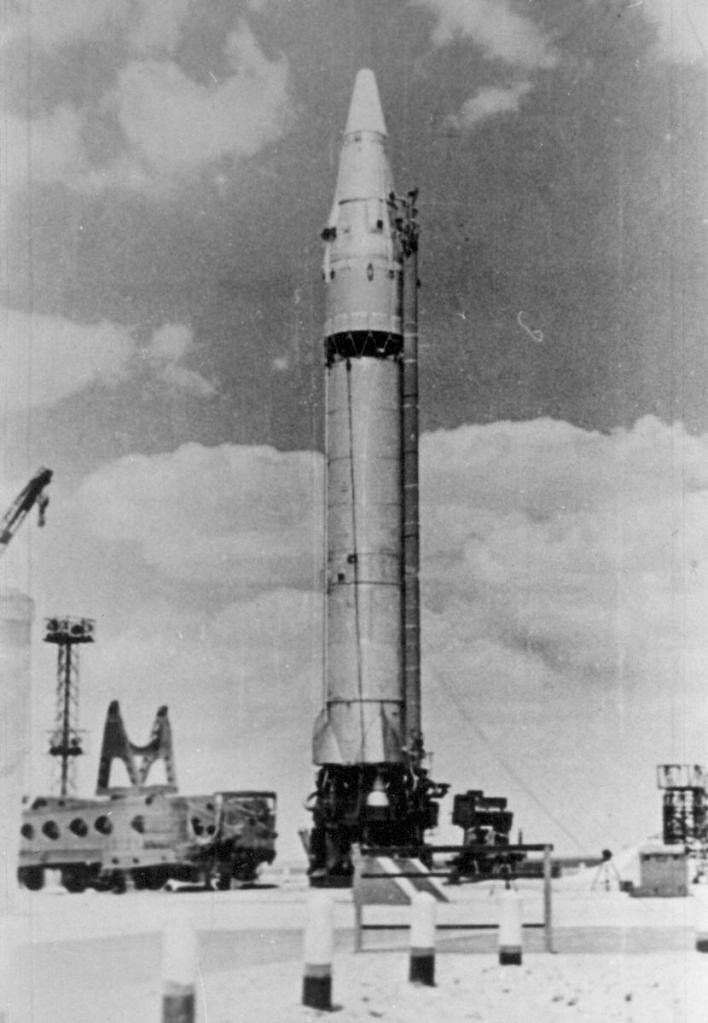
It would be very cold and then very, very hot.
In the early-mid 1970s, arthouse filmmaker Alejandro Jodorowsky ended up helming an “adaptation” of Dune. The quotes are deliberate as the movie and its tone would have been Starship Troopers/The Natural levels of intentionally different from the book. In 2013, the story of the most extravagant and absurd movie that never was was finally told in the titular documentary.
This is a great production. Everyone is clearly enjoying themselves as they talk about how the production got more and more crazy. Jodorowsky had his own son play a major role, and of course the son talks about it decades later. The art and effects brought together such figures as Jean “Moebius” Giraud, Dan O’Bannon, and H. R. Giger, the latter two of whom would make a monster movie that was a little successful. Yet the all-star cast was the craziest, featuring Orson Welles (paid in free food) as Baron Harkonnen, Salvador Dali, and Mick Jagger.
What makes the documentary shine is its soundtrack, with Kurt Stenzel’s minimalist electronic score being both a perfect accent and a great piece of music in its own right. (Although I’m biased because I like minimal electronic music, fair warning). The cinematography is also effective.
If I had to have one quibble, it’s that the documentary didn’t have the necessary devil’s advocate/reactor scram button to bring things down to earth. The movie is mentioned as being impossible, but in the sense it was too ambitious for Hollywood. In actuality, it would have been unreleasably bizzare, bound to burn money in its production, and simply strange. (There are scenes in at least some versions of Jodorowsky’s Dune that the documentary doesn’t mention, likely because they’re too weird and/or gross). If it actually got out the door, Jodorowsky’s Dune would probably just have been a bloated mess like Marlon Brando’s The Island of Dr. Moreau.
Still, this is a great documentary about a great story, even if it wouldn’t have been a great movie.
An Osprey book on the air war in WWII’s final year, Eastern Front 1945 is about the often-overlooked in the west clash in the eastern skies. It basically does every Osprey book thing right. While it’s not the most detailed, it provides an excellent overview of the somewhat different air war (ie, where the P-39 shined even as it flopped in other theaters).
One thing I particularly liked was how the book accurately showed the air campaign’s influence on postwar Soviet/Russian doctrine. Instead of a “big blue blanket” smothering every enemy in its tracks, it was focused on targeted air superiority and supporting maneuver formations. Which led to February 1945 when the Luftwaffe actually regained air superiority for a time. ( In short, they pulled more or less every propeller fighter away from the fruitless bomber interceptions and were were able to operate from intact developed airbases while the Soviets were worn and had their field strips wrecked by bad weather)
It’s a good look at both Soviet air doctrine being successful and at the eastern air war.
Actor Louis Gossett Jr has passed away. I knew him best as Chappy in Iron Eagle. RIP.
So the question has to be asked: What about this?
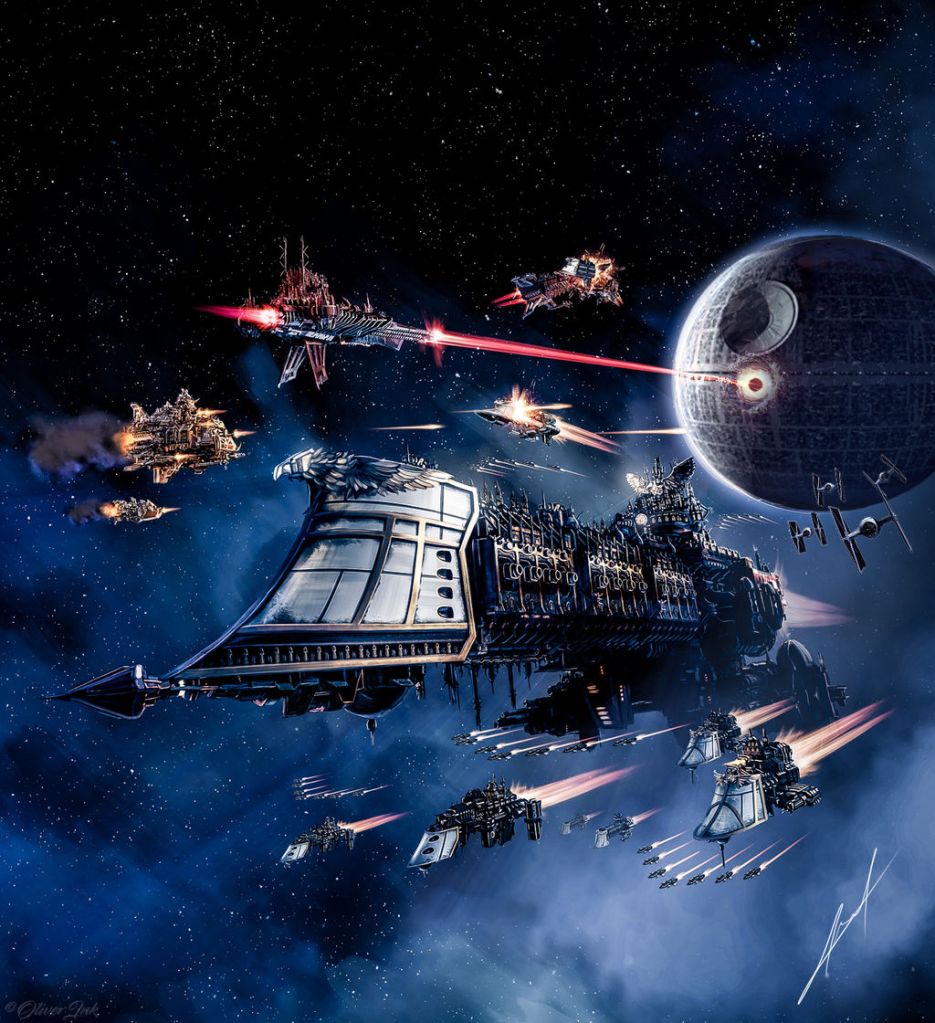
A Star Wars/Warhammer 40k crossover has to include the battles of evil vs. slightly more justified evil and feature a large Imperial Navy cathedral armada going up against the Death Star (presumably with its own array of Star Destroyers). Now I have put some actual thought into this.
Passenger planes made in Britain followed an almost exactly stereotypical British pattern: At first bold and trend-setting, then fell behind due to both luck and skill, finally becoming just an international cog. The could have beens and never weres of this are shown in Richard Payne’s Stuck on the Drawing Board.
This is a fun, if niche, book for aviation enthusiasts. The big problem from the nature of the planes it describes. For passenger planes that are all essentially just tubes with different capacities, VTOLs and odd shapes are the absolute most different you’re going to get.
But this isn’t the book’s fault, and you’re left with a fun look at what could have happened before the 707 and its successors crushed any hope of a full-scale British aviation industry.
So time for one of the biggest internet controversies surrounding the Warhammer 40k fandom. Note that I said “internet controversies”, not “controversies”. This post therefore might be controversial itself. Oh well.
This has to do with Female Space Marines. In-game, for basically all of 40ks solidified existence, the gene-seed that produces the super-space-knights who serve as the mascots of the setting only works with men. Games Workshop has been extremely strict and clear with this. Some online advocates have opposed this and wanted a change.
I’m pretty firmly in the the “no female space marines” category, and not just because my Imperial Guard doesn’t have this problem in the slightest.
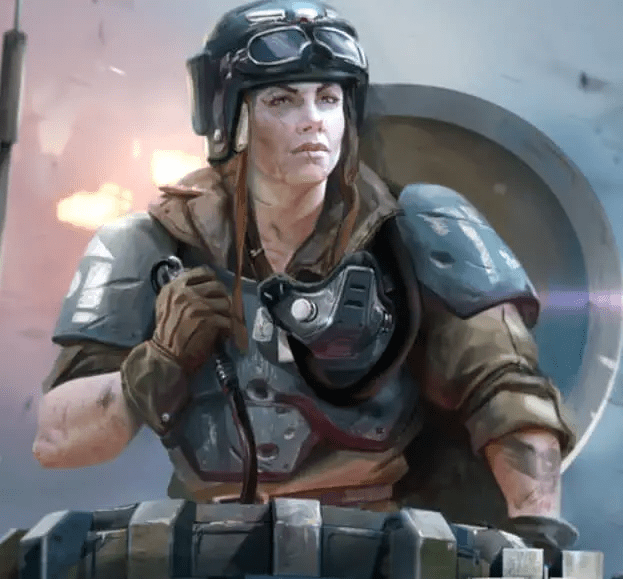
I think one of my reasons is because a Space Marine has become a very specific thing. I would even argue that if you asked a layperson unfamiliar with the setting to describe one, you’d end up with either a Sister of Battle or a female Tempestus Scion (neither of which has any issue). Those can and do exist without any issue. Female techpriestesses can and do exist without issue, if you like someone so covered in augumentations that their initial number of chromosomes becomes irrelevant. Female Eldar and Tau can and do exist…
In fact, this is the diversity argument I have. If female space marines were adopted, they’d actually make the setting significantly less diverse. It means (even) more of the already pushed setting mascots and (even) less of the factions where this isn’t an issue.
(As for diversity in the setting overall, I have three big takes:
 Fuldapocalypse Fiction