TK Blackwood’s 1990s continued Cold War gone conventionally hot series continues in White Horizon, an excellent installment. The Fuldapocalypse not only continues apace but features the powerful but often overlooked country of Sweden as a major setting. Featuring everything that has made the past installments so good, this was a joy to read.
The only real “problem” was teasing a successor. But that’s a good problem to have. This shows that the “cold war gone conventionally hot” subgenre still has quite a bit of life in it.
Officially, this was the second movie in the Ator series of Conan the Barbarian knock offs. But it’s as “Cave Dwellers” that it leapt into my heart as the greatest Mystery Science Theater 3000 episode I have watched. The small and sus company known as Film Ventures International took a questionable strategy of getting the rights to show clips from movies, changing the titles and credits, then calling the rest of the movie a “clip” for legal reasons. It only worked because they were small.
Anyway, the film started with an extremely blurry clip from a 1960s Italian Tarzan knockoff in its bootleg credits, and then only got crazier from there, following up with an action-packed climax featuring a hang glider and concluding with nuclear bomb footage(!). Joel and the robots excelled, especially because this is the kind of mock where the movie itself has enough great material to build on (for instance, it’s hard to do that much with a stilted, no-budget 50s movie).
Yeah. This is my favorite Mystery Science Theater episode of all time. It’s amazing, and the movie it’s mocking is amazingly bad.
The GENFORCE-Mobile organizational chart got the then-still-in-development BTR-90‘s stats wrong. It’s both too light (at 17 metric tons compared to the 21 of the real one), and more importantly has too many dismounts (ten as opposed to seven I’ve seen in every real source). The real BTR-90 was cursed by coming right as the USSR fell, but in many ways it was also just a wheeled BMP-2, so its lack of entry into service is understandable.
But I thought (both for the All Union story and for my own fun) “Well, what if you could get a vehicle with ten dismounts?” The squad would grow to USMC size (two or three in the vehicle plus ten dismounts), and it presents a very tricky puzzle: Get a vehicle that is fit for a mobile corps (so it has to be viable in direct combat, both offensively and defensively), can carry ten dismounted troops as standard, and can’t be too big or heavy. If you want heavier weapons, it basically needs a remote uncrewed turret to not tip the scales. It’s not technologically impossible by a long short, but tradeoffs will have to be made.
Finally, the big squad means I can finally introduce my “eastern fireteam” concept I rejected for the next-gen BMP. Which makes more tactical sense, since doctrinally they’ll be fighting away from their vehicle more often, especially in rough terrain or as part of a tactical heliborne operation. So they need to be (theoretically) better in terms of both equipment and skill.
As for how it works, well, I’m writing right now a chapter where such a motorized rifle unit storms a Romanian town…
I stumbled into this 1920s American training document on building fortifications with the lessons of World War I in mind. The full piece has detailed guides on everything from “the kind of thing you build when you have only a few hours” to “the kind of thing you build when you have a few years”. Both fighting positions and gargantuan medical/residential/command underground dugouts (or “cave shelters” as the document calls them) are there.
There are a couple things I found interesting in particular. The first is that antipersonnel mines, despite becoming a hallmark of later fortifications, are only mentioned very briefly and dismissively. According to it, they take too much effort to emplace for something that’s going to be knocked aside/detonated by the big artillery preparation already. (Antitank mines, including ones rigged to be sensitive, are treated somewhat more favorably.)
The second is that what became known as an overpressure system (ie, higher pressure in the area than out of it, pushing clean air out instead of poisoned air in) is talked about as a counter to poison gas for large bunkers. I didn’t know it was talked about that early, and thought it was a Cold War invention. So that was interesting.
The third is that while machine guns were present, very few of the later infantry support weapons were. Besides indirect mortars, the only thing talked about for forward emplacement is the 37mm infantry support gun. So this was a very interesting time capsule, and some of its TTPs (techniques, tactics, and procedures) are still relevant. After all, artillery hasn’t exactly gotten less lethal since the 1910s.
I recently finished Infiltrated, the latest (as of this post) entry in the Duncan Hunter series by Mark Hewitt. I was extremely relieved to be done with it, having gone ahead with the final two books out of plain curiosity. It probably was not the wisest decision out there.
By now the main character is an internet Navy SEAL meme done unironically. The set pieces are reduced to the same old superplane gimmick that’s already been repeated many times over. But those are small problems compared to the absolute biggest sign of devolution: The series has become more than ever like William W. Johnstone.
Like Johnstone, the final two books have been taken over more and more by repetitive political rants. They reach a particular low in Infiltrated, not helped by a change in tone. The conspiracies go from “The Hindenburg was destroyed by communists and Amelia Earhart kidnapped by a Soviet submarine and sold into slavery in the Middle East” to boring, annoying, and slightly creepy internet conspiracy theories turned real. It’s like going from “Actually, JFK was killed by a combination of Jackie and the car’s driver” to someone going on tirade after tirade on the “international bankers”.
So yeah, I’m glad to be finished. It was a fun ride for a few books, but overstayed its welcome without a good stopping point.
It’s very rare that I find a book that’s essentially a “strictly worse” version of another one. Where another work exists that can do literally everything it can and do it better. Yet that is the case for Small Unit Infantry Ambush Tactics, a how to fight guide about-look at the title.
By itself it’s not too bad, showing different ambush types and critiquing rote training. But it’s just that Special Reconnaissance and Advanced Small Unit Patrolling has everything it does and so much more. Plus the latter book has a far better tone, giving credit to the establishment where the author thinks it’s due instead of the more overly critical one of this book. So I feel comfortable in saying: Get Wolcoff’s masterpiece instead.
Now long since in the public domain (the first edition was in 1877 and later ones were published to 1913), George Denison’s A History of Cavalry From the Earliest Times was a look back at thousands of years of mounted operations. It’s an interesting time capsule. The aim was a sincere chronicle of cavalry and a look forward into an age of increased firepower. It’s a successful one given the limitations of the time.
The biggest problem, besides a 19th Century perspective on the world, is that Denison only had famous text sources to work with. Still, you can’t blame someone for being a product of their time or not having resources that only emerged later on. And he gets both important analyses essentially right. The first is how the role of mobile forces hasn’t really changed for thousands of years. Even if they swapped their horses for motorized vehicles. The second is how firepower and lethality was increasing, with him citing vastly higher casualties in recent (as of publication) battles compared to earlier ones with muzzleloaders.
Of course, the flame of cavalry would be briefly extinguished when offense against it rose massively by 1914 while defense did not. But another vehicle would soon pick up the torch. In any event, this is a good piece of classical military history.
So first I must say that I owe a lot to the Battle Order website and channel for inspiring me. Go check it out. Anyway, the GENFORCE-Mobile document, while a tour de force overall, has surprisingly little on the absolute smallest unit tactics. It does say that the basic and mobile forces do use very similar tactics (it’s just the latter have more training on them). Anyway, there isn’t much to say for the high-intensity doctrine. Primarily use lines, squads are unitary without teams, the vehicle commander doubles as squad leader, and that’s that.
The table of orders and equipment does (by virtue of looking at quantities of in a platoon), have one RPK variant and one RPG variant (marked as an RPG-29 in that example) per squad in the mobile forces, similar to historical practice. The company weapons platoon has an array of light ATGMs (marked as Metis, but those would probably be superseded) and PKM belt-fed machine guns.
(Strangely, the early 199X OPFOR squad is actually weaker on paper dismounted than its predecessors, with only one magazine machine gun instead of two belt-fed ones).
Soviet unitary squad line. From DDI-1100-7-776, The Soviet Motor Rifle Company, 1976
The legacy regular army, basic forces, or whatever you call them uses this doctrine relatively unchanged. But what about the new ones?
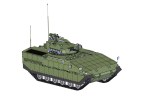
I had the Sovereign Union’s mobile corps using tank-based IFVs. There have been similar attempts in actual history, yet I figured these would be the more interesting. Basically the priorities shift a lot here. The historical BMP-3 is skewed in exactly the wrong direction. Instead of a glass cannon packed with all kinds of boom-makers, the focus is on shielding the newly-important resource with tank-level armor.
So in this timeline the BMP-3 is one of those things that only sees small amounts of use in its home country, but nonetheless achieves success on the export market. The Mobile Corps in All Union primarily rode into Romania with either BMP-2s or IFVs based on existing tank platforms. Whereas the historical T-64 APC proposals were an act of desperation, these have a deliberate goal of more protection and mass production ability, similar to the Israeli tank-APCs of real life.
Two real Soviet surplus IFV proposals are two from Ukraine, the circa 36 ton “Vavilon” on the T-64 chassis and the 46 ton “Berserk” on the T-84 (upgraded T-80) one. Apart from trading protection (the Vavilon was advertised as having STANAG 6 30mm AP protection and being able to withstand a 125mm round from 500 meters, likely against the front) for weight and logistical issues, the armament is pretty standard IFV fare: A 30mm autocannon, various machine guns and grenade launchers, and ATGMs. Crew of both is three for the vehicle itself and up to eight dismounts.
Now for the fun part.
Option A: 7+3 Unitary
Composition: Squad leader/vehicle commander (rifle/PDW), vehicle driver (PDW), vehicle gunner (PDW), 1-2x machine gunner (LMG), 1x rocket launcher (RPG), 1x assistant (rifle+RPG ammo), 1x rifle grenadier (self explanatory), 2-3x riflemen (rifle). One of the riflemen could be a “deputy leader” who commands dismounts when the commander stays with the vehicle.
This is the smallest and most conservative organization. It’s designed to duplicate the BMP procedure of having one empty paper-strength seat so that platoon/company troops can ride along. It fights like a standard unitary squad.
This also fights as a unitary squad, although a marksman is moved to squad level and the deputy commander who controls the dismounts is a permanent table position. Still fights as a simple unitary squad. Marksman is optional
Option C: 4-4-3 Fireteam
Composition: Squad leader/vehicle commander (rifle/PDW), vehicle driver (PDW), vehicle gunner (PDW). Fireteam A: Team leader (rifle), team machine gunner (LMG), team launcher (RPG), rifleman (rifle, ammo for MG/RPG). Fireteam B: Team Leader (rifle), team machine gunner (LMG), team launcher (RPG), rifleman (rifle, ammo)
This is a massive divergence and features the dawn of the fireteam, with two four-man elements and two RPG launchers (with one of the riflemen possibly a marksman). Naturally, more advanced formations and dismounted maneuvers are used.
My personal choice for the sake of the All Union story would be Option B. It’s still similar enough to be comfortable, informal task-organized teams can still easily be formed if need be, but is also more advanced. Not just having a squad marksman but in having a specific dismount commander, which makes it easier for the APC to act as part of a separate “armored group“.
Surrounded by all kinds of danger, a threat can come out of nowhere and kill you. This describes war, but it also describes roguelikes, the kind of deliberately unfair randomized video games that have occupied a niche for decades. Naturally, someone had the great idea to combine them. The result was the Armoured Commander series, with the second installment being the subject of this review.
You are a tank in World War II. You can command just about any kind of tank in any campaign at any point during the war. Try and survive in a world of ASCII graphics and constant threats. The deliberately ultra-retro UI gives the game a bit of a learning curve, but I didn’t consider it too hard. A more intentional “issue” is that you get what you want. I learned the hard way that a Renault FT means you’re slow, you’re weak, you’re inaccurate, and the commander has to do a ridiculous amount of multitasking.
This is an excellent game for anyone who likes roguelikes and/or tanks.



 Fuldapocalypse Fiction