Review: Will To Fight

Will To Fight

In the Will To Fight study/book, RAND analysts tried to take a look at one of the most important yet hard to study parts of war-the will of the soldiers to fight. It’s a mixed bag. On one hand, it’s sincere in trying to tackle something essential, and its detail is excellent.

On the other, it’s centered around a chart that resembles what you see in the dreaded DoD Powerpoints of Doom. This is not the most surprising thing, but it is still a little too awkward. And beyond the well done simulations and descriptions of games with morale factors and how they affect outcomes, it still has the feeling to trying to directly quantify what’s admitted in the study itself as not directly quantifiable.

Nonetheless, the topic is well-cited and well handled, and is important enough that “mixed” quality still makes it well worth a read.

My OPFOR Countries

Screenwriter Stephen E. de Souza has a catch-all Latin American country called “Val Verde” he uses whenever a politically neutral country in that part of the world is required for one of his movies. (In Arnold’s Commando, John Matrix wiped out the entire military of Val Verde by himself.) I have made several Val Verdes in my brain that I’m in the process of putting down in writing, and which may become more than just an order of battle chart.

They are:

Cardona

Cardona is the conventionally weakest OPFOR country and the closest to de Souza’s Val Verde in terms of theme. It draws from both South American and Southeast Asian influences (if I wanted to be really shameless, I could have it have large conveniently Spanish-speaking regions and equally large parts with native Asian languages.)

Cardona’s military is large in numerical terms but lightly equipped and is focused on internal control rather than external invasion. It also has no shortage of irregular groups of all shapes and sizes.

Seleucia

Named for the Seleucid Empire, Seleucia is a catch-all Middle Eastern OPFOR country. Like its namesake, it features terrain from the Mediterranean to the Altais. A diverse and fractious nation, it is at times (ie, when the scenario calls for it) a strong state and at times a weak one. But even at its conventionally weakest, it’s still more powerful in material terms than Cardona is.

Seleucia can be the opponent in everything from irregular warfare to Gulf War level major battles. It also can have nuclear weapons in some cases.

Teutonia

Named after a form of Germany, Teutonia is the developed western European country. The most technologically advanced of these states for the time period, it was once a world power and remains a continental one.

In addition, Teutonian exports are found all over the world, including in the other two mentioned countries. Teutonia is a nuclear power if the tech level of the scenario allows it.

All three will be elaborated on, possibly in prose form… (winks)

Review: The Last Great Death Stunt

The Last Great Death Stunt

Clark Howard’s The Last Great Death Stunt is perhaps the strangest and most bizarre book about a man deciding to jump off the Golden Gate Bridge imaginable. Written in the 1970s, it’s basically to Evel Knievel-style feats what the movie Rollerball was to football and other physical sports. It’s a future where the world is so peaceful that conventional sports with winners and losers are so boring and out of focus, they’ve gone under.

Instead, the public’s eye is on ever-crazier “Death Stunts”. However, there is a backlash against even this, and the book begins with the government planning to outlaw them. Before they do, legendary Death Stuntman Nick Bell aims to do one mega-stunt on the final day of legality-leap off the Golden Gate Bridge and survive! The book centers around him, rival Jerry Fallon, and the authorities trying to stop the stunt from taking place.

The execution is only adequate, with prose and plotting worthy of a 51% cheap thriller. There are sleazy secenes you’d expect from a 1970s mass market novel. There are a few too many padding infodumps in a short book.

But the concept, taken completely seriously, is so great that adequate execution still makes for an excellent, if weird book. But I like weird. So I loved The Last Great Death Stunt.

Weird Wargaming: Conventional Bush War

The Rhodesian Bush War passed without a decisive 1975-style conventional campaign. Of the two main guerilla organizations, it was the Ndebele, Soviet-favored ZIPRA that placed more of an emphasis on conventional operations, compared to the majority Shona, China-favored ZANLA’s “people’s war”. A combination of largely successful preemptive strikes by the Rhodesian military and a (smart) focus on inherent strengths than weaknesses by the opposition meant that the large battle never came.

The common wisdom about such an operation “Zero Hour” (as one code name for it was) is that it would be stopped with ease (although it does not help that most surviving prominent sources are either from the ZANLA-veteran regime or former Rhodesians, neither of which has an incentive to talk up their opponent). But even if the first such offensive was stopped with ease, the rebels definitely had the people and enough hand-me-down aid to try multiple times.

Such an offensive would feature the fairly light Rhodesian military against an opposition that would have at least T-34/85s, BTR-152s, appropriate artillery, and even rumors of fighter aircraft. (If said fighter aircraft could disrupt the deployment of the infamous Fire Forces, it would not be good for the Rhodesians). It can obviously be played with any kind of wargaming ruleset that can handle early/mid Cold War equipment and formations.

Review: Punk’s Fight

Punk’s Fight

Former F-14 RIO Ward Caroll’s Punk’s Fight is actually the third book in his series starring an F-14 pilot (write what you know, I guess). I nonetheless chose it as my starting point because it takes place during the beginnings of Enduring Freedom and I was fresh off reading about the Afghan air wars. Maybe the first two books were better. Because this one was not very good.

Do you want Herman Melville’s Overdescriptive F-14 Ride followed by a contrived way to get his main character to the ground war and lots of self-aggrandizing? If so, then this is the book for you. To be fair, its technical realism is an arguable selling point, but it squanders it on unlikeable and axe-grinding characters, mixed with the protagonist’s not-exactly-ideal adventure on the ground when his Tomcat goes down.

I can see why some people would like this book and series, but I didn’t.

Review: Wings Over The Hindu Kush

Wings Over The Hindu Kush

Lukas Muller’s Wings Over The Hindu Kush shines a light on an obscure footnote in aviation history: The Afghan air forces (yes, plural) between the Soviet withdraw and Enduring Freedom. Leaving behind a large quantity of helicopters and aircraft, there were enough parts and willing pilots for the Taliban and its rivals to create air forces up until 2001. As someone aware of their existence and interested in how functional air units could be maintained from such “scraps”, this book was an easy purchase.

In a complex, fluid situation without the best documentation, getting the detail that Muller did was no small feat. The book isn’t the biggest or most absolutely detailed, but it does tell the story of these helicopters, Fitters, and Fishbeds. And it’s a very interesting story.

The strike aircraft were far from the most capable or effective (the transports in a place with poor infrastructure were far more vital), but their mere presence in such conditions was surprising. And this book clears up the surprise in a great way.

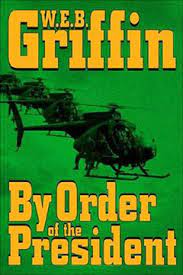
Review: By Order of the President

By Order Of The President

Despite being one of the most prolific and successful military fiction writers, it’s taken me a very long time to read W. E. B. Griffin. I started with By Order of the President. And well, I sure hope the rest of his books aren’t like it. The story of the search for a stolen Boeing 727 and the sinister plot behind it, it doesn’t exactly fly through the skies gracefully.

Although to be fair it does seem like the wrong genre for its author’s writing style. Viewed one way, it’s just a stylistic misfit. All the detail, the flashbacks to the past, and the grounded way of writing all feel much more fit for historical fiction (which most of Griffin’s famous work is) than a contemporary thriller (which this is). As for the parade of meetings and travel that makes up nearly all of the book, it arguably fits into the “too realistic for its own good” category. At the very least, it’s an orange read by someone who prefers apples. But I could all this the benefit of the doubt…

…If the main character was someone other than a half rich German, half rich Texan (Griffin famously said outright that “rich people are more interesting than poor people”) super-agent who hit my suspension of disbelief hard. Or if the story, regardless of realism or style, was better paced. As it stands, it just clunks along and then rushes when it’s near its conclusion.

Finally, I got the impression that this was aimed for the people for whom reading about something is interesting in and of itself. The technical descriptions and organizational procedures made it seem that way. It’s either a flaw or another orange compared to my favored apples.

I can still see Griffin’s appeal, and he was successful and famous for a reason. This isn’t something inexplicably popular and published like William W. Johnstone. But I still see him striking out at the first at-bat I noticed.

The Eternal Death (And Life) Of The Tank

The year is 1916. Someone peers through his binoculars and sees an artillery shell smashing into one of these new tracked machines called “tanks”, destroying it. Shaking his head, he goes “These can’t amount to anything, they can be destroyed so easily.” (Even with modern tanks, if a big artillery shell hits it, it’s gonna hurt.)

The year is 2022. Someone looks on the internet and sees a drone launching a smart munition and destroying a tank. Shaking his head, he goes “these must be obsolete, they can be destroyed so easily.” Some things never change.

I could point to 1918 and heavy machine guns (really, the M2 Browning was considered a prime antitank gun at its introduction), 1944 and bazookas, 1973 and ATGMs, 1991 and laser-guided bombs, 2003 and smart cluster shells-you get the idea. Many others have said with far more knowledge and eloquence than me about the importance of armor, mobility, and firepower, regardless of its destructibility. So I’ll take another route.

Imagine something that is objectively less well armed and less armored than a tank. Now imagine that it, vulnerable to everything a tank is and so much more, is nonetheless not obsolete but remains totally indispensable. I’m talking of course about the classic basic box-APC, proof against small arms and some shrapnel. There’s a reason why Ukraine in the current war has been so eager to receive any kind of vehicle with an engine and armor plating, and why released footage of its current offensive in Kherson has shown them being put to good use.

There’s a reason why, especially on any kind of open terrain, armored forces are so much more accomplished than unarmored ones. And no amount of anti-tank gadgets can change that.

Review: Soviet Era Airliners

Soviet-Era Airliners: The Final Three Decades

In many ways, Aeroflot mirrored the USSR itself. Its breakup in 1991 scattered the massive airline’s assets across all the independent republics. Christopher Buckley’s Soviet-Era Airliners: The Final Three Decades tells the story of what happened to all the “Classics”, “Crusties”, “Carelesses”, “Clobbers”, and more. While the collapse of the USSR and the failure of its aviation industry to make a competitive product caused its new-build civil aircraft industry to fall apart instantly, there were lots of surplus planes around.

This book does a great job showing most of their fates. There’s lots of details and even more excellent photographs. If you like civil aviation at all, this is a great book. I was curious to see what happened to these flying trilobites, and now I know.

Weird Wargaming: Missile Iowas

The Command database now has many more hypothetical proposed missile upgrades of the Iowa-class battleships, including adding a ramp for fixed-wing aircraft in one entry (!). These ships bring a very strange feeling to me. Because they inspire equal parts awe, horror, and disgust.

See, the problem is that missile launchers intended for long-distance operations render the 16 inch guns nothing but a heavy explosive risk. This has been known in real life too. There was a serious consideration during the reactivation of the Iowas (primarily to have tons of box launchers for Tomahawks) of just leaving the guns closed up and inoperable. They’d be unlikely to fire in a fleet action, and if they did fire, it couldn’t be good for any sensitive machinery in the rest of the ship.

So my head regards the Missile Iowas with derision. But my heart adores them. Simply because of how crazy and audacious they are. Do I really need to explain this?

Anyway, for the boring details, they’d likely be used in a way similar to how the real 1980s reactivated Iowas were. As the centerpiece of surface action groups. If you wanted to be cold-hearted, you could treat them as expendable sunk costs. But you can also revel in the absurdity.