A roguelike platformer based on Finnish mythology, Noita (Finnish for “mage” ) is a brilliant game of losing. You control a vague purple-robed wand-wielding adventurer and delve into one randomly generated cave after another, facing all sorts of threats and almost always getting killed.
The big gimmick of Noita, besides its huge array of customizations, is that every single part of the game world is destructible. So yes, with the right tools you can blast a tunnel down and avoid the monsters-in theory. In practice you’ll probably just break open the entrance to a lava pit or something. This is not a fair game.
But it is a fun one, and it handles well. The player character has a limited levitation “jump” that handles a lot like the jetpack in the classic platformer Cave Story (that’s unlikely to be a coincidence). It’s very smooth and precise, and thus works beautifully. Obviously not everyone will play as story-light, unfair a game as Noita, but for what it is, it’s incredible.
The subject of Rhodesia and its war is dominated by uh, “iffy” sources that I shouldn’t have to explain the problems with. Thankfully, among these strides a beautiful unicorn: Moorcraft and McLaughlin’s The Rhodesian War: A Military History. Originally released not long after the war’s end and Zimbabwe’s creation, it recently got an updated edition on post-war developments.
What this is is a very evenhanded, very detailed look completely devoid of “Fire Forces! Selous Scouts!” “Shorts!” “Be a Man Among Men!” Soldier of Fortune romanticism. It doesn’t hesitate to look at the negatives of the guerillas (and, in the updated edition, the Mugabe regime), but it’s unsparing in its blunt assesment of the minority government: Rhodesia was doomed from the start. The British knew it. Apartheid South Africa knew it, which is why they tried to twist Rhodesia into stepping aside in favor of a moderate African government, rather than face a radicalized one on their border that would develop from a victorious war. I don’t think it’s an exaggeration to say that even South Vietnam and 2001-2021 Afghanistan rested on vastly sturdier foundations than Rhodesia did.
The Rhodesians had no concept of war as a political entity and were only good at leveraging limited resources in tactical operations. Even those were aided by weaker opponents (Rhodesians themselves had said that if the guerillas had been as astute in military craft as the Vietnamese ones had been, the war would have been lost much sooner), and said opposition was becoming better as the end of the decade neared.
This is one of the best-single volume military histories I’ve read. It’s also a great antidote to noxious internet fandom surrounding a country that simply did not deserve it.
Nicolas Freeling’s Gadget is a book about a terrorist nuclear weapon. It can sort of be described as Red Army (villains win) meets The Sum of All Fears (nuclear terrorism). Only without the strong points of ether and with the latter’s weaknesses.
See, if you really, really loved the scenes in Fears where the nuclear bomb is being constructed, you will like this book. In fact, if the editor had chopped the entirety of that novel down to just the bomb construction scenes and ended the book right when it was successfully brought to the target and detonated, you’d have something very much like Gadget-a dry, technical nuclear tale.
I’ve pondered before why most nuclear terrorism novels were the way they were. The reason is “because it’s more dramatic than this”. If you absolutely need a detailed Herman Melville’s Nuclear Bomb story, this is the book for you. Otherwise, stay away.
Eric Bishop’s The Body Man is a remarkable piece of thriller writing. This tale of an extra-secret Secret Service man has managed to dethrone past champion Marine Force One for the “most adequately middling novel” crown. It incorporates every plot trait of a cheap thriller-the agent heroes, the high-level conspiracy, the Russians, the Arabs, the action-in a simply adequate fashion.
It’s never actually bad, even if it’s a little longer than it probably should have been. But it never really becomes, or even tries to become more than what it ends up being. Which is the most solidly “median 51%” book I’ve read in a long, long time. The action is neither bad nor excellent. The stakes are not too low but not too high either. You get the idea. It’s weirdly distinct because of its “genericness”. And that’s not a small feat.
I’ve always been intrigued by “superjumbos, which I unscientifically define as “any airliner which is bigger and/or can carry more passengers than a 747.” Perhaps the only mass-produced superjumbo has been Airbus’ doomed A380, a luxurious plane that was nonetheless brought down by an inability to be used as a freighter and a shift away from the “hub and spoke” model that it was designed for.
But with the hub and spoke model in place, and with air travel increasing, the superjumbo does make at least conceptual sense. The justification works like this: If, thanks to a lack of runway space, you can only get X number of flights per major airport, you might as well give them to a bigger plane. To oversimplify it, the choice isn’t between two planes with 300 passengers each or one with 600, it’s between one with 300 or one with 600.
Granted, there are many, many practical obstacles too, like if your superjumbo needs more engines and/or is less fuel efficient (neither an unreasonable thought). But the place for these aerial titans is a legitimate one. Or at least an excusable one with regards to getting one or more of the many on the drawing board designs into alternate production.
And of course, mammoth aircraft that, unlike the A380, were designed to be heavy freighters, do have a niche role in carrying big and oversized loads. See the late An-225 (which had a passenger variant proposed!) and the Super Guppy/Beluga/Dreamlifter oversized transport planes.
It’s all food for thought. After all, what aviation enthusiast doesn’t like gargantuan planes?
The one thing going in the would-be nuclear terrorists favor is that nuclear weapons have a lot of “slack” built into their design. IE, they can be ridiculously “inefficient” and still be devastating. Even a rough-implosion sub-kiloton warhead is still a much hotter, radioactive version of this:
But that’s it. Everything else works against them. There’s a lot of attention paid to nuclear material ever since the 1940s for obvious reasons. The materials require specialized personnel and are hazardous (radiation is the least of the worries-both uranium and plutonium are extremely flammable, for one). I used the analogy of Y2K in my review of the best book on the subject that I’ve read.
While reading Brian Michael Jenkins’ own book, one passage jumped at me. This was Jenkins, a renowned terrorism and security expert, talking about how the yields increased.
We have too easily slid from the scientists’ first estimates of terrorist nuclear devices with yields likely to be in the tenths of a kiloton range to a now-assumed standard of a ten-kiloton terrorist bomb. The worst case has become the baseline assessment.
-Brian Michael Jenkins. Will Terrorists Go Nuclear? (Kindle Locations 3611-3612). Kindle Edition.
And yet, both seem valid. Ten kilotons is slightly less than Little Boy, an extremely simple “bang two chunks of HEU together” design whose biggest limiter is that it requires a lot of fissile material. Less than a kiloton is what’s often theorized for a very basic implosion design, necessary with plutonium as the explosive material. Since in the 1970s there was justified fear around the glut of plutonium, that is not an unreasonable assumption. Likewise, it’s also not unreasonable to assume that with access to Little Boy levels of material (Cold War “Surplus”?) one could make a Little Boy level bomb.
There are no real case studies to go on. Aum Shinrikyo conducted the only known and most credible attempt to acquire nuclear weapons by a terror group. It never got beyond basic theoretical designs, as has every other terror daydream. With a (thankful) sample size of zero, all planners can do is base the possibilities on theory.
David Putnam’s The Gamekeeper’s Night Dog is one of the weirdest alternate history novels I’ve read. And yes, I have read every single Kirov novel. None comes close to this… thing. Really, to talk about it in conventional literary terms is almost beside the point. It’s middling in terms of quality and is a little too bloated, but why talk about that when you have such a befuddling premise?
See, in the 1890s, protagonist David Banner (no relation to the Hulk) has the Judeo-Christian God appear in a dream from His home in the black hole in the center of the Milky Way. A nightmare scenario (aka actual history) awaits if the last of the classic English Bulldogs (always capitalized in the book) goes extinct. There’s exposition where World War I, II, and even III is shown, with animal cruelty activists being portrayed as the equals of history’s worst monsters.
Also, apparently the divine value of a nation comes from the kind of dog that it has. Yes, it’s a weird book. Anyway, man and dog alike uplift the world, fight a very different Boer War, and continue to battle in an ahead-of-its-time World War I. We get loving depictions of bulldogs ripping men and animals to pieces. In fact, most of it is basically just bulldogs in “action”. The question remains: How do you even judge this book? My answer is simple. You can’t. It is not a novel so much as a very bizarre artifact.
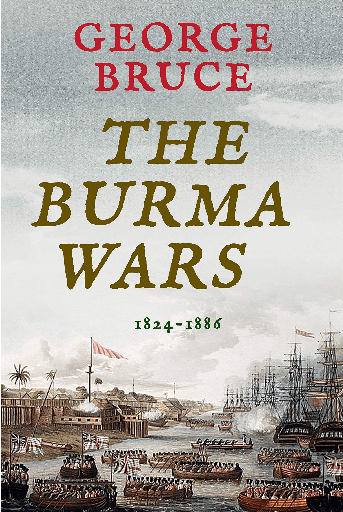
Because Myanmar/Burma features so prominently in my current novel draft, I figure I’d look at George Bruce’s The Burma Wars , a history of the British conquest. There were three large Anglo-Burmese wars, but Bruce mostly concentrates on the first. This is understandable, as the latter two were uninteresting squashes.
Bruce is every bit the Empire fan you’d expect a British pop-historian of the 1970s to be, but he still gives the Burmese credit when due. They were comparably armed, had a knack for building fortifications quickly, and the Anglo-Indian force that went against them was logistically troubled and questionably led. And yet, the British still eventually won, and it only got better/worse from there.
I wouldn’t make an old piece of popular history the sole source on any big historical event, but this at least made for a good starting point. I’m glad I read it.
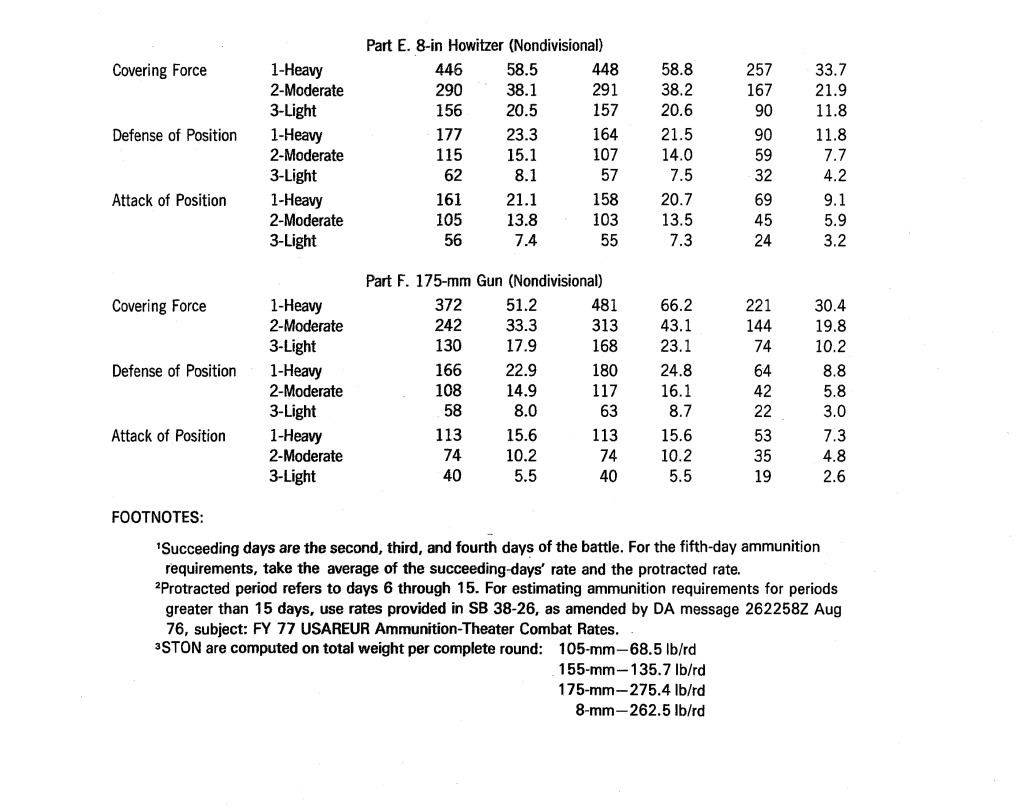
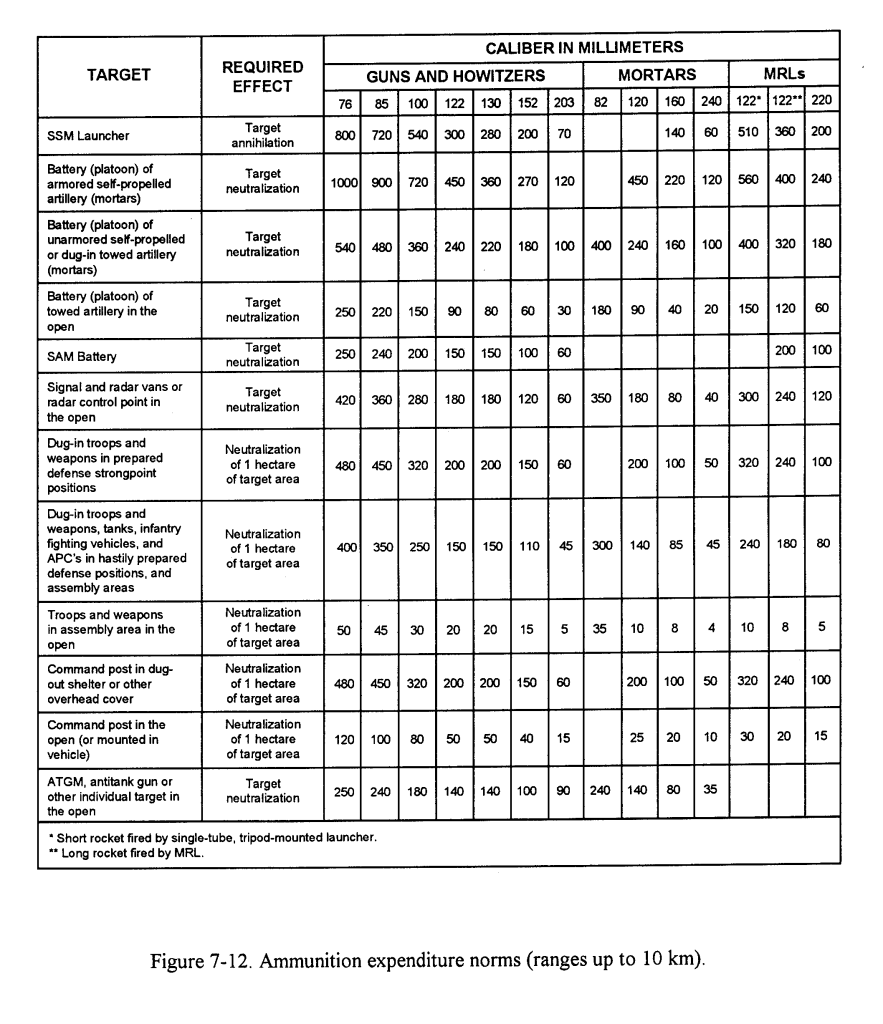
High-intensity warfare uses up a LOT of artillery shells. Like, a lot. How much? Well, these charts from the Light OPFOR Tactical (for eastern calibers) and FM 101-10-1/2, 1987 edition (for western calibers) give a notional example. They’re not identical-the OPFOR norms chart is shells fired towards a target while the FM 101-10-1 one is shells used up by a certain artillery piece per day-but they both show how much metal and explosive is going to fly (the answer: A lot).
Artillery is called the “king of battle”, and the king can get very, very hungry sometimes. Moving large quantities of heavy, highly explosive shells is no small feat, and to succeed or fail with that task means the difference between victory and defeat. A conventional Fuldapocalyptic World War III in the 1980s would have a massive quantity of artillery shells fired every day.



 Fuldapocalypse Fiction