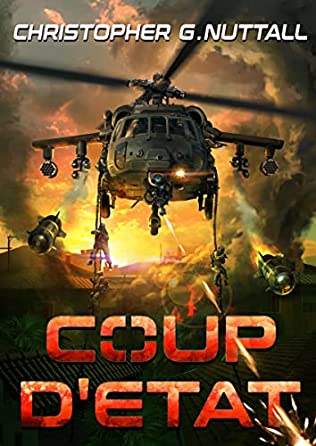
Review: Coup D’Etat

Coup D’Etat

Chris Nuttall’s Coup D’Etat is a book I knew I had to get when I saw the premise. A princess of a Middle Eastern country wrangles western mercenaries to overthrow it in a modern Dogs of War (explicitly cited as an influence, and obvious enough even without the citation)? Sounds good enough. The possibility of a thriller that can be more than just a small group of commandos? You betcha!

The premise is thus very good. The problem is that the execution is not. First, the main character comes across as an uncomfortable Mary Sue, and his opinions along with a more important portrayal cross the line from “hardened realist” to “creep”. But the bigger problem is the setting.

Taking place in a petrostate is a good, and arguably great setting. Having a fictional one so you don’t need to step on real toes and can make it to your needs is another good literary tool this book uses. The problem is that, well…

Say you had a fictional US state in the Old South for your story, and it was portrayed as being composed entirely of corrupt redneck bosses, uneducated and bigoted rural poor, Klansmen, and oppressed African-American sharecroppers who are used entirely as a mentioned prop to show how bad things are without actually being elaborated on. Replace that with the contemporary Middle Eastern equivalents and you have “Kabat”, the oil kingdom the novel takes place in. Compounding the worst true elements of an environment for the sake of fiction isn’t necessarily bad, but here it is. It takes away the stakes by making it look like an irredeemable and worse, dull wasteland. Pretty much any character who isn’t a power broker, trigger puller, or supervillain is used as nothing but a pop-up attraction in the freak show obstacle course.

Granted, you could reasonably argue that I’m overthinking the backdrop for an action thriller. Except this isn’t a very good action thriller. Not just because the prose is only decent at best, but because so much is devoted to the setup and exploring this dubious setting. So this book fails at being a suspense thriller and it fails at being an action thriller. It aims very high and falls very, very short.

A Thousand Words: The Death of Stalin

The Death of Stalin

For May Day, I figured I should do something Soviet. And what more “appropriate” than this movie? Armando Iannucci’s The Death of Stalin is a blisteringly dark satire which uses the events surrounding the titular event as the basis for twisted humor. It’s not exactly the most accurate historically, but it has many good actors and good scenes.

Steve Buscemi steals the show as eventual victor Khrushchev. He slides into the role with the perfect mix of earnestness, sleaze, and silliness. Likewise, even though his entire character is ahistorical (at this point IRL, Zhukov was kicked upstairs to command a district in the middle of nowhere) Jason Isaacs does a similarly excellent job as the head general. The casting isn’t perfect, though. Jeffrey Tambor’s one-note portrayal of spineless wimp Malenkov is grating and mostly not funny.

Still, this is a funny, entertaining and now relevant movie.

The Poker Boom

As someone very young during the online poker boom of the mid-2000s, I knew it existed but wasn’t anywhere near aware of how insane it got. Looking back and doing research, I can say that for about three years, robbery became legal, as long as you were a good poker player. The excesses of it were sometimes just big, like how pros “multi-table” at several sessions at once, playing thousands upon thousands of hands a day, all while staring at the computer for many hours.

But the most interesting part is the zero-sum nature of poker and how that doomed the bubble to pop as much as anything the government did (after all, laws and court cases didn’t stop offshore sports betting at all). The boom featured sharp sharks dropping the equivalent of nuclear depth charges on poor square fish who’d seen Rounders and Chris Moneymaker living up to his namesake and thought “why not me?”

The problem came when liquidity dried up. Without a stream of new fish to get skewered, many former pros learned that they became the lower ones on the food chain. Many moved on to the similarly zero-sum daily fantasy sports, which popped just in time for sports betting to get legalized and crypto speculation to take off. And if the people complaining about restrictions because they tried to arbitrage off of William Hill got their wish and forced the sportsbooks to sharpen, the same feeding frenzy/market bubble that benefited only a few ultra-sharps would happen. In fact, I’m half-convinced it’s happening already, sportsbook restrictions or not.

The reason being that neither sports betting nor poker are actually that profitable for the house, especially after promotions, but that’s another story for another time. As is the story of poker-the book takes place roughly at the same time as the historical poker boom and one of my Sure Bet King ideas envisioned main character Eddie Ross being a moderately skilled poker who crushed weaker ones during the boom (with obvious effects on his ego), but a combination of the path the novel took and me thinking I didn’t know enough about poker nixed it.

While I don’t regret it, I think the right terms to use is that there was an opportunity that I did not follow. After all, the climax of The Sure Bet King is of a-based-on-a-true-story boxing event where sharps took advantage of squares in massive force. The poker boom was like that, only for years instead of one day.

Review: Redux

Redux

The second book in Steven Konkoly’s Black Flagged series of thrillers, Redux sadly doesn’t live up to either its predecessor Alpha or the later Deep Sleep. Granted, it took me a while to read it because of too close things-first, it involved killer diseases, second, it involved Russia, but I finally got around to it. It’s still not exactly the worst thriller ever, but it’s not the author’s best, unfortunately.

While the action isn’t exactly bad per se, the book still bounces around too much from character to character and place to place. This combined with the frequent exact spelling out of every weapon and accessory makes it look like a Gold Eagle book-and not in a good way. Even the best players can swing and miss, and this is a miss.

The Journeyman

In sports, “journeyman” often just means a lower-tier player. This is certainly the case in the individual sport of boxing, where “journeyman” is often a polite way of saying “tomato can”. But in team sports, “journeyman” often means a peculiar kind of athlete.

The two most stereotypical journeymen in baseball were pitchers Bobo Newsom and Mike Morgan.

From their Baseball Reference pages, I can say that that’s a lot of uniform numbers. The baseball player who currently holds the “record” for most teams played with is Edwin Jackson. So this kind of super-journeyman has to have a certain quality. They must not be bad enough that they simply drop out of the big leagues altogether after a comparably short and disappointing career, but they also can’t be good enough to have one team try and hold onto them. On that point, while free agency has allowed journeymen to move elsewhere on their own terms, the shuffled-around player definitely existed long before that-just ask Bobo Newsom himself, or all the other pre-1976 (when free agency began) baseball journeymen.

Some journeymen have unique skill sets. Jesse Orosco is perhaps the best example. With a pitch that was close to unhittable by left-handed batters, he became a “LOOGY” (Left Handed One Out Guy) who pitched into his mid forties as someone who showed up, threw to one or two batters, and then left the game.

To me, the journeyman offers a unique literary opportunity. The character can thrive at their sport and play for champion teams. But they aren’t a dominating superstar and live life on the edge in a way that said dominating superstar doesn’t. And they could go from a winner one day to a loser the next. The possibilities are massive.

Review: Africa Burning

Africa Burning

Back when I was young, I made a horrendously negative review of Gavin Parmar’s Africa Burning, talking about how little sense the tale of a giant army of T-90s and M113s (really) appearing in the Chadian desert to charge up into the modernized, reformed, opened Libya made. (Boy did that “prediction”, made pre-2011, about the direction of the country, age poorly).

Now, well, I have a soft spot for this amateur Ian Slater/technothriller/shoot the terrorist-wannabe novel. It reads like someone acting out their action hero fantasies after seeing and reading a lot of relevant fiction, and the earnest, genuine quality of it has made me smile. I may not recommend actually reading it, but at least I don’t have a bad feeling towards it anymore.

Inputs

The analysts who swung and missed regarding the (initial phase of the) Ukraine War and the Russian performance in it still made reasonable assumptions.

  • It was reasonable to assume that Russia’s modernization was deep and genuine.
  • It was reasonable to assume that, having spent a year moving the forces, that Russia would also spend a year planning.
  • It was reasonable to assume that modern weapons on the Ukrainian side (like the few Georgia had in 2008) and/or any degree of qualitative superiority would just increase Russian casualties slightly without changing the outcome.
  • Finally, it was reasonable to assume that Russia would follow its paper doctrine, like it did in Chechnya, Georgia, and in 2014.

Of course, it was also reasonable to assume that even a smashed-by-the-fire-strike Ukraine would still fight ferociously, and that a conventional “victory” would just mean occupying a large country that loathed them. Yet few expected something that would have a Voroshilov instructor saying this:

Yet the most baffling part is how the Russians struggled with the very areas where they had a reputation for being good: Operational planning, concentration of force, and air defense. It would be like the U.S. going to war, and not just struggling, but struggling with logistics and air power. Goes to show that even the best model or most well-thought out analysis is only as good as its inputs.

And one of those inputs, and one of the hardest to actually measure, is personnel quality. It came to me as an armchair theory that “professionalizing” the military without creating more incentives for the middle class to join meant that its recruit base, centered around the rural poor, would actually be of lower quality. Then I saw a piece from the Organized Crime and Corruption Reporting Project that seemed to reinforce this, containing the explicit quote “‘Contract soldiers are getting worse and worse‘” amidst describing training woes. This would seemingly lead to the worst of both worlds-personnel who are more expensive but not more capable than the previous mass-mobilization system.

A Thousand Words: Money Plane

Money Plane

Adam “Edge” Copeland and Kelsey Grammer’s Money Plane is the story of an attempt to rob a flying super-casino. It fails. Not the heist, the movie. This is an extremely stupid movie. And it’s not even that stupid in a fun way. It’s just inept. Even if one follows the reasonable assumption that action movies do not have to make sense, it’s a failure. Its suspension of disbelief refuses to be followed.

For instance, in-universe, a “master thief” doesn’t seem to know how many people crew the average commercial cockpit. Out of universe, a professional wrestler is squandered by having him spend the bulk of the movie sitting at the controls and talking. In-universe, there are no staff on this supervillain plane and no one goes to check on the cockpit even after the plane shakes and diverts from its original course. Oh, and almost all the resistance comes not from the plane runners but from other gamblers.

The film is very short but still feels overstuffed, not knowing if it wants to be a serious heist movie or a silly heist movie. None of the protagonists are very developed or charming, and even Grammer’s performance is a little too forced. The people behind the titular super-plane are squandered: The actors who play the “concierge” and “bookkeeper” on the plane actually do their supervillain roles well, but the movie bizarrely shifts away from them and towards unfunny “wacky” guests like a cowboy who ends up shooting himself in the head (it’s a long story). I wanted to like this movie, but it really doesn’t work, even as a dumb action movie.

Review: Deep Sleep

Deep Sleep

Steven Konkoly’s Deep Sleep is a tight, excellent spy thriller. When agent Devin Gray finds out that his recently deceased mom has uncovered the mother of all conspiracies, the game is on. I loved this book. I really did love it. I’ll even let its “the action wants to be just a little grounded while the backdrop of the conspiracy could have been written by Jon Land” dissonance slide.

One thing I loved about this book was its personality. For the heroes and villains alike, this felt more personal, close, and intimate than a 51% book where the action hero crushes a ton of faceless goons. Not that I mind such books, but it’s good to have variety.

Combine this with the spectacular set pieces that do exist and you have a rarity. A book that can have its cake and eat it too. I highly recommend reading this.

Weird Wargaming: The Abrams-SPH

The year is 1995. Faced with either leaping into the unknown with a clean-sheet system or plugging along with legacy platforms, several contributors to Armor Magazine decided to pursue a middle ground. In the November-December edition, they unveiled their contraption: An Abrams-chassis 52-caliber (same as the PzH2000 and Archer) self propelled howitzer with an autoloader and a whopping 80 rounds inside.

The M1-Arty, or AFAS/M1. Of note is the Archer-esque “backwards” layout of the main gun.

AFAS/M1 would fire 4 to 8 rounds in a Simultaneous Impact Mission (SIM) between 6-40 km. All rounds will impact within 4 seconds (first-to-last round). This requirement can be attained with an effective combination of a battle management system, fire control system, global positioning system (GPS) and an autoloader.-claim for its power from the article.

A resupply vehicle on the same chassis would also be designed. The AFAS/M1 had a target weight of 55 tons.

For all the unusual elements about its design, in practice this beast would have been deployed conventionally. In action, it would have served with heavy divisions/brigades in the usual format. It could be simmed by using the offensive stats of the PzH-2000. Yet it still stands out, in appearance if nothing else.