Review: Red Bandit

Red Bandit

Mike Guardia’s Red Bandit is a brief history of the MiG-29, covering its basic designs and all the conflicts it participated in. Do not expect a technical deep dive or a massive tactical overview. This is a short and small book.

It’s also a book that won’t surprise any serious scholar. The MiG-29 was really just a rich man’s Fishbed meant as a point interceptor first and foremost. It did not have the versatility or capability of western 4th gen fighters or the Su-27. In most of the conflicts it’s fought in, it’s suffered heavy losses, though not always by fault of its own. We see its service in the Gulf War to Ukraine in a short overview.

This isn’t the most illuminating book on the Fulcrum. But it is an excellent start for a plane I have a soft spot for.

A Thousand Words: The Simpsons Wrestling

The Simpsons Wrestling

Simpsons games have a reputation for a few hits (Hit and Run, the original arcade game) and a lot of misses. One of those is The Simpsons Wrestling, one of the last Playstation 1 games released. By this point, a lot of wrestling games had been made. A lot of 3d and 2d fighting games for it had been made. A lot of Simpsons games were just low-quality knockoffs of the big popular genres, from skateboarding to platforming.

This is at least interestingly bad. It’s a 3d fighting game whose only actual “wrestling” is a pin incorporated in the final knockout. The characters are laughably imbalanced, and the action is unhinged (and not in a good way). Simpsons characters with crude early 3D models pinball around the wrestling ring. Yet the worst thing is the moveset. You have only three attacks, something that Street Fighter 1 had more than twice of.

But if “it’s interestingly bad” is the best one can say about this, then… it’s bad.

Review: Russian Gunship Helicopters

Russian Gunship Helicopters

The content of a book called Russian Gunship Helicopters should be pretty self-explanatory. Especially as it’s a Yefim Gordon book. This means you get tons of technical details that are uncited and frequently questionable, mixed with bad formatting and huge diversions into the pros and cons of various scale model kits. And a ton of pseudo-witty quotes that are really jarring compared to technical analysis. They come out of nowhere.

This book naturally covers the Mi-24, Mi-28, and Ka-50. As it was published in early 2013, it’s dated and doesn’t cover things like the Ukrainian and Syrian wars where these saw their first extensive use. It’s one big infodump and model kit review on the Hind, then one on the Havoc, then one on the Hokum.

The biggest problem is that while we get long explanations of what various components are on the helicopters, there’s one glaring omission. That’s how they’re actually used. The Mi-24 with its extensive track record is treated as an afterthought with Wikipedia-level “it flew around and shot things and occasionally dropped off people” simplicity. Reading a single Heavy OPFOR free document gives a lot more info on the actual doctrine of these things.

This is like many aviation enthusiast books: Weird and clunky but detailed. Even if in the wrong ways.

A Thousand Words: Aqua Teen Hunger Force

Aqua Teen Hunger Force

Now Aqua Teen Hunger Force is the most misunderstood show on television. See, most people perceived it as a crude, absurdist, and surreal Adult Swim animation that made South Park look highbrow and subtle. A place featuring the strange happenings of straight man (or straight hovering box of french fries with a beard) Frylock, delightfully immature meatball Meatwad, and idiotic troublemaking drinking cup Master Shake. And their human neighbor Carl.

No. They have it all wrong. Aqua Teen Hunger Force is actually a nature documentary showing viewers the hidden, wondrous and fearsome at the same time place known as New Jersey. People don’t get it, but they just don’t get that this is what Jersey is like.

Seriously, it’s great for what it sets out to do.

Paradrops

The problem with large parachute drops, especially post-World War II, is that you need to be able to get a bunch of large transport planes to the DZ. However, if you are able to do that, chances are you won’t need to do something as risky as a parachute landing anyway.

Then you run into the issue of whether or not the resources spent on guarding the paradrop are worth it or not. There’s a reason why large operational/strategic paradrops are more in the theoretical than real. However, even theoretical offers an advantage. The force in being strategy means that a defender must prepare for the possibility that a paradrop could happen.

A Thousand Words: Nip For Speed

Nip For Speed

One rarely encounters a work of fiction, much less a video game as deep and enlightening as Nip For Speed. It is a point and click adventure game where you, sitting in the front seat, have to help a cat drive a car. The game is very short but I had a hugely fun time laughing my head off at it.

Make of this what you will, be it a game on materialism, a lecture on the beauty and stress of travel, or just a silly surreal game where you help a cat drive a car.

Review: Star Wars Incredible Cross Sections

Star Wars: Incredible Cross Sections

In the late 1990s and early 2000s, as the Star Wars prequels and their merchandise machine rolled into action, an interesting reference book series emerged. This was Dorling Kindersley’s Incredible Cross Sections. I remembered (and loved) similar books as a child showing real things ranging from Boeing 747s to T-34/85 tanks to old age of sail warships. So the art is beautifully done, even if there are issues like the Millennium Falcon being impossible to square totally with its interior and exterior differences.

So these are beautiful books. Unfortunately, the later ones were marred by a controversial author, Curtis Saxton. Saxton’s story is a nerd’s dream come true: An astrophysicist and Star Wars fan who became the writer of a site called the Star Wars Technical Commentaries. Getting to write official material would have been something.

There were two main issues with Saxton. The first is that he was a maximalist who tried to squish the incredibly soft space fantasy of Star Wars into a Stephen Baxterian hard plausible mold. Yes he gives technically accurate numbers for a galactic scale civilization-but it just doesn’t mesh with the actual movies. The second was his fixation on the “Endor Holocaust” (no really he used the exact name) where the debris from the Death Star would have wiped out the Ewok species. Imagine if a Star Trek fan was absolutely adamant that transporters were ‘destructive teleportation’ (ie killing/destroying the original subject and making a copy on the other side). (Ironically the Warhammer 40k fandom has a section like this in the opposite direction, where every Imperial Guardsman is a special forces equivalent elite soldier and most of the human population lives on advanced peaceful civilized worlds).

So not for the first or last time, it was someone plopping their fanfiction into “canon” in a way that didn’t quite fit. But at least the pictures were and are incredible.

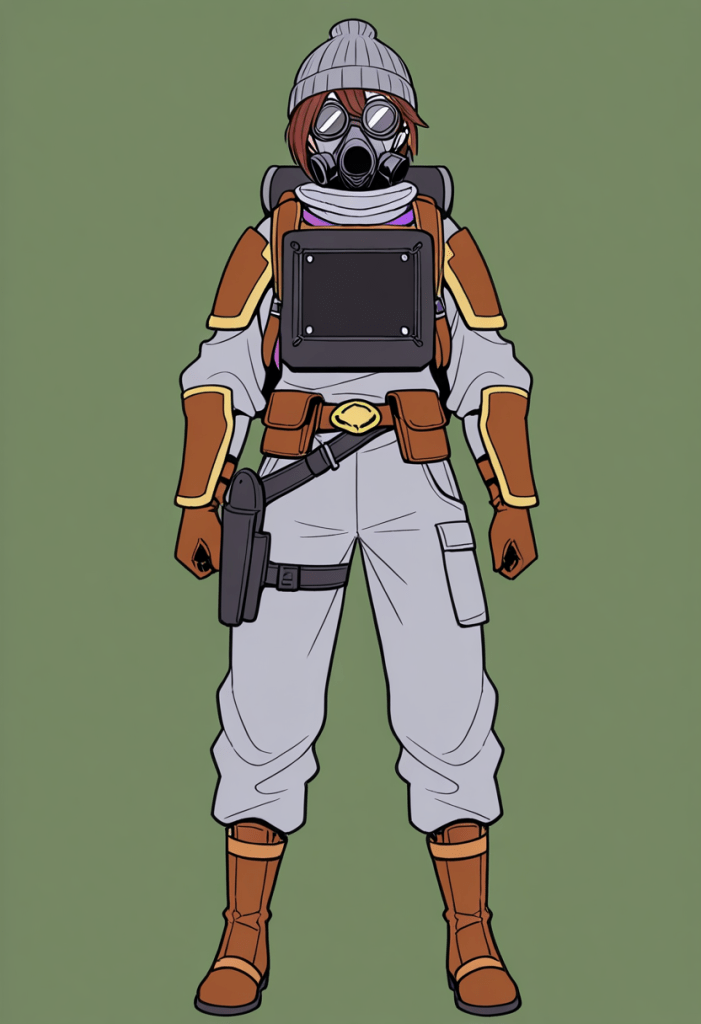
Another Operator-Ette

Image made in Stable Diffusion

One of the things I love doing in Stable Diffusion is adding in a bunch of stylistic prompts and applying it to someone in a military uniform. This young lady here is one of my favorite recent generations.