Review: ATP 7-100.3 Chinese Tactics

ATP 7-100.3 Chinese Tactics

After seeing the excellent work on North Korea, I eagerly awaited the next installment in the ATP 7-100 series on the most potential opponents. When ATP 7-100.3, Chinese Tactics dropped, I was not disappointed. Well detailed and well laid out, this is the first comprehensive unclassified analysis of the PLA in decades.

In some ways, being a far more advanced opponent that’s far closer to the fictional maximum-challenge “composite OPFOR” than North Korea is means that the tactics shown feel a lot more mundane and slightly less interesting. But showing the (deliberately overcomplicated and confounding) organization is where this shines. The modern PLA is organized a lot like the old “GENFORCE-Mobile” OPFOR with a bunch of brigades and combined arms battalions jumping straight to corps-equivalents with six line brigades each.

This is a great resource and I highly recommend reading it. Besides its topicality, seeing a force structure diverge from the classic Russo-American style is interesting to see and valuable for wargamers.

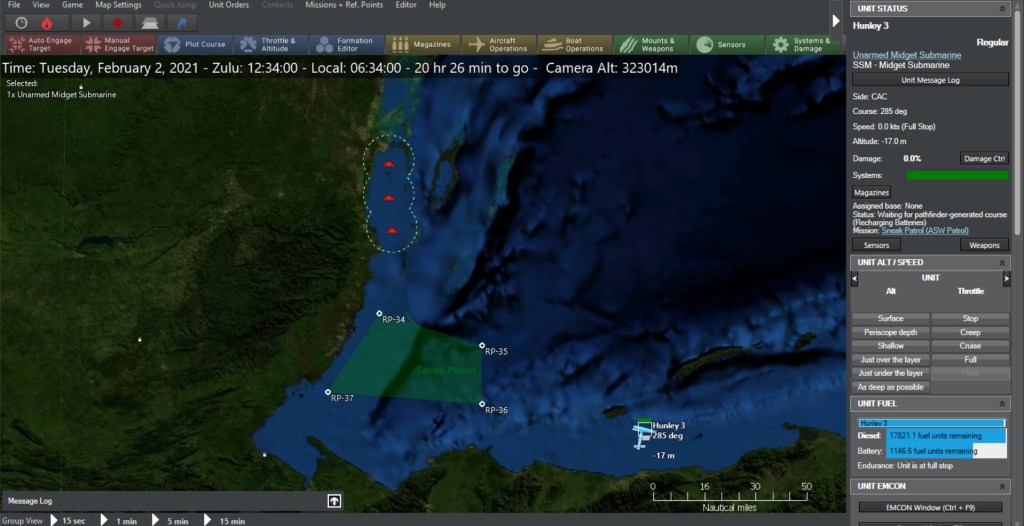
New Command scen for testing: Sneaky Sneaky

I got back into making Command: Modern Operations content with another draft scenario that I’ve called Sneaky Sneaky. It’s in an alternate historical setting where a “Walkerist” rogue state survived in Central America. Now they have to try and slip a few improvised mini-subs past the Royal Navy to Belize. Much inspirational thanks goes to the Covert Shores website for its great work on analyzing such submarines.

The scenario can be tried out here.

Review: Our Man On The Hill

Our Man On The Hill

Matthew Kresal’s debut on Sea Lion Press (full disclosure, I’m published there too) is Our Man On The Hill, a story which takes a bit of historical commentary and plays with it. It’s been said that Joe McCarthy was such a blustering bumbler that he actually did damage to legitimate anti-communism. Thus Kresal turns into him being a Soviet agent intended to sabotage the opposition.

Though not exact, this has parallels with Agent Lavender, the book that started SLP in the first place. Both make alternate histories where a conspiracy theory about a huge political figure (Wilson, McCarthy) is treated as true. Both are well researched. And both are excellent reads.

Even though I’m not generally the biggest fan of this kind of political/spy story, Our Man On The Hill is well done enough that I had a blast reading it. I highly recommend this book.

The Advantages of Boxing Fiction

Boxing (or MMA, or any other individual combat sport) offers a few advantages when it comes to literature. The first is logistical. A boxing match can theoretically happen in any place big enough to fit a ring. Thus they can be, and have been staged in areas from small rooms to gigantic stadiums. Other sports require a specialized field, but officially sanctioned boxing matches have been held everywhere from mansion lawns to prisons.

The second is personal. While there are important trainers/promoters/managers/cut specialists, boxing is a clash between individuals in a way that any team sport is not. The character implications of this are obvious. Finally, the inherent shadiness of boxing makes it a perfect setting for a thriller or mystery story.

Review: Silent Assassin

Silent Assassin

The second Dan Morgan thriller (albeit the third I’ve actually read), Silent Assassin is an awkward novel. By itself, it’s a decent enough cheap thriller that does decent enough cheap thriller things. The action is never worse than passable, and some of the set pieces, like an ultra-secret facility on Long Island of all places, made me smile. Yes, it’s cheesy and ridiculous, but that’s what cheap thrillers are for.

However, having read two other books in the series, it felt like it was a step up from the first book, but not as good as the third. Reading it gives the impression of an author trying to find a footing that he would get in the next installment. So I would recommend, unless you found you really liked this series, to just start with Black Skies.

The Uses of Big Pistols

Giant pistols have very, very limited applications, especially with the development of first submachine guns and later short carbines. The only semi-practical use I can think of for the giant Dirty Harry-style monster is hunting/defense against large angry animals.

Otherwise, well, even before the advent of widespread body armor, pistols were very limited to the point where many troops have unhesitatingly just taken extra rifle ammunition to fill the space and weight that would have been taken by them instead. The only other niche role is as a backup/close weapon for someone who carries around something bulky (ie, a big launcher/machine gun or piece of heavy equipment). Except even there there have been better options. Especially since a big pistol would almost certainly require an exotic caliber that would be harder to resupply.

Of course, cheap thriller writers are infamous for just giving their characters the biggest guns possible. Before the Desert Eagle, Mack Bolan wielded an Automag and a .460 Weatherby rifle, something that Jerry “Detonics .45” Ahern took issue with.

Review: Air Battle Central Europe

Air Battle Central Europe

Alfred Price’s Air Battle Central Europe is a magisterial study of aviation plans for a hypothetical conventional World War III. What makes it different from other technical studies? The answer is simple-it looks at the whole and not just the sum of the parts.

In the interviews and discussions, every piece of the NATO air power puzzle is studied, and each role of each aircraft is talked about. The result is a lot of detail, and an important look at how combined arms works in the air. It’s both accessible and comprehensive.

There are a few sour parts. Some aren’t it’s fault, like the book being dated compared to a post-Gulf War understanding. The biggest issue I thought that was its fault was a willingness to talk more about the ideals of what air power would do than a stress-tested analysis that involved a worse case. But the book is still excellent and a must-read for anyone studying a conventional Fuldapocalypse.