Review: Memories of Midnight

Memories of Midnight

Sidney Sheldon’s The Other Side of Midnight was his breakout mega-successful novel. It is also by far the worst he’s written in hindsight. So you can guess why I was less than enthusiastic about reading its sequel, Memories of Midnight. The least interesting book and setting getting an expansion?

Thankfully, I could see from the first few dozen pages that this was better. The Sidney Sheldon formula he developed after Midnight was obvious, and that’s not a bad thing. Young Constanin Demiris is more interesting as he heads to Saudi Arabia, and Sheldon’s research into both the mechanics of oil drills and the “desert queen” phenomenon where scarce western women become fifty times more attractive in such an environment is a lot better than “here’s Aristotle Onassis”.

Sadly, we had to return to Catherine The Dull, the “heroine” of the last book before she got amnesia (long story). Which leads to a pattern in this book: When it goes back to its wretched predecessor, it doesn’t often work (although shipping tycoon Demiris is far better an antagonist than the two in Midnight, or even the past version of himself). When it stretches its legs into the world of the pop epic Sheldon excelled at so much, it works. There’s even an eerily prophetic courtroom scene where a super-defense lawyer in a high profile case uses a physical prop (I won’t spoil it) in a way that reminded me of the later OJ Simpson trial to get his client acquitted.

This weird trend makes it below average by Sheldon’s standards. But below average is still better than “bottom of the barrel”. It’s far better than its direct predecessor and in isolation is perfectly readable, but I still wouldn’t recommend it as anyone’s first Sidney Sheldon book. Even an excellent conclusion that involves a million double crosses and Chekov’s Heating Boiler (seriously, it was foreshadowed in a way that made me smile) can’t totally redeem it. But it can make for a massive improvement….

Not that that’s saying much.
A Thousand Words: Action PC Football

Action PC Football

From the same company as Action PC Baseball comes [American] Football. It’s a season simulator that can offer both historical and (my favorite) draft seasons. It has a similar minimal visual interface (that can be enhanced by the player if they add more stuff into the folders) and a similar statistical crunchiness. This later part makes it more interesting than Baseball.

See, in baseball, each plate appearance is basically its own thing. It’s a high variance sport where even having a great shortstop and centerfielder on the other team just makes getting hits a little less likely. But in football, if you have two excellent safeties, a good pass is a lot less likely. Both Action PC games simulate this well.

So Action PC Baseball is more a relaxing “see what happens” game. Action PC Football is a more cerebral and demanding game. They’re apples and oranges, but both are tasty.

A Thousand Words: Battle Circuit

Battle Circuit

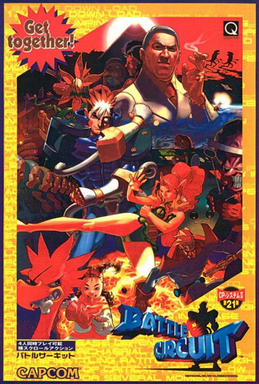
One of the last arcade beat em ups that Capcom released in the wake of Final Fight, 1997’s Battle Circuit was obscure for many years until its availability in the Capcom Arcade Stadium collection. This is a shame, because of all the successors to that masterpiece, Battle Circuit is the best I’ve played.

The plot is simple: In a sci fi future, control one of five bounty hunters as they pursue a bunch of colorful villains. The quirkiness and silliness of the genre shows in both the heroes and villains. You can choose between Cyber Blue, a pretty normal anime hero, Captain Silver, a Plastic Man/Mr. Fantastic style stretch-armer, and three goofballs: Catgirl Yellow Iris, walking Venus Flytrap Alien Green, and the weirdest yet: Pink Ostrich, the titular bird with a girl riding on its back (it’s unclear who’s the brains). Similarly, the bosses are just as ridiculous. They start with a disco Elvis impersonator and go through such things as a woman and her giant mandril, an all-female biker gang, and a robot samurai riding some giant beast. The final boss can only be described as looking like an evil Santa Claus.

But what makes the game amazing beyond these characters and their beautiful sprites/animations is how it’s both easy and deep. Sure, it can be played like Final Fight. You can jump around, throw, and do sweep attacks that cost you health. But each character has a lot of moves, and they can be upgraded between levels if you’ve earned enough coins-which you get by landing lots of hits on enemies. Mastering each of these moves makes things a lot more fun. Especially as the characters have their styles, with Alien Green being the slow grappler a la Haggar and Yellow Iris being the rapid “Guy”. All can jump and power up with a special gauge, the effects of which range from gaining more power to recovering health to becoming very durable for a brief time.

There are a few snags. The first is that the characters are not exactly balanced compared to each other. Cyber Blue is the cheap easy mode character. Not only is he intuitive and strong, but his upgraded sweep attack damages everything on the screen. Bosses can be cheesed by just powering up (which increases his strength) and then spamming that move. Meanwhile, Pink Ostrich is very weak normally, only has a flight power of dubious use, and is hard to control. The others fall between those extremes. The worse one, I’d say, is that the segments between the bosses are kind of minimal and forgettable. There’s only a few enemy types and no real engaging set pieces. It’s not really bad, but it doesn’t have the spark the rest of the game does.

Also the third boss is a blander giant robot with very wonky hit detection that’s just frustrating and not fun. But hey, five out of six aren’t bad.

If you like any kind of beat em up, you deserve to check out Battle Circuit. It’s an amazing underappreciated game.

A Thousand Words: Captain Commando

Captain Commando

Capcom, fresh off the success of Final Fight, made another arcade brawler called Captain Commando in 1991. I’m sure the title was just a coincidence. You can control the titular vanilla superhero, a ninja, an alien mummy named “Mack The Knife”, and, most bizarrely, a baby prodigy that controls a mech-that can ride other mechs. It’s like the walking robot version of a nesting doll.

Anyway, to call it a superhero version of Final Fight would be unfair. It’s more like a souped up superhero Final Fight. For instance, the second boss of Captain Commando is almost exactly like the final boss in that game (someone who jumps around with a crossbow). Only he’s much faster. As for the real final boss, it’s one of the cheapest in all arcade brawlers, and exists primarily to devour quarters.

For all this enhanced goofiness, it doesn’t seem as graceful or punchy as Final Fight was. The new move additions consist of the previously mentioned mechs (which are few and far between, and clunky enough to generally be more trouble than they’re worth) and dash moves that are both hard to do and rarely of that much use.

It gets the basics right, but if you have to choose, I’d say either Final Fight itself or one of the better successors. This is not one of the better successors.

Review: Knee Deep In The Dead

Doom: Knee Deep In The Dead

You might think that a classic video game with a plot of “run around, shoot monsters” would be hard to novelize. Yet a writer by the name of Dafydd ab Hugh (which is the most Welsh name ever) gave it a try in Knee Deep in the Dead. This could have very easily been a low-effort potboiler. The author would just type out the blandest adherence to the and some filler, submit it, collect the money, and never look back. This has happened with many other visual media adaptations.

But not here.

Knee Deep In The Dead has a lot of running around and shooting monsters. But it also has this very bizarre style (that grew even more bizarre in its sequels, from what I’ve heard) that is nothing short of endearing. It’s one of those books that kind of has to be read to be believed.

Is it “good”? Not really. Is it readable? Yes. Is it fun? Oh yeah. Should you check it out? In my eyes, you betcha.

Review: Tomorrow’s Soldier

Tomorrow’s Soldier

David Alexander’s Tomorrow’s Soldier is a book that you’d expected to be dated based on its subject matter. It’s a 1999 popular account of the WARS AND WARRIORS OF THE FUTURE. And it is dated. It’s also somewhat shallow even by the standards of the time.

It’s still interesting, but isn’t really a rigorous study. The descriptions basically consist of trends that were obvious even at the time (ie, more digitization/etc…) and the obligatory description of wunderwaffe like power armor. This is a little less triumphalist than some other books of its nature, but it isn’t really more substantive.

This felt like a throwaway book even when it was written. And now it’s an older throwaway book. So I’m not really recommending it except as a curiosity. I do wonder if the same “David Alexander” who wrote this was the same “David Alexander” who wrote the ultra-middling Marine Force One. If so, it would be fitting.

A Thousand Words: Carrier Air Wing

Carrier Air Wing

Capcom’s 1990 Carrier Air Wing is a fairly standard side scrolling plane shooter. Except for one thing that elevated it massively in my eyes. That’s the surprisingly detailed and (in a visual sense) accurate depiction of military hardware. You can control either a Hornet, a Tomcat, or an Intruder (which is marked as an A-6F. Wonder if they knew of the never-was upgrade or if it was a happy coincidence because they chose the next letter after E.)

When I saw Tu-22 Blinders as enemies in the first level, I was in love. When I saw Yak-38s in a later stage, I was even more in love. This is quite possibly the most Fuldapocalyptic shmup there is, and I loved playing every second of it. Yes, there’s the sci-fi superweapons (such as a final boss that includes a Buran shuttle) but it’s otherwise very grounded-looking compared to other games of its time and nature.

This is basically a video game adaptation of a Mack Maloney novel. What’s not to like?

A Thousand Words: Cave Dwellers

Cave Dwellers

Officially, this was the second movie in the Ator series of Conan the Barbarian knock offs. But it’s as “Cave Dwellers” that it leapt into my heart as the greatest Mystery Science Theater 3000 episode I have watched. The small and sus company known as Film Ventures International took a questionable strategy of getting the rights to show clips from movies, changing the titles and credits, then calling the rest of the movie a “clip” for legal reasons. It only worked because they were small.

Anyway, the film started with an extremely blurry clip from a 1960s Italian Tarzan knockoff in its bootleg credits, and then only got crazier from there, following up with an action-packed climax featuring a hang glider and concluding with nuclear bomb footage(!). Joel and the robots excelled, especially because this is the kind of mock where the movie itself has enough great material to build on (for instance, it’s hard to do that much with a stilted, no-budget 50s movie).

Yeah. This is my favorite Mystery Science Theater episode of all time. It’s amazing, and the movie it’s mocking is amazingly bad.

The Zombie Gym Leader Who Never Was

It’s no secret that all kinds of fictional works change from their beginning to their final product. And a minor character in a classic video game embodies this very well. In the Kanto Pokemon games, Erika is the grass-type specialist leader of the Celadon City gym. Wearing traditional Japanese clothing, her characterization is that of a graceful flower lady (who has a tendency to fall asleep).

But apparently she wasn’t always that way. And some of the changes made to her were after her Gen I artwork had already been drawn.

Development and concepts assets that have emerged have shown a picture of the original Erika. She would have been placed in what would have been Lavender Town (which in the final version didn’t have a gym at all). And, unsurprisingly, she would have specialized in ghost types. The sole ghost specialist who actually emerged in Gen I was Agatha, portrayed as a normal person who just happened to use ghost types.

At least judging from her art design, Erika would, uh, not have been. Her eyes were closed and the Poke Ball in her sprite was in midair, which could be justified as her juggling it but which was likely meant to have her hovering it with supernatural powers. Finally, her clothes were folded in a way that was only used for the dead in her initial sprite. (A pretty big implication of this is that her design was changed in Yellow and all later appearances to be folded the correct way).

In other words, she was heavily implied just from the visual assets alone to be some kind of undead. Since no final text dialogue was made, there’s no 100% confirmation, but it’s pretty clear. Would this design carrying over really change much?

Probably not. Unlike a few other Gen I leaders, Erika did not become a superstar in her own right. At the time, not much would really change. Except for her prominence. See, spooky Lavender Town became a centerpiece of internet creepypasta campfire stories immediately. And having someone who was an outright zombie? Oh yeah, she’s definitely getting featured in them. So even if official media stays out, Erika the Zombie would become a star of the internet.

Since a multiverse canonically exists in Pokemon, Zombie Erika probably lives in some variant universe. Much as how creepy supernatural anime Sabrina exists alongside normal actress game Sabrina. Who knows, maybe this Erika starts conventional Fuldapocalypses as a hobby. Has the zombie sorceress been found?!?

The Armored Group

Looking at the 1990s OPFOR documents, a “new” (well, newer in a formal sense) type of formation arises: The “armored group” (bronegruppa). It’s important to note the history of Soviet-style doctrine beforehand. The stereotype, often true, is of formations operating as entire units for a certain task. Thus a formation (generally a company as the smallest) will as an entire unit operate as one arm of an attack or another. In defense one formation will sit and fire behind fortifications while another will act as the counterattack/reserve.

The armored group is ad hoc by nature. Formed with a number of armored vehicles usually equivalent to slightly more than a platoon (although GENFORCE-Mobile mentions ones slightly smaller than a company if the parent unit is big enough to handle it), the key is the following:

  • The tanks operate away from their parent unit.
  • More crucially and importantly, the IFVs operate “empty”, with their infantry having already dismounted.

The use of an armored group depends on the situation, of course. Examples given in the GENFORCE-Mobile and Heavy OPFOR Tactical documents are:

  • Sweeping around to hit the side while the dismounted infantry and main force attacks from a different axis.
  • Serving as the base of fire while the dismounted infantry and supporting arms do the sweep.
  • Acting as a reserve/pursuit force, especially one that can quickly roar in and (however temporarily) block off a route from a retreating foe.
  • Acting as a counterattack force on the defensive.

The armored group’s origins come from the Soviet war in Afghanistan, where such formations were used in an irregular, nonlinear, frequently rough-terrain war.