Review: Raptor Force

Raptor Force

raptorforcecover

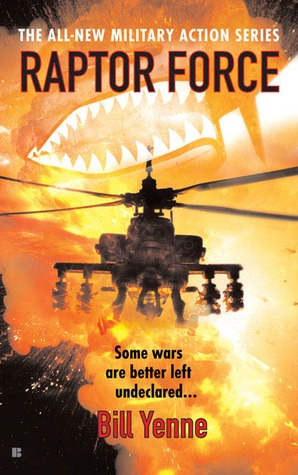
Bill Yenne’s Raptor Force is a case of a book that dips into multiple action subgenres and seems determined to take the worst parts of each while being unable to grab the best. It’s the kind of commandos-vs-terrorists novel that might seem simply pedestrian if it didn’t have the premise it did.

See, the reason the task of hunting down bloodthirsty and effective terrorists is entrusted to this mega-top-secret band of off the grid commandos (based on the Flying Tigers in-universe) is because the US (along with most other countries) gave the UN veto power over its military power projection (!). This is the kind of thing that zombie sorceresses were made to do.

The heroes are all flat space-fillers, the villains are the most cliche terrorists straight out of Command and Conquer Generals, and the stock supporting characters are exactly who you’d expect them to be. This wouldn’t be a big problem if the fundamentals were good, but they’re not.

Raptor Force has the constant perspective and place-hopping of a technothriller but none of its technology or great power conflict. It has the focus of a small-unit book but none of the spectacle or “punch” that a good one has. The actual action scenes are decidedly underwhelming, the worst thing a cheap thriller can be.

This was not a good novel. Even the potentially over the top premise wasn’t run with, opting for the overly serious technothriller style instead of a shameless spectacle.


Review: Marine Force One

Marine Force One

The book Marine Force One is an example of a “51% book” that is elevated by the context in which it stands.

The book tells the story of an elite commando force tasked with hunting SAMs in the Balkans, in a conflict that feels like a jumbled mix of historical recollections of Operation Allied Force (evasive SAMs! Stealth fighters lost!) and think-tank reports (Resurgent Red Russians!) all tossed together. The Cobra Force of our heroes has to hunt the SAMs while butting heads with a Spetsnaz force assisting their Slavic ally.

If there’s one thing distinctive besides being dated, it’s that the main character, Maj. David Saxon, is an ass. He’s a one-dimensional figure who gave up his material possessions and marriage to focus on being in the military (and doesn’t miss his ex or even his son at all), he punches someone for being annoying to him during a debriefing, and when (however briefly) off-duty, he just uses prostitutes as the sole “relationship”. Yet rather than have his seriously flawed character be taken advantage of, Saxon is otherwise treated as a Mary Sue who can do what the rest of the military can’t. Very few other characters, even the villains, enjoy such detail.

Other than that, everything is just good enough. The action is just good enough but not the best. The pacing is at least fast, if not the best. The exposition can be annoying but isn’t too annoying, and so on. So why did I feel better about this book than I ‘ought to’ have? Well , the first part is that sometimes a 51% book is what one needs.

The second part is that given the publication date of 2001, the beginning of a very, very dark decade for technothrillers, the “competition” is less serious. In a context full of overpriced, under-proofread self-published books, legacy series continuing on pure inertia, and the few remaining editor-proof super-authors, a nice light 51% book isn’t bad at all.

Review: Sixth Fleet

Sixth Fleet

meadowssixthfleet

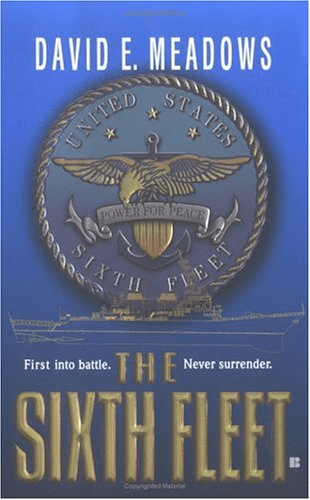
I look at the Sixth Fleet series by David Meadows. Looks like it could be to naval warfare in general what Tin Soldiers was to tanks and Raven One was to aviation. Then I look at the publication date-2001. I start to have a bad feeling. Still, I shouldn’t stereotype 2000s technothrillers, so I go ahead anyway. Then I read the book in full, and yipes.

It’s very much a 1990s technothriller at heart. Regional enemy (Libya) with a super-gimmick? Check. Hand-wringing over defense cuts? Check. COMPUTER DIGITAL WARFARE? Check. Even leaving all of that aside, the prose is just very, very clunky and any scene with a character who isn’t American is rather “dubious”.

Worse still is how the first book is meant as the opening act in a long series. This means the pacing goes from “bad” to “REALLY REALLY BAD”. I’ve seen better pacing in later Survivalist books than here, and instead of Ahern’s flights of fancy, there’s a generic “mustache twirlers with super-gimmicks” story with the usual technothriller viewpoint jumping.

I wanted to like Sixth Fleet but just couldn’t. The fundamentals are too iffy, the subject isn’t that conceptually interesting, and its pacing is just horrifically slow and uneven. In many way, it feels like the stereotypical late-1990s/2000s technothriller writ large.

Review: Terror Descending

Terror Descending

terrordescending

When I browsed the Stony Man Executioner spinoffs on mackbolan.com , I followed one of my personal rules-when in doubt, go for the most ridiculous. Upon seeing the ridiculous commentary about Terror Descending, I went “go for it” and got it.

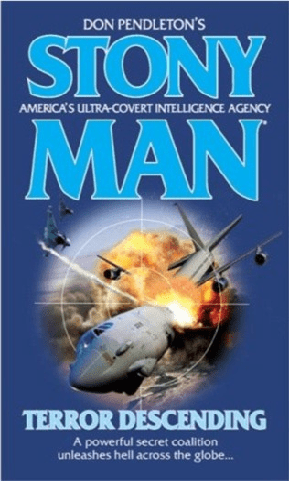
A 1960s relic left-wing terror group is using B-52s disguised as 707s to hit targets around the world with the aid of Cray supercomputer-launched cyberwarfare, and the Stony Man Farm team must stop them. This zombie sorceress-licious premise made me get the book. One reviewer compared it to a Mack Maloney book-this especially made me want to get it.

Terror Descending has the problem of “going into big technical detail and getting it wrong” with a vengeance. “F-17 Eagles”, F-22s staging from aircraft carriers, B-52s being “common” with thousands built, B-52s being disguisable as 707s, “Chinese-made Stingers”, and “MiG-8” fighters. And that’s without the “interesting” aircraft procurement this world has made (Austria uses F-14s). Oh, and despite the book being released in 2009, “Yugoslavia” still exists. This would have been more of a problem if I had the slightest expectation of genuine realism out of this book. Fortunately, I did not. The Mack Maloney comparison is very apt indeed.

Terror Descending, like the previous Gold Eagle Bolan Season of Slaughter, is rather overstuffed. There’s everything from skinhead gangs to airstrikes to a dogfight over Chad to every single flashpoint in the world from the Aegean to the Korean DMZ flaring up to South American prisons. And that’s just the villains. Having to use both Able Team and Phoenix Force as the heroes doesn’t help matters. While workable, the action isn’t good enough to really compensate for all of these flaws.

Still, I’d rather have “fun/crazy bad” than “dull bad”, and Terror Descending is definitely the former.

Review: Technokill

Technokill

The novel Technokill is easily the worst Starfist novel I’ve personally read. Back a few Thanksgivings ago, I had to pass the time and chose this book, which had been sitting unread on my shelf until then. Welp.

Who and What

This is the story of MARINES, bird-aliens, and criminals selling forbidden weapons to the bird-aliens. It’s long. It’s dull. It has weaving, tangled subplots. It has descriptions of twisted fetishes of various characters that feel like they’re as long as the few “battles”.

DEEP HISTORY OF TEM

This isn’t that much worse than the rest of Starfist, at least.

Zombie Sorceresses

At least nothing beyond the normal Starfist MARINES in Space Vietnam with a few gadgets contrivances.

Tank Booms

Ok, so at the height of this book, the MARINES face the challenge of (hold on to your seat belts) bird-aliens with these. And not some futuristic equivalent, the description is very close to the actual takedown .22 survival rifle. Even the (literal) tank army in Steel Gauntlet was better and more intimidating. The battle isn’t even that well-written and has no gimmick to make it better than it would seem. Then there’s an afterthought (literal) spacesuit commando scene that’s equally underwhelming, even by the series’ standards.

The Only Score That Really Matters

This is the low point of the Starfist series for me. It’s mostly just dull, and not in a good way. The low-powered opponent is only slightly amusing and doesn’t make up for the bad fundamentals.


Unstructured Review: The Valor Series

Valor Series

One of my first “get me through a vacation” books was an omnibus containing the first two volumes of Tanya Huff’s Valor series of military sci-fi. At the time, I was impressed by how an author who was clearly new to the genre could write something well. Now, some time later, I’m even more impressed. Other authors of either fantasy or (surprisingly) contemporary action have stumbled, in my opinion, when they turned to the difficult genre of military science fiction. Huff, for the most part, did not.

Oh, it has its pitfalls. Some of the prose is a little “flowery fantasy”-esque, but that’s not necessarily a bad thing. There’s a line in one of the later books that about how drones were obsolete compared to a “good pair of eyes” because they kept getting shot down (when the alternative is losing those eyes). But those are tiny compared to the advantages.

Heroine Torin Kerr is a good enough protagonist, especially by the standards of the genre. Huff tends to keep her in smaller, fantasy adventure party sized engagements that she’s comfortable with and work very well. And the series takes out a lot of the “brown M&Ms” that plague the ‘spacesuit commando’ subgenre (that I groan at but still somehow read and like anyway). For instance, while other, worse military sci-fi books have the main character promoted ridiculously high ridiculously fast, Kerr starts as a staff sergeant and ends the series as a… gunnery sergeant.

For these reasons I recommend the Valor book. Sure they’re lightweight, but they’re lightweight in a good, solid way.


Review: Strikemasters

Strikemasters

Mack Maloney’s Strikemasters follows in the footsteps of his earlier “Wingman” books, being set much later and with a much different background, but maintaining the elements that made that novel so much fun.

Who and What

The book can be summed up as “Special Operations Forces in super-powered C-17s fight terrorists in a super-powered mountain fortress.” It’s the sort of bombast that characterizes Maloney’s work and makes it able to navigate the dark technothriller decade of the 2000s without many problems.

And to his credit, Maloney is not afraid to throw challenges and imperfections at his super-characters and super-planes. He’s not afraid to kill central characters off. Doing this while going full-crazy ahead might be dissonant on paper, but it works here, being a writer who can have his cake and eat it too.

Of course, the characters, good and evil, are little but shallow stereotypes, but this is the kind of book where this isn’t that big a deal. And the last part of the book is a little rushed. But this also isn’t that much of an issue.

DEEP HISTORY OF TEM

Yes, we do get huge, loving descriptions of the super-tech. Why did you ask?

Zombie Sorceresses

Like every Mack Maloney novel, this book is full of bombastic, ridiculous super-contrivances. But it strangely doesn’t feel as contrived. A lot of technothrillers are stuffed with what Nader Elfhefnawy rightly calls the “illusion of realism” . As they became steadily more ridiculous, this issue amplified. The pure bombastic unrestrained “go for it” attitude of this book and Maloney’s others solves the problem.

Tank Booms

The action, as mentioned above, manages a good balance between “over-the-top” and “challenging”. It could have failed in either direction. It could have had a jarring effect of flaws clashing with the “look at the superplane go!” It also could have had the superplane effortlessly cakewalking to victory. Strikemasters did not fall into either pit, and is all the better for it.

The Only Score That Really Matters

This is another excellent Mack Maloney title, with him being able to leverage his strengths to make a tale of super C-17s doing superpowered feats in a well-told fashion. Highly recommended.


Review: Carrier – Enemies

Carrier: Enemies

The “Carrier” series was a long-running series. When searching for books in it to read and review, I followed my famous rule: When in doubt, go for the most outlandish. The enemy of this book, the fifteenth of the series, is…. Greece. How could I resist?

Who and What

As the Greek-Macedonian conflict (at least a strange version of it) heats up and a news helicopter is brought down by a Greek Tomcat on a false-flag mission, Admiral Matthew “Tombstone” Magruder and the carrier USS Jefferson goes to the region to enforce peace while a reporter who survived stays on the ground amidst the Macedonians. And that’s about as coherent as it gets.

There are really two parts of this book. The first is essentially applying the technothriller “top-to-bottom” viewpoint style to the “low budget assembly line book” quality level. So there’s the conference rooms, the scrambling reporter, the subplots, and the aviators themselves, all done in a slapdash style. For instance, the main antagonist is a general but is called an “admiral” in one passage. Then there’s the small problem of the book’s ending being abrupt and simply unfinished. That’s the boring, bad part.

The second is the goofy part. Greeks with bad names flying F-14s. An evil general launching a ridiculously obvious (to the reader) false flag plot. A main character with the nickname “Tombstone.”

DEEP HISTORY OF TEM

There really aren’t that many “The F-111F triggered the Pave Tack and dropped a GBU-12B straight on the Spoon Rest” moments in this book. There are, however, a lot of conference room scenes.

Zombie Sorceresses

The zombie sorceresses were changing everything from Greek aircraft procurement to naming customs to the nature of the Greece-Macedonia conflict to well, almost everything.

Tank Booms

The actual action isn’t the best. Most of the dogfights between aircraft feel like fanfiction of the Top Gun movie from someone who has that and maybe one other technothriller as their sole source for aerial combat, and there isn’t much “adrenaline”, for lack of a better word. Constantly cutting back to conference rooms doesn’t help.

The Only Score That Really Matters

Like Ian Slater’s USA vs. Militia series, this book is the kind of thing someone like me would find more appealing than a “normal” person probably would. The plotting and action is too dry, badly done, and generic to hold that much appeal, but the premise and excesses were music to my ears. But even they can’t stop the very bad fundamentals this book has.

Review: Unseen Warriors

Unseen Warriors

While I’ve read some books in Gavin Parmar’s Unseen Warriors series before, it was only very recently that I actually read his debut. As an early independent novel, it has issues but manages to be better in context.

Who and What

A group of what appear to be ordinary American soldiers suddenly and quickly find themselves in a “Black Ops” unit. The main protagonists are sent to “Black Ops”, which has a camp in Russia, as a form of semi-punishment after getting in a fight in Seoul.

Then from there it’s a disjointed mess of action that involves everything from nuclear blasts (multiple ones over the course of the book, similar to Dale Brown) to firefights to dogfights to infantry-vs-tank. This is a first independent novel, and it shows in the prose with inconsistent descriptions and grammatical issues-the most obvious is referring to martial law as “Marshal Law”.

In terms of characterization, it ends up being clunky cheap thriller characterization but still earnestly tries-something that can sum up the entire book very well.

DEEP HISTORY OF TEM

Unseen Warriors starts with an infodump on how the US military adopted a version of the G3 rifle for their own use after the 5.56mm rifles [that they’d used for decades] somehow proved unsatisfactory. It continues in this style throughout the entire book. As an example, it has Mi-35s (export Hinds) referred to sometimes as Mi-34s (a real but totally different helicopter).

Zombie Sorceresses

Pretty much the entire book (and the later series) has their heavy hand. Tanks appear everywhere and ignore logistics and concealment. The main characters just go into a “Black Ops Unit” like that. Terrorists can have gigantic arsenals that no one noticed before, even with stuff that would be hard to conceal and raise lots of red flags. Nuclear bombs are treated very cavalierly and continuously used. The jumping around plot doesn’t help.

Tank Booms

The action is well-intended (see a pattern?) but suffers from several big problems. The first is its constant repetition (including the gore), the second is the clunky prose, and the third is that it’s hard to tell the exact context sometimes thanks to the careening, weaving plot.

The Only Score That Really Matters

Judged purely in isolation, this book and series are not the best. My first impression while reading one of them long ago was that the writing style was poor, the action repetitive, the premise and plausibility ludicrous, and thus it was hard to get into.

However, as an early earnest effort, it feels better. After all, I’d rather have a sincere amateur effort (and Parmar has improved in later Unseen Warriors books, especially in terms of flow and pacing) that was clunky and zombie sorceress-heavy than a cynical commercial effort that was also, as many 2000s technothrillers were, clunky and zombie sorceress-heavy.

Review: Hangfire

Hangfire

Sadly, Hangfire has to rank as one of the lower entries in the wildly uneven Starfist series. The basic premise-intrigue on a world that’s a combination 1950s Cuba and Westworld-style historical theme parks-is good. Unfortunately, this just makes the rest of the story worse.

Who and What

To infiltrate a mobster-ruled resort world of debauchery named “Havanagas” (I told you it was based on 1950s Cuba), the government turns to… MARINES, of course. Also, there’s intrigue on a colony world as aliens invade it.

The relative cohesion of Steel Gauntlet is lost, and the group of tangled, clunky subplots I’ve seen in worse Starfist books are in full force.

DEEP HISTORY OF TEM

There are a few infodumps here, but not that many. The problem is that the potentially interesting focus (The Space 1950s Cuba) gets sidelined.

Zombie Sorceresses

Hard to judge, save for all the MARINE contrivances.

Tank Booms

There really isn’t much action involving the MARINES. This is a shame because the chance to throw them into a Murderworld-style deathtrap amusement park would be amazing. Instead there’s intrigue that isn’t too well-written, a tiny bit of action, and an arena scene that is ridiculously foreshadowed. The barely related alien invasion is nowhere near as good, so of course it takes up a big chunk of the book.

The Only Score That Really Matters

While I’ve read worse Starfist books, this seems disappointing as well as bad. What should be a romp through Mobster Murderworld ends up treating that tamely while devoting a ton of time and space to uninteresting aliens invading an uninteresting world and fighting uninteresting battles to set up an uninteresting arc.

It’s a shame.