Review: Threat Warning

Threat Warning

The third Jonathan Grave “shoot the terrorist” thriller, Threat Warning remains mostly as good as its two predecessors. However, it backslides just a little, as I’m seeing plot elements decisively solidify. The first part of this isn’t too bad, simply featuring Gilstrap deciding on a certain style and it becoming less novel to me. Any long series would have this problem.

The second part is that it features my “this isn’t the movies-it’s worse!” pet peeve where the books go into a lot of semi-realistic detail, and then Grave turns into John Rourke and can fight off giant armies of goons on his own. It’s not a deal-breaker by any means, but it’s still a little annoying.

There’s also two issues specific to this book. The first is that it tips its hand about the main plot too soon, unlike the last two. Again, this doesn’t ruin the book and the action/execution is still as good as ever (with the previously mentioned caveat), but it is a downgrade. The second is that the climax has the villains failing as much due to their own incompetence as the heroes action. While plausible, it isn’t as satisfying. These issues lower Threat Warning from the heights of the previous two novels, but it’s still a fine thriller.

Review: Whiskey And Roses

Whiskey and Roses

In my last review of one of Bradley Wright’s Alexander King novels, I mentioned that the ones I’d previously read were so middling and forgettable that I’d actually forgotten about them. And the first one of those books was Whiskey and Roses. How is it?

Well, I’ll put it this way. This could very well replace Marine Force One for “most absolutely, utterly, middling thriller novel there is”. There is one pseudo-advantage and that’s that the title is a little less bland. Yes, it’s so “middle of the pack” that I need to talk about the title to find something distinct. However, there’s also one disadvantage and that’s that the proofreading and prose is sloppier than Marine Force One’s.

This is, to be fair, the first book in a series and Wright’s writing has improved since it. But this is still thriller fiction at its most middling and mediocre.

Review: Hostage Zero

Hostage Zero

John Gilstrap’s second Jonathon Grave novel and a tale of kidnapping, intrigue, and action, Hostage Zero lives up to the first. It might be a tiny bit “worse” than No Mercy, but that’s probably just me being more familiar with the series now. So I lack the awe at finding a newer, good author. Though the book itself is excellent.

Gilstrap’s action isn’t “realistic” unless benchmarked against the most absolutely ridiculous alternatives (not that I have a problem with that), but it’s as solid as always. There’s the slower middle portion, but even that demonstrates another strength of its author-a great sense of buildup. Stuff is revealed at a just-right pace. Not too quick, and not too slow. Jon Land has been consistently good at buildup, and in these two books, Gilstrap is too.

And this book and its predecessor also succeed in, well, having the cake and eating it too, for lack of a better word. Jonathan Grave has a huge network of resources at his disposal, but they don’t feel like easy victory buttons. He has to get his hands dirty and challenges do appear in his path. I love finding series that are good that I didn’t previously know about, and so far this is one of them.

A Thousand Words: Metal Slug

Metal Slug

SNK’s classic series Metal Slug takes the Contra-type “side scrolling shooter” game and adds an unforgettable art style to it. The excuse plot is you controlling a member of the elite “Peregrine Falcons” against the “Rebel Army”-and more weird enemies.

The art, from the goofy yet legitimately detailed sprites to the lavish backgrounds to the smooth animations, is consistently amazing. The music isn’t as standout (with a few exceptions), but is always at least serviceable. As for the gameplay, it’s both very good and inherently limited.

The action, weapon combinations, and controls are all excellent with the exception of a few clumsy platforming sections. The issue is the games are very short and were originally for arcades. So it’s either “be good enough at this very hard game to avoid deaths or just brute-force your way through with credits”. This probably couldn’t have been avoided, but it’s still a little bitter. That being said, this series is a classic for a reason and the games are well worth playing.

Review: The Suriname Job

The Suriname Job

Vince Milam’s The Suriname Job is the first book in the Case Lee series of thrillers. In a very crowded field, it only stands out in a few ways. The first is its very format. This is told in a first-person, “hardboiled” narrative style. It’s different than a lot of cheap thrillers, but I’m not sure it’s for the better.

The second is a bigger issue, and that’s that the action isn’t very good. It’s basically flat, which isn’t what you want to feel when you read a cheap thriller. The third is that the plot is a little too mundane, which isn’t necessarily a bad thing in and of itself but drags it down even more when combined with the poor action. With these issues in mind, I’m not exactly eager to read the later books in the series.

Review: Fire Ice

Fire Ice

The novel Fire Ice holds a great deal of importance to me. It was, without a doubt, the first real “cheap thriller” a young me read. This makes it hard to truly judge its literary quality. After all, young me saw the name Clive Cussler on the cover and didn’t know at the time about how the “co-author” system worked, so I assumed it was all him (which had the thankful effect of leading me to earlier Cussler books that were indeed all his own).

With its big locales, action, and high-stakes plot with a Russian oligarch and a supervillain scheme, this has all the ingredients a Cussler thriller and a cheap thriller in general needs. Certainly, for one’s first cheap thriller, you could do a whole lot worse than that. While my reading habits are such that another cheap thriller probably would have taken its place, I still owe Fire Ice a lot for getting me into them.

Review: Assault Into Libya

Assault Into Libya

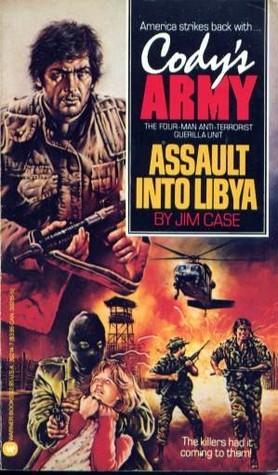
With this post, I will have reviewed every book in the Cody’s Army series on Fuldapocalypse. How does the second, Assault into Libya, hold up compared to the others? Well, it does what a men’s adventure novel is supposed to. Like some of the other entries, it’s a 51% book in a 51% series. Beyond the basics, it only really stands out in being a little more willing than some when it comes to killing off supporting characters.

For the series as a whole, it’s ideal for showing off the most single representative example of what 1980s men’s adventure was like. Teams of secret agents pursue terrorists through headline-ripped locations (this particular book has Libya, the crown jewel then). There’s lots of at least moderately effective action. And yet this book has the same issue that all Cody’s Army entries save for the truly engaging Hellfire in Haiti share-they’re mostly interchangeable and there’s no reason to pick them ahead of better examples in the same genre.

What Happened To Men’s Adventure Novels?

So, what happened to the likes of “men’s adventure novels”? If the technothriller declined enormously after 1991, the smaller “men’s adventure” series seemingly just dissolved completely. But now, from my own readings, and from looking at Serial Vigilantes of Paperback Fiction and reviews/commentary of later “men’s adventure” books, particularly on Glorious Trash, I think I might have found it.

They did drop dramatically after the 1980s, and the reason, from pretty much everything I’ve heard and readabout, is economic. They were just too low margin. I should refer you to this post by thriller author Jack Badelaire about the details, and he brings up another reason I agree with, which is that visual media got better.

But whatever the why, what happened? Well, cheap thrillers did not stop being written by any means, as Lee Child can attest. Someone comparing Jack Reacher to a classic men’s adventure hero would find more similarities than differences. But as for those dime novels, the surviving ones sort of – shifted. A look at everything from page counts courtesy of Serial Vigilantes to review commentary to my own study finds three main things.

  • They grew longer and their MSRPs grew higher.
  • They became increasingly “militarized” for lack of a better word (another connection to technothrillers), a process that started with the team-based novels of the 1980s and grew more and more prominent.
  • They increasingly began piggybacking on the names of big-time authors.

Yes, what happened is that the men’s adventure book became the “Tom Clancy’s” book.

Review: No Mercy

No Mercy

John Gilstrap’s debut in the Jonathan Grave series, No Mercy, is very much a “grocery store book”. In fact, I first learned of this series after seeing a later book by him in-a grocery store. That being said, not all grocery store books are bad.

This is, in fact, one of the best thrillers I’ve read in a while. Sure, the plot and characters are nothing out of the ordinary for thriller novels, but the execution of Jonathan Grave and his adventure is fantastic. From the opening rescue sequence, I was impressed by the quality of the action. It’s not perfect. The middle drags just a bit. But it’s fantastic nonetheless.

The action is so good that, even though I saw some of my usual quibbles, I brushed them aside effortlessly. From the opening to some unconventional-yet-effective scenes in the middle to a gigantic battle ending, this was a tour de force. No Mercy was the kind of opening act that deserved to bring about a large book series.

Review: Termination Orders

Termination Orders

Leo Maloney’s Termination Orders begins the Dan Morgan series of thrillers. The plot is basically cheap thriller boilerplate, as an action hero faces off against a super-conspiracy. Of course, cheap thrillers succeed and fail based on execution, not concept.

In that sense, the book works. Its action is competent and the pacing done fairly well, although there are a lot of flashbacks in weird places. The exception to the generic yet decent action is one set-piece involving lions that made me smile.

The conclusion I drew is that this book manages to go juuuuust above the middle of the very crowded pack. It’s not the most distinct or best cheap thriller. But it’s done well enough that I wouldn’t call it a mere “51%” book.