Review: If It Bleeds

If It Bleeds

A collection of short stories featuring the infamous Predator alien hunters, If It Bleeds is the first anthology I’ve reviewed on Fuldapocalypse. From ancient history to futuristic fighting rings, the Predators come to hunt.

In many ways, these aliens are ideal crossover/setting shifters. A combination of a sense of (comparative) self-restraint and a desire for (by their standards) a “fair” fight mean they can be put almost anywhere, and they are. Compare this with the other half of the “Alien vs. Predator” franchise. The xenomorphs are one-dimensional and will inevitably either devour everything or get crushed themselves.

The various writers take advantage of this to bring about various “prey”. For the most part, they’re successful. However, there’s a few small issues. The first is that the stories that go for some kind of mystery don’t work because you know what the anthology features. The second is that there is no story where Theodore Roosevelt fights a Predator.

Otherwise, this is a very fun group of stories that any science fiction or action fan should enjoy.

Review: The Tenth Circle

The Tenth Circle

The latest, and as of now the last Blaine McCracken book released, The Tenth Circle is a frustrating misfire. While Dead Simple was, for the most part, a consistent middling slog without Land’s past spark, this occasionally shows the craziness that makes most of the series such a treat-and then drops dramatically.

The book opens with a delightfully preposterous and ridiculous set piece that does Blaine McCracken justice as he destroys an Iranian nuclear site. If the rest of the book was like that, I’d be giving it a wholeheartedly positive review. Unfortunately, it isn’t.

The problem is that the rest of the book is just too inconsistent. It’s often too self-serious for its own good-and then it returns to individually out-there set pieces. It’s not as (comparably) bad as Dead Simple and a lot of the fun is still there, but shares the problem in that its central core is a more conventional thriller that revolves only around the use of exotic explosives. Yet unlike its immediate predecessor, Pandora’s Temple, it just doesn’t live up to the classic McCrackens.

Review: The Kamikaze Legacy

The Kamikaze Legacy

A sequel to The Yakusa Tattoo, The Kamikaze Legacy continues to follow hardboiled Ed Mulvaney as he moves to foil another international plot in a stereotypical Japan, this one concerning a deep-sea expedition with sinister motives. This is less the “crazy Jerry Ahern novel mixed with technothriller” of its predecessor and more “crazy Jerry Ahern novel mixed with Clive Cussler-esque technology/ secret history thriller.”

While it still has the strengths and weaknesses of The Yakusa Tattoo (strengths: good ridiculous action and an even more ridiculous plot-weaknesses: blocky prose and a million weapon descriptions), I found that this has a MacGuffin that by all means should belong in a boring “shoot the terrorist” novel, but ends up being just as crazy as the rest of the book. This emphasizes that, especially for cheap thrillers, execution is more important than concepts by far. As for what it is, it shouldn’t be too hard to guess.

This is a very stupid-fun Jerry Ahern book. It’s the kind of book where the mountains of technical inaccuracy and implausibility actually add to the appeal of it all. While it’s not quite as bizarre as its predecessor, it’s still a very fun cheap thriller.

Review: The Foundation (Steve P. Vincent)

The Foundation

Not to be confused with Asimov’s sci-fi classics, Steve P. Vincent’s The Foundation is a cloak-and-dagger story. In it, journalist protagonist Jack Emery battles the super-conspiracy known as the Foundation for A New America. The Foundation thus takes its place alongside the Patriots, Those Who Slither In The Dark, “Valhalla”, the Kataru, the Delphi, the X Syndicate, the Y Syndicate, the Socrates Club, the Council of Ten, the “Wise Men”, and even more super-conspiracies I’ve forgotten about.

(Look, I read a lot of cheap thrillers with super-conspiracies in them, all right?)

This is very much a 51% book through and through. There’s a super-conspiracy, there’s a conventional war between nuclear states in the background where no one seems particularly concerned with it going nuclear (did the zombie sorceresses come in?), and, slightly unusual for the genre, the main antagonist is a woman. Otherwise it’s just middling cloak and dagger fiction.

Review: Black Friday

Black Friday

I decided to finally do it, reading a book by a super-famous author. James Patterson’s Black Friday (original title Black Market) is a thriller of financial and physical chaos. It’s also a book that’s (as far as I can tell) genuinely his and not simply a “James Patterson’s” book with his name on it.

The chapters tend to be very short, in a style I already knew about from secondhand talk of his writing. I generally don’t mind short chapters, and he was not the first author to use them, but somehow they didn’t fit here. I think it’s a combination of them and a ton of shifting viewpoint characters that make the whole thing just look disjointed and sloppy.

And then there’s the tone, which is this constant plodding of Deep, Dark Seriousness. The jarring differences between that and the inaccuracies, particularly surrounding firearms, is astounding. This isn’t (just) having guns work on action movie logic or making mistakes like calling an SKS “automatic” and not knowing which airborne division has an eagle as its symbol. It isn’t even having a character use an American-180 for no discernable reason except the “it’s an exotic gun I’ve heard of” factor.

This is references to “machine gun pistols” (Exact words). This is talking about how submachine guns weren’t used in city fighting due to their high rate of fire (er…), and a gun that combines ridiculously effective silencing (even by cheap thriller/action movie standards) with implied heat seeking bullets. Said gun is only used in a single scene. It’s bad, even by the standards of someone who’s read a lot of cheap thrillers.

The plot feels like an absurdist jumble of cheap thriller cliches. There’s a super-conspiracy, lots of cutaways, and everything from international terrorists to crazy veterans. But with the tone and janky pacing getting in the way, it’s not the kind of book where you can enjoy the excess. There are a lot better books, even mainstream thrillers, out there.

Review: Primary Target

Primary Target

Jim Heskett and Nick Thacker’s Primary Target is not the deepest story, nor does it have the most plausible premise. Basically, circumstances lead to assassin Ember Clarke having to participate in a trial by combat, fighting off other assassins trying to kill her over the course of several weeks.

However, in spite of this setup, it’s well done. Yes, it has the “this isn’t a movie but I do super stuff anyway” gripe I’ve seen far too often, and its premise deserves action far more bizarre and over the top than what actually occurs. But the book remains a solid cloak and dagger thriller.

Granted, I’m not the biggest fan of such novels, but I still like variety. And this is cloak and dagger done very well.

Review: The Protocol

The Protocol

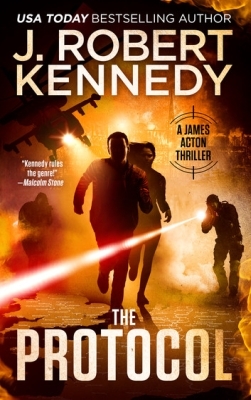
The initial book in J. Robert Kennedy’s James Acton series is The Protocol. This secret history conspiracy archeology thriller comes at sort of the tail end of my reading binge of this “genre”. Having read a lot of them, I’ve returned to more conventional cheap thrillers and have moved on for now.

This book embodies the reason why. A 51% book with an ancient mystical MacGuffin and super-conspiracy is still a 51% book if it has middling, mundane action. Especially if the MacGuffin itself is an unoriginal ripoff (as this is-I’ll just say there was an Indiana Jones movie that had the same kind of artifact and leave it at that). Just because something seems more outlandish than the blandest “shoot the terrorist” novel on paper doesn’t mean it comes across that way when actually reading it.

I’m not against ancient bizarre MacGuffins and super-conspracies in the slightest. But just having them doesn’t make them the equals of the best thrillers any more than using a similarly shaped bat makes one equal to a baseball Hall of Famer. It’s a lesson I’ve learned throughout my binge, and this is a good, even if not the most pointed, example of that.

A Thousand Words: Alien Vs. Predator Arcade

Alien Vs. Predator Arcade

Coming on the heels of my last post about beat ’em ups, one of the more interesting examples came from Capcom. The 1994 Alien Vs. Predator arcade game is fascinating. As a game, it has the same beautiful spritework you’d expect from a Capcom game of this time period. Its mixture of enemies is not exactly a bunch of street punks led by a well-dressed man with a gun.

But what the most interesting thing is is that it does what an adaptation needs to do. Granted, in many ways the setting tone is kind of incompatible with the game-you aren’t an outmatched human facing horrific, inhuman monsters, you’re beating up hordes of them en masse. But in terms of the pure essence, it distills all the convoluted lore into one simple goal. Humans reluctantly ally with monsters who sometimes want to kill them against both monsters who always want to kill them and a government/corporate conspiracy foolishly trying to use the latter monsters.

And this is done so well that Capcom could put a bubbly-voiced kounichi in and have it work.


Weird Wargaming: Beat Em Ups

Ah, the “beat ’em up”, a type of video game that achieved its first popularity with Double Dragon, and may be known best from Final Fight and Streets of Rage. Should one wish to simulate it using tabletop rules, the following should be adhered to:

  • Given the genre, the system must have robust melee rules. This is an obvious requirement that needs no further explanation.
  • The enemies will resemble, by and large, stereotypical 1980s “punks”. Bosses will be bigger and stronger versions of them and/or exotic in some way.
  • If they have weapons, it will be stuff like pipes, bricks, and knives. Because…
  • The amount of guns used, especially any bigger than a pistol, can be counted on one hand. Double Dragon set the precedent that only the final boss is allowed to have a gun. While the degree to which this adhered to varies, it’s still generally enforced.
  • The final stage will be this opulent area that contrasts massively with the tone and theme of the rest of the game. Double Dragon had an ancient temple complete with mechanical traps. Final Fight and the first two Streets of Rage games have giant mansions. The latest Streets of Rage has an island supervillains lair complete with a castle.


Review: Sandstorm

Sandstorm

sandstormcover

James Rollins’ Sigma Force series begins with Sandstorm.

I might have a little bit of “hype backlash” because of the way this series has been praised so much. I might also be used to ridiculous thrillers because of the way I’ve actively sought them out, so what seems utterly crazy to a less prolific reader might not be that way to me.

That being said, this was a very good, very out-there cheap thriller. I’d describe it as a more tacticool version of Clive Cussler. The ridiculous technobabble and ancient puzzle-solving is there, but the action (which is both incredibly frequent and often janky) is more conventional and, for lack of a better word, “tactical”, save for an amazing scene where someone dual-wields pistols on horseback. While I like it, it’s not the best ever in my eyes.