Delighted to say that A Period of Cheating, the next book in the All Union series, is now available for pre-order. Its projected release date is April 12.
The ebook can be preordered here.

Delighted to say that A Period of Cheating, the next book in the All Union series, is now available for pre-order. Its projected release date is April 12.
The ebook can be preordered here.
I’m torn with submarine names for the MX-SSB class, a real proposed design that I’m using in All Union
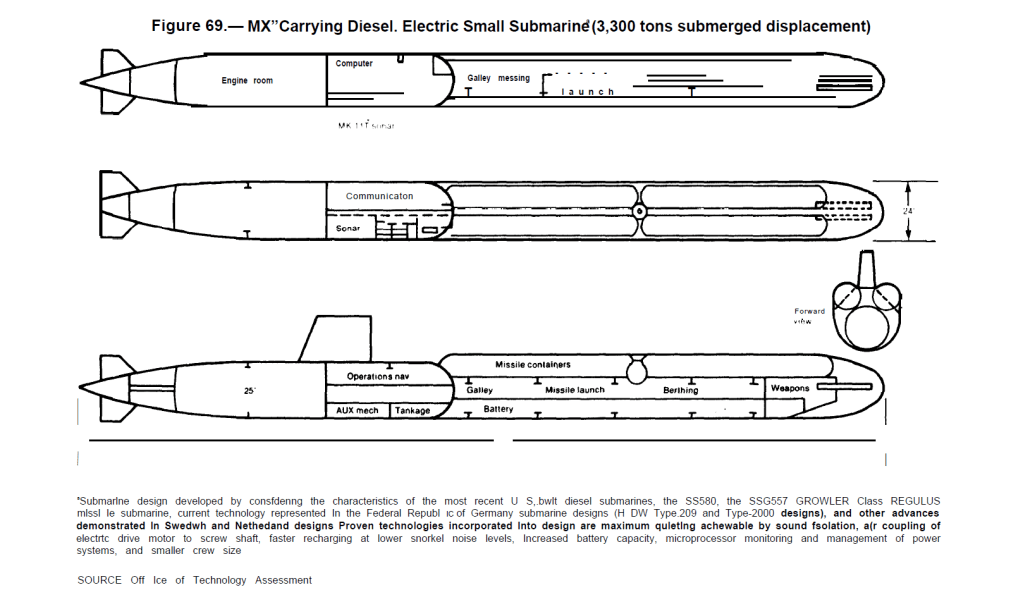
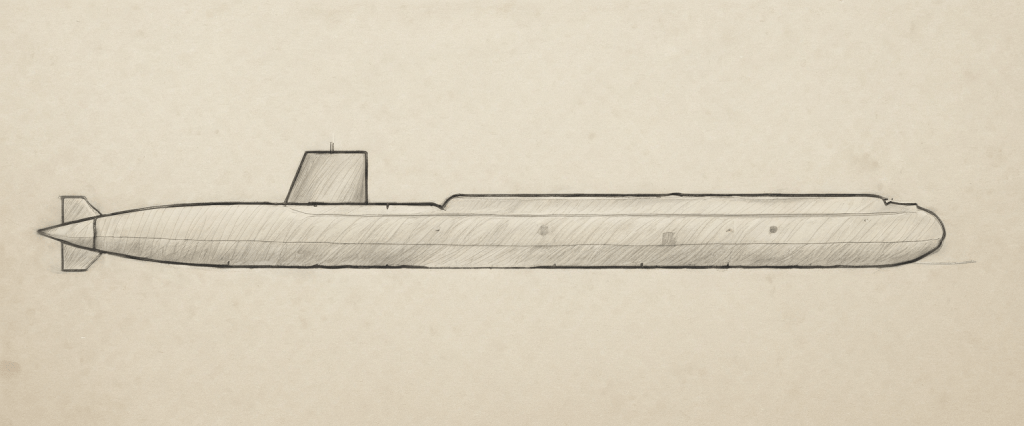
(Bottom picture made in Stable Diffusion from the outline of the sub above)
The problems are:
I’m leaning towards lakes (ie, the Lake Tahoe class with some/all of the Great Lakes thrown in), but am wondering if there’s something that just can click. Thoughts?
So Fuldapocalypse closes the door on 2023. It was a good year for me if not necessarily for this blog. The best thing I did in 2023 is publish All Union, which was in my head for years. I’m still working on a successor, but first usual writers issues happened, then AI Art (which I love) happened, then Rogue Trader happened. So my dream of getting multiple full length entries in that series out the door didn’t happen.
Oh well. Still had a good year. See you next January!
So I’ve slowed down blogging. The biggest reason is me playing the new Rogue Trader video game. I’ll admit it’s a little raw and a combination of just being released and having a ton of moving parts has led to a giant case of Bethesdaitis, and thus to me maniacally saving and being prepared to redo entire arcs if not the whole game (not that I mind). But in spite of that it’s an awesome experience and is a side of Warhammer 40k that I hadn’t seen as much of before. The second biggest reason is me working on A Period of Cheating, which has gone great in a time of year that normally isn’t the best for writing.
Between those and my other responsibilities/pastimes, there just hasn’t been much time for reading and reviewing. But rest assured I’m well.
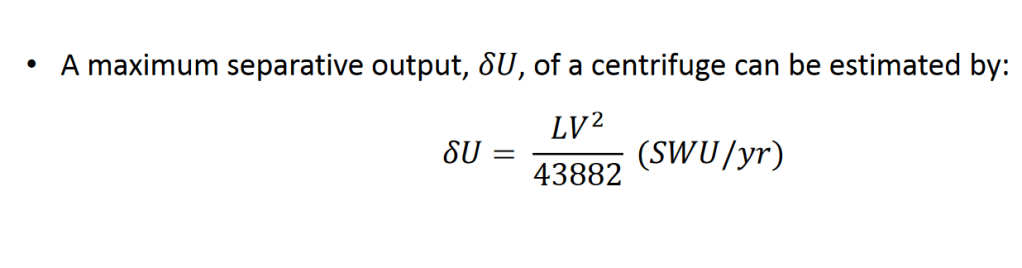
The Holzer Centrifuge is a uranium enrichment centrifuge I’ve used as a Macguffin in various settings of mine. It is one of the smallest viable centrifuges and a simpler yet less effective design compared to its contemporaries. It has a maximum capacity of around 0.9 separative work units per centrifuge[1]. In practice with inevitable inefficiences and losses this leads to a mere 0.5-.6 in practice, one of the weakest individual centrifuges to ever spin in its hideous mission.
In All Union, the Polish Holzer centrifuge (named after the ethnic German scientist who led the program), served as one of the primary enrichment sources for the nation’s uranium path. The goal was ease of assembly with just domestic resources, hence why Holzer centrifuges were around 40-50 years behind their contemporaries and low-powered even by the standards of other first-gen designs. Nonetheless, they accomplished their goal.
[1]A napkin calc is as follows, with L being length in meters and V velocity in meters per second. Don’t really ask me to explain what an SWU exactly is.
Poland produced at least 50,000 Holzer centrifuges and operated 25,000 of them. Using an enrichment calculator and going by 0.6, the fully functional cascades would produce 77 kilograms of weapons grade uranium a year if working with natural ore to start, or 270 kilograms if working with reactor-grade LEU.
Today is Veterans Day, or Armistice Day at the end of World War I. Now I’ve said many times-I’m a soft sheltered civilian who could do absolutely nothing in a real fight except get killed. I also have no immediate family who have served in the military. That being said, even though all my knowledge comes from secondary sources, I feel pretty confident in saying one thing, which I think today is as good a time as any to say it.
Veterans simply cannot be lumped into any one category.
And I’m not even talking about different countries, different wars, different branches, different specific units (of course an administrator in the back who faced only the occasional rocket, be it a V-2 or Type 63, is going to have quite a different experience from the tip of the spear). Seriously, the accounts from people in very similar places and roles at the same time can be totally different, as do their beliefs on everything from politics to military doctrine.
Granted, I think part of the problem is pop culture having a tendency to treat the military with the two extremes of either “John Wayne” or “Oliver Stone”. Which is at least understandable, I mean I can give a lot of it the benefit of the doubt. It’s just that “Yeah this isn’t like Hollywood” just makes me go “uh, and? Yes? Fish live underwater? The New York Knicks are not a good basketball team?”
Bringing this to my own writing, there’s not much precedent for how to describe the experiences of a female forward nurse from Kyrgyzstan fighting in the most intense nine days of battle since 1973. So with regards to All Union’s Cholpon, I guess I have to hope I did my best.
And yes I know a lot of you hate it when we say that but to all veterans who served honorably, thank you today.
Now that the focus has changed (a little), I figured I’d do an infodump of something in my mind that I probably wouldn’t get to and honestly shouldn’t elaborate on in the next All Union installment. Enjoy.
In All Union’s timeline, Poland has the world’s fifth or fourth-largest nuclear arsenal.
Polish nuclear infrastructure:
Polish Material Plants:
Polish Reactors:

On May 20, 1992, Poland detonated a 1.1 kiloton plutonium “physics package” at the Opole Test Site. This was a rushed, improvised device of essentially no practical usability. The bomb was cobbled-together from reactor-grade plutonium taken from the Ignalina power plant in nearby, friendly Lithuania. It was intentionally fizzled to prevent the explosion from being too big, and was controversially detonated above ground to ensure the world knew. But a frenzied construction of nuclear arms and infrastructure began.
The fuel cycle starts at the processing plants. The main and largest by far is the redox chemical plant by Gdansk. The process there is inherently proliferation-resistant due to the fact that it takes a long time to make LEU, and an impossibly-long time to make weapons-level material (as in, over a decade). Low enriched uranium is taken from Gdansk and assembled into fuel rods for reactors home and abroad.
Poland in-universe has seven civilian reactors in two plants. One has three units of 300mw reactors and is located about 30 kilometers northeast of Bydgoszcz. The other has four 600mw reactors and is located near the German border slightly south of Szczecin. All are pressurized water reactors, although the Szczecin plant is of a substantially more advanced design.
However the uranium can also go into the three centrifuge collections, where it is enriched to weapons-grade levels. This makes up one half of their nuclear weapon path. Using LEU enables them to work more effectively than they could with raw uranium.
While the first proper plutonium bombs were made from “goosing” the Ignalina reactor, it was not a sustainable long-term solution. The Poles responded by building two Hanford-style graphite-pile production reactors near Nowe.
HEU and weapons-grade plutonium is taken to the highly classified Powidz assembly facilities (home to a historical/real air base) where the actual warheads are made. Every remnant is taken to the gigantic reprocessing/separation center at Ostroda, known as Nowa Energia (New Energy). There everything from MOX fuel systems for export to depleted uranium bullets are made (the Polish nuclear program makes a lot of DU, so they incorporate it into their arms industry).
For the finished products, Poland is believed to possess around two hundred warheads. It uses a dyad of aircraft/air-launched missiles and ground-based TELs. Naval deployment has been considered but is not believed to be practical as of the setting present.
Because I’m inspired by WWIII87 doing something similar and since I don’t think I’ll ever touch on the topic in any proper All Union successor, here it goes. It was in my mind, now it’s not. Enjoy.
Like with most wars since 1900, if not since the invention of gunpowder, the Soviet-Romanian War in All Union was won by artillery. While the Soviets had far more and far more advanced tube pieces, fire control was a lot more varied on both sides.
The top tier of fire control lay in the front level assets and units in the mobile corps, from battalion to corps itself. These contained most of the what the “recon strike complex” needed to succeed and did. Drone (and advanced non-drone) spotters, high performance datalinks, widespread designators for smart munitions, and advanced digital computers, all of it was present and used to great success. Perhaps the biggest air/artillery feat was the near-destruction of the Romanian 6th Tank Division before a single bullet was used in direct fire. The Romanians and allied Bulgarians had nothing like it. This was what caused a gigantic amount of alarm in the US and western militaries…
…although calmer heads pointed out that while still dangerous in the extreme, the Romanians had very little ability to disrupt the system.
The medium tier was done by most regular Soviet units in the traditional division/army formation and the best Bulgarian/Romanian units. This involved fire control computers and other technological advantages, but still showed signs of stiffness and weakness in comparison to their upper tier (not the same as ineffectiveness, of course).
The low tier was largely manual and familiar to anyone in World War II, and was conducted by the bulk of Bulgarian and Romanian units, as well as a few low-category Soviet units mobilized for the war. There were many reasons why the southern front was less open and why the Romanian defense there was more effective: Units of mobilized Bulgarians instead of high-tech mobile brigades, the use of the Danube and more defensive lines, the proximity of Bucharest meaning that there was a “back to the wall” attitude, and many of the regime’s most loyal and stubborn units being deployed there prewar, possibly for political reasons.
Yet one has to be better C3I on the Romanian side (a large fortified area meant they could use field telephones and other such rugged measures far better) and worse such measures on the Soviet/Bulgarian side (especially as they had to go on the offensive). Which in turn made fire control better/worse.
So the conventional forces of the United States in All Union, unlike its superpower counterparts, have not been the most central to any of my drafts (yet…). Therefore I figure I should infodump some of my musings on it right now.
The reformation of the USSR brought about a period of aimlessness among the US Army. With the fall of the Berlin Wall and the former Warsaw Pact states forming an independent de facto buffer, priorities became much lower. Going from all of Germany to the northern tip of Norway and Thrace is somewhat of a downgrade.
That being said, there has been a shift of forces to the south. The US 9th Infantry Division is in Turkish Thrace to, in the event of a Thraciapocalypse, serve as a mobile counterattack force. The lighter 51st Infantry is in Northeastern Greece near the triple border to make sure the rival NATO countries play nice serve as a tripwire for any Soviet-Bulgarian push south.
The need for “Americi-BTRs” that historically was filled by the Strykers came in the form of LAVs, both the LAV-25/Piranha of real life USMC fame for that branch and the unrelated but similarly named LAV-300/600 series for the Army.
The medium-ization of the Army came as followed: Two brigades in existing heavy divisions with their Bradley mech inf brigades replaced with LAV mech inf brigades ie BMP-BTR mixes, two “medium-heavy” divisions based around LAV-300s with a divisional tank battalion that would stay behind on lower-intensity deployments, and one “medium-light” division with the LAV-300 series, more uparmored HMMVs as the infantry carrier, and no organic tanks. For the USMC, the Seventh Marine Division came into being, along with Combined Arms Regiments (mixes of tanks and LAV-Bisons proposed in real life) for the three active USMC divisions.
More to come…
A while ago I did a post on the various Sovereign Union Mobile Corps in All Union, which included their “mascot” animals that appeared on each emblem. Now that Stable Diffusion XL has been released, I’m delighted to say that their logos became a reality. (Note: Some are rougher than others. Goal was general idea)

Starting things off is the 17th Corps that heroine Cholpon Murad-Kyzy served in during the Soviet Romanian War. Its mascot is the Huma Bird, and I chose the output/prompt that didn’t look so much like an eagle. Located in Central Asia, it serves as the de facto strategic reserve corps, being ready to go east, west, or south in equal measure.

The Belarusian 5th Corps is a bison. Historically, it was the only such corps actually made (and not have a bison as its symbol.)

The 7th Corps is an elk. Not much else to say about it.

The Northwestern TVD’s 26th Corps has the Karelian Bear Dog as its mascot animal. It did not participate in the Soviet-Romanian War, but in the event that the All Union and Northern Fury timelines were fused into one combined World War III, it would be the central Soviet force in Norway.

The Lviv-centered 28th Corps is one of the main units opposite new archrival Poland. Its symbol is a fairly plain lion.

The Donbass-garrisoned 64th Corps was in many ways the “pet” unit of legendary reformist president Anton Yatchenko, who happened to come from that area. Its symbol is a nightingale, and it was one of the key units in the Romanian War.

The Crimea-based 32nd Corps was the only such one to serve in the southern Danube Front, and it only entered the battlefield after the initial Soviet-Bulgarian force had established firm bridgeheads on the northern side of the river. It’s the corps with the most focus on amphibious, airborne, and light infantry operations. Rumor has it that part of it is earmarked for a separate attack on Iceland. Its mascot is a hippocampus, a mythical literal sea horse.

With its cartoon mosquito being the most whimsical logo of the entire army, the 43rd Corps is the primary mobile corps opposite the old and rising enemy: China. Because of this, it was never even considered being sent west to Romania in 1998.
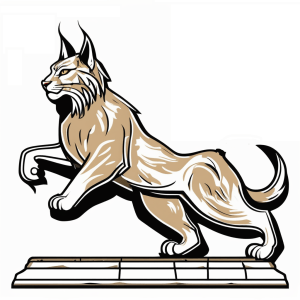
The leaping lynx that is the 57th is the other Far Eastern mobile corps. Like its “brother” the 43rd, it did not fight in the Romanian War. However, it was on standby along with the 26th in case a second mobilization and major operation needed to be launched (it didn’t).
 Fuldapocalypse Fiction