Defenders of the Danube

The narrative of the Soviet-Romanian War in All Union focused largely on the northern front, where advanced mechanized units burned through the Romanian countryside in a rapid (but not bloodless) stomp. However, by far the hardest going was the southern front, a push across the Danube with Soviet and (majority) mobilized Bulgarian troops.

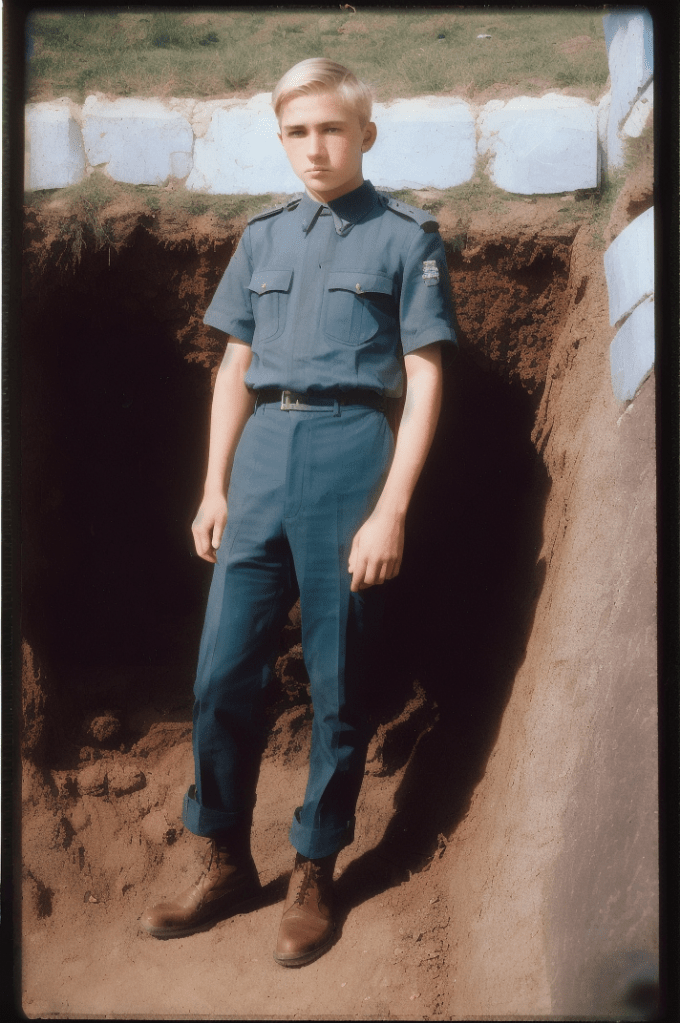
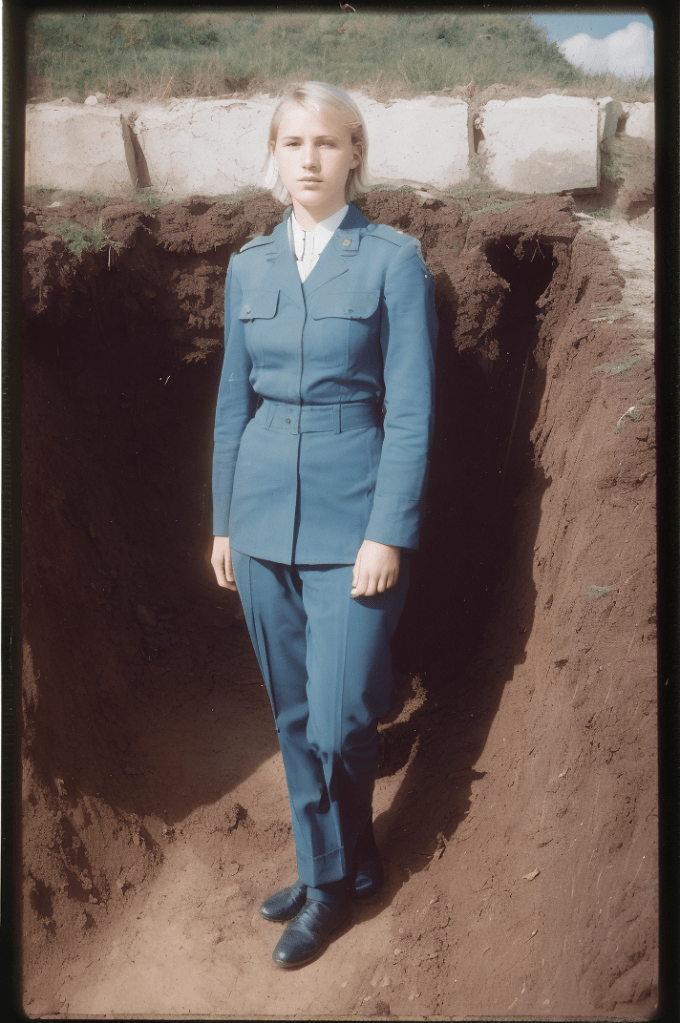
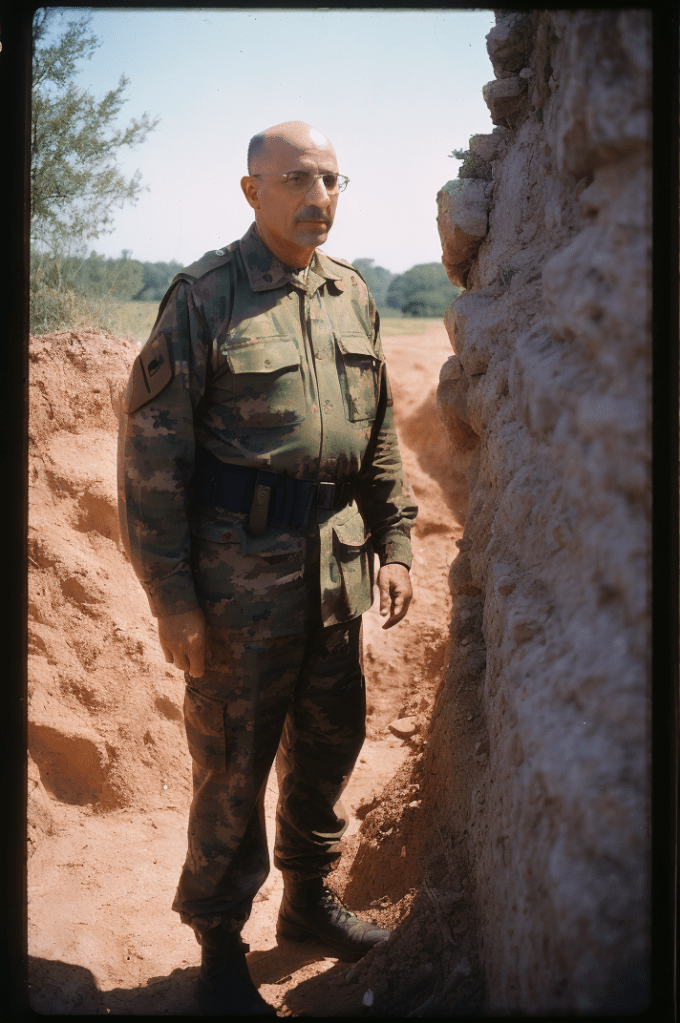
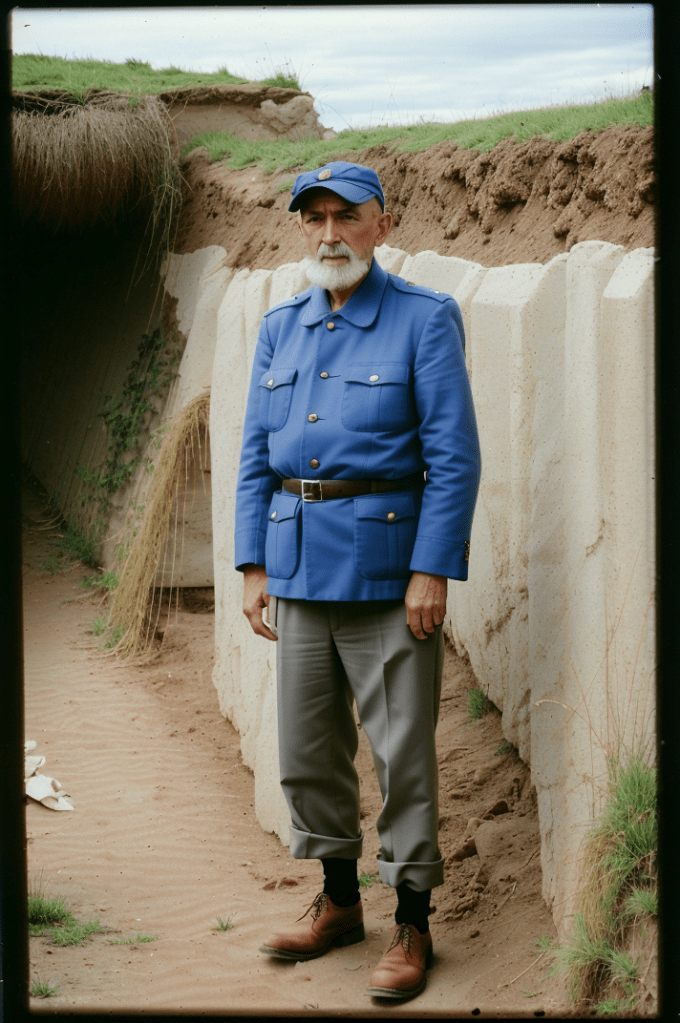
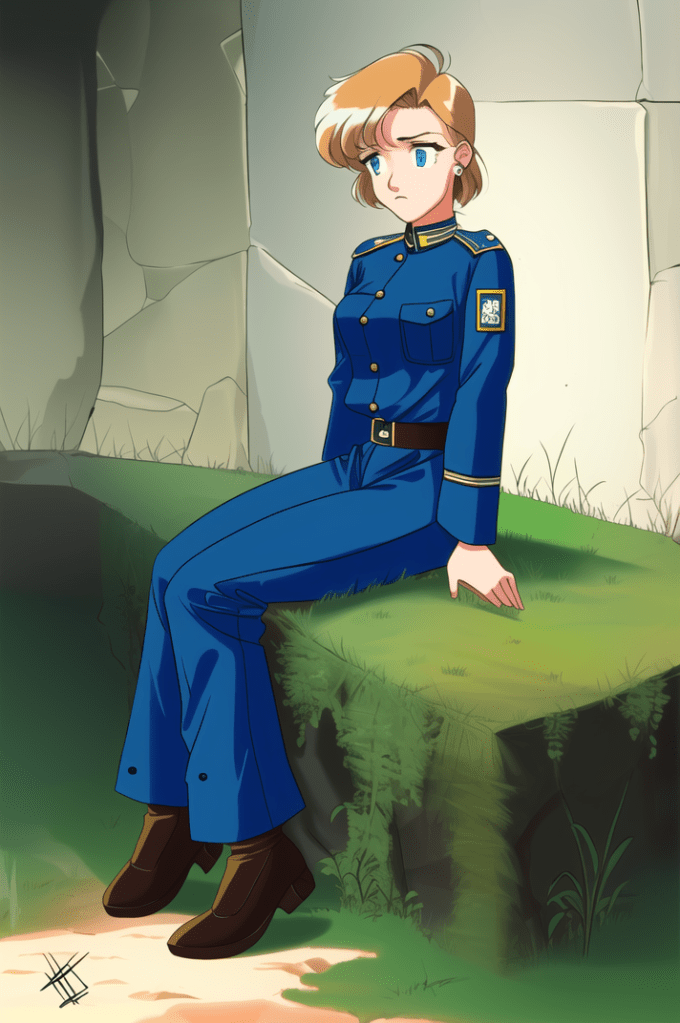
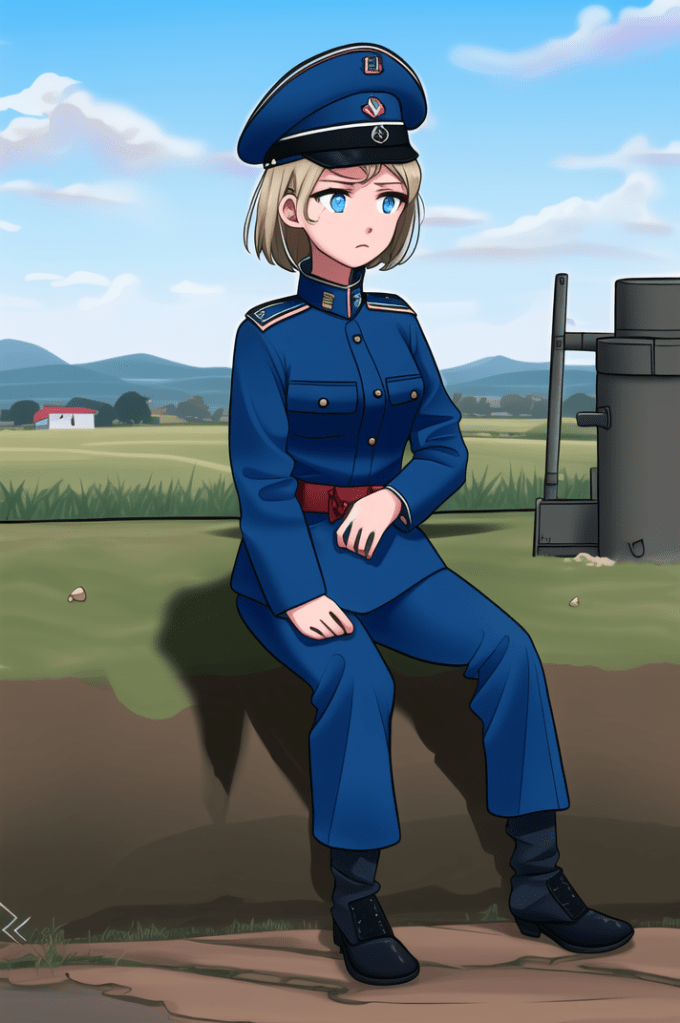
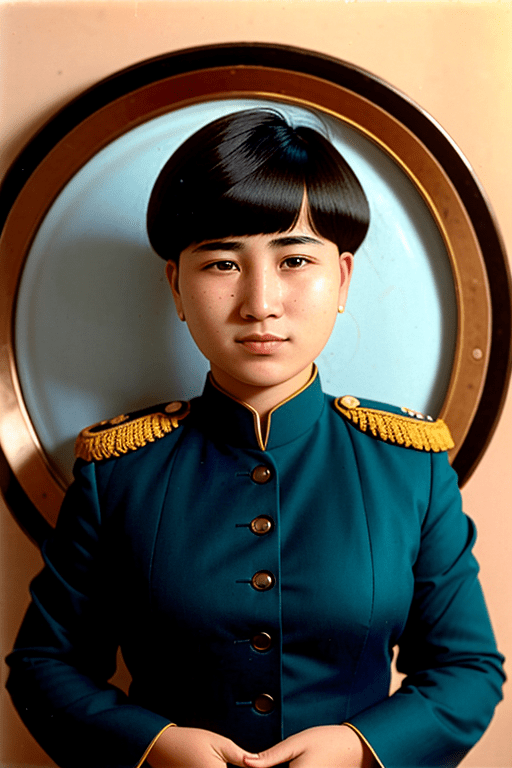
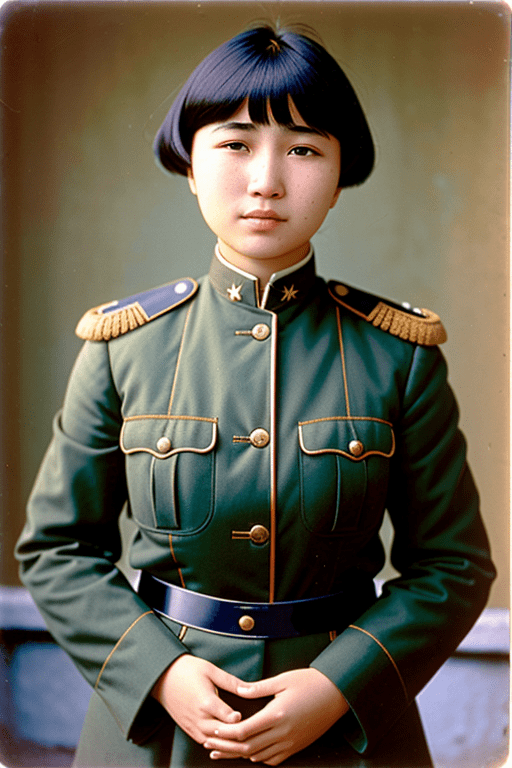
Shown here are several of the Romanian defenders in fortifications prior to the battle. Most of the troops in the fortified positions were mobilized Patriotic Guards , almost all from areas ineligible for the (itself stretched and mobilized) regular army: Women and men both too young and too old for “regular” service.

There was very little standardization for these desperation formations in terms of either equipment or uniforms. The blue uniforms designed for the Patriotic Guards can be seen in these [pseudo] photos and drawings of them in the fortifications prior to the war, but so can plain and camouflage uniforms.

All pictures made in Stable Diffusion.

Note: Stable Diffusion, at least the models I use most, is currently not very good at doing exact military equipment pieces well. Hands are pure genius in comparison. Hence why I don’t have them actually holding weapons. You can justify it by saying that the Securitate was afraid of mutinies or wasting ammo. -C

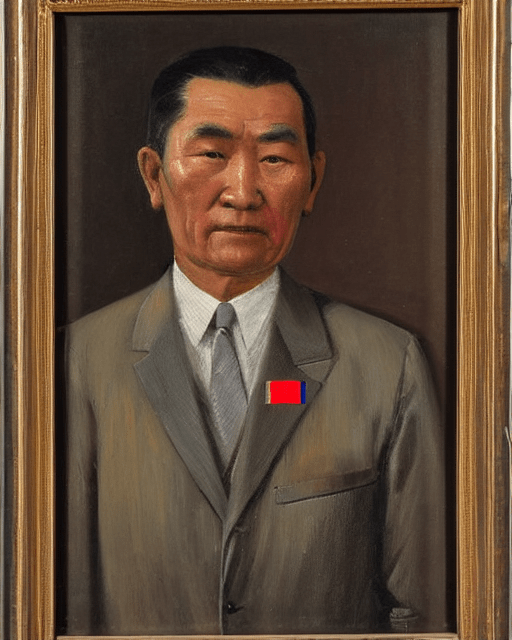
Amin Hayatov Official Portrait

One of the things I like about AI art is the ability to translate my words and mental images into pictures. This is a recent Stable Diffusion “portrait” of Amin Hayatov, president of the Union of Soviet Sovereign Republics in All Union’s present. The original picture had facial hair and something in his pocket that was inpainted out, and the Sovereign Union flag lapel pin was added in externally and then smoothed out through mild AI runs.

Sovereign Union flag for comparison

A Soviet Romanian War Photo

Had too much fun making this “recon aircraft photo” of wrecked armored vehicles in a field in Stable Diffusion. I actually found it was easier to just make the field and then inpaint in the wrecks. And if it’s a high altitude, somewhat blurry photo, that makes the imprecision regarding tanks and the like less important.

A common sight in September 1998 and after. Soviet air supremacy led to fields full of destroyed and abandoned Romanian vehicles throughout the country.

Creative Update

Unfortunately, my work on All Union’s successor has been slowed due to two factors, one unpleasant and one very pleasant. The unpleasant reason is that it’s been getting hot and, worse, allergies are in full blast. The pleasant reason is that I just got an excellent new computer, so that’s been occupying a lot of my time.

While I still want to do Soldiers of the Void, my original planned direct successor, I’ve found my creative muse leading towards a less militarized, more political thriller that I’ve called A Period of Cheating. The driver of that plot is nuclear arms control negotiations, and I’m already having a lot of fun.

Soviet Romanian War Aircraft Losses

For the Soviet Romanian War in All Union, since World War III 1987 is doing aircraft losses, I figured I might as well too. (Also, enjoy the Sovereign Union’s flag in picture detail!)

Sovereign Union

  • 22 aircraft lost in the war to hostile fire. Of those, three were lost in aerial combat, two to radar SAMs, and the remaining seventeen to AAA/MANPADS.
  • Around 10 more lost to friendly fire and accidents (the former being folded into the latter for obvious reasons)
  • 30 helicopters lost in the war to all causes.

Bulgaria

  • 19 aircraft lost in the war to hostile fire. Two in aerial combat, the rest to AAA/MANPADS. Worse equipment, training, and heavy intense support of the Danube forcing contributed to the lopsided ratio.
  • 8 more to friendly fire and accidents.
  • 16 helicopters lost in the war to all causes.

Romania

  • The Romanian air force of around six hundred prewar aircraft was completely destroyed, save for thirteen confirmed escapes to Hungary and U̴̪͇̺͒̽̚ṅ̴̬͖å̶͇̦͚̈́u̷̧͓̞̿t̸̬͛͒̌h̴̳͆o̴̤̍̐͝r̶͈͑̊͘ĭ̶̡̈ͅz̸̜̗̤͒̾̇è̷̡͙̊̿d̶͍̖̄͗̑ ̷̡̩͋͆̊ͅC̴̨͂͗͜l̷̰̤͎̊͝͠ẽ̷͈̟̅̍a̸̱͑r̵̨̯̽̆ä̴̞̠́n̷͉̘͊c̸͓͇̪̍͆e̷͕̾̀͆ ̶̫͔͔͑D̵̢̻̊̽E̸͍̗͆͝T̵̘̽͆̚E̶̞͐̓͝Ċ̵̟́T̶̢̖̔Ę̸̋Ḋ̵̯̒.
  • Over four fifths of the Romanian Air Force was destroyed on the ground in the initial fire strike. Of the remaining not overrun/eliminated in the same way later, sixty one were downed in aerial combat, thirteen escaped to Hungary, thirteen more were lost to friendly fire, and only eight were taken out by the vaunted air defenses. (SAMs were on a tight leash as the planners knew there’d be a lot more friendly ones in the sky).

All Union is now out

After months of work and preparation, I’m delighted to say that All Union is now out in both electronic and paperback versions. It’s an alternate history novel about a world where the Soviet-ahem, Sovereign (totally not Communist or anti-Western, we swear!) Union remains a superpower and the dawn of high-tech war was in Romania and not Kuwait. It’s, as the subtitle says, a novel of love (seriously and unironically), war, and mystery, as everyone from a “Generallismus” to a New Jersey clerk to a Kyrgyz nurse makes their way through this different but similar world.

It and particularly the style in the second half is the kind of book I’ve wanted to write ever since I’ve started Fuldapocalypse. And now I’ve done it. Writing this was incredibly joyful and satisfying, and I hope reading it is as well.

All Union February Update

All Union, my alternate history novel project, is coming along very, very nicely. The first volume (yes, it’s grown big and ambitious enough to require multiple volumes) should hopefully release sometime in the spring. I’m very excited.

I’ve long since wanted to write a book like the one I’m making now, and I’m finally doing so. And yes, I’m doing things that the snarker me would have slammed several years ago. Oh well.

The Vehicle Puzzle

The GENFORCE-Mobile organizational chart got the then-still-in-development BTR-90‘s stats wrong. It’s both too light (at 17 metric tons compared to the 21 of the real one), and more importantly has too many dismounts (ten as opposed to seven I’ve seen in every real source). The real BTR-90 was cursed by coming right as the USSR fell, but in many ways it was also just a wheeled BMP-2, so its lack of entry into service is understandable.

But I thought (both for the All Union story and for my own fun) “Well, what if you could get a vehicle with ten dismounts?” The squad would grow to USMC size (two or three in the vehicle plus ten dismounts), and it presents a very tricky puzzle: Get a vehicle that is fit for a mobile corps (so it has to be viable in direct combat, both offensively and defensively), can carry ten dismounted troops as standard, and can’t be too big or heavy. If you want heavier weapons, it basically needs a remote uncrewed turret to not tip the scales. It’s not technologically impossible by a long short, but tradeoffs will have to be made.

Finally, the big squad means I can finally introduce my “eastern fireteam” concept I rejected for the next-gen BMP. Which makes more tactical sense, since doctrinally they’ll be fighting away from their vehicle more often, especially in rough terrain or as part of a tactical heliborne operation. So they need to be (theoretically) better in terms of both equipment and skill.

As for how it works, well, I’m writing right now a chapter where such a motorized rifle unit storms a Romanian town…

Weird Wargaming: The Mobile Corps Squad

So first I must say that I owe a lot to the Battle Order website and channel for inspiring me. Go check it out. Anyway, the GENFORCE-Mobile document, while a tour de force overall, has surprisingly little on the absolute smallest unit tactics. It does say that the basic and mobile forces do use very similar tactics (it’s just the latter have more training on them). Anyway, there isn’t much to say for the high-intensity doctrine. Primarily use lines, squads are unitary without teams, the vehicle commander doubles as squad leader, and that’s that.

The table of orders and equipment does (by virtue of looking at quantities of in a platoon), have one RPK variant and one RPG variant (marked as an RPG-29 in that example) per squad in the mobile forces, similar to historical practice. The company weapons platoon has an array of light ATGMs (marked as Metis, but those would probably be superseded) and PKM belt-fed machine guns.

(Strangely, the early 199X OPFOR squad is actually weaker on paper dismounted than its predecessors, with only one magazine machine gun instead of two belt-fed ones).

Soviet unitary squad line. From DDI-1100-7-776, The Soviet Motor Rifle Company, 1976

The legacy regular army, basic forces, or whatever you call them uses this doctrine relatively unchanged. But what about the new ones?

I had the Sovereign Union’s mobile corps using tank-based IFVs. There have been similar attempts in actual history, yet I figured these would be the more interesting. Basically the priorities shift a lot here. The historical BMP-3 is skewed in exactly the wrong direction. Instead of a glass cannon packed with all kinds of boom-makers, the focus is on shielding the newly-important resource with tank-level armor.

So in this timeline the BMP-3 is one of those things that only sees small amounts of use in its home country, but nonetheless achieves success on the export market. The Mobile Corps in All Union primarily rode into Romania with either BMP-2s or IFVs based on existing tank platforms. Whereas the historical T-64 APC proposals were an act of desperation, these have a deliberate goal of more protection and mass production ability, similar to the Israeli tank-APCs of real life.

Two real Soviet surplus IFV proposals are two from Ukraine, the circa 36 ton “Vavilon” on the T-64 chassis and the 46 ton “Berserk” on the T-84 (upgraded T-80) one. Apart from trading protection (the Vavilon was advertised as having STANAG 6 30mm AP protection and being able to withstand a 125mm round from 500 meters, likely against the front) for weight and logistical issues, the armament is pretty standard IFV fare: A 30mm autocannon, various machine guns and grenade launchers, and ATGMs. Crew of both is three for the vehicle itself and up to eight dismounts.

Now for the fun part.

Option A: 7+3 Unitary

Composition: Squad leader/vehicle commander (rifle/PDW), vehicle driver (PDW), vehicle gunner (PDW), 1-2x machine gunner (LMG), 1x rocket launcher (RPG), 1x assistant (rifle+RPG ammo), 1x rifle grenadier (self explanatory), 2-3x riflemen (rifle). One of the riflemen could be a “deputy leader” who commands dismounts when the commander stays with the vehicle.

This is the smallest and most conservative organization. It’s designed to duplicate the BMP procedure of having one empty paper-strength seat so that platoon/company troops can ride along. It fights like a standard unitary squad.

Option B: 8+3 Unitary

Composition: Squad leader/vehicle commander (rifle/PDW), vehicle driver (PDW), vehicle gunner (PDW), deputy commander (rifle), 2x machine gunner (LMG), 0-1x marksman (DMR), 1x rocket launcher (RPG), 1x assistant (rifle+RPG ammo), 2-3x riflemen (rifle, possibly one with underbarrel).

This also fights as a unitary squad, although a marksman is moved to squad level and the deputy commander who controls the dismounts is a permanent table position. Still fights as a simple unitary squad. Marksman is optional

Option C: 4-4-3 Fireteam

Composition: Squad leader/vehicle commander (rifle/PDW), vehicle driver (PDW), vehicle gunner (PDW). Fireteam A: Team leader (rifle), team machine gunner (LMG), team launcher (RPG), rifleman (rifle, ammo for MG/RPG). Fireteam B: Team Leader (rifle), team machine gunner (LMG), team launcher (RPG), rifleman (rifle, ammo)

This is a massive divergence and features the dawn of the fireteam, with two four-man elements and two RPG launchers (with one of the riflemen possibly a marksman). Naturally, more advanced formations and dismounted maneuvers are used.

My personal choice for the sake of the All Union story would be Option B. It’s still similar enough to be comfortable, informal task-organized teams can still easily be formed if need be, but is also more advanced. Not just having a squad marksman but in having a specific dismount commander, which makes it easier for the APC to act as part of a separate “armored group“.