Review: Kirov

Kirov

Having started later in John Schettler’s massive series, it’s taken me quite a while to actually pick up the original book. I had very low expectations and somehow managed to still be disappointed by Kirov. This might seem strange, but it makes sense.

The book stars a “Frankenstein-Kirov” assembled from the rest of the class on a live fire exercise during a period of heightened tension before it’s timeshifted back to World War II. I’d heard this book was a tinny Final Countdown/Axis of Time knockoff. I suspected this book would be a tinny Final Countdown/Axis of Time knockoff. I was right.

So why the extra disappointment? Well, the structural issues from later in the series I saw were there from the start. The descriptions are over-detailed, the action scenes are too precisely described, and the dialogue is still extremely clunky. Worse, it’s more concentrated, for lack of a better word, instead of being incredibly spread out. The plot has the main characters acting in ways intended to set up battles in a forced way.

Finally, though the timeshifting, feuding and cosmic changes are there from the start, the main scenario of “modern ship fights a 1940s fleet” just isn’t as interesting as the the places the later books go. So even knowing what I was getting into, I found the first Kirov book to be a letdown.
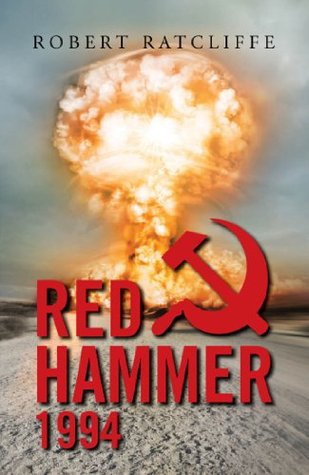
Review: Red Hammer 1994

Red Hammer 1994

Robert Ratcliffe’s Red Hammer 1994 is a tale of an alternate nuclear World War III in the early 1990s. The feared regression to authoritarianism takes place in post-1991 Russia, and its leader proceeds to launch a nuclear strike on the west. Cue a big picture, wide-scope look at everything from bombers to silos to submarines to, yes, conference rooms.

The characters feel just like they’re just there to operate military equipment instead of being actual characters. The plot is basically “have a nuclear war that stays mainly counterforce and thus only mauls civilization instead of wrecking it totally, and show every part of it in set pieces”. The grounded and frequently realistic (at least technically) nature of the book is somewhat admirable, but works against it when questionable moments like a giant force of super-Spetsnaz in the continental US emerges-or for that matter, the basic plot happening at all. The ending is incredibly abrupt (and not in a plausible Dr. Strangelove way) and the most positive elements are some of the set pieces themselves.

This is what it is. If you like technical detail and want to see Herman Melville’s Story Of A Moderate Nuclear War, you’ll like this book. But if you want a solid narrative, this isn’t it.

Review: The Weekend Warriors

The Weekend Warriors

Reading James Burke’s The Weekend Warriors means I’ve now read all ten of the alternate history conventional World War III series I’d identified. So how is it?

Telling the story of National Guard soldiers and their families during a 198X Fuldapocalypse, Burke uses some plot devices I’ve thought would have worked, like using fictional unit designations. He also aims for characterization and doesn’t hesitate to show the duller parts of military life. The result is something that tries to be something fuller than just tanks exploding…

…With an emphasis on tries. A lot of the high-level military details are anachronistic and in some cases outright “off”. The most jarring example to me was how the Soviets would focus on NORTHAG (which would be true) and thus do nothing but special forces operations in the American sector at the beginning of the war (which would not be). The action suffers from the same rough prose as the rest of the work and sometimes devolves into listing armaments in full.

Because of this, it comes across as being like a somewhat worse Chieftains-a tale of a conventional World War III that’s ambitious, but erratic and unpolished in execution.

Review: The Man With The Iron Heart

The Man With The Iron Heart

One of my theories about Harry Turtledove is that, for all times he’s been labeled “the master of alternate history”, he never had the most enthusiasm for the genre. It goes like this: Turtledove wanted to write Byzantine/Eastern Roman-themed fantasy, but after Guns of The South, alternate history became the money-making niche that he was stuck in. Turtledove would be neither the first nor last writer to have their most successful fiction be considerably different from the type they actually wanted to write.

Or maybe he did have enthusiasm for the genre, but didn’t have the mindset needed to really take advantage of it. Or maybe the nature of alternate history and needing to appeal to a generalist audience who doesn’t have the most knowledge of history forced him into a corner. Whatever the reason, The Man With The Iron Heart symbolizes the weaknesses of his style vividly.

The plot is simple. Reinhard Heydrich survives, gets the Werwolf resistance movement up and running, and launches a horrifically hamfisted/anachronistic Iraq War analogy. In reality, the German populace at large had no stomach for continued resistance, and the Allies, who came close to turning Germany into a giant farm, were prepared to crack the whip. The Werwolf plan was doomed from the get-go by the scarce resources and infighting that was baked into the Nazi regime from day one.

The execution of the book is done just as clumsily and clunkily as the setup. Much of Turtledove’s writing has the problem of what I frequently call the “technothriller without technology or thrills”, and this is no exception. It uses the “alternate history as a genre format” where there’s a big-picture, broad-viewpoint look at the situation and changed world. However, if the changed world is nothing but an unrealistic and worse, uninteresting analogy, that format is the worst possible.

Alternate history is a very divided genre. There are a lot of reasons for this, from the vague nature of what it even is to the different desires of different fandoms to how it’s frequently not considered advantageous to label a work as such. But that the “mainstream” end often consists of books like this doesn’t help.

Maybe there’d be more overlap if someone really did extensive research, made it more character focused, and kept it feeling substantially different while providing still noticeable but far more subtle commentary. Instead, Turtledove wrote this book, which I do not recommend.

Short Baseball

I discovered a sport called “short hockey” existed. That is hockey played with four skaters and a goalie per team with 10 minute periods across the width of a half-rink. As it’s much less exerting, teams can play a lot of games in just one day. As the ownership/sponsorship of all the Russian short hockey leagues I’ve seen by sportsbooks shows, it’s aimed more at gamblers than actual fans.

So I figured, what would “short baseball” look like? As is, baseball already has many more games feasibly scheduled than many other sports. Yet I decided to amplify it more with two tiers.

  • Semi-short baseball, which is like conventional baseball only with six innings, games ending in ties after two extra ones, a designated hitter, and some pace of play rules. Semi-short leagues, despite their betting-friendly nature, are treated as serious competitions with ceremony, champions, and the same rigorous record-keeping.
  • Mega-short baseball, which is just a means to an end of making as many gambling-friendly matches. Games are five two-out innings which automatically end in ties after the bottom of the fifth, there are rapid pitch clocks, and, most crucially, pitchers have to throw the ball in the least stressful way possible. This both saves on the need for countless pitchers and encourages scoring by having pitches be easier to hit. There are also no formal standings and essentially no official record-keeping.

If I can find an appropriate place for it in my fiction, I’ll gladly put “short baseball” in, with an alternate history background as to how it got started and developed (which almost certainly means earlier and more widespread legal sports betting in baseball-friendly countries).

Alternate History World War IIIs

That there are significantly fewer “conventional World War III” books than I thought when I started this blog is something I’ve repeatedly said. But I recently decided to take a look and see just how many (or, to be honest, how few) World War IIIs fit the “tail of the elephant” category of what I first saw online. The criteria were as follows.

  • They obviously had to be mostly conventional World War IIIs.
  • They had to be commercialized, even if only in self-published form.
  • They’re listed by series and not author to prevent long individual series from skewing the results.
  • They had to be unambiguous alternate history. So the 1980s classics wouldn’t count because those are set in a then-contemporary time.
  • They had to take place after 1980. The “just after World War II” WW3s are a different kind of fiction in my eyes.

With that, I got the following rough list.

  • -Harvey Black’s “Effect” series
  • -William Stroock’s World War 1990 series
  • -The Bear’s Claws by Russell Phillips
  • -Northern Fury H Hour
  • -John Agnew’s Operation Zhukov
  • -Brad Smith’s World War III 1985
  • -Martin Archer’s War Breaks Out
  • -James Burke’s The Weekend Warriors
  • -John Schettler’s Kirov series.
  • -Mark Walker’s Dark War series

There’s obviously ones I missed, but still, only ten entries. Ten. For comparison, there’s easily more different authors on the “action hero” tag here (I counted around 17.) It feels both satisfying to see even a general number and a little weird to know that what you saw was something as narrow in scope as Worm fanfiction (even if understandably so).

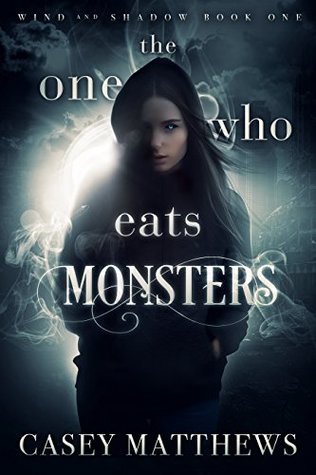
Review: The One Who Eats Monsters

The One Who Eats Monsters

monstercover

Once again, Fuldapocalypse takes the plunge into a new genre. After seeing a good review of it on Spacebattles, I decided to read Casey Matthews’ The One Who Eats Monsters for myself.

This of course, is an “urban fantasy” novel, where you have supernatural entities hidden inside the modern world. Ryn, the protagonist is one of them, an ancient humanoid creature and vicious ‘hunter of monsters’. Throughout the book she alternates between being a vigilante and protecting a politician’s daughter she begins to develop very human feelings for.

Urban fantasy isn’t really a genre I read much of, although more for matters of admitted personal taste than any actual, inherent dislike. With that in mind, it was good for what it was. It definitely has some notable flaws. The human dialogue was often, er, “subpar”, and there were dramatic contrivances that made sense in-universe but still felt forced from a storytelling perspective.

But that’s more than made up for by the book having exactly what a cheap thriller needs to succeed-good action and good pacing. This definitely has both, although the sequel hook segment at the end is incredibly rushed.

The characterization is mixed but still ultimately positive. Many of the other characters are either shallow, stereotypical, or both. However, Ryn’s “monster with a conscience” is well-done, and that’s what matters most. Even the romance (and this is not a romantic fiction blog) is done surprisingly well-done.

One interesting note is that this is technically an alternate history novel. Among other things, supernatural shenanigans prolonged the existence of the Soviet Union (ah, those Fuldapocalypse zombie sorceresses). It reminded me, alternate history reader and writer, of this very big phenomena where a lot of fiction could be reasonably labeled “alternate history”, but because there’s no real incentive to do so, it isn’t.

I’m still not exactly a fan of urban fantasy, but I don’t regret taking a chance on a different genre with this book.

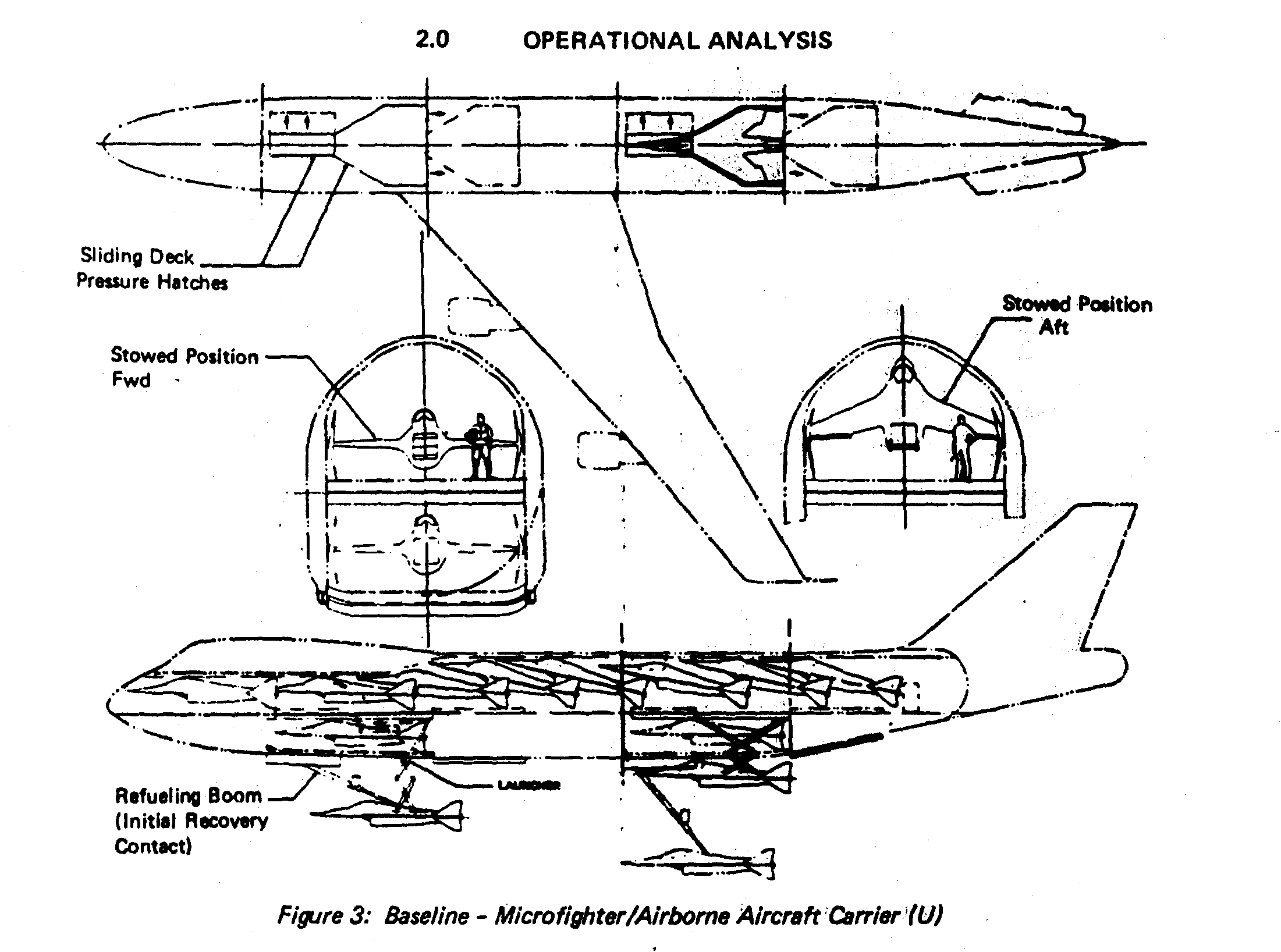
The Flying Aircraft Carrier: Not Just For Comic Books

Yes, there was a serious study on the possibility of equipping 747s with trapeze catches and stuffing them full of “microfighters” to serve as flying aircraft carriers that could reach any hot spot soon.

aacdesign

Besides the expense and equally obvious safety issues, these microfighters were only benchmarked against the MiG-21 and their small size would make them harder to upgrade (although this could be mitigated by increasingly miniaturized electronics and giving them smart weapons that didn’t need to be carried en masse). Still, this is a similar gimmick to what the absolutely crazy (in a good way) Black Eagle Force series did with its fighters, and it’s great for fiction.

Box Press released

Box Press, my second Smithtown Unit ebook, has been released by Sea Lion Press. While the first installment  aimed to pay homage to the “men’s adventure” genre in all its forms, this one has a narrower and more obscure foundation. That would be the weirder books in the 1970s that tried to move beyond just shooting mobsters and brought in stranger antagonists as a result.

Enjoy the next adventure of Bill Morgan.

Review: Operation Sea Lion

Operation Sea Lion

The most infamous invasion that never was, Operation Sea Lion holds a special place in the annals of alternate history. Richard Cox’s book takes a 1974 wargame of it at Sandhurst and turns it into a Hackett-esque big picture tale. This can be described as a World War II version of The War That Never Was, taking simple wargame results and giving them a tiny fig leaf of “plot” via various vignettes.

Not surprisingly to anyone knowledgeable about alternate history, the wargame, despite deliberately going easy on the first wave (to have a substantive ground element at all) ends with the Royal Navy cutting the lines and the Germans defeated. It’s not Cox’s fault, but something with the outcome never in doubt is hard to make exciting for someone who knows the context.

That being said, this remains an amusing little historical alternate history footnote. It’s aimed at a popular audience who wouldn’t necessarily know the context, and is at least more literary than a rote after action report of the wargame itself would have been.