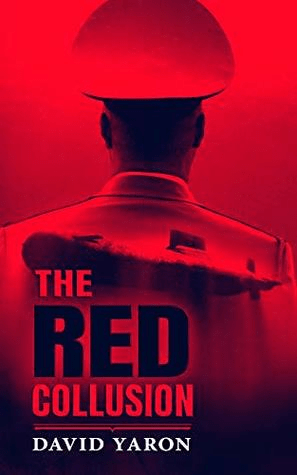
Review: The Red Collusion

The Red Collusion

redcollusioncover

David Yaron’s The Red Collusion is a tale of rogue Soviets in 1981 attempting to start World War III, leading to a climax where they attempt to attack an American ballistic missile submarine.

This book is mostly pedestrian but has managed to surprise me in one regard-the sheer number of conference room scenes. The ratio of “people talking” scenes to “people actually doing something” scenes is very, very, high.

It’s realistic to have people talking and arguing about a big plan before they (attempt to) carry it out, but it’s also realistic to have cars stopped at red lights. Imagine a travel book where the author described every single red light, stop sign, and gas station the car stopped at, as well as every single argument the occupants of the car had about where to stop for gas or food. And then in the final action, there’s a time limit-so they urgently, reluctantly, and desperately stop at those traffic lights.

This is the technothriller version of that. Much of the book, apart from a few decently-written if generic spy fiction scenes, consists of the conspirators talking. It amounts to chapter after chapter of…

“Let’s do this.”

(cue long explanation of and preparations for what they want to do.)

“Actually, it would be better if we did this.”

(cue long explanation/plot thread)

“No, we should really do this.

(you get the idea).

Once they finally get going, the rushed “action” isn’t the worst, but isn’t exactly good either. This leaves the book as a strangely amusing novelty. The Red Collusion is saved from  simple mediocrity by taking a genre trope to ridiculous excess. I’ll leave it up to the readers to decide if it’s a good or bad thing.


Review: The Guns Of The South

The Guns of The South

gotscover

Harry Turtledove’s classic alternate history novel started when another author complained to him that the cover art on one of her books was as anachronistic as “Robert E. Lee holding an Uzi.” After that, writing a book about South African time travelers changing the fate of the American Civil War via a huge quantity of AK-47s was in order.

Guns of the South is a frustrating book, because it manages to be good, bad, and unnerving at the same time. The good part of the book is in its action and use of viewpoint characters. It has only two, Lee himself and low-ranking soldier Nathan Caudell, and the perspectives they can apply are well taken advantage of. As for the action, it keeps it well-written even when one side has muzzleloaders and the other AKs-and that’s not always the case.

The bad part is mainly in its ultimate antagonists, the time travelers themselves. These rank in my eyes as some of the worst villains I’ve ever seen in fiction. Besides the moral issues which I’ll discuss in a bit, they’re ultimately dumb and mysteriously stop taking advantage of their high technology and training at exactly the moment it’s convenient for the plot.

The unsettling part is that Guns of South has a disturbing feel of Confederate apologism to it. I think it’s just the result of unintended consequences, but still. Make Confederate protagonists who a modern audience will find relatable and sympathetic, and there’s going to be some (no pun intended) whitewashing. The two biggest problems are the Confederately ultimately phasing out slavery without much protest and the behavior of the time travelers. Said time travelers are stupidly and cartoonishly racist in ways that exist to make the CSA look better in comparison. It’s not only creepy, it’s lazy and annoying-and makes them even worse as antagonists.

This is still readable and it’s still one of Turtledove’s better books, lacking the bloat a lot of his later novels have. It’s just weighed down by its terrible villains.

Review: The Black Effect

The Black Effect

blackeffectcover

Harvey Black’s The Black Effect is the kind of book I thought I’d be reviewing en masse on this blog, at least in terms of basic plot. Namely, in 198_ World War III breaks out. Cue a lot of tanks exploding. This is the second book in Black’s _____ Effect series, and the first I reviewed at Sea Lion Press before this blog even started.

The Black Effect is what I feared Team Yankee would be before being pleasantly surprised.  It’s a mostly-conventional 198X WW3 book that happens to be a picture-perfect case for why a bowl of ingredients does not equal a meal.

Some of the individual ingredients (battle scenes) in the novel are good, if repetitive. Others are weighed down by things like Black constantly listing the full designations of every piece of equipment in overwhelming detail (fog of war? target fixation? Limited viewpoints? What are those?). But as a whole the book just amounts to a disorganized parade of various pieces of military equipment and graphene-thin Steel Panthers Characters differing only in what they’re crewing and how much ‘camera time’ that they get before being blown up.

There is an almost total lack of anything cohesive or coherent beyond “WW3 stuff happens”. It gets to the point where the intelligence photographers who were the high point of the previous installment turn into just another pace-breaking liability. This at least doesn’t have The Red Effect’s using up nearly all of its space on historical events with names badly changed (ie, Stanislav Petrov became “Perov”) before rushing to stuff a bunch of battles into the last thirty pages.

The Black Effect isn’t all bad. It’s more evenhanded than a lot of WWIII stories, it being written as an alternate history with decades of hindsight helps with some (but not all) technical accuracy issues, and it works at providing simple action scenes. It’s just I’ve read better, even in this very specific subgenre.

Review: Northern Fury H-Hour

Northern Fury H-Hour

(note: I received a review copy).

When I first got into Command: Modern Air/Naval Operations, I noticed a scenario set called Northern Fury, describing a third world war with a surviving USSR in the early 1990s. One of the first scenarios I played was one of the smaller ones there, called “A Cold And Lonely Place.”

Since then, I’ve been following the scenario set, and was delighted to hear that the novel had been announced. Having gotten a review copy and been cleared to post, I can say that H-Hour, the first book in the Northern Fury series, works well and dodges a lot of the pitfalls it could have fallen into. The August Coup has succeeded and the Third World War is not far off, with this story focusing not on Central Europe but in other theaters, particularly Norway and its waters.

First, it needs to be said: This book wears its technothriller heritage and inspiration on its sleeve, for better or worse. It has many of the prime technothriller elements in it. That being said, it handles them well, and in particular manages to escape-and escape completely- two pits that fiction like it tends to fall into.

The first is that it does not feel like just a rote let’s play/after action report of Command. Without giving too much away, focusing a lot on land makes it seem better, deeper, and out of the sim’s comfort zone, so to speak.

The second is more impressive and more important. Northern Fury manages to avoid what I call “Steel Panthers Characterization.” Named after how in the computer wargame “Steel Panthers”, units will have a rank and surname in the language of their nationality, Steel Panthers Characterization is when Character Name X controlling Military Weapon Y will appear in scene Z, with no characterization save for maybe a thrown-in national or rank stereotype. They will appear, operate the necessary piece of military equipment, and often die in the process. Then another flat character will appear.

In Northern Fury, this doesn’t happen. While there is a lot of viewpoint hopping, all the characters and their arcs have meat on their bones. This was an impressive feat that did a lot to raise my opinion of the book.

So, to briefly conclude, Northern Fury: H-Hour is both an excellent example of how a simulation can be used in the creation of a novel (like the original Harpoon tabletop version was for Red Storm Rising) and a very good throwback to the technothriller/WWIII fiction of days past.

Northern Fury: H-Hour releases on May 6. Its official website is here

Review: Houdini vs. Rasputin

Houdini vs. Rasputin

I was in the mood for a change of pace, and upon seeing Houdini vs. Rasputin I felt I had to give it a shot. I was not disappointed.

Who and What

Harry Houdini makes an ahistorical second trip to Russia in 1911, brought over by the head of the secret police to try and deal with the mystic Rasputin. What follows is a book-long adventure as the mystic and the escape artist match wits and trade blows. Pitting the two larger-than-life figures against each other is brilliant.

DEEP HISTORY OF TEM

Almost all the descriptions are for something actually important to either the plot or scene at hand. Imagine that!

Zombie Sorceresses

This just isn’t the kind of book where this category is important or even viable. I could argue “not even memetic Houdini could escape from that” but this isn’t the kind of book for that. I could argue “is it a coincidence he runs into everyone from Stolypin to Lenin?” but this isn’t the kind of book for that. This is the kind of book where you just run with it.

Tank Booms

After dozens of books of red-blooded Mack Bolan wannabes, tanks booming, clinical technothriller battles, and spacesuit commandos, the earnest old-fashioned adventure here, beautifully written, is highly refreshing. I could almost imagine a John Williams score in the background for some of the scenes.

The Only Score That Really Matters

Houdini vs. Rasputin is a fresh, earnest, amazing tale. Not since the first few volumes of Jerry Ahern’s Survivalist have I read with such  totally along-for-the-roller-coaster-ride enthusiasm. I highly recommend it.

Review: Festung Europa

Festung Europa

Festung Europa: The Anglo-American Nazi War is a very tricky book. Judged by one standard, It’s a World War III with the same participants as our World War II, fought with what amounts to Korean War-era technology. This kind of tale doesn’t have that much leeway in how it’s set up.

Who And What

Festung Europa tells of how, after a German victory on the Eastern Front in World War II, the Reich and United States have the inevitable confrontation.

This is not really a story, it’s a recitation of equipment and events. A routine cheap thriller is gigaparsecs ahead of this in terms of actual “story-ness”, and even an excessively infodumpy tale is still far close to a conventional story than this. I want to make clear that this is not necessarily a bad thing. This pseudo-historical document style can work.

That being said, I feel that there are several pitfalls to this style. First, it utterly demands the reader be already interested in the subject matter, for there’s no plot or characters to gain attraction to. Second, at least to me, it opens the work up for more plausibility criticisms, because beyond the blanket talk, it’s hard to criticize it on grounds other than “does it make sense?”

And the “prose”, such as it is, feels clunky in this case even by the standards of history books or historical genres.

DEEP HISTORY OF TEM

You will learn exact casualty rates. You will learn the exact details of tanks. You lurn because yu at tem wur cool leg to learn tem’s DEEP HISTORY. If the entire book is one infodump, which it is, can it be considered many infodumps or just one big infodump?

Zombie Sorceresses

The major contrivances are:

  • The German victory on the Eastern Front being done in an openly handwaved manner.
  • Allied firepower, particularly air power, being probably a little too effective given the time period.
  • The Germans sidelining the Heer, turning the SS into what amounts to their entire military, and devolving dramatically in terms of skill. (I’m one of the first to criticize the “super-military only beaten by the Allies throwing more Shermans and T-34s than they had antitank rounds” cliches, but still think it went too far in the opposite direction)

There’s more than that if I wanted to dig deeper.

None of these are too bad by themselves and some can be arguable. The problem is that, as mentioned above, there’s no “cushion”. This isn’t like “well, the setup is weird [if understandable] but the action/characters/pacing is good”. No, this is just a sequence of events, and thus every zombie sorceress handwave makes itself a lot clearer and a lot more blatant.

Tank Booms

There are no booming tanks. There are simply narrations of “this unit of tanks went boom.” The “action” is extremely clinical. And often repetitive.

The Only Score That Really Matters

This is a stark example of an ultra-niche story. Do you want a hypothetical pseudo-history of a German-American third world war? Do you care if it’s drier than the Gobi Desert? Are you willing to accept unfiltered contrivances?

If the answer is yes, then Festung Europa is for you. If the answer is no, it isn’t. This kind of specialty alternate history has a very narrow audience base, and it’s no shame to not be in it.


The New Scale

So, here’s the new formal scale. The older one was a little too restrictive.

Who and What

This is the new introduction part, replacing both Icelands and “The Wha?'”. First it gives me a chance to summarize the plot, and I can point out if it’s cliche or not, formulaic or not. Second, I can say the exact subgenre it belongs. Third, I can talk about the characters and flow.

DEEP HISTORY OF TEM

This is a joking reference to the game Undertale, where going to a bizarre town of dog-cat-rabbit thingies leads to the talk of a “Deep history” that is never explained or elaborated on further, save for one picture.

So, what information included in the book is actually relevant to it? It replaces “Rivets” in that it (hopefully) doesn’t just say that infodumps exist, but how smoothly they’re integrated into it.

Zombie Sorceresses

Unchanged. They’re still keeping the nukes from detonating and setting up weird situations post-1991.

Tank Booms

How good is the action (if there is any) or the conflict? I figured this deserved its own category, since cheap thrillers need good action to succeed and any story needs conflict.

The Only Score That Really Matters

Unchanged. This is the only score that really matters.