For the first World War III review of the new year, I turn to T. K. Blackwood’s Alamo on the Rhine, a spinoff/side story of the Iron Crucible 1990s World War III. It’s about a daring strike on a vital air base at the start of the war. Told with the same effectiveness as the other entries, I greatly enjoyed it.
I couldn’t help but see the parallels to Market Garden, Kitona, and Hostomel and wonder what role those historical battles played in the crafting of this book, similar to how I wanted a “Soviet Gulf War” in All Union but not an exact one. It’s to Blackwood’s credit that the excellent story does not come across as a simple historical copy-paste. This is a very fun book of the kind I haven’t read in a while. Nice job.
Naval forces in All Union’s Soviet Romanian War were bound to play a peripheral role. Romania had a small and weak navy, a relatively short coastline, and massive conventional amphibious landings were geographically dubious and militarily even more so. Constanta was overrun and surrendered almost immediately after the war began. Even Soviet historiography talks very little about what they and the Bulgarians did at sea, mostly just mentioning bombardment, surveillance, transport, and other routine supporting tasks. Most naval infantry units fought on land.
Yet it would be a mistake to assume that the navies did nothing or that there was no drama. Although overshadowed by the crossing of the Danube and the massive deep airborne operations, one of the largest postwar aerial/amphibious landings was conducted in Tulcea County.
Units near Bolhrad would cross/lift/fly over or infiltrate via smaller boat.
Heliborne units from the Black Sea would stage and make large landings in the depths. Black Sea Fleet aircraft and ships would naturally support them.
The Tulcea operation was considered lower priority and was assigned fewer resources and, uncharacteristically, had its commanders given instructions to not try and force it if the initial advance stalled. (In contrast, the Danube Front units tasked with taking the Constana area were told to rightfully treat it as a high-priority one).
Notable events:
September 8-9: Landings. Many inoperable Romanian ships destroyed in port.
September 8: Romanian corvette M290 sunk by SS-N-14 missile. Romanian submarine SC-02 sunk.
September 9: Sole successful Romanian air attack against Soviet Warships. Missile craft Kittivyek sunk by Romanian MiG-21s. Two other unsuccessful attacks. Five aircraft and four ASMs shot down.
September 10: Gunboat PSKR-710 destroyed by mine. Four Romanian craft sunk. Romanian submarines Pastrav, SC-01 sunk.
September 11: Final attempted Romanian air/missile attack on naval targets. Completely unsuccessful. Romanian submarine SC-05 sunk by Soviet submarine S-39 in the first post-WW2 mutually submerged sinking. Soviet landing ship SDK-303 sunk by mine.
September 13: Tulcea operation completed with mutual link-up.
September 14: Final surface engagements of the war, a duel between small boats in the north and Bulgarian ships sinking an attempt to flee southeast into the open ocean, presumably to Turkey.
September 16: Final naval engagement. Romanian submarine Ton sunk.
The main takeaway was that ASW was successful (no Soviet ships lost, no disruption) but it was under ideal circumstances (being able to just smother a small area).
So a while ago I did the obsessively number-crazed Soviets studies on their planned rates of advance. Looking at my descriptions and map games writing in All Union, I’ve thought “hmmm, how could this go in practice? Or at least fictional speculative practice?”
The Theory
Against NATO, 40-60 km a day on average was the goal. Against a weaker opponent (like one based on the Chinese conventional forces at the time), it was even more, around 70-100. By the 1990s GENFORCE (what I patterned the mobile corps off of), it was down to ideally 30-40, albeit against a stronger opponent.
Romania in Practice
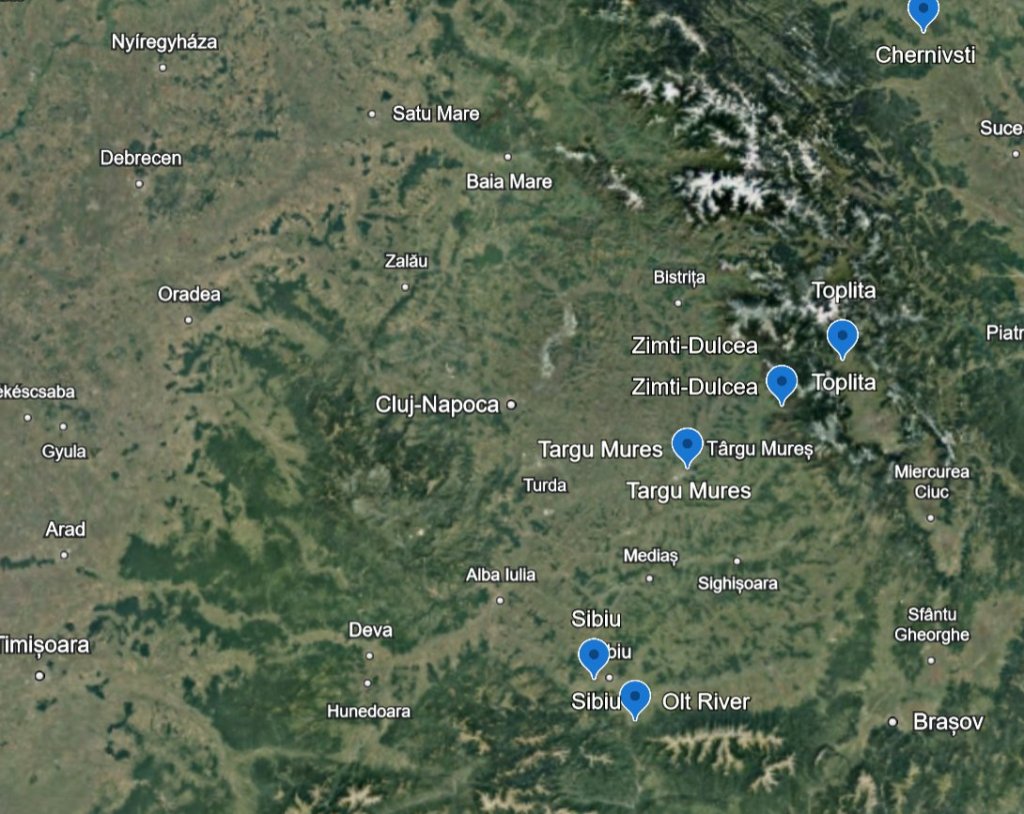
As it stands, I focused mainly on the 17th Mobile Corps, and had a (fairly) detailed route after much Google Mapping. It left a line of departure from near Chernivtsi on September 8, 1998, and came to a final stop around Sibiu on the 16th-17th. On the way it cleared out the important crossroad town of Toplita, crossed the Carpathian mountain roads, and fended off an attack on its bridgehead near Dulcea.
Map is a vague generality. Different subunits progressed around different mountain roads and frontages. Length is hard enough, don’t ask me to do width.. :p
Using a pure napkin calc, this comes to 285 kilometers from the Chernivtsi border region to Sibiu, which leads to 8-9 days of high-intensity fighting, which means a very rough 30-35 kilometers a day. So not bad by GENFORCE standards, especially with a rough terrain making up for a weaker on paper opponent and with the counterattack at Dulcea costing it an entire day.
So not too bad….
The Problem
Of course the definition of “rate of advance” is incredibly arbitrary (does it mean anything in that unit, so can we count a patrol of BRDMs moving far ahead and encountering no resistance before circling and stopping, then the main force reaching that spot without issue later?) and depends a lot, as anyone would admit, on circumstances.
In the same war, many Danube Front formations barely made it past the river, and some that did moved at the equivalent of a brisk walk. But clearly a unit of press-ganged Bulgarians with 1940s equipment having to do an opposed crossing of a very long river and then facing coherent defenders with many fortifications is not the same as a high-tech, high priority force smashing across the plains against a broken foe.
Reading Dominion got me thinking about an alternate history setup of a similar nature. Not a plausible one but a way to pit the British Empire against the ex-British Empire/Commonwealth. What got me thinking at first was the British in the book struggling to hold onto India. I’m thinking “hang on, this could be playable.”
So I fired up Command: Modern Operations and saw an opportunity to use many of the low-end WWII-era platforms, including German 1940s ones. I did a sample scenario and fell in love. So I expanded. It may or may not lead to anything more, but it’s something worth telling. Again, historical plausibility is not the main focus, so I’ve probably gotten a lot wrong.
The main forces are the fledgling independent Indian Army along with reinforcements of ANZACs and other volunteers, including American “Flying Tigers” in that animal’s home country. Opposing them are the Collaborationist UK Government and Germans, the latter struggling massively to project power. They still send the now-completed Graf Zeppelin carriers over. (Look, this isn’t a hard AH).
The scenario I did was of a bombing raid on Karachi from Oman-based Anglo-German bombers. (Why Oman? It was in range. Why Karachi? Partition into India and Pakistan hasn’t happened, at least not yet). While this scenario saw the attackers sweep aside the defenders and drop successfully with the loss of only one bomber, circumstances can always change. In any case, it was very interesting and fun to play in an area not typically covered by wargames, and got my imagination flowing.
CJ Sansom’s Dominion is a combination spy story and exploration of the classic Axis victory World War II alternate history. Britain is defeated but not “hard-conquered” in World War II, the Germans control the continent but continue to fight in the east, and with the Americans the only nuclear power, now everyone else wants the secret, with a man with nuclear knowledge trying to escape. And that’s basically about as much of a central plot there is in this novel.
It honestly reminded me a lot of Harry Turtledove’s In The Presence of Mine Enemies. Not the obvious divergence or setting, but rather the tone and pace. It’s a push through a dreary, dull, banality of evil world where evil triumphed over good. Which isn’t exactly the best to read about. Its biggest problem is that a lot of exposition is devoted to its background and worldbuilding, which just amounts to “the Germans won and a lot of bad stuff happened”. It’s a setting-first book in a setting that’s neither very pleasant nor interesting.
Plus while ‘plausibility’ is normally not the highest priority in alternate history, this just feels wrong. Britain becoming a satellite state of Germany without a military invasion and being able to not have its already eager-for-independence possessions secede? (Like India, which somehow hasn’t gone independent). I’d honestly accept a successful invasion over this.
The whole thing just feels unfocused, and when it does focus, it goes to the wrong thing. Not the best alternate history out there.
Perhaps Viktor Suvorov’s most infamous work is Icebreaker, a revisionist historical book that claims that Stalin was juuuuuust about to invade the rest of Europe from the east when the Germans launched a preemptive attack in 1941. What makes this not just wrong in the sense that his book on the hyper-Spetsnaz was inaccurate but outright disturbing is that someone else publicly stated such a claim repeatedly. Said someone else was famously portrayed in a movie by Bruno Ganz.
Thankfully, the book itself does not make the best case for this incredible claim. It’s not just that with hindsight and primary sources (that Suvorov inaccurately claimed were destroyed to cover them up) the image of the shambling wreck in peacetime formations that was the 1941 Red Army facing off against the bunched-up offensive force of the 1941 Wehrmacht. (Fun fact BTW: The Germans actually had a 3-2 numerical advantage in the early part of Barbarossa, and even more in practice if you account for the terrible logistics of the Soviets then).
The only evidence besides ‘trust me bro’ that Suvorov puts forward is basically “The Soviets had lots of ____ [such as fast tanks and/or paratroopers] that clearly meant they were meant for an offensive into western Europe.” It couldn’t just be that their doctrine was on mobile warfare and that they tried and failed to implement it defensively.
I knew about how bad its premise was, but I wasn’t expecting so weak an argument. Which is probably a good thing. Unlike this book.
Raconteur Press’s Hooves, Tracks, and Sabers is an anthology of alternate history cavalry stories. You get helicopters in Southeast Asia (but not the way you might think), airships (of course) in the American Civil War, and plenty of good old horsies. While none of the stories are bad, a lot just feel like historical fiction with different names, which is a problem a lot of alternate history unavoidably has (I think that World War IIIs actually avoid this by being something so completely different from say, the Vietnam War, but that’s another story).
Thankfully, there are ones that go above and beyond that. My favorite is a World War I divergence where the Tsar Tank actually works. How can you not love a giant armored tricycle? Anyway, while the execution may not be the best in every case, the concept is so great that I still recommend this collection (and lament that I couldn’t write a story about armored recon units in the Soviet-Romanian War for it).
So WW3 1987 talked about a classic counterfactual: “What if Iraq attacked south in August 1991 against Desert Shield”? Actual Gulf War commanders have had differing opinions, and of course the context matters. I’ve done a bit of simming in Command Modern Operations, and have come to the conclusion that, well, it would have only been troublesome for the coalition by the standards of the actual war’s total squash. Why? Three main reasons.
Air power is more powerful and immediately influential. Though I’m an air power skeptic, disrupting an offensive in the open is one of the easiest things for air power to do, especially one that’s trained for a much harder Fuldapocalypse.
Geography and politics. That literally every country from Qatar down to Oman was part of the coalition means that the Iraqis literally can’t move far enough to stop the landing of reinforcements in friendly territory of some kind.
Historical context. The Iraqis who didn’t think the takeover of Kuwait was a big deal historically had no contingency plans to move farther south. So they’d be winging it, and that’s not exactly a recipe for success given the other problems.
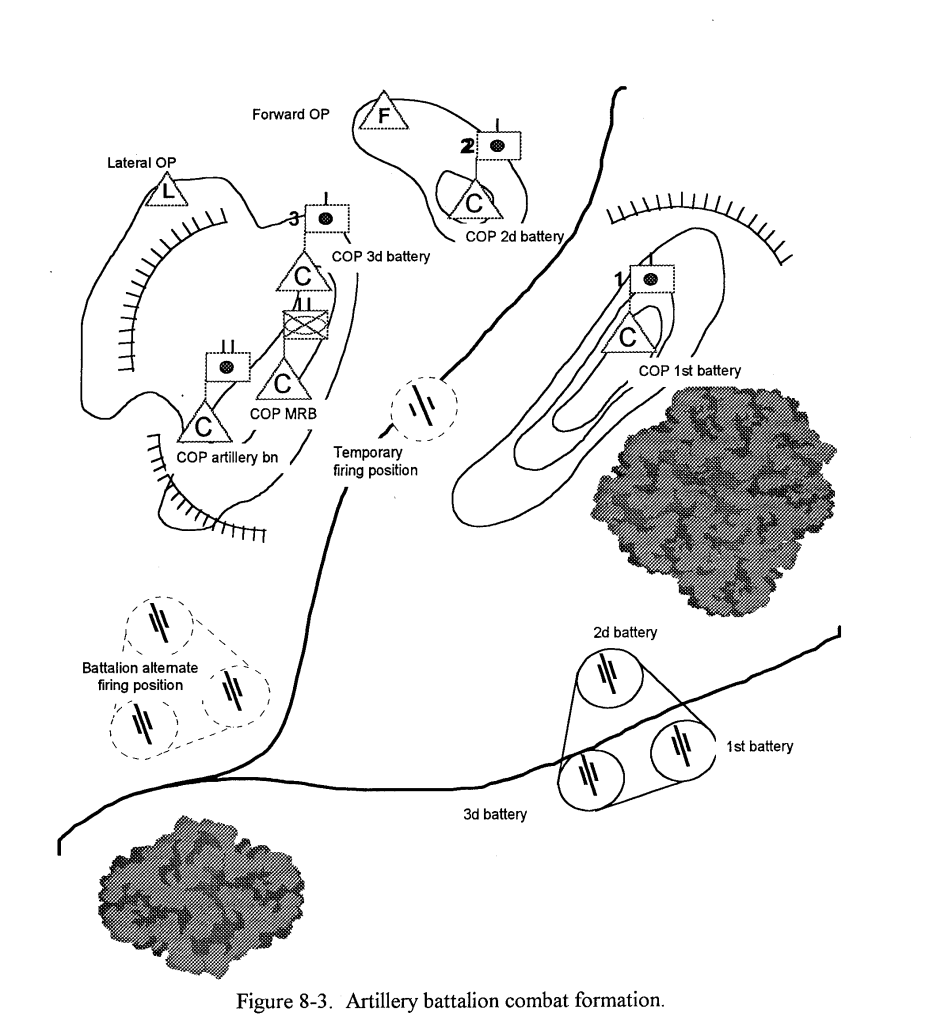
Now a 199X Soviet-patterned formation isn’t going to be representative of everything (in particular, the commander is not always going to double as a forward observer), but it’s worth noting that the movement involves narrow movement around different parts of the same observed, prepared area, not wide ranging, sweeping kiting.
Now redeployment is another story, and it’s where the artillery is going to be more inherently vulnerable and varies a lot on the circumstances. IE not so much in a stabilized front like WWI, post-1951 Korea, or contemporary Ukraine, but a lot in a classic Fuldapocalypse, 2003 Iraq, or the Southern African brush. It also depends on how much the artillery has to actually fire (because if it’s forced into moving/hiding, then it’s effectively suppressed).
So for the fictional case study of the Soviet-Romanian War:
The northern front is going to be advancing extremely rapidly, close to the best-case paper projections. Deployed artillery will cover the armies when they have to stop, but even the Sovereign Union will struggle to keep their mega-barrages during the rapid advance. Thankfully (for the invaders) enemy counter-artillery capabilities are very weak, especially in the context.
The southern front has a lot fewer SPGs (and even less advanced ones) and has to bludgeon its way across a very wide river and through fortified areas. There’s just less room to move and the opponent’s capabilities (due to their better units and C3I on this front) are more dangerous.
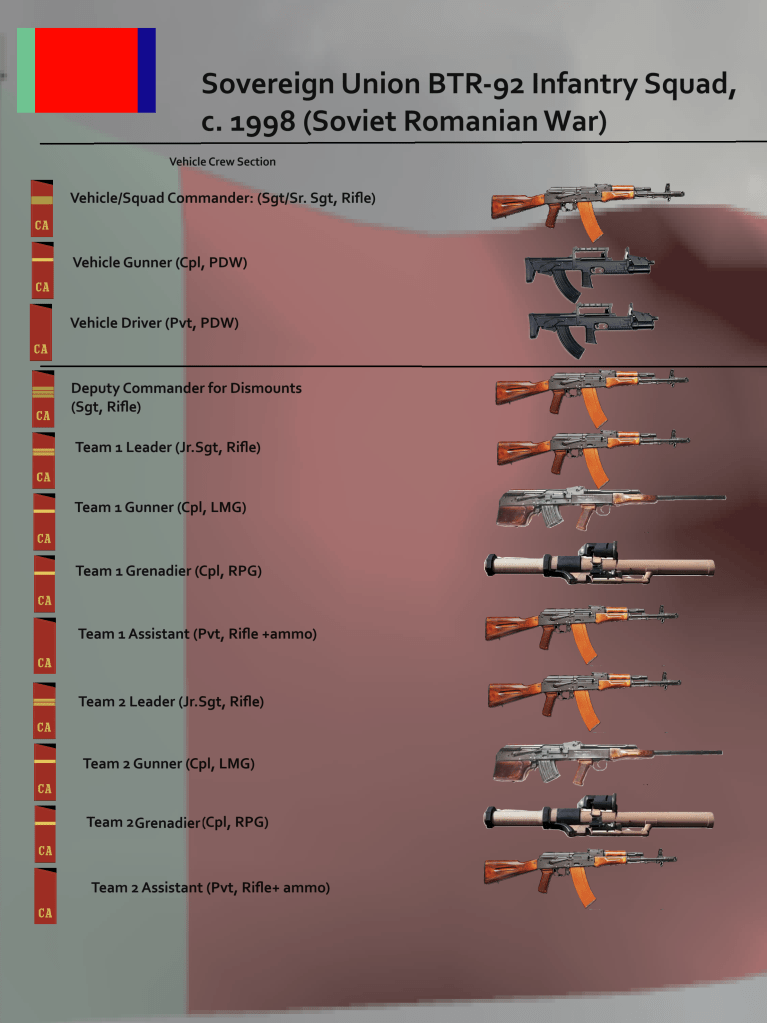
First I did my past piece on Mobile Corps squads, then came the BTR-92. Now the most ahistorically Soviet part of All Union’s military can be made with the two mixed together. In-universe, the creation of this squad was an extremely involved and controversial process.
Unlike previous examples, including the mobile corps own BMP/IFV squads, this operates two organizational fireteams. With lots of teeth-gritting, the doctrine emphasizes that “if necessary”, it can operate as a unitary squad or simple overall fire/overall maneuver element. In the Soviet-Romanian War, many did.
This has a full-time deputy squad leader for dismounts, whose job is pretty obvious. An emphasis was put on out-of-vehicle operations as these units were designed to spend more time outside.
The PDW is the A-91M. The LMG is the “Vepr”, one of many bullpup RPK proposals. The light RPG is in real life the South African (!) Denel FT5 (since a post-apartheid government would be very close to a surviving USSR, and since a post-apartheid arms industry would be very desperate, a license deal for this Goldilocks Rocket Launcher is not impossible).
This can be detailed in the Kestrel Publishing entry: Clash: Soviet BTR vs. Romanian TAB . Despite the name, about 80% of that book is just devoted to the Mobile Corps BTR reformation. The pieces on the Romanians basically amounted, cruelly but not inaccurately to “They just followed 196X BTR doctrine, had the equipment to match, and lost”.

 Fuldapocalypse Fiction