Review: Rust Skies

Rust Skies

TK Blackwood delivers another World War III treat in Rust Skies. I loved the unusual-for-Fuldapocalyptic standards location in Turkey (which was, after all, one of the few direct NATO-USSR borders). I also liked the timely political dilemma about an enhanced American military draft, which is both plausible and interesting. It does stuff a lot of plot and characters into a small package but rarely overwhelms and never feels bad.

The big “problem” is that it ends on a cliffhanger. Oh well! I’ve done it myself, so I guess I can’t complain.

Review: Bush vs. The Axis of Evil

Bush vs. The Axis of Evil

Another former internet timeline turned book, Bush vs. The Axis of Evil amounts to “What if World War III broke out in the early 2000s”?

It starts with Hezbollah conducting 9/11 while thinking it’d just be a minor message-sender, which gets it off to a “good” start. All this is told in a long series of blocky exposition posts with the occasional in-universe “book excerpt” that mysteriously resembles a blocky exposition post. Anyway, this leads to a spiraling 200X WWIII against Iraq, Iran, and North Korea at once, with such amazing things as:

  • Millenium Challenge 02 being used as a serious reference for a Battle of Hormuz, which leads to a carrier (the Lincoln) being sunk. This is a “good” benchmark for how militarily plausible all of it is.
  • A copy-pasted Christmas Truce straight out of 1914 pop culture.
  • Divergences into music festivals and pro wrestling pay per views, since every contemporary internet AH timeline MUST have a “what about the thing?” pop culture segment.

There’s some potentially interesting divergences like the Unification Church converting ex-northerners en masse, but it squanders all of them. The bulk is just horrible gore-atrocity descriptions done with all the immediacy and intensity of the instruction manual for a 2009 Mitsubishi Lancer.

Stuff like this has made me a lot more respecting of Larry Bond, because he manages, however imperfectly, to combine storytelling competence with knowledge of military operations. Often you get one, or as in this case, neither.

Soviet-Romanian Air War

With All Union now on a little cooldown, I figured I’d share my exposition/notes about the Soviet-Romanian air war:

Overall course of the war: Starting on September 8, 1998, the Sovereign Union invaded Romania with two fronts (army groups). The northern Dniester Front was arguably the most advanced and powerful fighting force in history at that time. That combined with good terrain made it sweep south in close to nine days. The southern Danube Front had a more difficult task in the form of more fortifications,more cohesive defense, the daunting task of crossing a massive river opposed, and the bulk of it consisting of forcibly mobilized Bulgarians. Still, after the same nine days they had encircled Bucharest and linked up with the Dniester Front. For the rest of the month they prepared to storm the city, continued bombardment, and tried to push for a surrender that eventually came.

In the end, the USSR lost around 3,500 soldiers and the Bulgarians and other minor allies around 7,000. Romanian casualties are almost literally uncountable with at least 70,000 being essentially confirmed and with estimates as high as 120,000 KIA.

Now for the air:

The USSR’s air force was a curious mixture of everything from the hyper-advanced Su-37 Fermion fighter to dozens of ancient Il-28s. In general, METT-TC was used to allocate things, with older planes doing area strikes with smother/splash damage weapons in the daytime and newer ones using PGMs at night whenever possible. While not perfect, it was extremely devastating.

Romania:

The initial fire strike took out around five hundred Romanian aircraft on the ground, over 80% of its total. This caused a lot of panic in the USAF after the war. A few planes made it through, most notably in the defeat of a Danube Front forward detachment at Alexandria very early on. Otherwise Romanian aircraft were limited to tiny nuisance strikes and suffered very heavy losses while doing so, though surprisingly few to the vaunted SAMs. (Total air superiority+tons of friendly Soviet aircraft = a very short ROE leash and lots of fighter opportunities).

The Imperium Vs. The Death Star

So the question has to be asked: What about this?

Original source

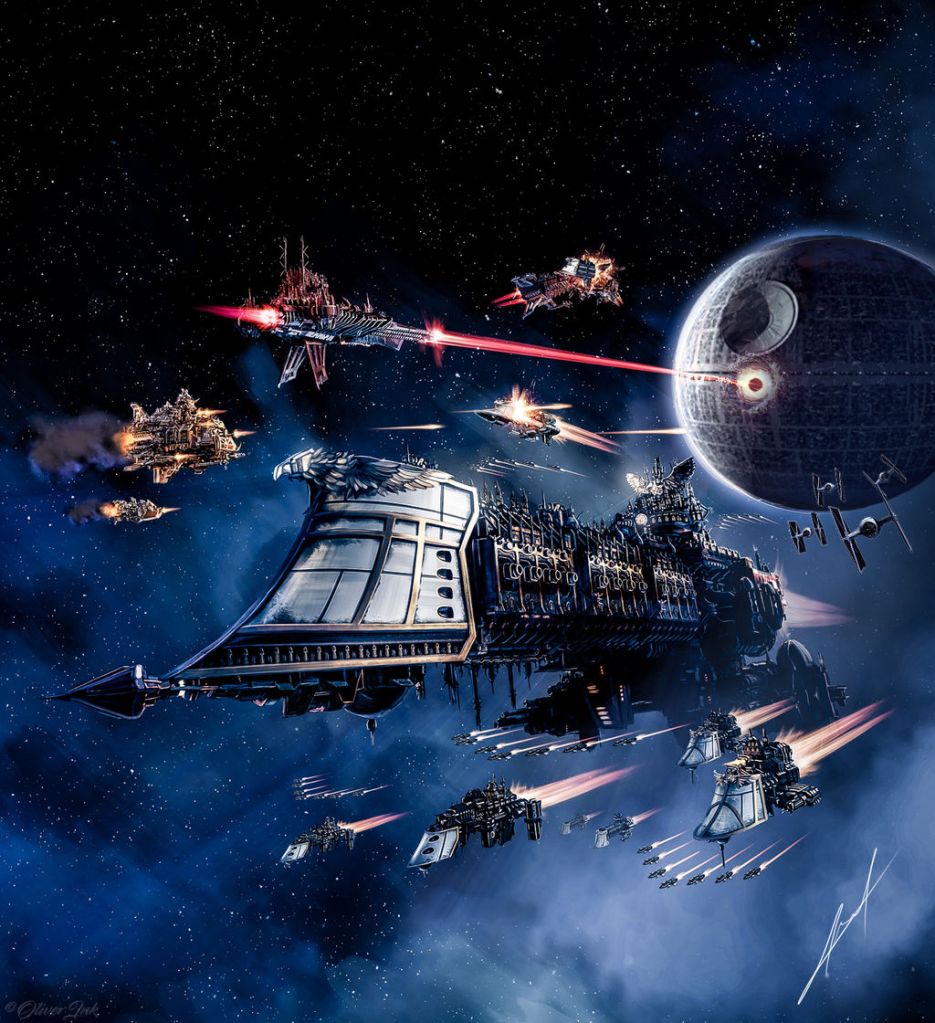
A Star Wars/Warhammer 40k crossover has to include the battles of evil vs. slightly more justified evil and feature a large Imperial Navy cathedral armada going up against the Death Star (presumably with its own array of Star Destroyers). Now I have put some actual thought into this.

  • The Imperium is not likely to be terribly fazed by the Death Star, thanks to confrontations with giant horrific superweapons being known as “Wednesday” over there.
  • If they cannot overpower it via masses of lances, nova cannons, and whatever other exotic tricks they’d undoubtedly pull out (ie psychic lashes, vortex torpedoes to just shunt it into the warp, etc…), for the main Imperial Navy it would be difficult to duplicate what the Rebel Alliance did. The reason simply is because Warhammer 40k space fighters are substantially larger than their Star Wars counterparts, and their ordnance is the same.
  • However, moving in for a pinpoint strike on a difficult but decisive target is the exact thing that Astartes were made for. So trench runs of Thunderhawks, vacuum chainsword fights, and tossing a melta bomb down the port would make for a fitting story.

Review: Stuck On The Drawing Board

Stuck On The Drawing Board: Unbuilt British Commercial Aircraft Since 1945

Passenger planes made in Britain followed an almost exactly stereotypical British pattern: At first bold and trend-setting, then fell behind due to both luck and skill, finally becoming just an international cog. The could have beens and never weres of this are shown in Richard Payne’s Stuck on the Drawing Board.

This is a fun, if niche, book for aviation enthusiasts. The big problem from the nature of the planes it describes. For passenger planes that are all essentially just tubes with different capacities, VTOLs and odd shapes are the absolute most different you’re going to get.

But this isn’t the book’s fault, and you’re left with a fun look at what could have happened before the 707 and its successors crushed any hope of a full-scale British aviation industry.

Fictional and Alternate Historical Airlines

Airplane manufacturing is a very tough process. Barring some strange point of divergence, it’s hard to avoid large airplane builders sorting out into a few giants. Yet airlines are another story altogether. It’s interesting how in the “Goldilocks businesses”, airplane builders and airlines fall on opposite disadvantageous ends.

For the manufacturers, it’s the “too many barriers to entry, thus you end up with a oligopoly” issue. For the airlines, where existing planes and even crews are just a few lease deals away, it’s the “too few barriers to entry, which leads to too many participants chasing too small a market”. In many cases both of these are unavoidable. (Novels, sadly, were the latter even before the rise of internet self-publishing).

What this means is that it’s incredibly easy to change the fates of the airlines, and even easier with a point of divergence after the large and successful deregulation of the late 1970s.

Eurasia Aviation

Eurasia Aviation is a fictional company of mine that I can plop into basically any setting I want that’s appropriate.

Logo created in Stable Diffusion XL
Eurasia aircraft factory, also created in Stable Diffusion. Don’t ask exactly what the cone-thing is for, I just thought it’d look cool

Eurasia is an unashamed way for me to put any never-was alternate history aircraft (or even aircraft concept) into production. Since it’s a conglomerate with a presence on every continent, it can take designs for every one, and so on. Not the most plausible but I’m having fun with it.

The Alternate Airliner

It can be fun to put an alternate airliner into service, but unless it’s really big, really fast, or both, a lot of people wouldn’t notice much difference. That being said, the same can be said about a lot of things and it’s never stopped alternate history writers before.

I’ve even made a couple “formal” tiers:

Tier 1: Barely Noticeable

Planes like these (in this case the MD-XX and the An-218 “777ski”), are going to be barely noticeable to non-aviation afficiandos, however different they may be on the inside.

Tier 2: Standing Out A Bit

The dreaded propfan is one instance of these airplanes having one obvious standout in addition to their other more subtle features. Others include a distinct shape like the 747 fuselage or even a “four engines all in the back” like the VC-10/Il-62

Tier 3: Really Stand Out

These involve strange but technically plausible shapes like lifting bodies or circular hulls of various nature. Their mere appearance makes them stand-out. This ironically applies to delta wings and civilianized early jet bombers.

Tier 4: Exotics

These are the ones that ascend into pure science fiction.

Naming a Submarine Class

I’m torn with submarine names for the MX-SSB class, a real proposed design that I’m using in All Union

(Bottom picture made in Stable Diffusion from the outline of the sub above)

The problems are:

  • The class is large at circa 50 boats, so the naming scheme needs to support such a large class.
  • There is no historical precedent since the US never used diesel missile subs, much less in large numbers.
  • Both fish and people just don’t seem right to me (subjective I know)

I’m leaning towards lakes (ie, the Lake Tahoe class with some/all of the Great Lakes thrown in), but am wondering if there’s something that just can click. Thoughts?