A Thousand Words: Dave’s Redistricting

Dave’s Redistricting

One of my internet hobbies has been using the Dave’s Redistricting site. It allows you to draw up hypothetical legislative districts and see their demographics. I’m currently using it to make hypothetical seats for a vastly expanded US House of Representatives. It’s both fun and illuminating to see how you have to balance various challenges.

It’s very illustrative of showing how it’s actually harder to make “fair” districts than you might think. You can get a nice sensitive block of counties-that are safe seats. Or you can take half of those counties, balance it with half of a large city, and then you can make an evenly bipartisan district-but how “representative” really is an obvious artificial creation like that?

If you like politics in any form, you have to check this out. It’s simple, easy, and is great for both counterfactuals and actual debate.

World War III Sports

With the actual war done, the WW31987 blog turns its attention to the really important things: Sports! My personal hunches, since this is in July/August.

  • MLB stops the season and probably either voids it (sure beats the real life World Series cancelations of the 94 strike and the 1904 boycott), or goes straight to the playoffs after the war ends.
  • The NFL hasn’t started yet and won’t start the first game until the second week of September, and the war ends in late August. (Ironically, there was a disruptive strike that year, dunno how the war would affect that). Given its lucrative nature, I can see a wait and see approach followed by starting the season after the war.
  • The NBA and NHL start in the late fall and are thus largely unaffected.
  • For European soccer leagues, I’d say it depends on the country. The historical Bundesliga started several days before the war would have begun, though a crisis could have averted it. My hunch is that the countries not directly hit (ie, France, etc…, would just launch a delayed and possibly shortened season after the war’s end), while Germany, the nuke victims, and the Scandanavian countries that were invaded would wait and possibly cancel the seasons.

One footnote: 2020 was the historical season that Mike Trout qualified for the Hall of Fame (played in at least 10 seasons). With obvious fears of the season not being able to be completed due to COVID, there was talk as if it would count as official. The Hall responded by saying that 1994 counted for the sake of eligibility, and thus even a World Series less 2020 would as well. Or a World Series-less 1987.

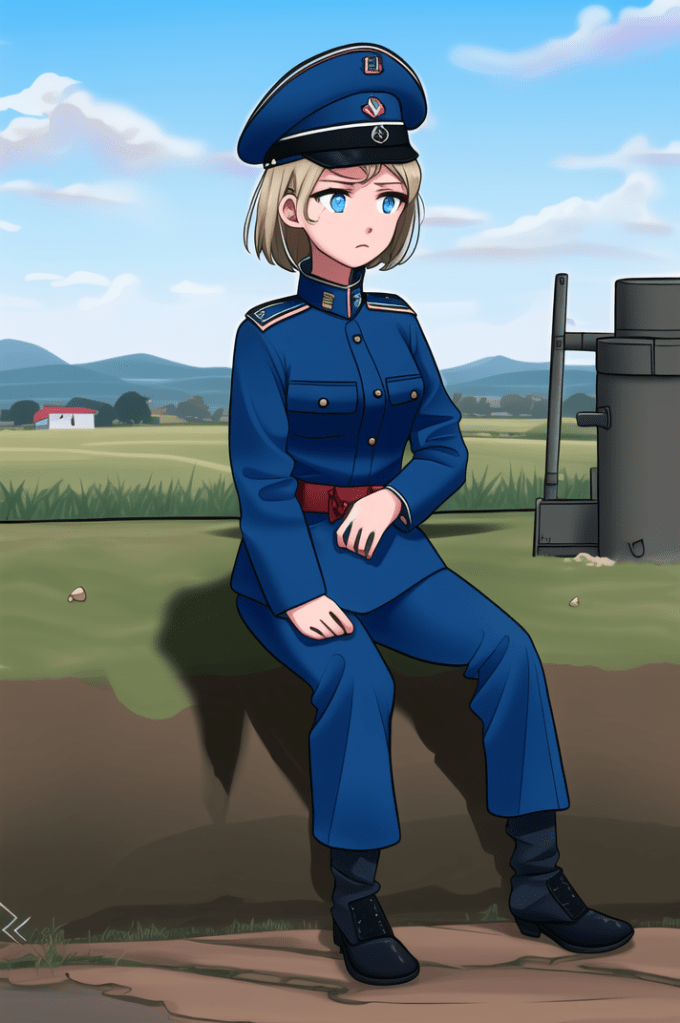
Defenders of the Danube

The narrative of the Soviet-Romanian War in All Union focused largely on the northern front, where advanced mechanized units burned through the Romanian countryside in a rapid (but not bloodless) stomp. However, by far the hardest going was the southern front, a push across the Danube with Soviet and (majority) mobilized Bulgarian troops.

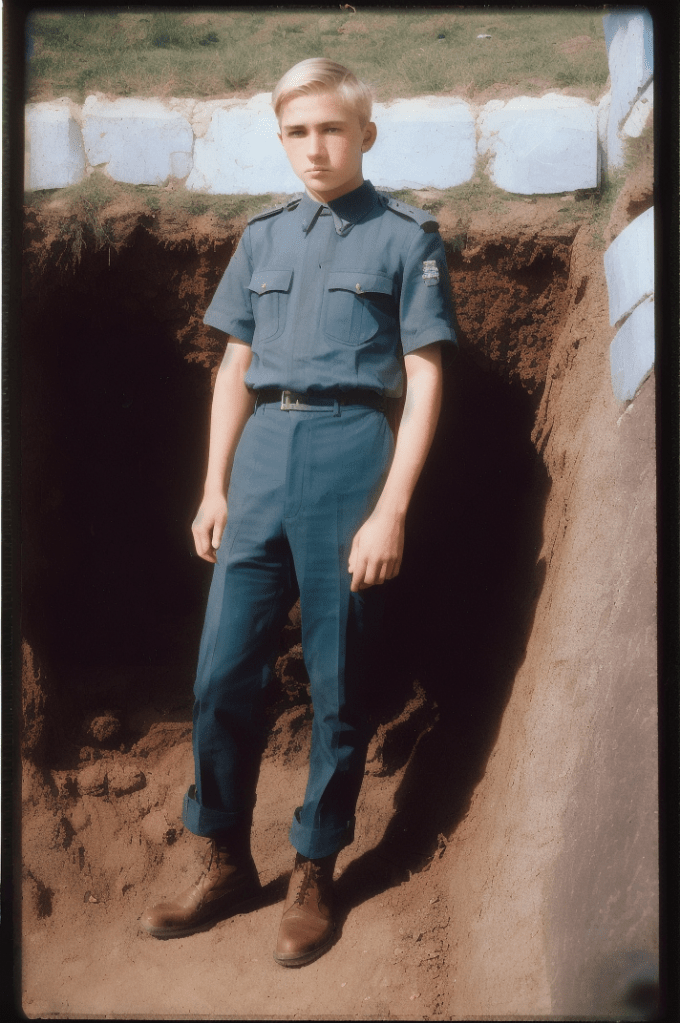
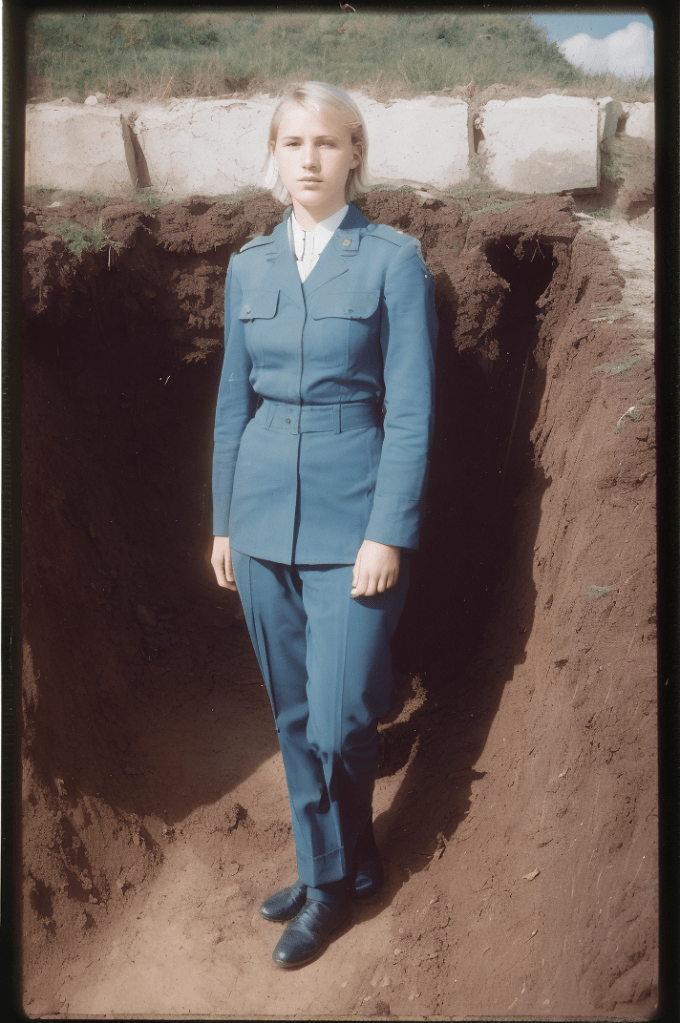
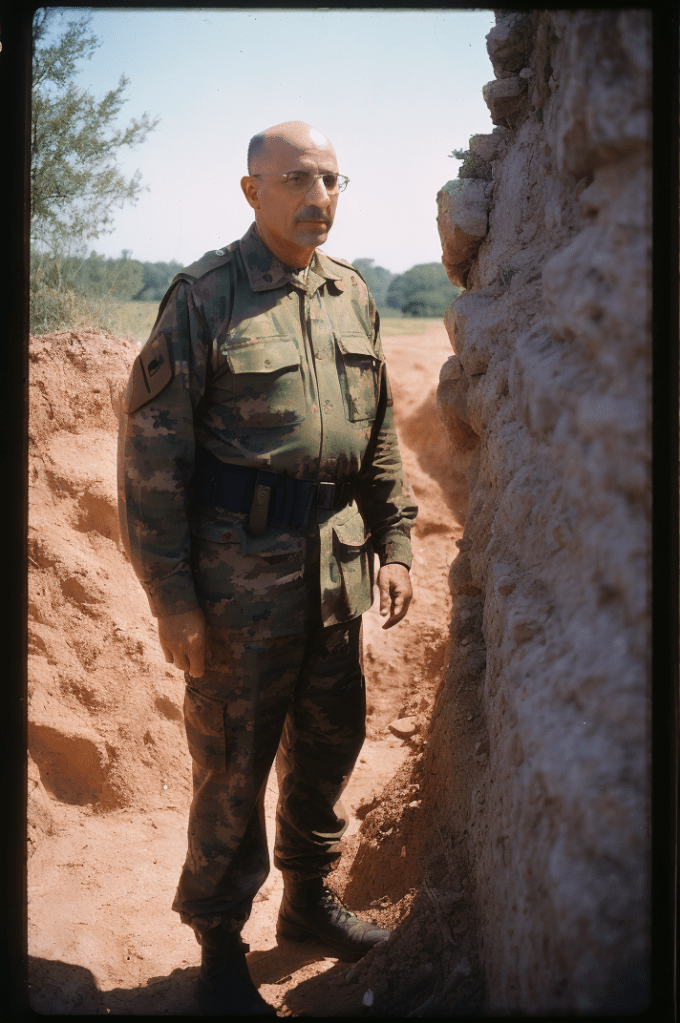
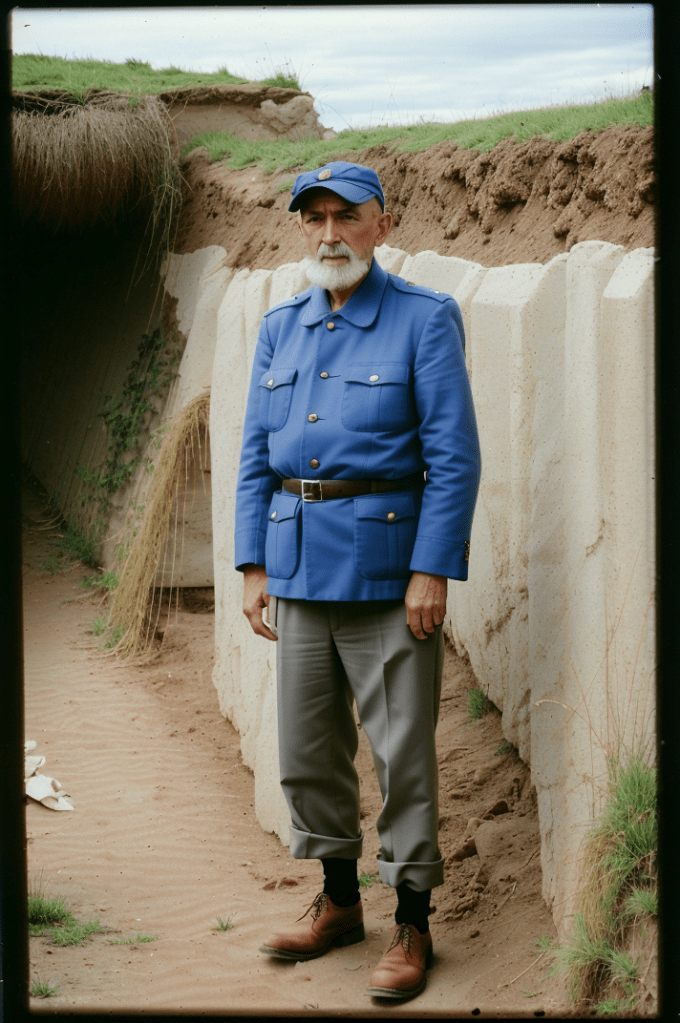
Shown here are several of the Romanian defenders in fortifications prior to the battle. Most of the troops in the fortified positions were mobilized Patriotic Guards , almost all from areas ineligible for the (itself stretched and mobilized) regular army: Women and men both too young and too old for “regular” service.

There was very little standardization for these desperation formations in terms of either equipment or uniforms. The blue uniforms designed for the Patriotic Guards can be seen in these [pseudo] photos and drawings of them in the fortifications prior to the war, but so can plain and camouflage uniforms.

All pictures made in Stable Diffusion.

Note: Stable Diffusion, at least the models I use most, is currently not very good at doing exact military equipment pieces well. Hands are pure genius in comparison. Hence why I don’t have them actually holding weapons. You can justify it by saying that the Securitate was afraid of mutinies or wasting ammo. -C

Cuban T-72s

I’ve used the term “Cuban T-72s” to refer to a very interesting phenomenon in fiction, especially contemporary fiction. Which is to say, something that’s technically inaccurate but makes an incredible amount of intuitive sense. And it’s technically achievable as well. What is a Cuban T-72?

Well, despite being one of the premier Soviet clients, Cuba has never operated T-72 tanks. T-72s are, of course, a common Soviet export tank. So even though Cuba historically never moved beyond the T-62 despite being actively engaged in Angola, if a thriller novel or alternate timeline had them operating that autoloaded tank, I would let it slide.

So if the rest of the work is pretty good, I can let things like wrong calibers off the hook. Especially if there’s an understandable reason why the author would think that way. Note that this only applies to small things like that-someone like Ian Slater who constantly gets the easiest-to-check facts wrong is not a “Cuban T-72.”

Amin Hayatov Official Portrait

One of the things I like about AI art is the ability to translate my words and mental images into pictures. This is a recent Stable Diffusion “portrait” of Amin Hayatov, president of the Union of Soviet Sovereign Republics in All Union’s present. The original picture had facial hair and something in his pocket that was inpainted out, and the Sovereign Union flag lapel pin was added in externally and then smoothed out through mild AI runs.

Sovereign Union flag for comparison

Review: The Death of Russia

The Death of Russia

It’s uncommon but not unheard of for a book to have its premise done better by something else in more or less every single way possible. So is the case with The Death of Russia, an alternate history story told through exposition and snippets about Yeltsin dying in the early 1990s and the world sinking into chaos. AH enthusiasts will also know that Zhirinovsky’s Russian Empire was another alternate history story told through exposition and snippets about Yeltsin dying in the early 1990s and the world sinking into chaos. Both started off as forum timelines and then were commercialized.

The first issue one notices is the writing style. Namely, giant breathless blocks of text. The timeline tries to do the “snippets from in-universe books and the like”, but this falls flat because all the “sources” read exactly the same. The second issue is the relentless grimdarkness. While based on stuff that sadly did happen, this just feels gratuitous. There being no real characters or anything but pure exposition makes both problems all the worse.

Eventually things spiral into a nuclear World War III. However, it’s worth noting that a fake interview with Evangelion’s producer starts off the chapter in question. Since pop culture is an obsession of the online AH fandom, this is not exactly a good start. The strike itself is no Arc Light or Red Hammer 1994. I actually fell annoyed at how a (mostly) survivable nuclear war, a topic that fascinates me, was handled so badly. It’s handled with all the grace of a minor league sportsball game report. Namely, a minor league game report written by an basic computer program that saw the box score.

In fact, what’s honestly interesting about the final nuclear exchange, besides the teeth-gritting “it doesn’t work like that” inaccuracies, is how it demonstrates a critique I’ve had for a while now. In the footnotes, the author doesn’t cite those two novels, or any real study on a limited/counterforce-heavy big nuclear strike that would leave society survivable. No, it’s another timeline, an earlier one called Able Archer 83.

But for any normal reading, I’d just say “read Zhirinovsky’s Russian Empire instead”.

A Soviet Romanian War Photo

Had too much fun making this “recon aircraft photo” of wrecked armored vehicles in a field in Stable Diffusion. I actually found it was easier to just make the field and then inpaint in the wrecks. And if it’s a high altitude, somewhat blurry photo, that makes the imprecision regarding tanks and the like less important.

A common sight in September 1998 and after. Soviet air supremacy led to fields full of destroyed and abandoned Romanian vehicles throughout the country.

The Nuclear-Pentand?

The term “nuclear triad” is a familiar one. It means the three main delivery systems-aircraft, land installations, and naval ones. Or rather, the three main American delivery systems. See, it’s easy to see the grouping of three when you have only deployed three types of strategic platforms: Silos, aircraft, and submarines.

From this American point of view, mobile ICBMs in use by other countries fit into the land part of the triad, and the oft-proposed surface ship bases would fit into the naval part. However, the proposed anchored capsules on the bottom of the sea have more in common with silos than mobile submarines.

So in a different world where nuclear basing was more widespread, the term “Tetrad” or “Pentad” could be used. A tetrad of silos, mobile land missiles (whether via truck, train, hovercraft, or Wienermobile), aircraft, and submarines. Or a pentad of all that plus surface ships.

Review: Fire and Maneuver

Fire and Maneuver

The second entry in James Ronsone and Alex Aaronson’s 1981 World War III, Fire and Maneuver continues its predecessor’s excellent work. While it does not bring the most novelty to the subgenre in terms of its structure, in execution it does very well, hopping between viewpoints in a way that’s both smooth and fast. And it actually has an M47 Dragon being able to destroy something in a stretch of logic that works for story reasons.

Jokes about the Cold War’s worst ATGM aside, this is a good entry in a scarce genre. If I had to make one criticism, it’s that long, exact system designations are used a little more often than I found credible. But that’s a tiny nitpick and doesn’t detract from the experience.