Review: Advance To Contact 1980 (Ronsone/Aaronson)

Advance To Contact 1980

The time has come to finally return to the starting theme of this blog. A 1980s World War III book is being reviewed here, Advance to Contact by James Ronsone and Alex Aaronson. This is a very Larry Bond-esque book taking place at an unusual time (beginning of the decade, or as I like to call it NATO Hard Mode) and in unusual places like Iran and Central America. Operation Eagle Claw succeeds-and things spiral from there.

Of course, I have an obligatory rivet-counting nitpick. Eagle Claw was more or less completely unworkable and it was probably for the best that it failed as early as it did. Reaching the city itself would just lead to massive collateral damage and the deaths of the hostages. Eagle Claw succeeding is like Operation Sea Lion succeeding in terms of plausibility.

But for the sake of the story, I’ll gladly it slide. Different theaters certainly beats Germany and the North Atlantic. Especially when the geography leads to different types of battles than giant mechanized blasts in the Fulda Gap.

As far as literary quality, this is a little rough but very forgivable. While at times it gets clunky, this is an extremely hard genre to write well. It certainly did not stop me from enjoying this book, and I look forward to the next installment.

Frankfurt Football

I have a crazy alternate history idea to spread American Football. So,the NFL’s desire to expand outside of its comfort zone has been mixed. But still, this alternate history enables the powers of the other kind of football to cash in. Many if not most European clubs best known for their soccer teams are in fact multi-sports, all under one umbrella. So for the sake of local laws and convenience, they’re technically the American Football branch of the club. Even if everyone but the kicker is an imported player from the states.

Frankfurt, being in the American military sector in the Cold War, has some of the most exposure to American popular culture. Therefore, its dominant team, Eintracht Frankfurt, gets an American football franchise. Of course, one quirk of the German 50+1 structure that ensures (nominal) control over a club by its members means that it and other German entries to the NFL would theoretically have a similar organization as the Green Bay Packers.

Silly? But that’s what AH is for. And besides, their team emblem looks like it’d fit perfectly on an American football helmet.

Review: Events

Events

The debut published work of Sea Lion Press author Charles E. P. Murphy, Events tells the story of alternate British prime ministers as they deal with the economy, other familiar problems, and, uh, alien invasions. The book is told in a deadpan pseudo-historical fashion, complete with footnotes that reference made-up history books. Anyone who knows internet alternate history will see the style being poked at instantly.

And this is the novella’s biggest issue: You need to be in an extremely small, insular community to really appreciate it. Otherwise, the obvious joke will just get repeated. “Oh, this prime minister dealt with an alien attack and then (insert mundane historical political problem here). And then this prime minister did (___)….” Even though it’s very short, the gag wears out its welcome by the third alien invasion.

But if you do know internet alternate history, the joke becomes better. A genre with a frequent rivet-counting “how many B-52s can dance on the head of a pin” obesssion and which cares absolutely nothing for conventional plot or characters gets skewered by Murphy treating made-up nonsense as if it was a meticulously researched order of battle for 1863/1942/1985.

Of course, the book also gets soured a bit by Poe’s Law (there is no parody of something that cannot be equaled in extremes by a sincere expression of the same). Since many internet alternate history timelines often portray events rivaling flying saucer wars in terms of divergence unironically, this can feel like just a handwaved in timeline that happens to be tongue in cheek. And (thankfully) without wikiboxes.

This is a first novel, so I can forgive its flaws. But it’s still made by and for those who follow a specific niche.

Operation Causeway

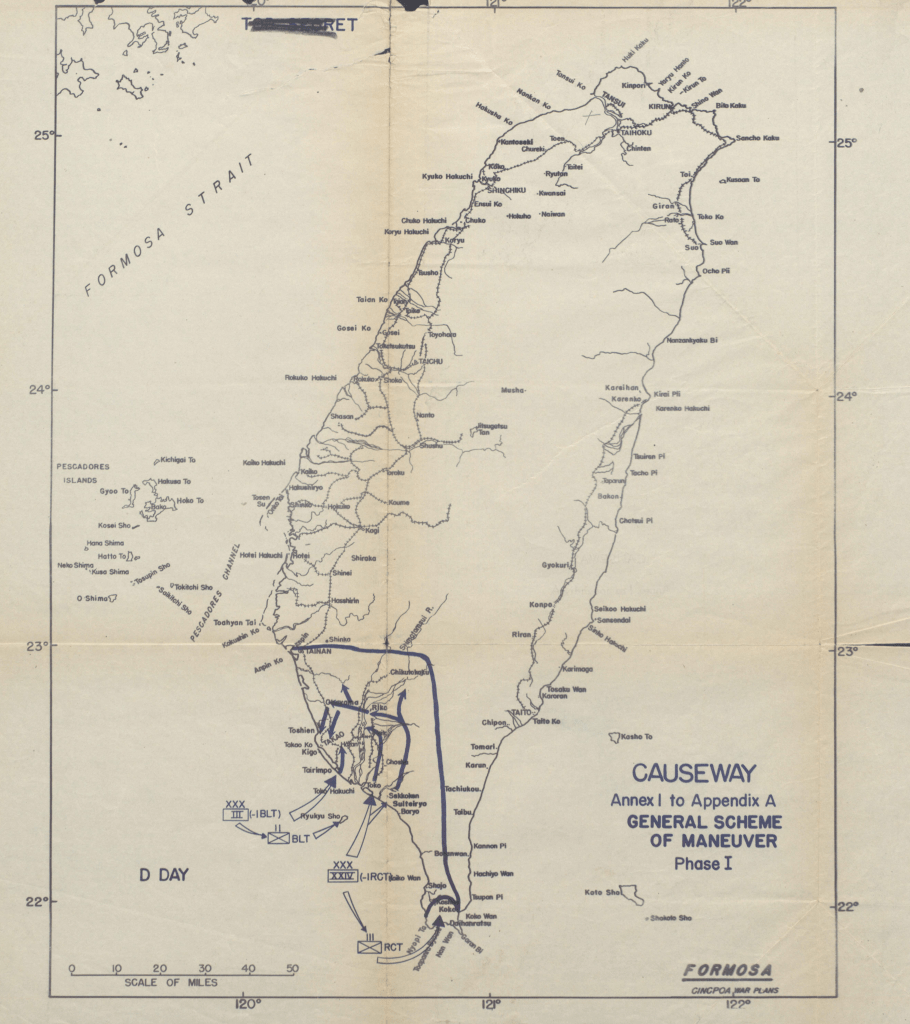
Operation Causeway was a proposed plan by the US military in World War II to land on Taiwan. It would have been a massive high risk, high cost, and high reward operation. In actual history, Causeway was shelved in favor of landing in Luzon.

The initial landing sites for Causeway would be in the south.

The Causeway documents are useful not just as an alternate historical reference, but also as a general guide to what a large amphibious invasion of Taiwan would entail (something that, for some mysterious reason, has remained relevant postwar).

A Thousand Words: SpringSharp

SpringSharp

Want to design a physically capable steam-age (1850-1950) warship? Then Springsharp is the game/program for you! Designing anything from coast defense ironclads with low freeboard to ridiculous twenty turret monsters, it works very well for any alternate shipbuilder.

Some caveats are in order. First, it’s just a weight simulator. This is why it doesn’t really work for volume-dependent missile age ships. Second, it works better for large (by the standards of the time) ships than small ones. Third, you have to know the basics of naval design and ship dimensions to really put in the right numbers for a viable ship.

But with this in mind, it’s an excellent simulation that can create the fleets of your dreams.

How Big Would The Mobile Forces Have Been?

The GENFORCE concept featured an eastern OPFOR divided into legacy “Basic” and more advanced, mixed, “Mobile” forces. Yet how many formations of the latter would plausibly exist in a nation the size of the USSR?

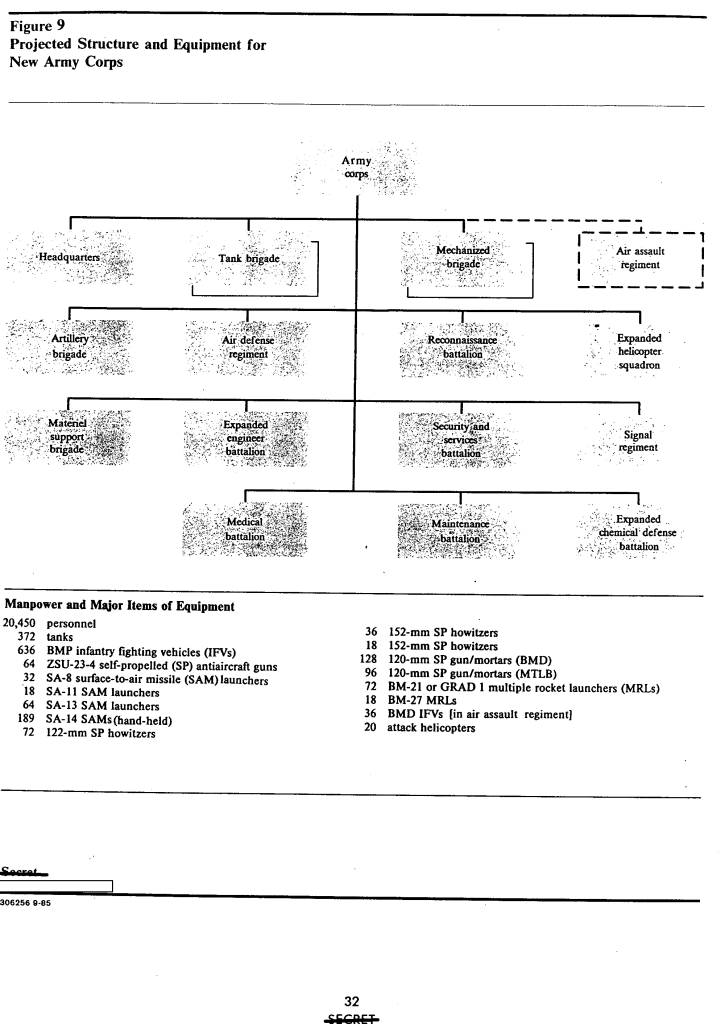
I found a possible answer in a 1985 CIA analysis called “Trends And Developments in Warsaw Pact Theater Forces, 1985-2000” (a great source for a continued Cold War in its own right). The mobile combined arms corps, effectively a big division, is mentioned.

Obviously assuming a surviving USSR and Warsaw Pact, the document estimated that nine such corps would be ready by 2000. Three of these would be in the western theater, two in the southwestern, and one on in the northwest. Two would be in the Far East and one in the south/middle east.

180,000 personnel would be needed from a napkin calc of corps numbers x paper strength of each corps. It’s actually closer to the actual number than most because existing tail assets could be used to support them. However, there will be undoubtedly more people than that necessary, especially to have them achieve their full potential.

The problem isn’t getting that many soldiers. It’s getting that many good soldiers, especially because these mobile corps are specifically designed to be better and more complex tactically than previous line formations. And because they have to compete with the airborne and naval infantry for the best inductees.

Interestingly, the document itself also mentions the possibility of the tank divergences continuing, with the basic forces (word choice deliberate) getting a less exotic model and the mobile corps getting a more out-there one. This would also coincidentally make two bureaus/plants very happy instead of one, so I can see it happening.

It’s an interesting document in any case.

Arthur Hailey: Technothriller Writer?

Generally speaking, alternate history questions about how some creative artist’s career could have gone differently are not my favorite thing. There are just too many inputs and inspirations, and one would be hard pressed to find something more volatile than popular culture tastes. That being said, I’ve found one author who I can definitely see sliding into a different genre if he’d come to fame 10-15 years later.

That author is Arthur Hailey, most famous for his novel Airport, which inspired the movie that spawned the entire disaster genre (and its parody in Airplane!). Hailey loved to write books that examined a complex thing (be it banks, airports, car factories, or what not) in amazing detail, before climaxing in some kind of crisis. He also loved technology to the point of taking too many futurists at face value (Passenger pods loaded into planes on conveyor belts!)

Hmmm, massively researched technical detail? A love of technology? That sounds like he’d be right at home with technothrillers.

In fact, I can so easily imagine Arthur Hailey’s Aircraft Carrier. The carrier and everything from the catapults to the air tasking order is described in minute detail. As is the drama surrounding members of the crew, which will consist of at least two middle-class Americans committing adultery. Then, in the final chapters of the book, the carrier will sail into action! But it won’t be a full on Fuldapocalyptic world war with the carrier fending off a hundred Tu-22s in the GIUK Gap while a nuclear sword of Damocles hangs over everyone’s head. Hailey just wasn’t that high stakes a writer, and his target audience probably wouldn’t go for something as tense as that. It would probably be something like El Dorado Canyon, probably against a fictional OPFOR country. The carrier accomplishes its mission, but not before a million more “I know the exact designation of a Scud TEL” infodumps are launched and at least one of the adulterers is blown up.

Look, I didn’t say it was going to be a good technothriller.

Indeed, as much as Clancy and Bond’s books may have been dated and rendered less potent by their technology becoming considerably less novel, Hailey’s have aged far worse. And I’m not (just) talking about their culture and characterization. Their entire gimmick is “this is a thing.” And if you already have the slightest familiarity with that thing in ways that audiences in the 1960s and 1970s did not, the books become empty clunkfests.

Still, it’s very easy to see the success of someone who wrote in a very similar style (Airport is basically a peacetime technothriller, after all) translating to something else down the road. That’s the fun of alternate history.


The Ameriyak That Never Was

Soviet airliners have an understandably poor reputation and record. It’s gotten to the point where one should be fair and point out that their less than ideal safety record was more to the issues with infrastructure and human resources and less to the mechanical design of the aircraft themselves. But it isn’t excessive criticism to point out that in spite of their rough-field capability, they were fuel-inefficient, uncomfortable, and only able to succeed in a politically closed field.

But there were still some diamonds in the rough, and not just giants like the Antonov beasts. The three-engined Yak-40 was interesting for being a pioneer in the field of light regional jets when the rest of the world was still using propeller planes for that role.

Which leads to a detente-era footnote: The plans to build and sell a version of the Codling (yes, that was its reporting name) in America. Amazingly, this was not a project from the legendarily Kremlin-friendly Armand Hammer. But it could have been. The potential plants were located in the depressed locations of Youngstown and Niagara Falls. The engines and avionics would be replaced with western models. A memo in the White House of all places (pgs 22-26) details the lofty goals for the LC-3, as it was planned to be called.

Of course, the deal unsurprisingly fell through. But it’s still an interesting piece of aircraft history. As is, it was the first Soviet civilian aircraft to attract legitimate attention from western airlines. And the irony of an airplane designed by a communist state being used to ferry rich private-sector VIPs to their vacations in Aspen is too fun not to smile at.

Review: Red Front

Red Front

The conventional Fuldapocalypse begins in earnest with Red Front, the second book in the Iron Crucible series. After the Yugoslav opening act in the previous entry , this follows the war everywhere from the Atlantic to… outer space. Author T. K Blackwood continues a solid Bond/Red Storm Rising style narrative in this installment.

This has the issues that a big perspective WWIII has, but it also has the strengths, and Blackwood succeeds in a genre that’s incredibly difficult to write well. The book ends on a cliffhanger, but it’s not an unsatsifying one. With a ton of varied battles in a type of novel that doesn’t come along very often, I can say that I highly recommend this to fans of the “conventional WW3” genre.