Review: Marque And Reprisal

Marque and Reprisal

I eagerly awaited the newest Brannigan’s Blackhearts book, Marque and Reprisal. After devouring it, I figured I had to review it. And it’s slightly disappointing. But only slightly. The issue isn’t the action or plotting (even if one “twist” of them getting betrayed is rather obvious). The issue is the setting.

Without going into spoiler-ish details, the villains feel like well, how do I put it? They feel like the kind of antagonists a mainstream action thriller would have. Which means the book fails to take advantage of both ends the series can go to-either gritty third-world mud fights or giant spectacles. They’re too out-there for the former and too mundane for the latter.

This is still my favorite thriller series ever, and it’s only a “disappointment” by the previous books massively high standards. But a part of it felt lacking nonetheless.

Review: PROMIS

PROMIS

Jack Murphy’s PROMIS series tells the story of wandering mercenary Sean Deckard as he makes his way around Cold War battlefields. A collection of short, action-packed novellas, it kind of reminded me of, well, Barry Sadler’s Casca of all things. Just replace the immortality curse with a super-prediction computer equation thingy in the background (the titular PROMIS system) and you have these books-kind of.

It’s like Casca in that it was created and written by a genuine special forces veteran, and like Casca in that it sets out a justification to plop the main character in action set pieces. The three published locations are Vietnam, Rhodesia, and South Africa. Not that it’s much worse than any other cheap thriller in practice, but I’d prefer a slightly less iffy location than both of those two. Even Central America would be better…

…Especially because, unlike Casca, there’s no real attempt at creating the surrounding scene outside of action sequences at all. While Casca had theme parks and parades of famous historical figures, this doesn’t even have that. Even by cheap thriller standards the characterization is really, really, really bare. The action is at least decent, even if it has the “try to have its cake and eat it too by trying to be both semi-grounded and spectacular” problem. But that’s not enough to raise the series to even a “51%” level.

Thankfully, I know that Murphy can do a lot better. Go read the far superior and awesomely titled Gray Matter Splatter instead of these.

Review: Red Front

Red Front

The conventional Fuldapocalypse begins in earnest with Red Front, the second book in the Iron Crucible series. After the Yugoslav opening act in the previous entry , this follows the war everywhere from the Atlantic to… outer space. Author T. K Blackwood continues a solid Bond/Red Storm Rising style narrative in this installment.

This has the issues that a big perspective WWIII has, but it also has the strengths, and Blackwood succeeds in a genre that’s incredibly difficult to write well. The book ends on a cliffhanger, but it’s not an unsatsifying one. With a ton of varied battles in a type of novel that doesn’t come along very often, I can say that I highly recommend this to fans of the “conventional WW3” genre.

Review: The Body Man

The Body Man

Eric Bishop’s The Body Man is a remarkable piece of thriller writing. This tale of an extra-secret Secret Service man has managed to dethrone past champion Marine Force One for the “most adequately middling novel” crown. It incorporates every plot trait of a cheap thriller-the agent heroes, the high-level conspiracy, the Russians, the Arabs, the action-in a simply adequate fashion.

It’s never actually bad, even if it’s a little longer than it probably should have been. But it never really becomes, or even tries to become more than what it ends up being. Which is the most solidly “median 51%” book I’ve read in a long, long time. The action is neither bad nor excellent. The stakes are not too low but not too high either. You get the idea. It’s weirdly distinct because of its “genericness”. And that’s not a small feat.

Review: The Gamekeeper’s Night Dog

The Gamekeeper’s Night Dog

David Putnam’s The Gamekeeper’s Night Dog is one of the weirdest alternate history novels I’ve read. And yes, I have read every single Kirov novel. None comes close to this… thing. Really, to talk about it in conventional literary terms is almost beside the point. It’s middling in terms of quality and is a little too bloated, but why talk about that when you have such a befuddling premise?

See, in the 1890s, protagonist David Banner (no relation to the Hulk) has the Judeo-Christian God appear in a dream from His home in the black hole in the center of the Milky Way. A nightmare scenario (aka actual history) awaits if the last of the classic English Bulldogs (always capitalized in the book) goes extinct. There’s exposition where World War I, II, and even III is shown, with animal cruelty activists being portrayed as the equals of history’s worst monsters.

Also, apparently the divine value of a nation comes from the kind of dog that it has. Yes, it’s a weird book. Anyway, man and dog alike uplift the world, fight a very different Boer War, and continue to battle in an ahead-of-its-time World War I. We get loving depictions of bulldogs ripping men and animals to pieces. In fact, most of it is basically just bulldogs in “action”. The question remains: How do you even judge this book? My answer is simple. You can’t. It is not a novel so much as a very bizarre artifact.

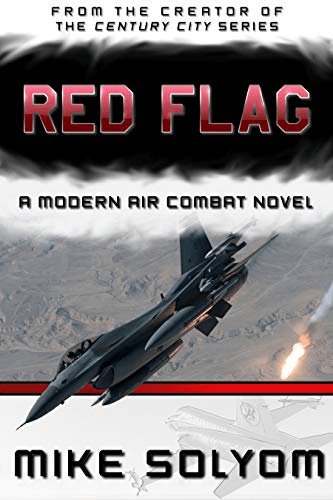
Review: Red Flag

Red Flag

I was intrigued by Mike Solyom’s Red Flag, a novel set around the titular air combat exercise. After reading it, I found it rather underwhelming. There’s actually more than one main plot. There’s the air combat exercise, there’s the backdrop of the author’s other books and ridiculous geopolitics with a de facto WWIII against a “Caliphate” armed with Cold War surplus stuff, and there’s a boilerplate science fiction UFO thriller.

The book isn’t bad at all. The author has genuine expertise, and it shows, even if sometimes it falls into the twin banes of Herman Melville Exposition and “Let me tell you how it really is, unlike on that TV” statements. What it does feel is dissonant. Because of the details and what’s supposed to be grounding, whenever there’s iffy geopolitics and/or weapons choices, it feels extra-off. And when there’s alien spider robots, it feels off even more.

I feel like truly weird, alien, Stephen Baxter-esque beasts would work better with a more grounded novel like it tries to be in air combat. I also feel like the aliens in this story would work fine in a more bombastic, Mack Maloney-type tale. But together they just don’t feel right.

Still, this is still a cheap thriller, and since when do cheap thrillers care about “dissonance”? As a cheap thriller, it may be a “mean 51%” book of varying degrees of quality instead of a “median 51%” book of consistent adequacy, but it still works.

Review: K Company

K Company

For the first in literal years, I deliberately sought out and read a western, Robert Broomall’s K Company. A story of army life on a hardscrabble post on the Kansas frontier and the inevitable conflict with Native Americans, it combines two genres that have never really gelled with me: The western and the historical war novel. How is it? Ok.

The old west is, of course, a setting more than anything else. Westerns can range from the cheapest cheap thrillers to the most staid literary epics. This book is more on the ‘realistic’ end, and I like that it’s vastly more evenhanded about the native/settler conflict than I feared it would be. Still, if I had to sum up the book in one sentence, it’d be “good, but not good enough”.

The writing is good, but not good enough for me to really get into it. The action is good, but not good enough for me to get into it. The characters-you get the idea. Still, I would recommend it if you do like westerns and/or more grounded historical war novels.

Review: Manhattan Massacre

Manhattan Massacre

In the mid-1970s, the Mack Bolan inspired “Men’s Adventure” genre reached either its height or its nadir with a trio of series overseen (and often written by) Peter McCurtin. The Sharpshooter, The Marksman, and The Assassin were a jumbled mess of mobster slayers intended purely to be released as quickly as possible. Their sloppiness led to internal inconsistencies in such minor issues as the main character’s name.

Anyway, Manhattan Massacre features interchangeable mobster hunter Robert “The Assassin” Briganti, who joins fellow interchangeable mobster hunters Johnny “The Sharpshooter” Rock and Philip “The Marksman” Magellan on a mobster-killing revenge trip. The book doesn’t really have much of a plot beyond killing mobsters, and its prose is weird. It alternates between long overdescriptive passages (especially concerning weapons, such as the insistence on saying that Briganti carries a Canadian 9mm Hi-Power) and short crude sentences with lots of exclamation points!

This is not a good book, and it’s kind of offensive even by 1970s cheap thriller standards (A scene where Briganti meets Black Power activists is particularly horrible in both political and literary terms) . But it’s weirdly amusing to see a genre at its most frenetic. I did not regret reading this-uh, book.

Review: In The Balance

Worldwar: In The Balance

In 1994, Harry Turtledove decided to run with what can rationally and scientifically be called one of the most awesome fictional concepts ever: Aliens invade during World War II. The opening book, In The Balance, starts things off with a bang.

A group of lizard-aliens known only as “The Race” with juuust the right amount of technological balancing to make for a great story attack a humanity that’s stronger and more advanced than anticipated. While the issues Turtledove has with long series (pacing, repetition, etc…) appear even during this book, they’re not deal-breakers. And the weaknesses are more than made up for by the amazing first impression the book makes.

If you like alternate history, science fiction, World War II, or just strange concepts in general, this is worth checking out.

Review: Diggstown

Diggstown

Leonard Wise’s Diggstown is a 1978 novel about a small town in the Deep South that is obsessed with boxing to the point that it’s named after a local who became a world champion. It’s also about an attempted swindle by a scam artist from up north that leads to boxer Honey Roy Palmer having to run a gauntlet of ten Diggstown dwellers in the ring. A colorful sports thriller, it nonetheless works a lot better as a comparably low-stakes sports novel than when it tries to be a serious thriller.

This unsteady wobbling also applies to its treatment of sensitive and difficult topics. For a 1970s book set in the south, I was pleasantly surprised to see it being tasteful and well-handled in terms of race. Yet the same cannot be said about it regarding its sex scenes. Those are not tasteful or well-handled.

The book also tries to be too setting-focused, taking its time before it finally gets to the climactic boxing matches. Yet once it gets there, those are as well-written as any other good sports fiction. You could do a lot worse than this book if you like boxing or old thrillers.