The First (and best?) Rock Opera

The first rock opera can be considered the Moody Blues’ Days of Future Passed. It tells the story of one day from morning to night. (It happens to also be an excellent album in its own right). Most people know this as where Nights in White Satin came from, but every track is great. My favorite is “Evening”, both “Tuesday Afternoon” and “Evening Time To Get Away”.

No track is wasted on pointless “story”, which is something that afflicts the otherwise excellent Tommy and The Wall. My favorite story concept album at any rate.

Review: Russian Gunship Helicopters

Russian Gunship Helicopters

The content of a book called Russian Gunship Helicopters should be pretty self-explanatory. Especially as it’s a Yefim Gordon book. This means you get tons of technical details that are uncited and frequently questionable, mixed with bad formatting and huge diversions into the pros and cons of various scale model kits. And a ton of pseudo-witty quotes that are really jarring compared to technical analysis. They come out of nowhere.

This book naturally covers the Mi-24, Mi-28, and Ka-50. As it was published in early 2013, it’s dated and doesn’t cover things like the Ukrainian and Syrian wars where these saw their first extensive use. It’s one big infodump and model kit review on the Hind, then one on the Havoc, then one on the Hokum.

The biggest problem is that while we get long explanations of what various components are on the helicopters, there’s one glaring omission. That’s how they’re actually used. The Mi-24 with its extensive track record is treated as an afterthought with Wikipedia-level “it flew around and shot things and occasionally dropped off people” simplicity. Reading a single Heavy OPFOR free document gives a lot more info on the actual doctrine of these things.

This is like many aviation enthusiast books: Weird and clunky but detailed. Even if in the wrong ways.

Review: The Shot That Kills You

The Shot That Kills You

A short story centered around one of the most realistic and sensible Warhammer Astartes chapters, The Shot That Kills You is about the Raptors. As it’s short and explody, one shouldn’t expect it to be anything except short and explody. Which it succeeds massively at.

It’s good enough to wash away the internet cruft surrounding the Raptors, who are the poster child for what I like to call the “Gothic-style Halo” ‘fans’ of Warhammer 40k, where the setting is tried to be made respectable and its exaggerated elements downplayed in a manner that annoys me. Thankfully it’s not the case here-an Astartes seemingly flees and lures the overconfident xenos into a trap, not uplinking to his servo-skull drone and calling down a Whirlwind missile strike that obliterates the melee duelists.

Review: Knockdown

Knockdown

Dick Francis’ Knockdown is a horse racing mystery. I feel like I would have liked it a lot more if I was into horse racing. It’s a little hard to review because the basics are very good. I can see what it’s trying to do. It’s just there isn’t really a connection with me.

I guess it’d be like if I was a horse racing enthusiast and I was reading a mystery novel set in a conventional World War III. The basics are mostly good, but there just isn’t anything to grab. Which is a shame. Or maybe I just jumped into the deep end of the series too quickly. Which is still a shame.

Review: The BAC Three-Eleven

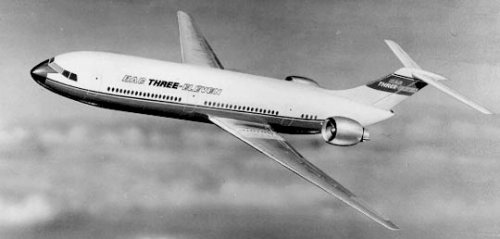
The BAC Three-Eleven: The Airbus That Should Have Been

In one of those “only someone like me would like this book” book purchases, I got Graziano Freschi’s book on the BAC Three-Eleven. The actual never-was airplane itself was an all-British two engine jumbo jet similar to the Airbus A300 only slightly larger and with both engines in the back.

Freschi both describes the plane and makes the argument that it was a mistake for the British to cancel it, as with many (if not all) their big postwar programs, they would spend large sums of money on something and then cancel it, getting the worst of both worlds. His case is weakened by Britain’s poor reputation in such regards, and he kind of hedges from “This would have been a success” to “Britain would have been in a better negotiating position when they rejoined Airbus”.

Though not perfect, it is an interesting look at an obscure plane.

Review: The British Carrier Strike Fleet After 1945

The British Carrier Strike Fleet After 1945

In my 5+ years running Fuldapocalypse, I think I may have found the most dull book I’ve ever reviewed. That would be a reference book with the appropriate name of The British Carrier Strike Fleet After 1945. I feel a little bad calling it that because A: It’s a reference book, and B: It actually has quite a lot of good information about British carriers.

However, even by those standards I found it a slog. To put it very mildly. And I read reference books for fun! So I’d still recommend it if you like aircraft carriers. Just be warned.

The Empire Vs. The Commonwealth

Reading Dominion got me thinking about an alternate history setup of a similar nature. Not a plausible one but a way to pit the British Empire against the ex-British Empire/Commonwealth. What got me thinking at first was the British in the book struggling to hold onto India. I’m thinking “hang on, this could be playable.”

So I fired up Command: Modern Operations and saw an opportunity to use many of the low-end WWII-era platforms, including German 1940s ones. I did a sample scenario and fell in love. So I expanded. It may or may not lead to anything more, but it’s something worth telling. Again, historical plausibility is not the main focus, so I’ve probably gotten a lot wrong.

The main forces are the fledgling independent Indian Army along with reinforcements of ANZACs and other volunteers, including American “Flying Tigers” in that animal’s home country. Opposing them are the Collaborationist UK Government and Germans, the latter struggling massively to project power. They still send the now-completed Graf Zeppelin carriers over. (Look, this isn’t a hard AH).

The scenario I did was of a bombing raid on Karachi from Oman-based Anglo-German bombers. (Why Oman? It was in range. Why Karachi? Partition into India and Pakistan hasn’t happened, at least not yet). While this scenario saw the attackers sweep aside the defenders and drop successfully with the loss of only one bomber, circumstances can always change. In any case, it was very interesting and fun to play in an area not typically covered by wargames, and got my imagination flowing.

Review: Dominion

Dominion

CJ Sansom’s Dominion is a combination spy story and exploration of the classic Axis victory World War II alternate history. Britain is defeated but not “hard-conquered” in World War II, the Germans control the continent but continue to fight in the east, and with the Americans the only nuclear power, now everyone else wants the secret, with a man with nuclear knowledge trying to escape. And that’s basically about as much of a central plot there is in this novel.

It honestly reminded me a lot of Harry Turtledove’s In The Presence of Mine Enemies. Not the obvious divergence or setting, but rather the tone and pace. It’s a push through a dreary, dull, banality of evil world where evil triumphed over good. Which isn’t exactly the best to read about. Its biggest problem is that a lot of exposition is devoted to its background and worldbuilding, which just amounts to “the Germans won and a lot of bad stuff happened”. It’s a setting-first book in a setting that’s neither very pleasant nor interesting.

Plus while ‘plausibility’ is normally not the highest priority in alternate history, this just feels wrong. Britain becoming a satellite state of Germany without a military invasion and being able to not have its already eager-for-independence possessions secede? (Like India, which somehow hasn’t gone independent). I’d honestly accept a successful invasion over this.

The whole thing just feels unfocused, and when it does focus, it goes to the wrong thing. Not the best alternate history out there.

Review: Shopping for Bombs

Shopping For Bombs

Gordon Corera’s Shopping for Bombs is a look at the then-recently busted AQ Khan nuclear network. It is very much an immediate-reaction book written in the close aftermath of an event aiming to capitalize on the media attention. Not surprisingly it has the strengths and weaknesses of such a thing. The strength is that it’s clear and understandable to a reader who isn’t a nuclear procurement nerd.

The weakness is that it feels a little shallow. Some of this isn’t Corera’s fault (how would he know at the time about the intricacies of Libya’s program). But it could have stood to have gone just a little deeper. And while being dated isn’t anything the writer can do anything about, it’s still an issue. Even for popular history about nuclear proliferation, there’s other stuff I would recommend more nearly twenty years on.

Review: Defence of Villages and Small Towns

Defence of Villages and Small Towns

It was 1940 and Britain stood alone. Colonel G. A. Wade published the pamphlet/book Defence of Villages and Small Towns to give the massively mobilizing Home Guard a rapid lesson. It’s worth the cost and as more than a historical curiosity. In fact, a lot of its lessons would applicable in contemporary Ukraine or similar (like defending a theoretical desert village in the NTC from the Donovian hordes).

Basically it’s intended to be a casual plain-text tome with as little field-manualese as possible about area defense. It’s about using terrain and available resources, the importance of time, and other crucial things like coordinating unit boundaries to avoid friendly fire. Useful in both historical and understanding terms.