Review: The Nordkapp Affair

Northern Fury: The Nordkapp Affair

(note: I got permission to read this book pre-release for the sake of a review).

This fairly short novella to the Northern Fury epic is a side story about a Norwegian ferry at the beginning of the war. It has to try and evacuate people from what could become a warzone (spoiler alert: It does). While a simple plot, it’s a very suitable one.

One thing I particularly liked was keeping the “camera” focused entirely on the ship itself and a running tally of its status. Whereas a lot of “Big War Thrillers” understandably show the big war, something as focused as this is a lot different.

Which is a good thing, as there’s something to be said for an HMS Ulysses type story. Which I mean both in terms of tone/structure and in terms of location-an excellent place for a war novel.

Review: Knee Deep In The Dead

Doom: Knee Deep In The Dead

You might think that a classic video game with a plot of “run around, shoot monsters” would be hard to novelize. Yet a writer by the name of Dafydd ab Hugh (which is the most Welsh name ever) gave it a try in Knee Deep in the Dead. This could have very easily been a low-effort potboiler. The author would just type out the blandest adherence to the and some filler, submit it, collect the money, and never look back. This has happened with many other visual media adaptations.

But not here.

Knee Deep In The Dead has a lot of running around and shooting monsters. But it also has this very bizarre style (that grew even more bizarre in its sequels, from what I’ve heard) that is nothing short of endearing. It’s one of those books that kind of has to be read to be believed.

Is it “good”? Not really. Is it readable? Yes. Is it fun? Oh yeah. Should you check it out? In my eyes, you betcha.

Review: Mercenaries in Asymmetric Conflicts

Mercenaries in Asymmetric Conflicts

I hate being disappointed by a book. But Scott Fitzsimmons’ Mercenaries in Asymmetric Conflicts was one of the most disappointing nonfiction books I’ve recently read. Or disappointing books in general, to be honest. It sounded good-studying the military cultures of different groups. When I started it, the stated influence of Kenneth Pollack made me even more interested.

Then the actual content emerged. The book is written in one of the thickest and least pleasant versions of academic-ese I’ve seen. If this was stylistic, I could forgive it as writing style is one of the most “natural” things and hardest to change. Plus, you know, it is an academic text.

But it also applies to more than that, which tips it over the edge. The book only talks about military performance in terms of different “theories”, as if they were some abstract phenomenon. It was one of the least helpful ways of approaching the matter, and almost the opposite of how Pollack did so in his own books.

Once the walls of jargon are slogged through, the final conclusion basically amounts to…. Well… Ok. The final conclusion is basically “Better trained and skillful armies with a good internal culture perform more capably, even if they’re at a material disadvantage.” That’s not exactly a big shock.

There is some good information on obscure in the Western Hemisphere African conflicts, but there are undoubtedly better sources on those that don’t involve huge amounts of pretentious analysis. I just can’t recommend this book.

Review: A History of Cavalry From The Earliest Times

A History of Cavalry From The Earliest Times

Now long since in the public domain (the first edition was in 1877 and later ones were published to 1913), George Denison’s A History of Cavalry From the Earliest Times was a look back at thousands of years of mounted operations. It’s an interesting time capsule. The aim was a sincere chronicle of cavalry and a look forward into an age of increased firepower. It’s a successful one given the limitations of the time.

The biggest problem, besides a 19th Century perspective on the world, is that Denison only had famous text sources to work with. Still, you can’t blame someone for being a product of their time or not having resources that only emerged later on. And he gets both important analyses essentially right. The first is how the role of mobile forces hasn’t really changed for thousands of years. Even if they swapped their horses for motorized vehicles. The second is how firepower and lethality was increasing, with him citing vastly higher casualties in recent (as of publication) battles compared to earlier ones with muzzleloaders.

Of course, the flame of cavalry would be briefly extinguished when offense against it rose massively by 1914 while defense did not. But another vehicle would soon pick up the torch. In any event, this is a good piece of classical military history.

A Thousand Words: Scanners

Scanners

The 1981 David Cronenberg film Scanners, about people with psychic powers, is a perfect movie to review in October. It’s also an underappreciated movie. See, it has Cronenberg’s trademark twisted body horror done in a way that’s suspenseful and not overexaggerated. It also manages to be excellently paced and creepy.

However, most people only know Scanners for the scene where a man’s head explodes. While that is well-done, there’s so much more to the movie than that. It’s well worth a watch.

Review: Kill Shot

Kill Shot

Every so often, I dip back into the Mack Bolan pool, with Kill Shot being my latest attempt. And I always come back to the realization that most of the Gold Eagle ones aren’t worth checking out when so many other, better cheap thrillers exist. And this was no exception.

Not only does Kill Shot do nothing to separate itself from the “Twinkies of literature” pack, but it’s worse than the norm due to its setup. As a “SuperBolan”, it’s longer than the normal throwaway Executioners. However, length does not equal substance or any other advantage in this case.

Even readers of action thrillers can do a lot better than Zombie Bolans like this.

Review: Wheels

Wheels

Arthur Hailey’s Wheels, published three years after Airport, turned its attention to the auto industry. While I’ve been a fairly new study to the aircraft industry, I’ve been interested in cars for much, much longer. So I knew I had to at least try this book. Especially because there are bizarrely few novels about the auto industry’s shenanigans. The biggest names are just this and The Betsy, which barely counts as a coherent book.

This is only somewhat more focused than Robbins’ scattershot, crazed novel. And it’s less focused than Airport. While that had a big broad soap opera and industry exposition that concluded with a rushed thriller plot, this is nothing but a Detroit drama. Or to be more specific, a series of Detroit dramas that range from car design to the struggles of a poor assembly line worker to the not-exactly-scintillating subject of middle class adultery.

I can respect this book for what it is-a lot of the research holds up, even if Hailey once again fell for futurist wonders being just around the corner (room-temperature superconductors in this case). It does work as a snapshot of an utterly rotten industry that was practically begging for the imports to come and whip it into shape (Published in 1971, the only reference to Japanese cars is a Subaru 360-esque “four wheeled motorcycle” that no one likes). But it doesn’t really work as a practical narrative.

Review: Airport

Airport

Author Arthur Hailey had a gimmick. He would find a certain field, research it massively, and then build a thriller and/or pop epic around said filed. One of his most famous and successful novels was 1968’s Airport, which inspired the movie series and the parody Airplane!. In it, an airliner is threatened by a both literal and figurative perfect storm of everything from horrible weather to a blocked runway to angry neighbors to a man determined to kill himself and blow up the plane-for the sake of insurance, nothing political.

Hailey spent a gargantuan amount of time on research, and it shows. I’ve always wondered if him being around in the age of the internet would have made his endeavours quicker and easier, or if it would have just prompted him to go even further down the rabbit hole. My hunch is the latter. There’s a lot of well-done and accurate depictions of airport operations (and a lot of weird-in-hindsight 1960s futurism, such as talk of superlifter cargo planes being thought of as something that would render sea freighters as obsolete as ocean liners and passenger pods being loaded into civilian C-5s).

The biggest issue is that the pacing is incredibly slow and lethargic for about four fifths of the book, then it hurriedly sprints to its conclusion. Maybe it was deliberate to try and be suspenseful, but if so, it didn’t work. The second biggest issue is that the characters are dull and dated-most obviously shown in a subplot where one of the main characters gets a flight attendant pregnant and the resulting drama.

This is a decent product of its time, but it’s still a product of its time and not the most recommended for later readers. It comes from an age when air travel was still something novel, and where readers would be less familiar with it. It’s not Hailey’s fault, but the book has aged terribly in that regard. Now it just comes across as 80% Herman Melville’s Airport Tales and 20% A Brief Disaster Novella, neither of which can really stand up.

Review: Africa Burning

Africa Burning

Back when I was young, I made a horrendously negative review of Gavin Parmar’s Africa Burning, talking about how little sense the tale of a giant army of T-90s and M113s (really) appearing in the Chadian desert to charge up into the modernized, reformed, opened Libya made. (Boy did that “prediction”, made pre-2011, about the direction of the country, age poorly).

Now, well, I have a soft spot for this amateur Ian Slater/technothriller/shoot the terrorist-wannabe novel. It reads like someone acting out their action hero fantasies after seeing and reading a lot of relevant fiction, and the earnest, genuine quality of it has made me smile. I may not recommend actually reading it, but at least I don’t have a bad feeling towards it anymore.

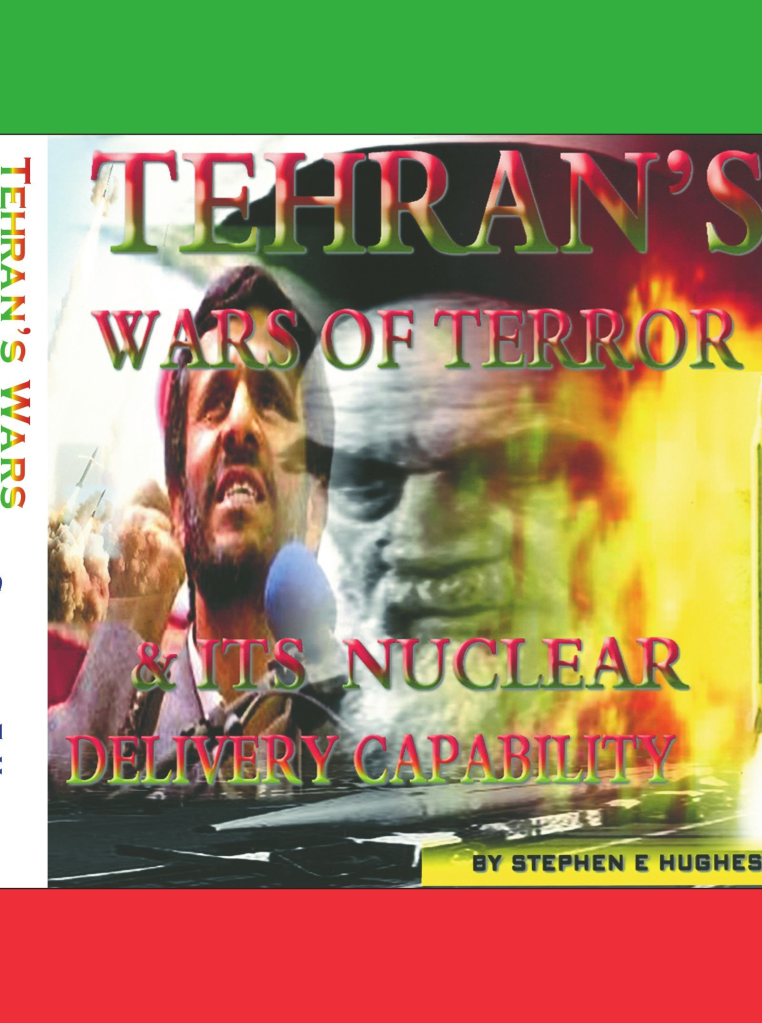
Review: Tehran’s Wars of Terror

Tehran’s Wars of Terror and Its Nuclear Delivery Capability

The worst book cover deserves to be seen in all its “glory”

Stephen Hughes’ The Iraqi Threat was a letdown. This is even more of a letdown. Trying to move through the smoke of the infamously secretive post-revolutionary Iranian military (with their five million new systems that appear in every new parade) would be a worthy and very useful endeavor. This not only fails in that regard, it acts like it doesn’t even try.

First off, I’m a “you can’t [usually] judge a book by its cover” type of person. I can understand having a bad cover or a crude cover. But this is an exception, because the cover of Tehran’s Wars of Terror is, without a doubt, the worst I’ve seen of any military reference book. And one of the worst I’ve seen period.

The cover is perfectly representative of the absolute slapdash mush inside. The Iraqi Threat at least had a central theme that it followed. This is just a rambling collection of various articles that are connected with only a vague link to Middle Eastern warfare. It doesn’t even work as a basic “know your enemy” primer because it’s so gargantuan and aimless. I feel surprisingly confident in saying that it’s quite possibly the worst military reference book I’ve read. And if not, it’s certainly down there.