Review: The Untold Story of China’s Nuclear Weapons Development and Testing

The Untold Story of China’s Nuclear Weapons Development and Testing

This book with a very long name is a very good look at the often-underlooked Chinese nuclear weapons program. It’s a scientific chronicle of all its tests from the initial blast in 1964 to the latest known ones in the 1990s. And it’s very good. Without getting too technical and being willing to admit what he doesn’t know, author Hui Zhang sheds a lot of light on the secretive program.

Some of it I knew, like a nightmare when a bomb being tested on a Q-5 (light ground attack aircraft) got stuck to the launch rail and wouldn’t drop. Others I didn’t, like a failed test not due to anything physics related, but simply because parachutes failed and the bomb broke against the ground before it could implode. Either way, it’s extremely detailed and effective.

It does have the nitpicky intra-academic arguments I see weirdly often in books about nuclear weapons, talking about how the Chinese have had the capability to miniaturize warheads more than other sources have claimed. Since Zhang’s claimed shrinking is not particularly unreasonable, it feels a little-strange. My reaction was “so what?”

This is ultimately still a small nitpick of a very good nonfiction book.
Review: Battledrills for Chinese Mobile Warfare

Battledrills for Chinese Mobile Warfare

Against my better judgement, I got another H. John Poole book. The title made me naively think “oh, this could be a set of practical drills approached from a different perspective.” So like any H. John Poole book, this is about 5% reasonable well-thought out arguments (in this case: Formations should be simpler and grenade skill should be focused and emphasized) mixed with 95% incoherent rambling about how artillery is useless.

The “logic” is a classic all or nothing where if the artillery fails to destroy everything in its path and close combat is still necessary, therefore artillery is useless and only suitable for clunky western armies and not cunning subtle ‘eastern’ ones. He even argues that artillery and aid of artillery has not been useful in the contemporary war in Ukraine, which is… something. But not something good.

By this point Poole has lost most of what teaching value his books had, and I recommend avoiding them.

Review: Tiger Chair

Tiger Chair

The recent Tiger Chair is the Max Brooks short story of the Chinese invasion of the American West Coast. Told in the form of a letter back home from a Chinese, it mentions how all the high-tech contraptions that were supposed to win were countered by know-how.

I’ll be blunt, this is not a good story. It’s told entirely through less-than-ideal exposition, and is loaded with both references that are bound to age like antimatter (mentioning some minor celebrity controversy from four years before this post that a normal person like the narrator would almost certainly not even know about) and older ones (there’s a ton of Iraq War lingo that makes me think at least part of this was originally written back in the 2000s).

But the real problem (at least for a military nerd like myself) is that Brooks’ Pentagon Reformerism is on every page. Obvious from as early as the Zombie Survival Guide (where he praised the AK and scorned the M16), this goes from “there are counters to high-tech contraptions” to “they make high-tech contraptions useless”. This is hammered home in a hamfisted manner continually.

Don’t get this.

Review: Dragon’s Wings

A 2013 book by noted PLAAF watcher Andreas Rupprecht, Dragon’s Wings is one of the first looks behind the curtain of the Chinese aircraft industry. Though now obviously old, it’s still a good snapshot into the past. Besides the familiar J-6/7s and the newer domestic J-8/10-etcs, it provides a look at many of the never-were (and frequently technically impossible at the time) aircraft proposed.

However much it’s shown its age, it’s still a great book. It’s an excellent coffee table book for aircraft enthusiasts.

Weird Wargaming: The Emperor of Bombs

In Nuclear War Simulator, one of my favorite creations to use and drop is something I’ve called the “Huangdi Bomb”. The name, after Chinese for “Emperor”, is a pun on Tsar Bomba. Only this has a bigger boom at 75 megatons. It’s also, in the backstory, a lot more advanced and sophisticated. Unlike the publicity stunt that was the Tsar, the Huangdi is a mass-produced, deployable weapon capable of fitting inside either an H-6 or large ICBM without issue.

It’s also, judging by the maximum payload of the Badger and its yield (the classic yield-weight calculation), the most efficient nuclear weapon ever made. As it has a multi-decade lead on the other megabombs, this isn’t surprising. As for how and why such a beast is used, the theories for the gargantuan warhead are hitting extremely large targets, making accuracy issues irrelevant for simple countervalue operations, improving warhead efficiency in a big design before trying to apply it to smaller ones, and contributing to deterrence by intimidating would-be-opponents with its yield.

In various NWS scenarios, I have about twenty Huangdis made overall, in both air-dropped and missile carried versions.

Review: Handbook of Military Knowledge For Commanders

Handbook of Military Knowledge For Commanders

One of the biggest treats I’ve read is the translated 1980s Chinese document called the “Handbook of Military Knowledge For Commanders”. Exactly as it implies, the document is a hundreds of pages long and highly deep look into the Cold War’s least advanced and most secretive major army. Because of this, it’s an excellent resource not just for the Cold War PLA, but also many of the client states/units equipped, trained, or even just inspired by it. As well for less-advanced (compared to major powers) armies in general.

A lot of this contains basic stuff that any field manual reader won’t find surprising. The layout, at least of the translated version, leaves something to be desired. And there are a few translation quirks like keeping the romanized Chinese word “Fendui”, instead of just saying “units” or “subunits” (as would be appropriate for the context.) In fact, the document has the worst of both worlds in that it shows “Fendui” but not the original characters, making it confusing for both English and Mandarin native speakers.

Still, this is an excellent study of not just that specific army at that point in time (mid-1980s), but also of many principles applicable to all forces at any time. If you have the time to dig through four hundred pages of field manualese, it’s well worth your while.

Review: Taiwan’s Former Nuclear Weapons Program

Taiwan’s Former Nuclear Weapons Program: Nuclear Weapons On-Demand

David Albright and Andrea Stricker’s 2018 book on the abandoned nuclear weapons program of Taiwan tells the true story of one of the biggest nuclear programs that never resulted in a functioning bomb. The authors themselves note the similarities to the previously-reviewed underground South African program-and the huge differences.

The big catalyst was, unsurprisingly, the mainland’s successful deployment of nuclear weapons in 1964. What followed was a decades-long game that lasted as long as the Taiwanese military regime itself, where it tried to slip nuclear construction ability under the nose of the Americans who feared escalation. A tale of both technical and political detail, it’s excellently told.

Where I differ book is in its conclusion. Albright and Stricker argue that the Americans were fully in the right in stopping the program. To me, I would feel a lot more comfortable about Taiwan’s security if it had the ability to make Shanghai and other close, large cities disappear in a fireball. Many Taiwanese themselves made legitimate arguments against them that were quoted in the book: It would trigger the PRC to rev up earlier, and Taiwan was so small that they’d be vulnerable to a counterforce strike. But I still think a submarine deterrent would go a long way.

Still, opinions aside, this is a great look at an underappreciated weapons program.

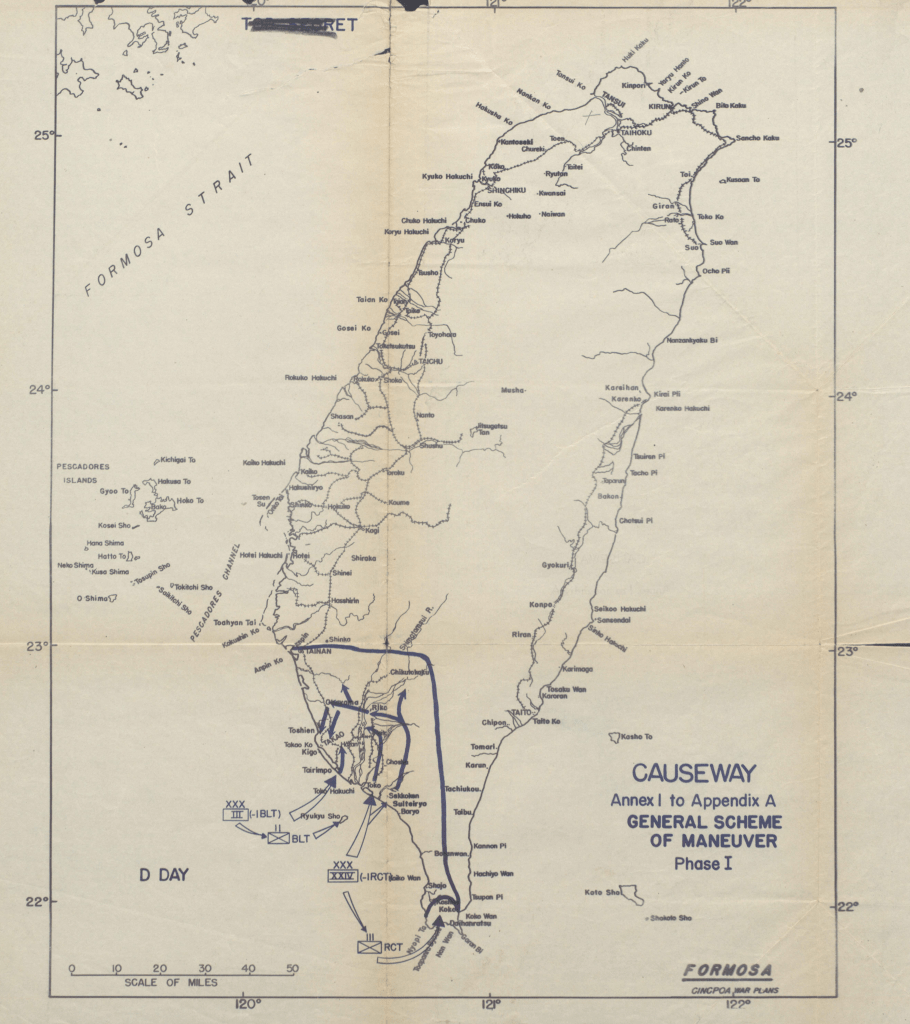
Operation Causeway

Operation Causeway was a proposed plan by the US military in World War II to land on Taiwan. It would have been a massive high risk, high cost, and high reward operation. In actual history, Causeway was shelved in favor of landing in Luzon.

The initial landing sites for Causeway would be in the south.

The Causeway documents are useful not just as an alternate historical reference, but also as a general guide to what a large amphibious invasion of Taiwan would entail (something that, for some mysterious reason, has remained relevant postwar).

The Asian Sportsbook

Finally got the chance to hear about the peculiarities of Asian sportsbooks in an old podcast by betting hand Matthew Trenhaile. Of course it comes a year after I wrote an Asian megabook as if it was a western-facing post-up (you deposit money in the book instead of operating on credit) one in The Sure Bet King. Anyway, the entire segment is great and I recommend you listen to it.

Asian sportsbooks have had (note the past tense) a reputation for being “sharp”, ie taking bets unquestioned with huge limits. But as the podcast notes, it’s wrong to compare them to the western-facing “sharp books” (Circa Sports / Pinnacle /BetCRIS). The short version for their “balancing act” is simple:

  • A complex “agent system” that evolved from technological constraints and also legal ones.
  • More importantly,a gargantuan pool of recreational money (at least in soccer) and the ability to, for lack of a better word, “dilute” the sharp money across it.

The podcast, recorded in 2018, mentioned this system declining already. Limits were being noticeably reduced, especially for lower-tier leagues. The wider adoption of the internet makes the tangled agent pyramid less and less necessary. Since then, everything I’ve seen has indicated this trend becoming more pronounced.

It’s a fascinating look at an extremely important but murky even by sports betting standards component.

A Thousand Words: The Story of Ricky

Riki-Oh: The Story of Ricky

It’s time to review one of my favorite movies of all time. The story of The Story of Ricky is one of bizarre decision-making. A Hong Kong producer looked at a Fist of The North Star knockoff manga and bought the rights. Then came the decision to make the movie. However, it comes across as having almost all of the budget spent on fake blood. And most of the rest spent renting out the sets for the jail.

The plot is this: The titular character ends up in a prison and gets into fights. Actually, that isn’t quite right. There is only one properly choreographed bout in the entire film. The rest is just someone getting hit and cheesy, bloody special effects resulting. That’s basically how you can describe the entire movie, and it is amazing. Hearing the bad-as-you’d expect English dubbing is part of the fun.

This movie is, in its own stupid, horrible way, a masterpiece. It’s one of the best “B-movies” I’ve seen and if you don’t mind (fake-looking but still plentiful) gore, then you have to watch this. Don’t expect well, anything technically good from it. But do expect a lot of fun.