The Italian Lesson

What has been said, and said accurately is that drones and tactics surrounding them are advancing and moving extra-fast in Ukraine. Yet counter-intuitively, this is a case for not rushing forward with swarms. Note: It is still important, and rapidly getting C-UAS, especially hard-kill weapons and proper training, is high priority.

Because this isn’t the first time this happened. And the (often unfairly) scorned Italian military of World War II is a stark example why.

So in the 1930s, automotive and aircraft technology was indeed roaring forward at a “Moores Law For Tanks and Propeller Planes” rate. Now I’m oversimplifying, but here’s what happened: Italy didn’t have the economy or resources for multiple huge waves, so they “modernized” too early , and were left with tons of biplanes and tiny tankettes .

I remember seeing a lecture on US interwar armor where even though he didn’t mention Italy or anything similar, he did use that as a reasonable answer for why America was slow in the same period. Now I mentioned the defensive priority being higher. Anti-tank guns and AA guns even if underpowered are still going to be useful in ways strictly worse tanks are not.
The UAV Illusion

So RUSI fellow Justin Bronk has given focus to what I’ve kind of grasped but struggled to articulate myself: Small UAVs are not a panacea.

A smaller piece by the same author.

The short version is:

  • The weirdest analogy I have but one I believe is comparing FPV/etc… drones to B-17s and the like. There’s been a giant debate about the effectiveness of WW2 strategic bombing. The Western Allies had less a choice in it than one might think. Until 1944 it was the only direct offensive ability they had, and being shielded by water made it viable. Similarly, Ukraine’s use of drones, as Bronk explains, is a necessary one, just like that a result of desperate circumstance. But it’s not the circumstance and abilities that others, just like how no one had the WAllies circumstances there, will have.
  • Practical effects, which very few people are mentioning- namely, relying on drones against a force that’s spent three years optimizing against them is like relying on deep pass plays against the Lawrence Taylor Giants (ask yourself how the Joe Gibbs teams behaved offensively most of the time).
  • Finally and most crucially, Bronk brings up it’s the Walter Payton in Super Bowl XX / SA-2 not scoring that many direct kills in Vietnam problem. Which is that what’s causing drones to be effective is massive amounts of traditional weapons: Normal artillery, mines, missiles, and backed by UAVs in the traditional spotter role.

A very good splash of cold water. This isn’t to say these aren’t dangerous and won’t get better, but it helps to have perspective beyond highlight reels. Speaking of which, here’s a veteran talking about the side you didn’t see.

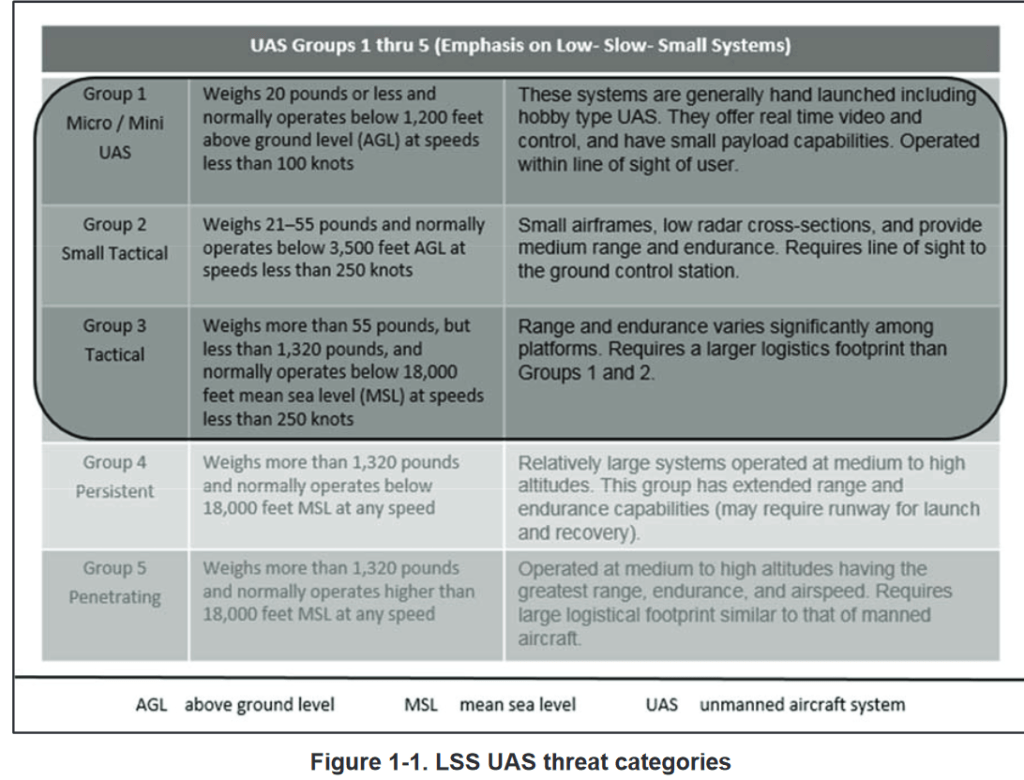
UAV Classes

The US Military has five official group of UAVs/drones.

(from ATP 3-01-81)

The standard hobby drone is a Group 1. Smaller military drones are groups 2 and 3. The ScanEagle is the best American example of a Group 2. The classic Iowa spotter Pioneer is a Group 3, so is the RQ-7 Shadow. Heavy attack drones like the Predator and Bayraktar TB2 are 4, while monsters like the Reaper and Global Hawk are 5.